

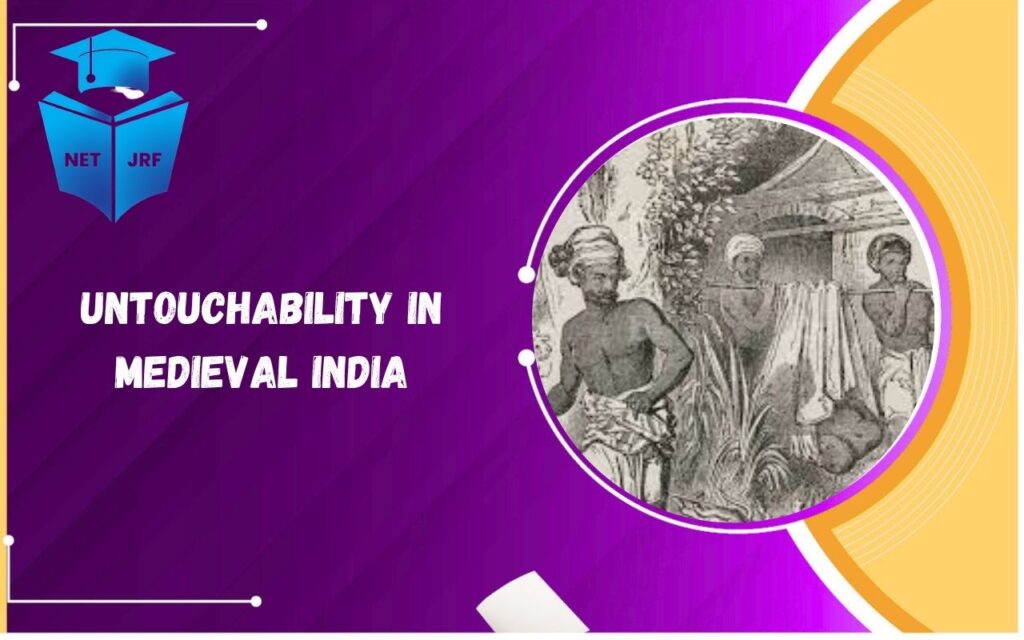
Untouchability represents a dark yet significant aspect of social history in early medieval North India. This concept refers to the practice of ostracising a group of people based on their birth, occupation, or ritual status. Between A.D. 600 and 1200, the caste system underwent major changes. Ancient law-givers, known as Smriti writers, introduced stricter rules that separated certain groups from the mainstream society. These rules were not just social, they were deeply rooted in notions of purity and pollution.

Roots of Untouchability
The period from A.D. 600 to 1200 witnessed a massive increase in the number of untouchable castes in Northern India. Historians note that the spirit of exclusiveness grew during this time.
- This was not a sudden change but a gradual process. Law-givers began to record and codify various social taboos that separated the “touchable” from the “untouchable”.
- The Vaneswara and Smriti commentators of this era intensified the rules of segregation. They believed that certain groups carried a “polluting” influence that could affect the ritual purity of the upper castes.
- This period marks the systematization of these rules, making them more rigid than in earlier times.
- For example, the text Vrdha Gautama Smrti mentions that if a person eats food given by a “candala,” their status drops to that of a candala for ten years. This shows how strictly the law-givers viewed social interactions.
- The early medieval period saw the expansion of caste rules. Law-givers focused heavily on purity, leading to the creation of new untouchable groups.
Top UGC NET Coaching in Jaipur
Temporary versus Permanent Untouchability
In ancient legal texts, scholars distinguished between two types of social exclusion. Some forms of impurity were temporary, while others were permanent and passed from one generation to the next. This distinction is crucial for understanding how the caste system functioned.
- Temporary impurity often arose from specific acts or natural life events. For instance, a person might become temporarily impure by touching someone already considered “polluting” or by performing a sinful act. In these cases, the law-givers prescribed specific purificatory rites, such as bathing or fasting, to restore the person’s status.
- Permanent impurity, however, was usually tied to birth. Groups like the rajaka (washerman), carmakara (leather-worker), and nata (acrobat) were often viewed as permanently impure. These individuals could not simply wash away their status. Their exclusion was hereditary, meaning their children would also face the same social barriers.
Example: If a member of a higher caste touched a candala, they became temporarily impure and had to perform a ritual bath with their clothes on to regain purity.
While some impurities were fleeting and could be cured with penance, others were fixed by birth and social status.
Untouchability Impact of Impure Occupations
The nature of a person’s work often determines their place in the social hierarchy. During the early medieval period, many occupations that were once seen as just “lowly” became classified as untouchable.
- This shift significantly increased the number of people living on the margins of society.
- The law-giver Samvarta listed several occupations as condemned.
- These included fishermen, hunters, butchers, and bird-catchers. Other texts added more names to this list, such as oil-pressers, smugglers, and even gold-smiths in some contexts. The reasoning was that these jobs involved “polluting” activities, like killing animals or handling “unclean” materials.
- Jain texts from the 7th-8th century also divided people into categories based on their work. They spoke of Kammajumupgita (those condemned because of their work) and Sippajumupgita (those condemned because of their arts and crafts). This shows that the idea of occupational exclusion was widespread across different religious traditions.
- Example: A washerman (rajaka) was considered untouchable because they handled dirty clothes, which the law-givers associated with impurity.
- Work involving death, dirt, or “low” skills led to permanent social exclusion for many communities.
Best UGC NET Offline Classes in Jaipur
Untouchability The Case of Candala
Among all the groups mentioned in historical texts, the candala faced the most severe form of segregation. The law-givers regarded them as the lowest point of the social scale. The rules governing their lives were harsh and designed to keep them completely separate from the rest of the village.
- Law-givers like Manu and Apastamba prescribed that Candalas must live outside the main village boundaries.
- They could not enter the village whenever they pleased. Some texts, like the Desi-nama-mala by Hemacandra, mention that Candalas had to carry a stick called a jhajhari or a wooden board called a khikkhiri.
- They used these to make noise, warning others of their approach so people could avoid coming into contact with them.
- The segregation was so extreme that even the shadow of a candala was sometimes considered polluting.
- If a person from a higher caste accidentally touched a candala, they had to undergo rigorous penances.
- For a Brahmana, this might involve reciting the Gayatri mantra 108 times or performing specific fasts like the Krcchra vrata.
- Example: Banabhatta’s Kadambari describes a candala girl coming to the court of King Sudraka, where even the king had to maintain a significant distance from her.
- The Candalas experienced the most extreme form of social distance, living in total isolation outside society.
Untouchability Ritual Purity and Sinful Acts
Sometimes, a person’s status changes not because of birth, but because of their actions. Ancient law-givers believed that certain “sinful” acts could lead to a loss of caste, effectively turning a “touchable” person into an untouchable for a period. This highlights how much the society valued moral and ritual conduct.
- Acts such as killing a Brahmana, drinking intoxicating drinks, or stealing were considered grave sins. If a person committed these acts, others were forbidden from teaching them, officiating as priests for them, or entering into matrimonial relationships with them. They became outcasts, wandering the world excluded from Vedic rituals.
- However, the legal texts also provided a path back to society. Through a process called penance (prayaschitta), a sinner could restore their original caste status. These penances were often long and difficult. They involved specific fasts, prayers, and sometimes giving up all worldly possessions for a set time.
- Example: A person who consumed food from a candala might have to perform the Prajapatya vrata or the Parakavrata to regain their ritual purity.
- Breaking social or moral laws led to temporary exclusion, but difficult penances allowed for eventual reintegration.
Untouchability Physical Impurities in Daily Life
The concept of purity extended beyond caste and occupation into the realm of biology. Law-givers identified certain natural physical states that caused temporary impurity. During these times, even family members were treated as untouchable for a few days.
- A common example found in the sources is the state of a woman during her monthly periods. During this time, she was regarded as “polluting.” Even the most affectionate friend or relative would avoid touching her for several days until her period ended. Once the period was over, her status was restored through a ritual bath.
- Similarly, the birth of a child or a death in the family caused a period of impurity for the entire household.
- This state was known as asauca. During asauca, the family members had to remain in seclusion and could not participate in regular social or religious activities.
- Example: After giving birth, a woman and those in contact with her were treated as impure until the period of asauca ended.
- Biological processes like birth, death, and menstruation caused temporary social withdrawal based on ritual rules.
Best UGC NET Foundation Course

Untouchability Segregation Practices in Villages
The physical layout of North Indian villages in the early medieval period reflected these social hierarchies. Segregation was a physical reality, not just a set of rules in a book. The law-givers ensured that “polluting” groups remained at the periphery of social life.
- The antyajas groups like shoemakers, weavers, and basket makers often lived in separate quarters. In some cases, they were not even allowed to live within the village walls. The famous traveler Alberuni noted that these groups lived in their own guilds or towns outside the four main varnas (Brahmana, Ksatriya, Vaisya, and Sudra).
- This physical distance served to maintain the “purity” of the main village. The exclusion extended to shared resources as well. For example, some texts forbid untouchable groups from drawing water from the same wells used by the upper castes. If a “touchable” person used a vessel touched by an untouchable, that vessel was often considered permanently ruined unless it was made of specific materials like brass or bronze.
- Example: Texts like the Atri Samhita state that if a candala woman enters a house, the inhabitants must remain incognito and the house should be “burnt” (ritually purified).
- Social exclusion was enforced through physical boundaries, ensuring that marginalized groups lived and worked outside the main community.
Religious Sects and Exclusion
Religion also played a role in defining who was “clean” and who was not. While the orthodox Brahmanical religion dominated, other sects and cults existed. Interestingly, the followers of some of these non-conformist or “heretical” sects were sometimes treated as untouchable.
- Texts like the Mitaksara and Apararka mention that touching followers of certain cults, such as the Saiva, Pasupata, or Lokayatika, required a ritual bath with clothes on. This was because these groups often ignored traditional Vedic rules or followed practices that the Brahmanical elite found “impure”.
- Even Brahmanas could lose their status if they associated with these groups. If a Brahmana worshipped a deity like Siva in a way that violated traditional norms, they might be treated like a sudra or even a candala. However, the sources also show that as these sects grew in popularity, the law-givers were sometimes forced to make exceptions to avoid losing a large number of devotees.
Categories of Social Exclusion
The following tables provide a quick reference for the complex social structures of early medieval North India.
| Category Type | Examples of Groups/People | Reason for Exclusion |
| Hereditary | Candalas, Rajaka, Carmakara | Birth into specific castes |
| Occupational | Fishermen, Hunters, Butchers | Handling “polluting” materials |
| Sin-Based | Slayers of Brahmanas, Thieves | Violating moral and Vedic laws |
| Biological | Menstruating women, families in mourning | Temporary physical “impurities” |
| Religious | Followers of Saiva or Tantric cults | Non-adherence to Brahmanical norms |
Comparison of Untouchability Types
| Feature | Temporary Untouchability | Permanent Untouchability |
| Cause | Specific acts or natural events | Birth and lineage |
| Recovery | Possible through prayaschitta (penance) | Usually impossible or very rare |
| Social View | Seen as a passing “cloud” of impurity | Seen as a fixed identity |
| Impact on Family | May affect family during asauca | Affects all future generations |
| Source Examples | Menstruation, touching a candala | Antyaja castes like leather-workers |
Best UGC NET Foundation Batch Online
Steps for Ritual Purification
If a person became temporarily impure, the Smritis prescribed a logical progression of steps to regain their status.
- Identification of the Sin: The person must first recognize the act that caused the impurity (e.g., eating forbidden food).
- Consulting a Law-Giver: In many cases, the individual would look to the Smritis or a priest to determine the required penance.
- The Ritual Bath: The most common immediate step was a bath in a river or pond, often with all clothes on.
- Recitation of Mantras: For minor impurities, reciting the Gayatri mantra or other Vedic prayers was necessary.
- Performing the Vrata (Fast): For more serious sins, the person performed a “vrata.” Examples include the Krcchra vrata or the Prajapatya vrata.
- Duration of Penance: The person must complete the fast for the required number of days, which could range from three to twelve days or more.
- Final Cleansing: After the fast, a final ritual bath or a gift to a Brahmana often marked the end of the exclusion.

Conclusion
The history of untouchability in early medieval North India reveals a complex system of social control. By using notions of purity and pollution, the ruling classes and law-givers created a rigid hierarchy that lasted for centuries. We see that while some forms of exclusion were temporary and could be “fixed,” the most damaging forms were hereditary and permanent. Understanding these historical roots is vital for anyone studying Indian society or preparing for academic exams. As we look to the future, studying these past injustices helps us appreciate the importance of modern social reforms and equality for all citizens.
Revision
- Time Period: The study focuses on A.D. 600–1200 in North India.
- Key Text Sources: Manu Smriti, Vrdha Gautama Smrti, Apastamba, and Alberuni’s accounts.
- The Candala: They were the most excluded group and lived outside villages.
- Antyajas: This term refers to the seven “lowest” castes, including washermen and weavers.
- Asauca: This term defines the period of impurity following a birth or death.
- Pollution Complex: The entire system was built on the idea that impurity could “spread” through touch or even sight.
- Purification: Rituals like the Aghmarsana vrata were used to cleanse a person of “sins”.
- Sudras vs. Untouchables: During this period, the line between the two began to blur as some Sudras were treated as untouchable.
Untouchability Medieval History, UGC NET FAQS

Q2: Who were the 'Antyajas'?
The Antyajas were seven castes including the washerman, leather-worker, and weaver, who lived at the edge of society.
Q3: How does the text define Untouchability for students?
It defines it as a social segregation based on birth, occupation, or ritual impurity as recorded in ancient legal texts.
Q4: Can someone lose their caste through their actions?
Yes, committing "sinful" acts like killing a Brahmana or stealing could lead to a loss of caste.
Q5: What is 'asauca'?
Asauca is a temporary period of impurity caused by a birth or a death in the family.
Q6: Why were Candalas forced to live outside the village?
Law-givers believed their presence or even their shadow would "pollute" the ritual purity of the village.
Q7: Were these rules the same for everyone?
No, the severity of the penance often depended on the person's original caste. Brahmanas often faced stricter rules.