

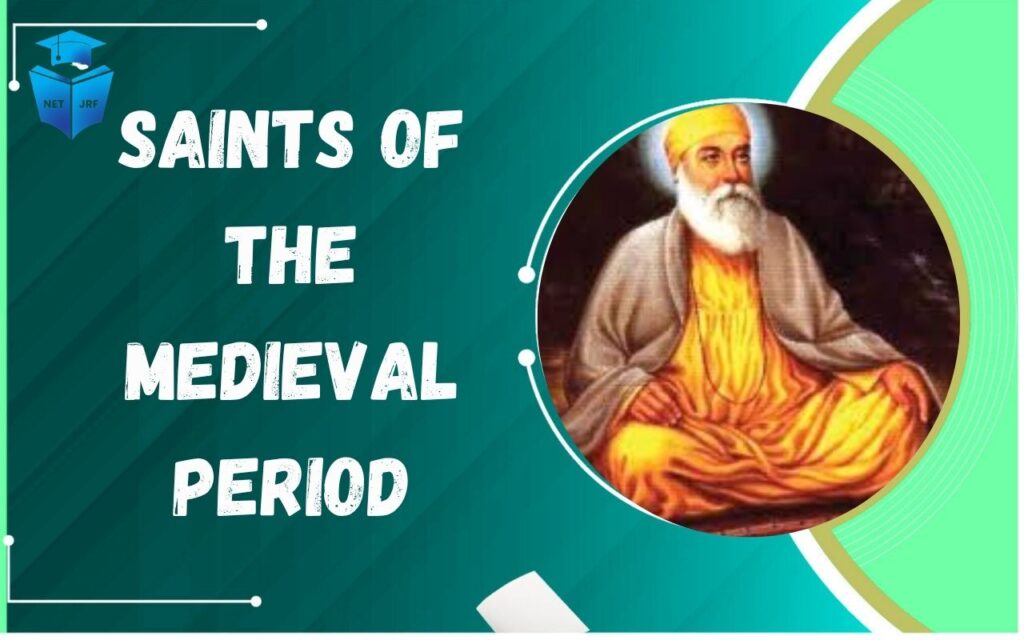
Saints of the Medieval Period reshaped the spiritual and social landscape of India between the 8th and 18th centuries. They led the Bhakti Movement, which focused on personal devotion rather than rigid rituals. This era marked a departure from Brahmanical orthodoxy and the complex Vedic ceremonies of the past. By choosing the path of love and faith, these reformers brought God closer to the common man.

The emergence of these spiritual leaders provided a voice for the marginalized sections of society. Many Saints of the Medieval Period belonged to the lower castes, successfully breaking the religious monopoly of the priestly class. They used local languages to spread their message, ensuring that spirituality reached every village and household. This movement did not just change religion; it acted as a massive social reform force that promoted equality and unity.
Best UGC NET Foundation Course
Saints of Medieval Period Role
The Saints of the Medieval Period acted as bridges between the divine and the ordinary person. They rejected the idea that one needed a priest or a complex sacrifice to reach God. Instead, they preached that pure, selfless love, known as Bhakti, was the most direct path to salvation or Moksha. This radical idea invited everyone to participate in religious life regardless of their social standing.
These leaders often lived nomadic lives, travelling across regions to share their insights. Their itinerant lifestyle helped them connect with diverse communities and inspire followers across different geographical boundaries. By communicating in vernacular languages like Tamil, Telugu, and Hindi, they democratized spirituality. This inclusive approach fostered a strong sense of community and collective devotion among the masses.
Key Characteristics of the Reformers
- Worship of Personal Deities: Most saints focused on specific forms of Shiva or Vishnu.
- Rejection of Caste: They actively challenged societal inequalities and invited all castes to worship.
- Use of Vernaculars: They wrote hymns and poems in local dialects to reach common people.
- Emotional Connection: They emphasized a deep, emotional bond with God over intellectual study.
Philosophical Foundations: Nirguna and Saguna
The teachings of the Saints of the Medieval Period generally fall into two categories: Nirguna and Saguna. These concepts define how a devotee perceives and worships the divine. Both paths emphasize the importance of surrender and faith over external rituals.
- Nirguna Bhakti refers to the worship of a formless God. Leaders like Kabir and Guru Nanak followed this path, believing that the divine has no physical shape or attributes.
- They often criticized image worship and the obsession with physical temples or mosques. Their focus remained on the internal realization of the divine presence within the self.
- On the other hand, Saguna Bhakti involves worshipping God with specific forms and qualities.
- Saints like Tulsidas, Mirabai, and Chaitanya focused on incarnations like Rama or Krishna. They expressed their devotion through passionate songs, prayers, and stories about the lives of these deities.
- This path made it easier for common people to visualize and love God as a relatable figure.
South Indian Pioneers: Alvars and Nayanars
The journey of the Saints of the Medieval Period began in South India during the early medieval era. Two major groups of saint-poets led this initial wave: the Alvars and the Nayanars. Their devotional hymns in Tamil laid the foundation for the entire Bhakti Movement across India.
- The Alvars were twelve saints entirely devoted to Lord Vishnu.
- They believed that Vishnu is the supreme protector and that salvation comes through his divine grace. Their compositions expressed an intense longing for union with the deity. Meanwhile, the sixty-three Nayanars were devotees of Lord Shiva.
- They viewed religion as a bond of love between the worshipper and the god, rejecting the need for extreme austerities.

Feature Breakdown: Saints of the Medieval Period
| Category | Alvars (Vaishnava) | Nayanars (Shaiva) |
| Number of Saints | 12 | 63 |
| Primary Deity | Lord Vishnu | Lord Shiva |
| Regional Origin | Tamil Nadu (South India) | Tamil Nadu (South India) |
| Core Message | Surrender to Vishnu’s Grace | Bond of Love with Shiva |
| Social Impact | Inclusive of all castes | Rejection of ritualistic austerities |
Radical Reformers of North India
As the movement spread northward, several Saints of the Medieval Period emerged with even more radical ideas. Ramananda was the first great saint to bring the message of Bhakti to North India. He famously opened the doors of devotion to everyone without any distinction of birth, caste, creed, or sex.
- His followers included people from various backgrounds, including women and members of the lower castes.
- Kabir, a disciple of Ramananda, became one of the most influential figures of this era.
- He was a radical reformer who opposed caste distinctions, image worship, and unnecessary rituals. Kabir sought to remove the differences between Hindus and Muslims, advocating for social unity. His verses, known as Bijak, continue to be popular for their directness and profound wisdom.
- Guru Nanak also played a pivotal role as a Nirguna Bhakti saint and social reformer.
- He founded Sikhism and preached the oneness of God and the equality of all human beings. Like Kabir, he rejected the caste system and emphasized honest labor and service to humanity.
- His teachings formed the basis for a new community that transcended traditional religious boundaries.
Enroll UGC NET Offline Coaching in Jaipur
Maharashtra Dharma and Varkari Tradition
In Western India, the Saints of the Medieval Period established a unique tradition known as Maharashtra Dharma. This stream of the movement was particularly profound and liberal in its approach to social reforms. It drew inspiration from the Bhagavatapurana and the teachings of the Shiva Nathpanthis.
- Jnaneswara, or Jnanadeva, acted as the pioneer of the Bhakti Movement in Maharashtra. He wrote the ‘Jnaneswari’ (also called ‘Bhavarthadipika’), an extensive commentary on the Bhagavad Gita in the Marathi language.
- He argued strongly against caste distinctions and believed that Bhakti was the only true way to attain God. His work laid the ideological foundation for subsequent saints in the region.
- The cult of Vithoba (a form of Vishnu) at Pandharpur became the mainstay of this tradition.
- Namdev, a tailor by caste, founded the Varkari sect centered around this deity.
- He was a contemporary of Jnaneswara and spent his life opposing caste distinctions through his hymns.
- Other notable figures like Eknath and Tukaram further enriched this tradition with their literature and devotional poems called Abhangas.
Krishna Bhakti – Role of Women Saints
The worship of Lord Krishna saw a massive surge thanks to several Saints of the Medieval Period. Chaitanya Mahaprabhu in Bengal was a prominent leader of this cult. He founded Gaudiya or Bengal Vaishnavism, emphasizing the chanting of the divine name and ecstatic dancing as forms of worship. His movement brought people from all walks of life together in communal prayers known as Kirtans.
- Mirabai stands out as the most famous woman Bhakti saint of the Krishna cult. A Rathore princess, she abandoned her royal life to devote herself entirely to Krishna.
- Her passionate devotional poetry, written in local dialects, expressed a deeply personal and unconventional relationship with the divine.
- She faced significant social opposition but remained steadfast in her faith, becoming an icon of female empowerment and devotion.
- In other parts of India, saints like Vallabhacharya and Surdas also sang the glory of Krishna. Vallabhacharya propounded the philosophy of Pushti Marg, focusing on the grace of God. Surdas, a blind poet from Agra, composed the ‘Sursagar’, which details the childhood and deeds of Krishna in beautiful verse. These contributions made Krishna Bhakti a dominant spiritual force in North and West India.
Saints in Medieval Period Social Impact
The Saints of the Medieval Period brought about revolutionary changes in Indian society. Their most significant contribution was the challenge they posed to the rigid caste system. By asserting that all are equal in the eyes of God, they provided a sense of dignity to the oppressed classes. This led to a more inclusive social structure where spiritual fulfilment was no longer a privilege of the high-born.Furthermore, the movement led to a massive revival of Hinduism.
- It countered the growth of Buddhism and Jainism by offering a more personal and accessible form of worship.
- The use of local languages fostered the development of regional literatures, such as Marathi, Hindi, and Bengali.
- This cultural flourishing enriched the linguistic heritage of India and made ancient wisdom available to everyone.
Social Benefits:
- Caste Barriers: The movement successfully broke down traditional social hierarchies.
- Gender Inclusion: Women like Mirabai gained a prominent place in spiritual life.
- Religious Harmony: Leaders like Kabir tried to bridge the gap between different faiths.
- Cultural Growth: It spurred the creation of vast amounts of devotional literature and music.
Evolution of the Movement
Over centuries, the Bhakti Movement evolved by adapting to regional cultures, incorporating local languages, and responding to social challenges, shaping a dynamic tradition of devotion across India.
- Initial Phase: The movement begins in the 8th century in South India with Alvars and Nayanars.
- Philosophical Growth: Scholars like Ramanuja provide an intellectual framework for devotion.
- Spread to the West: Saints in Maharashtra like Jnaneswara and Namdev popularize Bhakti in the 13th century.
- Northern Expansion: Ramananda brings the movement to North India in the 15th century.
- Radical Turn: Kabir and Guru Nanak introduce Nirguna Bhakti, challenging all organized religion.
- Devotional Peak: Tulsidas and Mirabai make Rama and Krishna household names through their literature.
- Final Synthesis: The movement leaves a lasting legacy on Indian culture, music, and social values.
Best UGC NET Offline Classes in Jaipur
Quick Revision
To summarise the Bhakti Movement, its core principles, literature, philosophy, and musical contributions highlight a transformative era of devotion, equality, and cultural enrichment across India.
- Definition: A spiritual and social reform movement emphasizing personal devotion.
- Equality: Believed that salvation is available to everyone regardless of caste or gender.
- Literature: Led to the creation of ‘Ramcharitamanas’, ‘Jnaneswari’, and ‘Abhangas’.
- Philosophy: Includes both formless (Nirguna) and form-based (Saguna) worship.
- Music: Influenced the foundations of Karnataka music through saints like Purandar Das and Thyagaraja.

The Saints of the Medieval Period acted as a revolutionary force that forever changed the course of Indian history. They replaced complex, expensive rituals with the simple and powerful path of devotion. By inviting people of all castes and genders into the spiritual fold, they created a more equitable society. Their legacy survives today in the vibrant music, rich literature, and inclusive values of modern India. The timeless message of love and faith shared by these Saints of the Medieval Period continues to provide guidance in a complex world.
The Saints of the Medieval Period FAQs

Who were the Alvars and Nayanars?
They were the early Bhakti saints of South India; Alvars worshipped Vishnu, while Nayanars worshipped Shiva.
Did the movement support the caste system?
No, most saints actively opposed caste distinctions and preached that all humans are equal before God.
Who wrote the Ramcharitamanas?
The great saint-poet Tulsidas wrote the 'Ramcharitamanas', which popularised the worship of Lord Rama.
What is the difference between Nirguna and Saguna Bhakti?
Nirguna is the worship of a formless God, while Saguna is the worship of God in a physical form like Krishna.
Who founded the Varkari tradition?
Namdev, a tailor by caste from Maharashtra, is the founder of the Varkari sect.
Why are local languages important in this movement?
Saints used local languages so that common people, who did not know Sanskrit, could understand spiritual teachings.
Who was Mirabai?
She was a princess and a famous woman saint devoted to Lord Krishna, known for her beautiful devotional poetry.
How did the movement influence Indian music?
Saints like Purandar Das and Thyagaraja laid the foundations of modern Karnataka music through their compositions.
What is 'Maharashtra Dharma'?
It refers to the liberal and social reform-oriented Bhakti tradition that flourished in Maharashtra.