
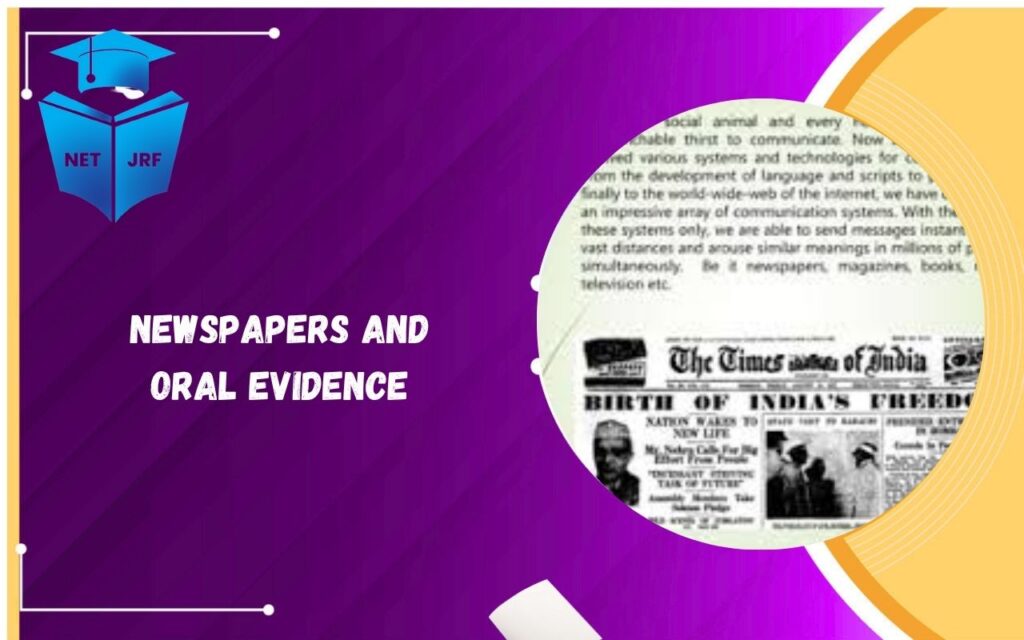
Newspapers, Oral Evidence, form essential tools for historians who study Modern Indian history. These sources help scholars understand how colonial rule shaped Indian society, politics, economy, culture from the eighteenth century onward. Modern Indian history begins roughly from the decline of the Mughal Empire after the death of Aurangzeb in 1707. European trading companies expanded influence during this time. Eventually the British East India Company gained political power after the Battle of Plassey in 1757. Historians depend on multiple types of records to reconstruct events during this period.

Importance of Historical Sources
Historical research depends on reliable evidence to understand and interpret the past. Historical sources provide factual information about political institutions, economic policies, social movements, and cultural life. By studying different types of sources, historians can reconstruct events and analyze historical developments more accurately.
Major reasons why historical sources are important include:
- They reveal the colonial administrative structure: Official records, reports, and correspondence help historians understand how the colonial government functioned and managed its administration.
- They explain nationalist movements: Newspapers, personal papers, speeches, and memoirs provide detailed information about the growth of nationalism and the activities of freedom fighters.
- They show the daily life of common people: Sources such as oral traditions, folk songs, travel accounts, and court records describe the social conditions, customs, and struggles of ordinary people.
- They preserve political debates of the time: Legislative records, editorials, and political writings show how different groups discussed and debated important issues.
- They provide evidence for scholarly interpretation: Historians use these sources as proof to support their arguments and interpretations while writing history.
Thus, historical sources form the foundation of historical research, helping scholars develop a balanced and accurate understanding of the past.
Enroll UGC NET Mock Test Series
Types of Sources of Modern Indian History
Historians classify sources into several categories.
1. Official Government Records
British administrators documented almost every activity. These records contain reports, letters, administrative files, surveys.
Examples include:
- Revenue reports: These documents contain information about land revenue collection, agricultural production, taxation systems, and economic conditions of different regions.
- Police records: Police files include reports on law and order, criminal cases, surveillance activities, and political movements. They also provide details about protests and revolutionary activities during the colonial period.
- Legislative proceedings: These records include debates, discussions, and decisions made in legislative councils and assemblies. They help historians understand how laws and policies were formulated.
- Census data: Census reports provide statistical information about population, religion, caste, literacy, occupation, and demographic changes. This data is essential for studying social and economic history.
- Departmental correspondence: These are official letters exchanged between different government departments. They reveal administrative decisions, policy discussions, and the functioning of the colonial bureaucracy.
Such records help scholars understand colonial governance.
Many documents remain preserved in the National Archives of India located in New Delhi. The institution stores records from the eighteenth century onward.
2. Archival Materials
Archives are repositories where historical documents are preserved. They contain primary sources used by researchers.
Important archival centers include:
- National Archives of India: The main national repository that preserves important government records, administrative files, treaties, and historical documents related to the history of modern India.
- State archives across India: Every state maintains its own archival institutions that preserve regional administrative records, land revenue documents, judicial files, and other materials important for studying local history.
- Foreign archives in London, Paris, Lisbon: Many records related to India are preserved in foreign repositories such as the British Library, Archives Nationales, and Arquivo Nacional da Torre do Tombo, which contain documents related to colonial administration and international trade.
These collections store:
- Official correspondence: Letters and communications exchanged between government officials, administrators, and departments. These documents reveal decision-making processes and administrative discussions.
- Treaties: Formal agreements signed between governments, rulers, or colonial powers. They provide evidence about diplomatic relations, territorial settlements, and political alliances.
- Political reports: Detailed reports prepared by officials about political conditions, rebellions, nationalist movements, and public opinion in different regions.
- Administrative documents: Records related to governance such as policy decisions, revenue records, orders, and departmental files that explain how the administration functioned during a particular period.
Archival sources provide original evidence for historical research.
Enroll UGC NET Foundation Batch Online
Newspapers, Oral Evidence, in Modern Indian Historical Research
Historians treat Newspapers, Oral Evidence, as crucial tools for understanding public opinion during colonial rule.
Importance of Newspapers in Historical Study
- Newspapers are an important source for studying modern history. They provide a daily record of political and social events that occurred during a particular period. Through newspapers, historians can trace how events unfolded day by day and understand the reactions of society.
- Another important advantage of newspapers is that they reflect public opinion. Editorials, opinion columns, and letters to the editor show how people felt about political developments, social reforms, and government decisions. In this way, newspapers help historians understand the mood and thinking of society at that time.
- Newspapers also contain discussions and criticism of government policies. Many editors openly debated administrative decisions, economic policies, and legal reforms. These discussions allow historians to analyze the relationship between the colonial government and the public.
- They also provide detailed coverage of nationalist movements. Newspapers reported protests, meetings, boycotts, and campaigns organized by freedom fighters. They published the speeches and statements of important leaders, which helps historians understand the ideas and strategies of the nationalist movement.
- Another valuable feature is the documentation of speeches and activities of political leaders. Newspapers often reported speeches given at public meetings, political gatherings, and legislative assemblies. These reports preserve the thoughts and messages of leaders during critical moments in history.
- However, historians must use newspapers carefully. Editors sometimes had personal or political biases, which could influence the way news was presented. Therefore, historians always compare newspaper reports with other sources before drawing conclusions.
However historians must verify accuracy because editors sometimes expressed personal bias.
Oral Evidence in Historical Study
Newspapers, Oral Evidence, also include spoken memories preserved through interviews, folklore, testimonies.
Oral Evidence in Historical Study
- Apart from written sources like newspapers and archives, historians also use oral evidence. Oral evidence refers to spoken memories and traditions that are preserved through interviews, stories, songs, and testimonies.
- These oral sources are especially useful because they help historians study groups that are often missing from official records, such as villagers, tribal communities, women, and ordinary workers. Through oral accounts, historians can hear the voices of people who rarely appear in government documents.
- For example, interviews with Partition survivors help historians understand the human suffering, migration experiences, and emotional trauma of 1947. Similarly, stories of tribal resistance passed down through generations describe local struggles against colonial authority.
- Folk songs and traditional narratives also act as oral evidence. Many folk songs describe colonial oppression, social injustice, and resistance movements. These songs preserve the feelings, struggles, and aspirations of ordinary people.
- Although oral evidence may sometimes change over time due to memory or storytelling traditions, it still provides valuable insight into people’s experiences, emotions, and cultural memory. When historians combine oral evidence with written sources, they gain a more complete and balanced understanding of history.
These narratives preserve the experiences of ordinary people. Historians often record oral testimonies using modern audio technology.
Enroll UGC NET Offline Classes in Jaipur
Comparison of Written Sources vs Oral Sources
Written sources and oral sources both help historians understand the past, but they provide different types of evidence and perspectives. While written sources offer recorded and documented information, oral sources present personal memories, experiences, and traditions that may not appear in official records.
| Feature | Written Sources | Oral Sources |
| Format | Documents, reports, books | Spoken memories |
| Preservation | Stored in archives | Recorded through interviews |
| Perspective | Often official viewpoint | Personal experience |
| Reliability | More stable records | Requires verification |
| Use in research | Administrative history | Social history |
Newspapers, Oral Evidence, Historical Sources
Newspapers and oral evidence together form important historical sources because they record both documented events and personal experiences of the past.
| Source Type | Example | Historical Value |
| Newspapers | Hicky’s Bengal Gazette | Political debate |
| Oral Testimony | Partition survivor memory | Social experience |
| Press Reports | Nationalist newspapers | Public opinion |
| Folk Songs | Tribal resistance songs | Cultural history |
These sources help historians reconstruct past events from multiple viewpoints.

Creative Literature as Historical Evidence
Literary works also reveal social conditions during colonial rule.
Famous examples include:
- Anandamath written by Bankim Chandra Chatterjee
- Stories by Munshi Premchand
- Poems by Rabindranath Tagore
The novel Anandamath introduced the patriotic song Vande Mataram. It inspired nationalist feelings among Indians.
Literature portrays poverty, rural life, colonial exploitation.
Visual Sources Paintings, Photographs
Visual sources are an important form of historical evidence. They include paintings, photographs, sketches, and monuments that visually represent events, people, and places from the past. Such records help historians understand aspects of history that written documents may not fully describe.
Important examples include:
- Paintings of Company School artists: These artworks, often created under the patronage of the East India Company, depict everyday Indian life, local customs, occupations, and landscapes during the colonial period.
- Photographs of the Salt March: These images capture the mass civil disobedience movement led by Mahatma Gandhi against the British salt tax.
- Images from the Indian Rebellion of 1857: Visual representations of this major uprising provide insight into battles, military responses, and the broader atmosphere of resistance.
Photographs and paintings often reveal details about clothing, architecture, urban planning, and social life of the time. They help historians visualize how people lived and how cities were organized.
Colonial monuments such as the Gateway of India also act as visual historical sources. Built during British rule, such structures symbolized imperial authority and the political presence of the colonial state in India.
Importance Private Papers
Private papers include letters, diaries, autobiographies.
Importance of Private Papers
- Private papers are an important source for historical research. They include letters, diaries, autobiographies, personal notes, and unpublished writings of individuals. Unlike official government records, private papers provide a personal and informal perspective on historical events.
- Many important national leaders carefully preserved their personal documents. For example, the private papers of Mahatma Gandhi, Jawaharlal Nehru, and B. R. Ambedkar contains valuable letters, diaries, and reflections. These writings help historians understand their personal views, political ideas, internal debates, and strategies during the freedom struggle.
- Private papers also reveal behind-the-scenes discussions that are often missing from official documents. Through these sources, historians can study the thought processes, relationships between leaders, and the emotional aspects of historical decisions.
- Therefore, private papers are extremely valuable because they provide first-hand insights into historical events and personalities, helping historians build a deeper and more human understanding of the past..
Private documents often provide details absent in official records.
Major Historical Sources Used in Research
Major Historical Sources Used in Research refers to the different types of evidence historians use to understand and reconstruct the past. These sources help scholars study political events, social life, economic conditions, and cultural changes over time. By examining different kinds of sources, historians can develop a balanced and reliable interpretation of history
| Source Category | Examples | Importance |
| Government Records | Census reports | Administrative history |
| Archives | National Archives documents | Primary evidence |
| Newspapers | Nationalist press | Public opinion |
| Oral Evidence | Interviews | Social experience |
| Literature | Novels, poems | Cultural history |
Role of Newspapers, Oral Evidence, in Freedom Movement Study
Nationalist leaders used press networks to spread political awareness.
Key Functions of Newspapers in the National Movement
Newspapers played an important role in shaping political awareness during the colonial period. Their major functions included:
- Criticizing colonial policies: Newspapers openly questioned British administrative decisions and exposed the negative impact of colonial rule on Indian society and economy.
- Promoting nationalist ideology: Many newspapers supported the ideas of nationalism and encouraged people to develop a sense of unity and national identity.
- Educating the public about political rights: Through articles, editorials, and discussions, newspapers informed people about civil rights, constitutional reforms, and political developments.
- Mobilizing people for protests: Newspapers helped spread information about meetings, boycotts, and demonstrations, which encouraged public participation in nationalist movements.
Join UGC NET Offline Coaching in Jaipur
Limitations of Historical Sources
Every historical source has certain limitations, so historians must study them carefully. No single source can give a complete or perfectly accurate picture of the past. Therefore, historians analyze different types of evidence before drawing conclusions.
Some common challenges include:
- Bias in colonial records: Many official documents were written by colonial administrators, so they often reflect the viewpoint and interests of the ruling authorities rather than the experiences of the local population.
- Memory distortion in oral testimony: Oral accounts depend on personal memory, which may change over time. People may forget details or interpret events differently after many years.
- Political influence in newspapers: Newspapers sometimes supported particular political ideologies or leaders. As a result, news reports and editorials could present events in a biased manner.
- Incomplete archival collections: Not all historical documents have survived. Some records were lost, damaged, or destroyed over time, which creates gaps in historical evidence.
Because of these limitations, historians usually compare multiple sources such as archives, newspapers, memoirs, and oral evidence to reach balanced and reliable conclusions about the past.

Conclusion
Modern Indian history depends on multiple forms of evidence that reveal different perspectives of colonial society. Administrative records provide official information while literature, photographs, and private papers show social realities. Newspapers, Oral Evidence, remain especially valuable because they preserve public opinion plus lived experiences of ordinary people.
Newspapers, Oral Evidence, Sources of Modern Modern Indian History FAQs

Where are most colonial records preserved in India?
Most colonial documents remain preserved in the National Archives of India located in New Delhi. State archives also store regional administrative records.
Why are newspapers important historical sources?
Newspapers record daily events, political debates, social reforms during colonial rule. They reveal public reactions toward government policies.
How do oral sources help historians?
Oral testimony preserves memories of ordinary people. Interviews with survivors provide insight into events such as Partition or local resistance.
Who wrote the novel Anandamath?
The novel Anandamath was written by Bankim Chandra Chatterjee. The work introduced the patriotic song “Vande Mataram”.
What are archival materials?
Archival materials include original historical documents such as letters, reports, treaties, administrative files preserved in record repositories.
What role did nationalist newspapers play?
Nationalist newspapers criticized colonial rule, spread political awareness, encouraged participation in the freedom struggle.
Why must historians verify sources carefully including Newspapers, Oral Evidence,?
Historians cross-check sources because bias may appear in official documents or personal memory. Comparison helps establish reliable interpretation.