
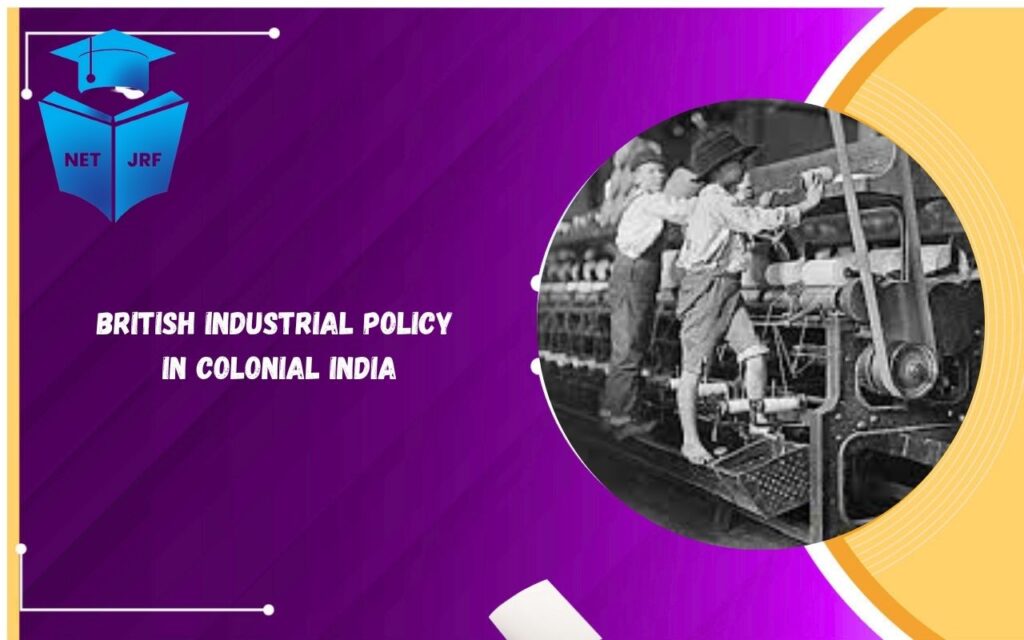
British Industrial Policy shaped the economic structure of colonial India in profound ways. British administrators designed economic policies that supported industrial growth in Britain while limiting industrial development in India. This strategy transformed India into a supplier of raw materials and a market for British manufactured goods.
Enroll UGC NET Mock Test Series
The British Industrial Policy created long-term changes in Indian society and economy. Traditional industries declined, new industrial centres emerged slowly, and the colonial economy became heavily dependent on agriculture and raw material exports.

British Industrial Policy Concept
British Industrial Policy refers to the economic strategy adopted by the colonial government to organize production, trade, and industry in India in a way that benefited Britain’s industrial economy.
Key Characteristics
- Encouragement of raw material exports from India
- Promotion of British manufactured goods in Indian markets
- Limited support for indigenous industries
- Integration of Indian economy into global imperial trade
This policy reshaped India’s industrial landscape during the nineteenth century.
Economic Structure of India Before Colonial Rule
Before colonial domination, India had a strong manufacturing base.
Major Pre-Colonial Industries
- Cotton textiles
- Silk weaving
- Metal crafts
- Shipbuilding
- Handicrafts
Indian artisans produced goods that were exported to Europe, Asia, and Africa. However colonial policies gradually disrupted this system, leading to industrial decline.
Enroll UGC NET Foundation Course
Objectives British Industrial Policy
The colonial government followed clear economic goals in India.
Major Objectives
- Provide raw materials for British factories.
- Create markets for British manufactured goods.
- Prevent competition from Indian industries.
- Maintain colonial economic control.
These objectives defined the direction of British Industrial Policy throughout the nineteenth century.
British Industrial Policy and Trade Structure
The colonial administration reshaped trade patterns to support British industrial growth.
Key Trade Changes
- Export of raw cotton, jute, indigo, and tea increased.
- Import of machine-made textiles from Britain expanded.
- Local manufacturing weakened.
These changes illustrate how British Industrial Policy transformed India into a colonial economic dependency.
British Industrial Policy Economic Features
| Feature | Description | Impact |
| Raw material export | Cotton, jute, tea exported to Britain | Supported British factories |
| Import of manufactured goods | British textiles flooded Indian markets | Decline of handicrafts |
| Limited industrial investment | Few industries developed locally | Slow industrialization |
| Colonial trade network | India integrated into imperial trade | Economic dependency |
Impact on Traditional Industries
Traditional crafts suffered severe decline during colonial rule.
Impact of Colonial Rule on Traditional Industries
- Decline of Traditional Crafts
- Handicrafts and artisanal industries, such as weaving, metalwork, and pottery, suffered a severe decline during British rule.
- These industries had previously supported urban economies and artisan communities.
- Loss of Markets
- Indian textiles and other handmade goods lost both domestic and international markets.
- Cheaper, machine-made British imports replaced local products, reducing demand for traditional crafts.
- Decline of Artisan Employment
- With shrinking markets, artisans lost their traditional occupations and income sources.
- Families dependent on craft work faced economic hardship.
- Migration of Artisans to Villages
- Displaced artisans moved to rural areas, often working as agricultural laborers.
- This migration increased pressure on village economies and land resources.
- Deindustrialization
- British industrial and trade policies systematically destroyed India’s traditional manufacturing base.
- This process is known as deindustrialization, making India dependent on British manufactured goods.

Rise of Modern Industries in Late Colonial Period
Although colonial policies restricted industrial growth, some modern industries emerged.
Cotton Textile Mills in Bombay
- Established in the mid-19th century, these mills marked the beginning of modern industrial production in India.
- They mainly produced cotton textiles for domestic and export markets.
Jute Mills in Bengal
- From the 1850s onwards, jute mills emerged in Bengal, especially around Calcutta, producing sacks, ropes, and industrial textiles.
Coal Mining in Eastern India
- Coal mining expanded to supply fuel for railways, factories, and steamships.
- Key coal regions included Bihar, Bengal, and Orissa.
Iron and Steel Industry
- The Tata Iron and Steel Company (established in the early 20th century) was a pioneering industrial enterprise in India.
- It laid the foundation for modern heavy industry in India.
Enroll UGC NET Offline Classes in Jaipur
Limitations Due to British Policy
- Industrial growth was slow and uneven.
- British Industrial Policy prioritized Britain’s economic interests, restricting India from developing industries that could compete internationally.
- As a result, modern industrialization remained limited, and India continued to serve as a supplier of raw materials for Britain.
Infrastructure Development
Colonial authorities developed infrastructure mainly to support trade.
Purpose of Infrastructure
- The British built infrastructure primarily to support trade and resource extraction.
- The aim was to facilitate export of raw materials to Britain and import manufactured goods.
Important Infrastructure Projects
- Railways: Connected raw material-producing regions (like coal and cotton) to ports.
- Ports: Developed in cities such as Bombay, Calcutta, and Madras to handle exports.
- Telegraph Lines: Improved communication for administration and trade.
- Roads: Built mainly to link plantations, mines, and industrial centers with railways and ports.
Impact
- While these projects modernized transportation and communication, they were designed to serve British economic interests rather than develop the Indian economy independently.
- Indian industries benefited indirectly and minimally, as the infrastructure primarily facilitated export-oriented colonial trade.
Industrial Policy Before and During Colonial Rule
Industrial policy in India changed significantly after the establishment of British rule, especially under the British East India Company and later the British Empire.
| Feature | Pre-Colonial Economy | Colonial Economy |
| Industrial strength | Strong handicraft industries | Declining traditional crafts |
| Trade pattern | Export of finished goods | Export of raw materials |
| Artisan employment | Large skilled workforce | Declining employment |
| Economic control | Local rulers merchants | British colonial administration |
This comparison shows how British Industrial Policy transformed the Indian economic structure.
Social Impact of Industrial Policy
Industrial policies affected different social groups.
- Loss of Artisan Jobs – Many artisans lost their traditional occupations due to the decline of handicraft industries.
- Migration to Villages – Unemployed artisans moved from towns to villages in search of work.
- Pressure on Agriculture – More people depended on agriculture, increasing pressure on land and resources.
- Growth of Rural Poverty – The decline of traditional industries and limited job opportunities led to the expansion of rural poverty.
Nationalist Criticism of Colonial Economic Policy
Indian nationalist leaders strongly criticized colonial economic strategies.
Important Thinkers
- Dadabhai Naoroji
- R. C. Dutt
- M. G. Ranade
They argued that colonial policies drained wealth from India. Their analysis highlighted the exploitative nature of British Industrial Policy.
Drain of Wealth Theory
Dadabhai Naoroji developed the famous Drain Theory to explain colonial exploitation.
Drain of Wealth Theory (Dadabhai Naoroji)
Concept
- Developed by Dadabhai Naoroji, the Drain Theory explained how British colonial rule exploited India economically.
- The theory argued that wealth was systematically transferred from India to Britain, leaving India impoverished.
Key Arguments
- Export of Wealth: India exported raw materials, agricultural produce, and revenue without receiving fair compensation.
- Transfer of Income: Salaries of British officials, pensions, and profits from trade were sent back to Britain.
- Trade Patterns Favored Britain: Policies encouraged India to import British manufactured goods while exporting raw materials cheaply.
- Role of British Industrial Policy: The policy destroyed Indian industries and ensured India remained a supplier of raw materials, intensifying the economic drain.

Industrial Policy and Agrarian Pressure
Industrial stagnation pushed many workers toward agriculture.
Industrial Policy and Agrarian Pressure in Colonial India
Industrial Stagnation
- British Industrial Policy limited the growth of Indian industries to protect British economic interests.
- As a result, many artisans and workers lost employment in towns.
Shift to Agriculture - Displaced workers migrated to villages and became agricultural laborers, increasing pressure on land and resources.
Join UGC NET Coaching in Jaipur
Key Outcomes
- Increase in Landless Laborers: More people worked on land they did not own, dependent on wages.
- Fragmentation of Agricultural Land: Subdivision of land among growing rural population reduced farm sizes.
- Decline in Rural Wages: Increased labor supply led to lower wages for agricultural workers.
- Growth of Rural Poverty: Many families faced economic hardship due to limited income and resources.
The British Industrial Policy fundamentally reshaped India’s economy during colonial rule. The policy encouraged raw material exports, expanded markets for British manufactured goods, and limited the growth of indigenous industries. As a result, traditional handicrafts declined while modern industries developed slowly under colonial control.
These policies transformed India from a manufacturing centre into a supplier of raw materials for British factories.
FAQs

Why did British policies discourage Indian industries?
British administrators wanted India to supply raw materials for British factories and act as a market for British manufactured goods.
How did colonial trade policies affect Indian artisans?
Machine-made imports from Britain replaced traditional handicrafts, which reduced employment among artisans.
Which industries developed during colonial rule?
Cotton textile mills, jute mills, coal mining, and later iron and steel industries developed in certain regions.
What role did infrastructure play in industrial policy?
Railways and ports helped transport raw materials to ports for export to Britain.
Why did nationalist leaders criticize colonial economic policy?
They believed British policies drained wealth from India and prevented independent industrial growth.
How did British Industrial Policy influence rural society?
Industrial stagnation pushed many workers toward agriculture, increasing pressure on land and rural poverty.