
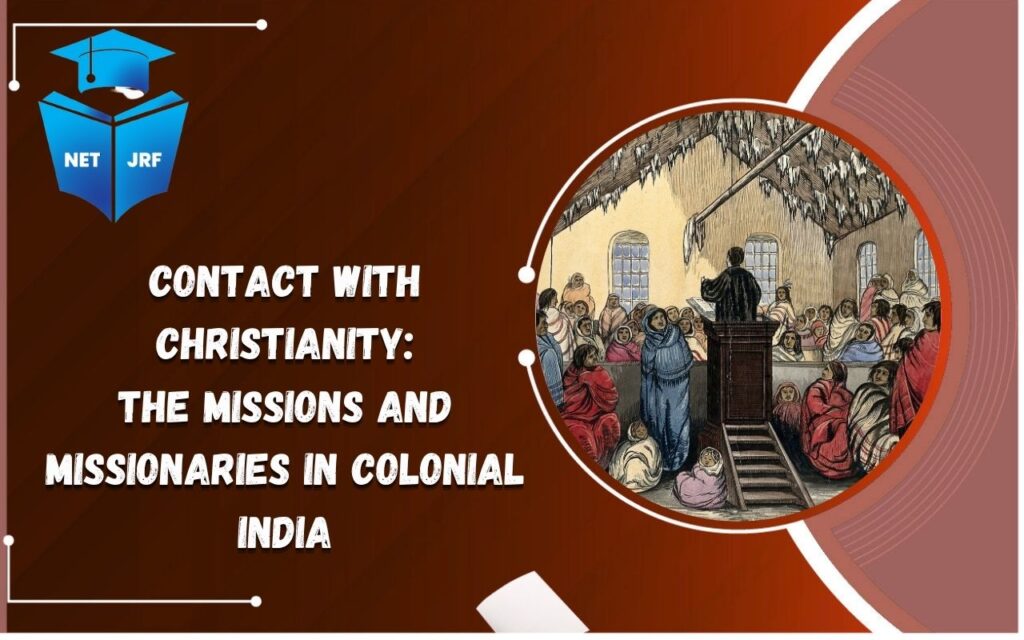
Contact with Christianity the Missions and Missionaries played a significant role in the transformation of Indian society during the colonial period. European missionaries arrived in India with the aim of spreading Christianity and establishing religious institutions.
The expansion of missionary activity during British rule created new interactions between Indian communities and Western religious ideas. Missionaries established schools, hospitals, printing presses, and social reform institutions.

Missionary Activity Meaning
Contact with Christianity the Missions and Missionaries refers to the interaction between Indian society and Christian religious organizations that arrived during colonial expansion.
Missionaries attempted to spread Christian teachings through education, preaching, literature, and social service activities.
Characteristics
- Spread of Christian religious ideas
- Establishment of educational institutions
- Translation of religious texts
- Social reform initiatives
- Cultural interaction between Europe and India
These activities created new forms of social and cultural contact in colonial India.
Contact with Christianity
The development of Contact with Christianity the Missions and Missionaries began with the arrival of European traders and colonial administrators.
- Christian missions expanded significantly during the eighteenth and nineteenth centuries when British political control increased in India.
- Missionaries received support from religious organizations in Europe and worked actively in different regions of India.
Early Christian Missions in India
Christian presence in India existed even before British rule. However, missionary activity expanded during colonial times.
Portuguese Missionaries
The Portuguese brought Catholic missionaries to India during the sixteenth century.
Missionaries worked in Goa and other coastal regions where Portuguese influence was strong.
Protestant Missions
Protestant missionary activity expanded after the British East India Company established political power in India.
Missionaries from Britain, Germany, and America established institutions across the country.
Role of Missionaries in Education
Education became one of the most important aspects of Contact with Christianity – the Missions and Missionaries.
Missionaries believed that education would help spread Christian values and modern knowledge.
Educational Contributions
- Establishment of missionary schools
- Promotion of English education
- Creation of colleges and training institutions
- Introduction of modern curriculum
These institutions played a major role in spreading Western ideas in Indian society.
Enroll UGC NET Foundation Batch Online

Missionary Educational Contributions
| Contribution | Impact |
| Mission Schools | Spread basic education |
| Colleges | Higher education opportunities |
| Teacher Training | Professional education development |
| Printing Press | Distribution of books and literature |
Social Reform Activities
Missionaries participated in several social reform initiatives during colonial rule.
Through Contact with Christianity – the Missions and Missionaries, many reform movements focused on improving social conditions.
Areas of Reform
- Promotion of female education
- Opposition to social practices such as sati
- Support for widow remarriage
- Development of healthcare institutions
These reforms created debates about tradition and modernization in Indian society.
Translation and Printing Activities
Missionaries also contributed to linguistic and literary development.
Important Contributions
- Translation of the Bible into Indian languages
- Publication of dictionaries and grammar books
- Printing of educational materials
These activities helped promote literacy and language development.
Enroll UGC NET Offline Coaching in Jaipur
Cultural Impact on Indian Society
The interaction between Indian traditions and missionary ideas created significant cultural change.
- Contact with Christianity the Missions and Missionaries introduced new ideas about equality, social reform, and education.
- However, these changes also created resistance among some sections of society who feared loss of traditional customs.

Missionary Influence vs Traditional Institutions
| Feature | Missionary Institutions | Traditional Institutions |
| Education | Western curriculum | Religious education |
| Language | English promotion | Sanskrit and Persian |
| Social Reform | Reform-oriented ideas | Preservation of tradition |
| Institutions | Schools and hospitals | Temples and traditional schools |
This comparison highlights the differences between colonial missionary institutions and traditional Indian institutions.
Response of Indian Society
Indian society reacted differently to Contact with Christianity – the Missions and Missionaries.
Some reformers welcomed new ideas about education and social equality, while others opposed missionary influence.
Positive Responses
- Adoption of modern education
- Support for social reforms
- Intellectual exchange between cultures
Negative Responses
- Fear of religious conversion
- Resistance to cultural change
- Protection of traditional customs
These reactions created complex social debates in colonial India.
Join UGC NET Offline Coaching in Jaipur
The history of Contact with Christianity the Missions and Missionaries reflects a complex process of cultural interaction between European missionaries and Indian society. Missionaries played an important role in education, printing, social reform, and healthcare.
Contact with Christianity: The Missions and Missionaries FAQs

2. When did missionary activity expand in India?
Missionary activity expanded mainly during the eighteenth and nineteenth centuries under British colonial rule.
3. How did missionaries contribute to education?
Missionaries established schools and colleges, promoted English education, and introduced modern subjects in the curriculum.
4. What role did missionaries play in social reform?
Missionaries supported female education, opposed harmful social practices, and promoted healthcare and literacy.
5. Why did some Indians oppose missionary activity?
Many people feared religious conversion and believed missionary activities threatened traditional customs.