
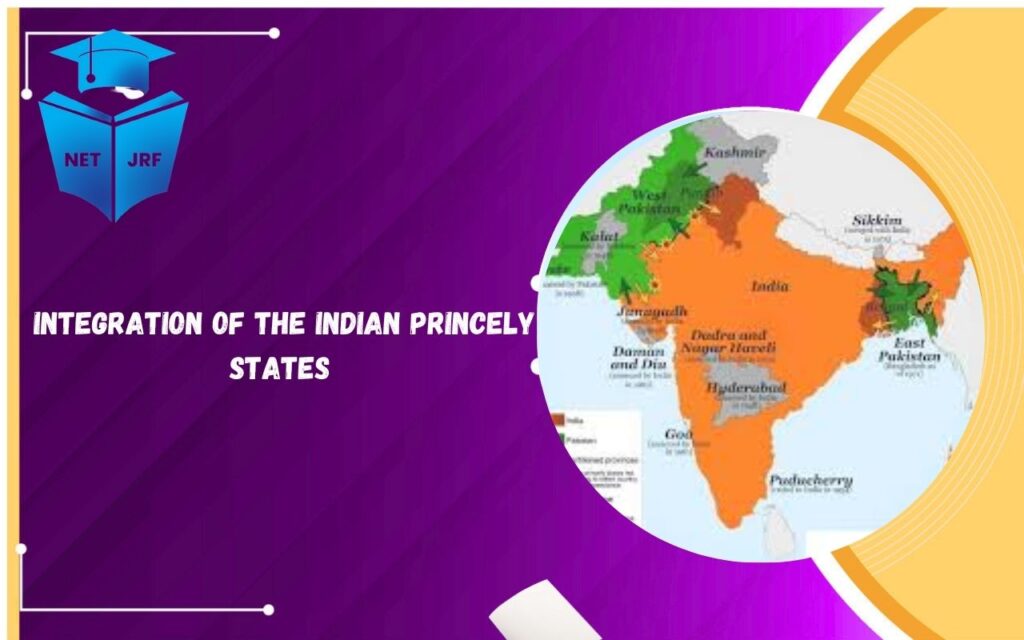
Integration of the Indian Princely States represents one of the most significant political achievements in the early years of independent India. When British colonial rule ended in 1947, the Indian subcontinent contained more than 560 princely states ruled by local monarchs. These states possessed varying degrees of autonomy under British supervision. The leaders of newly independent India had to ensure that these territories joined the Indian Union in order to maintain national unity. The process known as Integration of the Indian Princely States played a vital role in shaping the territorial and political structure of modern India. The integration process required diplomatic negotiation, political strategy, and in some cases military action. Leaders such as Sardar Vallabhbhai Patel and V. P. Menon guided the government during this critical period.

Background of Princely States
During British rule, the Indian subcontinent consisted of two major political entities. One part consisted of directly administered British provinces.
- The other consisted of princely states ruled by local kings, nawabs, and maharajas.
- These rulers accepted British authority but retained internal autonomy.
- At the time of independence in 1947, there were approximately 565 princely states. When British power ended, these states technically regained sovereignty. This situation created uncertainty regarding the territorial unity of India.
- The government had to persuade rulers to join either India or Pakistan. Therefore, the process of Integration of the Indian Princely States became essential for maintaining political stability.
Role of Sardar Vallabhbhai Patel
Sardar Vallabhbhai Patel served as the Deputy Prime Minister and Home Minister of India. He played the most decisive role in unifying the princely states with the Indian Union.
Patel worked closely with V. P. Menon, a senior civil servant who designed the political framework for accession. Together they convinced most rulers to sign agreements joining India.
Important strategies used in the Integration of the Indian Princely States included:
- Diplomatic negotiation
- Political persuasion
- Assurance of privileges to rulers
- Strategic use of military force when required
Patel’s leadership earned him the title Iron Man of India because of his decisive role in the Integration of the Indian Princely States.
Instrument of Accession
The Instrument of Accession was an important legal document used during the integration of princely states into the newly independent nation of India. At the time of independence in 1947, there were more than 560 princely states in the Indian subcontinent. These states were ruled by local kings or princes but were under the indirect control of the British government.
When the British left after the Partition of India, the princely states were given three choices:
they could join India, join Pakistan, or remain independent. To bring these states into the Indian Union, the government introduced the Instrument of Accession.
Meaning and Purpose
- The Instrument of Accession was a formal agreement between the ruler of a princely state and the government of India.
- By signing this document, the ruler agreed that the state would become part of India and accept the authority of the Indian government in certain important matters.
- This arrangement allowed a smooth and peaceful integration of many princely states into the Indian Union.
Key Features of the Instrument of Accession
By signing the document, the ruler accepted the sovereignty of India. This meant that the princely state officially became part of the Indian Union.
-
Transfer of Major Administrative Powers
-
-
- The rulers agreed to transfer control over important subjects such as defense, foreign affairs, and communications to the central government of India. These subjects were considered essential for national unity and security.
-
-
Internal Autonomy for States
-
-
- Even after joining India, the princely states were allowed to manage their internal administration for some time. This helped make the process of integration easier for the rulers.
-
-
Guarantee of Privileges for Rulers
-
- The Indian government also promised to respect certain privileges, titles, and financial allowances (privy purses) for the rulers. This encouraged many princes to join India voluntarily.
Enroll UGC NET Foundation Course
Historical Importance
The Instrument of Accession played a major role in the integration of princely states. Leaders such as Sardar Vallabhbhai Patel and V. P. Menon used diplomacy and negotiation to persuade most rulers to sign the document.
- As a result, hundreds of princely states became part of India, which helped create a unified and stable nation after independence.
- The Instrument of Accession became the legal foundation for integrating princely states into India. It ensured political unity while allowing a smooth transition from princely rule to a democratic national government.
Integration of the Indian Princely States Major Cases
Although most princely states joined India peacefully, a few cases created political complications. The most significant cases involved Kashmir, Hyderabad, and Junagarh.
-
Junagarh
-
-
- Junagarh was a small princely state located in present day Gujarat. Its ruler was a Muslim nawab, while the majority of the population was Hindu.
- The ruler decided to join Pakistan despite the geographical distance between the state and Pakistan.
- This decision created political unrest. The government of India intervened and organized a referendum in 1948. The people voted overwhelmingly to join India.
- This episode became an important example of Integration of the Indian Princely States through public consent.
-
-
Hyderabad
-
-
- Hyderabad was one of the largest princely states in India. It was ruled by the Nizam, who initially refused to join either India or Pakistan. The ruler attempted to maintain independence.
- However, political instability and internal unrest created serious problems. Armed groups known as Razakars supported the Nizam’s resistance.
- In 1948, the Indian government launched a military operation called Operation Polo. The operation successfully brought Hyderabad under Indian control.
- The Hyderabad case demonstrated how Integration of the Indian Princely States sometimes required decisive military action.
-
-
Kashmir
-
- Kashmir presented one of the most complex political challenges during independence. The state had a Muslim majority population but was ruled by a Hindu ruler, Maharaja Hari Singh.
- Initially the ruler attempted to remain independent. However, tribal forces from Pakistan invaded the region in October 1947.
- In response, the Maharaja signed the Instrument of Accession to join India. Indian troops entered the region to defend the territory.
- The Kashmir issue remains one of the most debated outcomes of the Integration of the Indian Princely States.

Integration of the Indian Princely States Key Events Timeline
the process of Integration of the Indian Princely States.
| Year | Event | Significance |
| 1947 | Instrument of Accession introduced | Legal framework for integration |
| 1947 | Kashmir accession to India | Beginning of Kashmir conflict |
| 1948 | Junagarh referendum | Public vote supported India |
| 1948 | Operation Polo in Hyderabad | Military integration of Hyderabad |
Strategies Used by Indian Government
The leadership of independent India adopted multiple strategies to bring princely states into the union.
-
Diplomatic Negotiations
-
-
- Most rulers agreed to join India through peaceful negotiations. Patel assured them that their status and privileges would remain respected.
-
-
Political Agreements
-
-
- The government signed agreements allowing rulers to retain ceremonial titles and financial allowances.
-
-
Military Action
-
- In rare cases such as Hyderabad, military action ensured the successful Integration of the Indian Princely States.
Enroll UGC NET Offline Coaching in Jaipur
Importance for Nation Building
The successful integration of princely states was one of the most important steps in the early years of independent India. At the time of independence in 1947, more than 560 princely states existed across the subcontinent.
- If these states had remained separate or independent, India might have been divided into many small territories. This could have created political instability and weakened national unity.
- Through the efforts of leaders such as Sardar Vallabhbhai Patel and V. P. Menon, most princely states, agreed to join India by signing the Instrument of Accession. This process helped create a unified and strong nation.
- Major Benefits of Integration
The integration of princely states strengthened the authority of the central government of India. A unified political system made it easier to implement national policies, maintain security, and manage administration across the country. - Establishment of Territorial Unity
By bringing different princely states under one national framework, India achieved territorial unity. Regions that were once ruled separately became part of a single nation with common laws and governance. - Development of a Stable Administrative System
Integration also allowed the government to establish a coordinated administrative structure. Uniform institutions, civil services, and governance systems could now function throughout the country.
Impact on Indian Democracy
The integration of princely states played a very important role in strengthening democracy in India. Before independence, many princely states were ruled by kings and princes who had absolute authority. The people living in these regions had very limited political rights and little participation in governance.
When these states joined the Indian Union through the Instrument of Accession, they gradually became part of the democratic system established under the Constitution of India. This transformation helped expand democratic governance across the country.
- Important Democratic Reforms
After integration, princely states were reorganized into provinces and later into states within the Indian Union. These regions began electing their own representatives to legislative assemblies and to the national parliament. This allowed citizens to participate in democratic decision-making. - Implementation of Constitutional Right
The people of former princely states received the same fundamental rights and legal protections as other citizens of India. These rights included equality before the law, freedom of speech, and protection of civil liberties. - Integration of Regional Economies
The economic systems of princely states were gradually integrated with the national economy. This helped create uniform economic policies, development programs, and better coordination between regions.

Conclusion
The Integration of the Indian Princely States represents one of the most remarkable achievements in the early years of independent India. Through diplomatic negotiation, political agreements, and strategic action, leaders successfully united hundreds of princely territories with the Indian Union. The integration of Kashmir, Hyderabad, and Junagarh demonstrated the complexity of this process.
Join UGC NET Coaching in Jaipur
Integration of the Indian Princely States: Kashmir, Hyderabad, Junagarh FAQs

Who played the most important role in the integration process?
Sardar Vallabhbhai Patel, along with V. P. Menon, led the efforts to persuade rulers and unify the princely states.
What was the Instrument of Accession?
It was a legal agreement through which princely rulers accepted Indian sovereignty and transferred control of defense, communication, and foreign affairs.
Why was Junagarh a controversial case?
The Muslim ruler chose to join Pakistan despite a Hindu majority population. A referendum later resulted in its accession to India.
What happened in Hyderabad in 1948?
The Indian government conducted Operation Polo to integrate Hyderabad after the Nizam refused to join India.