

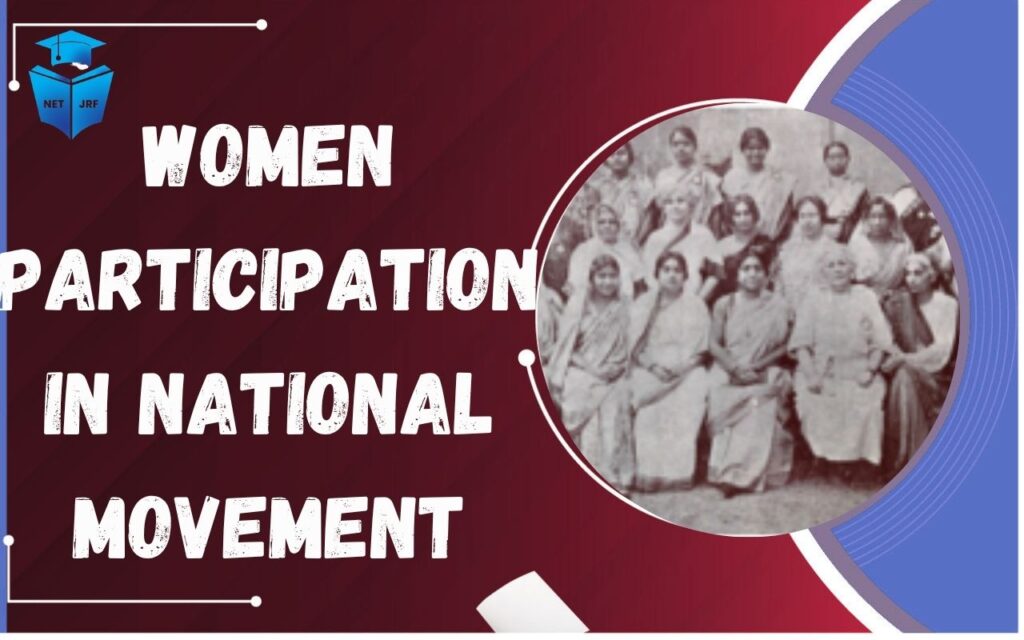
Women Participation in National Movement and Leadership in Indian Freedom Struggle

Women Participation in National Movement In this topic you learn how women leaders activists and revolutionaries shaped the freedom struggle through political leadership mass movements social reforms underground resistance and nationalist mobilization across India.

vishal

Women Participation in National Movement

Table of Contents

The Indian National Movement witnessed a massive transformation when women began to participate actively in the struggle for freedom. During the early stages, political activities mainly involved male leaders. Over time, women entered public life, joined protests, organized campaigns, and even participated in revolutionary actions. Their contribution gave new energy to the Indian National Movement.

Study Planner

Women came from different social backgrounds, including educated elites, middle class families, rural communities, and revolutionary groups. Their involvement expanded the social base of the Indian National Movement and helped transform the freedom struggle into a truly national movement.

Enroll UGC NET Foundation Batch Online

Early Social Reform and Women’s Awakening

Before women joined political protests, social reform movements prepared the ground for their participation. Reformers challenged harmful social practices and encouraged female education.

Important developments included:

  • Campaigns against child marriage
    Promotion of widow remarriage
  • Expansion of female education
  • Establishment of women’s organizations

These reforms created awareness among women and encouraged them to engage with national issues. As a result, women gradually became active participants in the Indian National Movement.

Indian National Movement Women Leaders 

Many women leaders played remarkable roles during the freedom struggle. Their leadership demonstrated courage, organizational ability, and political vision.

Sarojini Naidu

Sarojini Naidu became one of the most prominent female leaders of the Indian National Movement. She participated in several nationalist campaigns and supported Mahatma Gandhi’s movements. She also became the first Indian woman president of the Indian National Congress.

Her major contributions included:

  • Participation in Civil Disobedience Movement
  • Leadership during Salt Satyagraha protests
  • Promotion of women’s political participation

Annie Besant

Annie Besant contributed greatly to nationalist politics. She launched the Home Rule Movement which demanded self government for India. Her activism inspired many women to participate in the Indian National Movement.

Kasturba Gandhi

Kasturba Gandhi played an important role in Gandhian movements. She participated in protests, encouraged women’s mobilization, and supported campaigns for social reform.

Aruna Asaf Ali

Aruna Asaf Ali became famous during the Quit India Movement when she hoisted the national flag at the Gowalia Tank Maidan in 1942. Her action symbolized resistance against colonial rule.

App JRF Adda

Women Participation during Major Movements

Women played important roles in many mass movements organized during the Indian National Movement-. Their participation demonstrated that the struggle for independence involved the entire society.

Join UGC NET Mock Test Series

Non Cooperation Movement

During this movement, women supported boycott campaigns and promoted the use of indigenous goods. Many women encouraged families to reject foreign products.

Key activities included:

  • Promotion of khadi cloth
  • Participation in public meetings
  • Support for nationalist leaders

Civil Disobedience Movement

The Civil Disobedience Movement witnessed large scale participation of women. Many joined protests against British laws, especially the salt tax.

Important contributions:

  • Participation in Salt Satyagraha
  • Organization of marches and demonstrations
  • Leadership in local protests

These activities strengthened the Indian National Movement- by expanding grassroots participation.

Quit India Movement

The Quit India Movement in 1942 became one of the most intense phases of the freedom struggle. Women played important roles in underground networks, communication systems, and resistance activities.

Their participation demonstrated the revolutionary spirit within the Indian National Movement

Freedom Struggle Revolutionary Women 

Apart from nonviolent protests, several women joined revolutionary organizations. They participated in armed resistance and secret operations against colonial rule.

Some important revolutionary women include:

  • Kalpana Datta
  • Pritilata Waddedar
  • Durga Bhabhi
  • Bina Das

These women challenged gender stereotypes and demonstrated extraordinary bravery. Their actions strengthened the militant dimension of the Indian National Movement.

Women Organizations and Nationalist Mobilization

Women also formed organizations that promoted social reform and political awareness. These groups encouraged women to participate actively in nationalist activities.

Major organizations included:

  1. All India Women’s Conference
  2. Women’s India Association
  3. National Council of Women in India

These organizations supported female education, legal reforms, and political participation. They helped integrate women’s issues with the broader goals of the Indian National Movement.

Indian National Movement Women Leaders and Contributions

Enroll UGC NET Offline Classes in Jaipur

how different women contributed to the development of the Indian National Movement.

Leader Key Contribution Movement Role
Sarojini Naidu Led protests, promoted political rights Civil Disobedience
Annie Besant Home Rule Movement leader Early nationalist politics
Aruna Asaf Ali Flag hoisting during Quit India Underground resistance
Kasturba Gandhi Mobilized women in Gandhian campaigns Nonviolent movements
Kalpana Datta Revolutionary activism Armed resistance

Role of Women in Mass Mobilization

Women helped spread nationalist ideas across villages and towns. Their participation expanded the reach of political movements.

Major contributions include:

  • Organizing protests and marches
  • Distributing nationalist pamphlets
  • Encouraging boycott of foreign goods
  • Providing shelter to underground activists

Through these activities, women played a vital role in strengthening the Indian National Movement.

Impacts Women Participation

Women’s involvement produced several important outcomes during the freedom struggle.

1. Social Transformation

Women’s participation challenged traditional gender roles. It encouraged greater equality in Indian society.

2. Political Awareness

Women helped spread nationalist ideas among families and communities. This increased support for independence.

3. Expansion of the Movement

Women brought new energy and moral strength to the Indian National Movement-. Their involvement broadened its social base.

4. Inspiration for Future Generations

Female leaders became role models for young women across the country.

Social Change Through Nationalist Struggle

Women’s participation in the freedom struggle also produced long term social change. Their activism promoted political rights and education for women.

Key results included:

  • Increased female political awareness
  • Expansion of women’s organizations
  • Greater acceptance of women in leadership roles

These changes reshaped Indian society during the final phase of the Indian National Movement.

JRF Adda Book

Conclusion

The Indian National Movement became stronger and more inclusive because of women’s participation. Female leaders, activists, and revolutionaries contributed through protests, social reform campaigns, and underground resistance. Their involvement transformed the freedom struggle into a truly national effort. The courage and dedication of women created lasting social change and strengthened the Indian National Movement on the path toward independence.

Best UGC NET Offline Coaching in Jaipur

Read UGC NET Notes
1 Archaeological Sources for UGC NET Epigraphy – Study of Inscriptions Meaning of Historical Sources Archaeological
2 Meaning of Historical Sources Archaeological Sources for UGC NET Literary Sources in History Archaeological
3 Exploration in Archaeology Excavation Techniques in Archaeology Dating of Archaeological Sites Archaeological
4 Excavation Techniques in Archaeology Exploration in Archaeology Dating of Archaeological Sites Archaeological
5 Epigraphy – Study of Inscriptions Inscriptions in Reconstructing History Numismatics in History Archaeological
6 Inscriptions in Reconstructing History Epigraphy – Study of Inscriptions Archaeological Sources for UGC NET Archaeological
7 Numismatics in History Importance of Coins in History Epigraphy – Study of Inscriptions Archaeological
8 Importance of Coins in History Numismatics in History Archaeological Sources for UGC NET Archaeological
9 Dating of Archaeological Sites Excavation Techniques in Archaeology Dating Ancient Literary Sources Archaeological
10 Indigenous Literature Literary Sources in History Secular Literature as Historical Source Literary
11 Dating Ancient Literary Sources Literary Sources in History Dating of Archaeological Sites Literary
12 Literary Sources in History Indigenous Literature Foreign Accounts of India Literary
13 Foreign Accounts of India Greek Accounts on Ancient India Chinese Accounts on India Literary
14 Greek Accounts on Ancient India Foreign Accounts of India Chinese Accounts on India Literary
15 Secular Literature as Historical Source Literary Sources in History Indigenous Literature Literary
16 Role of Myths and Legends in Historical Reconstruction Literary Sources in History Secular Literature as Historical Source Literary
17 Chinese Accounts on India Foreign Accounts of India Greek Accounts on Ancient India Literary
18 Arabic Accounts on India Foreign Accounts of India Chinese Accounts on India Literary
19 Neolithic and Chalcolithic Phases Neolithic Revolution in India Chalcolithic Culture in India Neolithic
20 Hunting, Gathering & Food Production Neolithic Revolution in India Neolithic Settlements in India Neolithic
21 Neolithic Revolution in India Neolithic Settlements in India Tools and Technology in Neolithic Period Neolithic
22 Neolithic Settlements in India Distribution of Neolithic Cultures in India Neolithic Revolution in India Neolithic
23 Distribution of Neolithic Cultures in India Neolithic Settlements in India Tools and Technology in Neolithic Period Neolithic
24 Tools and Technology in Neolithic Period Neolithic Revolution in India Chalcolithic Culture in India Neolithic
25 Chalcolithic Culture in India Settlement Pattern & Economy in Chalcolithic Phase Trade & Exchange Networks in Chalcolithic Societies Neolithic
26 Settlement Pattern & Economy – Chalcolithic Phase Chalcolithic Culture in India Trade & Exchange Networks in Chalcolithic Societies Neolithic
27 Trade & Exchange Networks – Chalcolithic Societies Chalcolithic Culture in India IVC Internal & External Trade Neolithic
28 Indus Valley Civilization – UGC NET Major Sites of Indus Civilization Urban Planning in Harappan Civilization IVC
29 IVC Internal & External Trade Internal Trade – Harappan Civilization Craft Specialization in Harappan Civilization IVC
30 Political Organization – Harappan Civilization Social Structure – Indus Civilization Urban Planning in Harappan Civilization IVC
31 Major Sites of Indus Civilization Indus Valley Civilization – UGC NET Urban Planning in Harappan Civilization IVC
32 Urban Planning & Settlement – Harappan Civilization Architecture & Town Planning – Harappan Cities IVC as First Urbanization in India IVC
33 Architecture & Town Planning – Harappan Cities Urban Planning in Harappan Civilization Major Sites of Indus Civilization IVC
34 Craft Specialization & Industrial Activities – Harappan Agriculture & Food Economy – Harappans IVC Internal & External Trade IVC
35 Agriculture & Food Economy – Harappans Craft Specialization in Harappan Civilization Internal Trade – Harappan Civilization IVC
36 Internal Trade – Harappan Civilization IVC Internal & External Trade Craft Specialization in Harappan Civilization IVC
37 Religion & Beliefs – Indus Civilization Social Structure – Indus Civilization Indus Valley Civilization – UGC NET IVC
38 Social Structure – Indus Civilization Political Organization – Harappan Civilization Religion & Beliefs – Indus Civilization IVC
39 Decline of Indus Civilization Indus Valley Civilization – UGC NET IVC as First Urbanization in India IVC
40 IVC as First Urbanization in India Urban Planning in Harappan Civilization Second Urbanization in India IVC
41 Vedic & Later Vedic Periods – Aryan Varna System Early Vedic Society and Economy Later Vedic Society and Economy Vedic
42 Origin of Vedic Civilization Aryan Debate – Migration, Invasion & Indigenous Theories Early Vedic Society and Economy Vedic
43 Aryan Debate – Migration, Invasion & Indigenous Theories Origin of Vedic Civilization Early Vedic Society and Economy Vedic
44 Early Vedic Society and Economy Political Institutions – Early Vedic Period Social Structure – Early Vedic Period Vedic
45 Political Institutions – Early Vedic Period Early Vedic Society and Economy Monarchical States in Ancient India Vedic
46 Social Structure – Early Vedic Period Emergence of Varnas & Social Stratification Early Vedic Society and Economy Vedic
47 Later Vedic Society and Economy Emergence of Varnas & Social Stratification Impact of Iron Technology in India Vedic
48 Emergence of Varnas & Social Stratification Social Structure – Early Vedic Period Later Vedic Society and Economy Vedic
49 Emergence of Heterodox Sects in India Jainism, Buddhism & Ajivikas – Origins & Teachings Later Vedic Society and Economy Vedic
50 Impact of Iron Technology in India Later Vedic Society and Economy Agricultural Expansion & Economic Changes – Ancient India Vedic
51 Religious & Philosophical Vedic Ideas Emergence of Varnas & Social Stratification Emergence of Heterodox Sects in India Vedic
52 Megalithic Culture of South India Neolithic and Chalcolithic Phases Agricultural Expansion & Economic Changes General
53 State System in Ancient India Rise of Mahajanapadas Transition: Tribal Polities to Territorial States General
54 Transition: Tribal Polities to Territorial States Rise of Mahajanapadas Later Vedic Society and Economy General
55 Rise of Mahajanapadas Monarchical States in Ancient India Republican States (Gana-Sanghas) – Ancient India Magadha
56 Monarchical States in Ancient India Rise of Mahajanapadas Emergence of Magadha Magadha
57 Republican States (Gana-Sanghas) – Ancient India Rise of Mahajanapadas Monarchical States in Ancient India Magadha
58 Agricultural Expansion & Economic Changes – Ancient India Second Urbanization in India Impact of Iron Technology in India General
59 Second Urbanization in India IVC as First Urbanization in India Rise of Mahajanapadas General
60 Jainism, Buddhism & Ajivikas – Origins & Teachings Emergence of Heterodox Sects in India Ashoka’s Policy of Dhamma General
61 Emergence of Magadha Geographical Advantages of Magadha Early Rulers of Magadha Magadha
62 Geographical Advantages of Magadha Natural Resources & Economic Strength of Magadha Reasons for Success of Magadha Magadha
63 Natural Resources & Economic Strength of Magadha Geographical Advantages of Magadha Economic Policies of the Nandas Magadha
64 Early Rulers of Magadha Haryanka Dynasty – Rise of Magadha Emergence of Magadha Magadha
65 Haryanka Dynasty – Rise of Magadha Expansion Policy of Bimbisara Early Rulers of Magadha Magadha
66 Expansion Policy of Bimbisara Ajatashatru – Military Reforms Haryanka Dynasty – Rise of Magadha Magadha
67 Ajatashatru – Military Reforms Wars of Ajatashatru Expansion Policy of Bimbisara Magadha
68 Wars of Ajatashatru Ajatashatru – Military Reforms Udayin & Establishment of Pataliputra Magadha
69 Udayin & Establishment of Pataliputra Wars of Ajatashatru Shishunaga Dynasty Magadha
70 Shishunaga Dynasty Administrative Structure of the Shishunagas Nanda Dynasty Magadha
71 Administrative Structure of the Shishunagas Shishunaga Dynasty Central Administration Under Mauryas Magadha
72 Nanda Dynasty Mahapadma Nanda – Imperial Expansion Shishunaga Dynasty Magadha
73 Mahapadma Nanda – Imperial Expansion Military Strength of the Nandas Nanda Dynasty Magadha
74 Economic Policies of the Nandas Nanda Dynasty Taxation System – Mauryan State Magadha
75 Military Strength of the Nandas Mahapadma Nanda – Imperial Expansion Defeat of Nandas & Rise of Mauryan Empire Magadha
76 Reasons for Success of Magadha Geographical Advantages of Magadha Natural Resources & Economic Strength of Magadha Magadha
77 Mahajanapadas to Empire – Evolution & Rise of Magadha Rise of Mahajanapadas Emergence of Magadha Magadha
78 Mauryan Empire – Expansion Rise of Chandragupta Maurya Expansion of Mauryan Empire Maurya
79 Rise of Chandragupta Maurya Role of Chanakya in Rise of Mauryan Empire Defeat of Nandas & Rise of Mauryan Empire Maurya
80 Role of Chanakya in Rise of Mauryan Empire Rise of Chandragupta Maurya Defeat of Nandas & Rise of Mauryan Empire Maurya
81 Defeat of Nandas & Rise of Mauryan Empire Military Strength of the Nandas Rise of Chandragupta Maurya Maurya
82 Chandragupta Maurya – Seleucus Treaty & Diplomacy Expansion of Mauryan Empire Greek Accounts on Ancient India Maurya
83 Expansion of Mauryan Empire Chandragupta Maurya – Seleucus Treaty & Diplomacy Kalinga War Maurya
84 Administration of Chandragupta Maurya Central Administration Under Mauryas Mauryan Bureaucracy Maurya
85 Sources for Mauryan History Archaeological Sources for UGC NET Greek Accounts on Ancient India Maurya
86 Central Administration Under Mauryas Provincial Administration – Mauryan Empire Mauryan Bureaucracy Maurya
87 Provincial Administration – Mauryan Empire Local Administration – Mauryan Empire Central Administration Under Mauryas Maurya
88 Local Administration – Mauryan Empire Provincial Administration – Mauryan Empire Mauryan Bureaucracy Maurya
89 Mauryan Bureaucracy Central Administration Under Mauryas Espionage System – Mauryan Empire Maurya
90 Espionage System – Mauryan Empire Mauryan Bureaucracy Central Administration Under Mauryas Maurya
91 Ancient India – Trade and Commerce Trade and Commerce Under Mauryas Agrarian Economy – Mauryan Period Maurya
92 Agrarian Economy – Mauryan Period Taxation System – Mauryan State Trade and Commerce Under Mauryas Maurya
93 Trade and Commerce Under Mauryas Ancient India – Trade and Commerce Agrarian Economy – Mauryan Period Maurya
94 Taxation System – Mauryan State Agrarian Economy – Mauryan Period Economic Policies of the Nandas Maurya
95 Kalinga War Ashoka’s Policy of Dhamma Expansion of Mauryan Empire Maurya
96 Ashoka’s Policy of Dhamma Nature & Philosophy of Dhamma Kalinga War Maurya
97 Nature & Philosophy of Dhamma Ashoka’s Policy of Dhamma Jainism, Buddhism & Ajivikas Maurya

Indian National Movement: Women Participation in National Movement FAQs

Loader image

Important women leaders included Sarojini Naidu, Annie Besant, Aruna Asaf Ali, Kasturba Gandhi. These leaders mobilized women, led protests, and strengthened nationalist campaigns.

During the Civil Disobedience Movement, women joined the Salt Satyagraha, organized demonstrations, promoted boycott of foreign goods, encouraged families to support nationalist movements.

Revolutionary women such as Kalpana Datta, Pritilata Waddedar, Durga Bhabhi, Bina Das participated in militant resistance against British colonial rule.

Organizations like All India Women’s Conference, Women’s India Association, National Council of Women in India encouraged women’s education, social reform, political awareness during the nationalist movement.

Leave a Reply

Recent Posts
Aditi

Aditi Sharma, founder of JRFAdda, is a Computer Science educator with an MCA degree and JRF qualification (99.91 percentile, Dec 2019). Her experience includes roles as an SBI SO (DBA), work at Cognizant, and over 5 years of teaching online and offline. She has also served as a Government Computer Teacher in Rajasthan.