

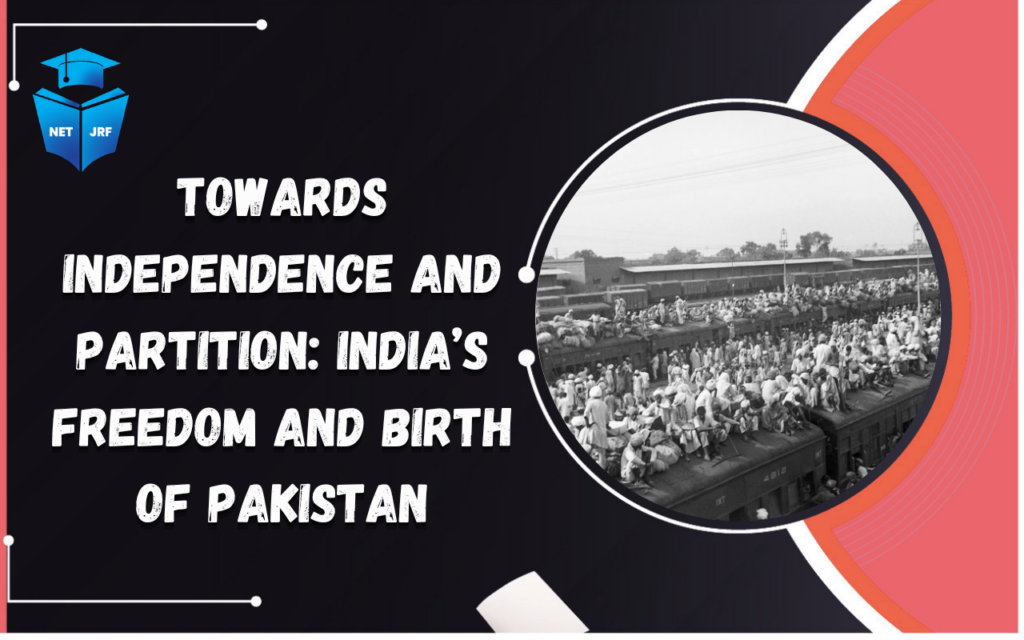
Towards Independence and Partition: India’s Freedom and Birth of Pakistan

Towards Independence and Partition In this topic you learn how nationalist movements, political negotiations, the Muslim League, Lahore Resolution, Cabinet Mission Plan, Mountbatten Plan and Partition led to the independence of India and creation of Pakistan in 1947.

gunjan

Towards Independence and Partition India’s Freedom and Birth of Pakistan

Table of Contents

Towards Independence and Partition marks one of the most decisive phases in modern South Asian history. During the final years of British colonial rule, political negotiations, nationalist movements, communal tensions, and constitutional reforms reshaped the political future of the Indian subcontinent. These developments ultimately led to the independence of India and the creation of Pakistan in 1947.

Enroll UGC NET Online Coaching

The period described as Towards Independence and Partition represents the culmination of decades of nationalist struggle combined with complex political negotiations among British authorities, Indian nationalists, and communal organizations. 

Study Planner

Background of Indian Freedom Struggle

The roots of independence developed during the nineteenth and early twentieth centuries. Nationalist leaders challenged British colonial rule and demanded political rights for Indians.

Important developments included:

  • Formation of the Indian National Congress in 1885
  • Rise of mass nationalist movements
  • Spread of modern political awareness
  • Growth of anti colonial resistance

These movements gradually intensified the demand for complete independence. As nationalist politics evolved, the stage of Towards Independence and Partition began to emerge during the final decade of colonial rule.

Rise of Communal Politics

Communal politics played a significant role in shaping the political landscape before independence. Political organizations increasingly represented religious communities rather than a unified national identity.

Key developments included:

  • Formation of the All India Muslim League in 1906
  • Separate electorates introduced by the British
  • Political debates over minority representation

These developments deepened communal divisions within Indian politics. Historians argue that communal tensions became one of the major factors influencing the phase of Towards Independence and Partition.

Towards Independence and Partition: Political Developments

During the 1930s and 1940s, several constitutional reforms attempted to address political demands in India.

Government of India Act 1935

The Government of India Act introduced provincial autonomy and expanded legislative representation. Indian political parties formed ministries in several provinces.

Key features included:

  • Provincial self governance
  • Expanded electorate
  • Legislative assemblies in provinces

Although the act provided limited autonomy, nationalist leaders demanded full independence. These demands intensified the political climate that eventually led Towards Independence and Partition.

Role of Major Political Organizations

Different political organizations influenced the political direction of the subcontinent during the final stage of British rule.

  • Indian National Congress

      • The Congress represented the primary nationalist movement seeking complete independence from colonial rule. Leaders organized mass movements, negotiations, and political campaigns.
  • Muslim League

    • The Muslim League gradually emerged as a major political force representing Muslim political interests. Under the leadership of Muhammad Ali Jinnah, the organization demanded the creation of a separate state.
    • The interaction between these political organizations significantly shaped the developments of Towards Independence and Partition.

Enroll UGC NET Online Course

Lahore Resolution and the Demand for Pakistan

In 1940, the Muslim League adopted the Lahore Resolution. This resolution proposed the creation of separate states for Muslims in regions where they formed a majority.

The resolution marked a turning point in the history of Towards Independence and Partition.

Important aspects of the resolution included:

  • Demand for autonomous Muslim majority regions
  • Emphasis on political safeguards
  • Recognition of religious identity in politics

The Lahore Resolution strengthened the political movement that later resulted in the creation of Pakistan.

Second World War Impact 

The Second World War significantly influenced the political situation in India. British authorities involved India in the war without consulting Indian leaders, which created political tension.

Important developments included:

  • Quit India Movement launched in 1942
  • Growing pressure on the British government
  • Rising nationalist sentiments

These developments accelerated negotiations and political discussions related to Towards Independence and Partition.

App JRF Adda

Cabinet Mission Plan

In 1946, the British government sent the Cabinet Mission to India to propose a constitutional framework for independence.

Major proposals included:

  • Creation of a federal union
  • Grouping of provinces into sections
  • Autonomy for provinces

Although the plan attempted to maintain a united India, disagreements between political parties prevented its success. The failure of this plan moved the political situation further Towards Independence and Partition.

Enroll UGC NET Coaching in Jaipur

Towards Independence and Partition Major Events Timeline

the key events that shaped the historical process of Towards Independence and Partition.

Year Event Historical Significance
1935 Government of India Act Provincial autonomy introduced
1940 Lahore Resolution Demand for separate Muslim state
1942 Quit India Movement Mass resistance against colonial rule
1946 Cabinet Mission Plan Attempt to maintain united India
1947 Independence and Partition Creation of India and Pakistan

Mountbatten Plan

In 1947, the British government decided to end colonial rule in India and transfer power to Indian leaders. To manage this transition, Lord Louis Mountbatten was appointed as the final Viceroy. He proposed a political plan to solve the growing conflict between the Indian National Congress and the All India Muslim League over the future of the country.

The proposal, known as the Mountbatten Plan, suggested dividing British India into two separate independent states. The plan aimed to resolve communal tensions and political disagreements that had intensified in the final years of British rule.

Important Features of the Mountbatten Plan

  • Partition of British India: The subcontinent would be divided into two sovereign countries.
  • Creation of India and Pakistan: Separate nations would be formed to represent different political aspirations.
  • Transfer of Power in August 1947: The British government agreed to transfer authority to the new governments by mid-August 1947.

The Mountbatten Plan therefore provided the final political framework for ending British rule and completing the long process of India’s struggle for independence.

Partition of India

The implementation of the Mountbatten Plan led to the Partition of India. In August 1947, British India was divided into two independent countries: India and Pakistan.

At the time of independence, Pakistan consisted of two geographically separate regions: West Pakistan (present-day Pakistan) and East Pakistan, which later became Bangladesh.

Important Consequences of Partition

  1. Large-Scale Migration
    Millions of people moved across the new borders to join the country where their religious community was in the majority. This migration was one of the largest population movements in modern history.
  2. Communal Violence
    The partition triggered severe communal riots in many regions, particularly in Punjab and Bengal. Thousands of people lost their lives, and many families were displaced.
  3. Social and Economic Disruption
    Communities were divided, properties were abandoned, and economic systems were disrupted. Refugees had to rebuild their lives in unfamiliar regions, creating long-term social and economic challenges.

Social and Political Impact

The events of 1947 had lasting consequences for South Asian society and politics.

Major impacts included:

1. Mass Migration

Millions of people moved across newly created borders to join communities of the same religion.

2. Communal Violence

Violence erupted in several regions as communities struggled during the transition.

3. Creation of New Nations

Two independent states emerged from British India, each with its own political system and constitution.

These consequences demonstrate the complex legacy of Towards Independence and Partition.

Enroll UGC NET Offline Coaching in Jaipur

Legacy in Modern South Asia

The events of 1947 continue to influence politics, society, and international relations in South Asia.

Important long term consequences include:

  • Political relations between India and Pakistan
  • Continued debates about communal identity
  • Historical memory of migration and displacement

The historical process of Towards Independence and Partition therefore remains an important subject for historians and political scholars.

JRF Adda Book

Conclusion

The period described as Towards Independence and Partition represents the final stage of India’s long struggle against colonial rule. Political negotiations, communal tensions, nationalist movements, and constitutional reforms shaped the path toward independence. The creation of India and Pakistan in 1947 transformed the political landscape of South Asia.

Read UGC NET Notes
1 Archaeological Sources for UGC NET Epigraphy – Study of Inscriptions Meaning of Historical Sources Archaeological
2 Meaning of Historical Sources Archaeological Sources for UGC NET Literary Sources in History Archaeological
3 Exploration in Archaeology Excavation Techniques in Archaeology Dating of Archaeological Sites Archaeological
4 Excavation Techniques in Archaeology Exploration in Archaeology Dating of Archaeological Sites Archaeological
5 Epigraphy – Study of Inscriptions Inscriptions in Reconstructing History Numismatics in History Archaeological
6 Inscriptions in Reconstructing History Epigraphy – Study of Inscriptions Archaeological Sources for UGC NET Archaeological
7 Numismatics in History Importance of Coins in History Epigraphy – Study of Inscriptions Archaeological
8 Importance of Coins in History Numismatics in History Archaeological Sources for UGC NET Archaeological
9 Dating of Archaeological Sites Excavation Techniques in Archaeology Dating Ancient Literary Sources Archaeological
10 Indigenous Literature Literary Sources in History Secular Literature as Historical Source Literary
11 Dating Ancient Literary Sources Literary Sources in History Dating of Archaeological Sites Literary
12 Literary Sources in History Indigenous Literature Foreign Accounts of India Literary
13 Foreign Accounts of India Greek Accounts on Ancient India Chinese Accounts on India Literary
14 Greek Accounts on Ancient India Foreign Accounts of India Chinese Accounts on India Literary
15 Secular Literature as Historical Source Literary Sources in History Indigenous Literature Literary
16 Role of Myths and Legends in Historical Reconstruction Literary Sources in History Secular Literature as Historical Source Literary
17 Chinese Accounts on India Foreign Accounts of India Greek Accounts on Ancient India Literary
18 Arabic Accounts on India Foreign Accounts of India Chinese Accounts on India Literary
19 Neolithic and Chalcolithic Phases Neolithic Revolution in India Chalcolithic Culture in India Neolithic
20 Hunting, Gathering & Food Production Neolithic Revolution in India Neolithic Settlements in India Neolithic
21 Neolithic Revolution in India Neolithic Settlements in India Tools and Technology in Neolithic Period Neolithic
22 Neolithic Settlements in India Distribution of Neolithic Cultures in India Neolithic Revolution in India Neolithic
23 Distribution of Neolithic Cultures in India Neolithic Settlements in India Tools and Technology in Neolithic Period Neolithic
24 Tools and Technology in Neolithic Period Neolithic Revolution in India Chalcolithic Culture in India Neolithic
25 Chalcolithic Culture in India Settlement Pattern & Economy in Chalcolithic Phase Trade & Exchange Networks in Chalcolithic Societies Neolithic
26 Settlement Pattern & Economy – Chalcolithic Phase Chalcolithic Culture in India Trade & Exchange Networks in Chalcolithic Societies Neolithic
27 Trade & Exchange Networks – Chalcolithic Societies Chalcolithic Culture in India IVC Internal & External Trade Neolithic
28 Indus Valley Civilization – UGC NET Major Sites of Indus Civilization Urban Planning in Harappan Civilization IVC
29 IVC Internal & External Trade Internal Trade – Harappan Civilization Craft Specialization in Harappan Civilization IVC
30 Political Organization – Harappan Civilization Social Structure – Indus Civilization Urban Planning in Harappan Civilization IVC
31 Major Sites of Indus Civilization Indus Valley Civilization – UGC NET Urban Planning in Harappan Civilization IVC
32 Urban Planning & Settlement – Harappan Civilization Architecture & Town Planning – Harappan Cities IVC as First Urbanization in India IVC
33 Architecture & Town Planning – Harappan Cities Urban Planning in Harappan Civilization Major Sites of Indus Civilization IVC
34 Craft Specialization & Industrial Activities – Harappan Agriculture & Food Economy – Harappans IVC Internal & External Trade IVC
35 Agriculture & Food Economy – Harappans Craft Specialization in Harappan Civilization Internal Trade – Harappan Civilization IVC
36 Internal Trade – Harappan Civilization IVC Internal & External Trade Craft Specialization in Harappan Civilization IVC
37 Religion & Beliefs – Indus Civilization Social Structure – Indus Civilization Indus Valley Civilization – UGC NET IVC
38 Social Structure – Indus Civilization Political Organization – Harappan Civilization Religion & Beliefs – Indus Civilization IVC
39 Decline of Indus Civilization Indus Valley Civilization – UGC NET IVC as First Urbanization in India IVC
40 IVC as First Urbanization in India Urban Planning in Harappan Civilization Second Urbanization in India IVC
41 Vedic & Later Vedic Periods – Aryan Varna System Early Vedic Society and Economy Later Vedic Society and Economy Vedic
42 Origin of Vedic Civilization Aryan Debate – Migration, Invasion & Indigenous Theories Early Vedic Society and Economy Vedic
43 Aryan Debate – Migration, Invasion & Indigenous Theories Origin of Vedic Civilization Early Vedic Society and Economy Vedic
44 Early Vedic Society and Economy Political Institutions – Early Vedic Period Social Structure – Early Vedic Period Vedic
45 Political Institutions – Early Vedic Period Early Vedic Society and Economy Monarchical States in Ancient India Vedic
46 Social Structure – Early Vedic Period Emergence of Varnas & Social Stratification Early Vedic Society and Economy Vedic
47 Later Vedic Society and Economy Emergence of Varnas & Social Stratification Impact of Iron Technology in India Vedic
48 Emergence of Varnas & Social Stratification Social Structure – Early Vedic Period Later Vedic Society and Economy Vedic
49 Emergence of Heterodox Sects in India Jainism, Buddhism & Ajivikas – Origins & Teachings Later Vedic Society and Economy Vedic
50 Impact of Iron Technology in India Later Vedic Society and Economy Agricultural Expansion & Economic Changes – Ancient India Vedic
51 Religious & Philosophical Vedic Ideas Emergence of Varnas & Social Stratification Emergence of Heterodox Sects in India Vedic
52 Megalithic Culture of South India Neolithic and Chalcolithic Phases Agricultural Expansion & Economic Changes General
53 State System in Ancient India Rise of Mahajanapadas Transition: Tribal Polities to Territorial States General
54 Transition: Tribal Polities to Territorial States Rise of Mahajanapadas Later Vedic Society and Economy General
55 Rise of Mahajanapadas Monarchical States in Ancient India Republican States (Gana-Sanghas) – Ancient India Magadha
56 Monarchical States in Ancient India Rise of Mahajanapadas Emergence of Magadha Magadha
57 Republican States (Gana-Sanghas) – Ancient India Rise of Mahajanapadas Monarchical States in Ancient India Magadha
58 Agricultural Expansion & Economic Changes – Ancient India Second Urbanization in India Impact of Iron Technology in India General
59 Second Urbanization in India IVC as First Urbanization in India Rise of Mahajanapadas General
60 Jainism, Buddhism & Ajivikas – Origins & Teachings Emergence of Heterodox Sects in India Ashoka’s Policy of Dhamma General
61 Emergence of Magadha Geographical Advantages of Magadha Early Rulers of Magadha Magadha
62 Geographical Advantages of Magadha Natural Resources & Economic Strength of Magadha Reasons for Success of Magadha Magadha
63 Natural Resources & Economic Strength of Magadha Geographical Advantages of Magadha Economic Policies of the Nandas Magadha
64 Early Rulers of Magadha Haryanka Dynasty – Rise of Magadha Emergence of Magadha Magadha
65 Haryanka Dynasty – Rise of Magadha Expansion Policy of Bimbisara Early Rulers of Magadha Magadha
66 Expansion Policy of Bimbisara Ajatashatru – Military Reforms Haryanka Dynasty – Rise of Magadha Magadha
67 Ajatashatru – Military Reforms Wars of Ajatashatru Expansion Policy of Bimbisara Magadha
68 Wars of Ajatashatru Ajatashatru – Military Reforms Udayin & Establishment of Pataliputra Magadha
69 Udayin & Establishment of Pataliputra Wars of Ajatashatru Shishunaga Dynasty Magadha
70 Shishunaga Dynasty Administrative Structure of the Shishunagas Nanda Dynasty Magadha
71 Administrative Structure of the Shishunagas Shishunaga Dynasty Central Administration Under Mauryas Magadha
72 Nanda Dynasty Mahapadma Nanda – Imperial Expansion Shishunaga Dynasty Magadha
73 Mahapadma Nanda – Imperial Expansion Military Strength of the Nandas Nanda Dynasty Magadha
74 Economic Policies of the Nandas Nanda Dynasty Taxation System – Mauryan State Magadha
75 Military Strength of the Nandas Mahapadma Nanda – Imperial Expansion Defeat of Nandas & Rise of Mauryan Empire Magadha
76 Reasons for Success of Magadha Geographical Advantages of Magadha Natural Resources & Economic Strength of Magadha Magadha
77 Mahajanapadas to Empire – Evolution & Rise of Magadha Rise of Mahajanapadas Emergence of Magadha Magadha
78 Mauryan Empire – Expansion Rise of Chandragupta Maurya Expansion of Mauryan Empire Maurya
79 Rise of Chandragupta Maurya Role of Chanakya in Rise of Mauryan Empire Defeat of Nandas & Rise of Mauryan Empire Maurya
80 Role of Chanakya in Rise of Mauryan Empire Rise of Chandragupta Maurya Defeat of Nandas & Rise of Mauryan Empire Maurya
81 Defeat of Nandas & Rise of Mauryan Empire Military Strength of the Nandas Rise of Chandragupta Maurya Maurya
82 Chandragupta Maurya – Seleucus Treaty & Diplomacy Expansion of Mauryan Empire Greek Accounts on Ancient India Maurya
83 Expansion of Mauryan Empire Chandragupta Maurya – Seleucus Treaty & Diplomacy Kalinga War Maurya
84 Administration of Chandragupta Maurya Central Administration Under Mauryas Mauryan Bureaucracy Maurya
85 Sources for Mauryan History Archaeological Sources for UGC NET Greek Accounts on Ancient India Maurya
86 Central Administration Under Mauryas Provincial Administration – Mauryan Empire Mauryan Bureaucracy Maurya
87 Provincial Administration – Mauryan Empire Local Administration – Mauryan Empire Central Administration Under Mauryas Maurya
88 Local Administration – Mauryan Empire Provincial Administration – Mauryan Empire Mauryan Bureaucracy Maurya
89 Mauryan Bureaucracy Central Administration Under Mauryas Espionage System – Mauryan Empire Maurya
90 Espionage System – Mauryan Empire Mauryan Bureaucracy Central Administration Under Mauryas Maurya
91 Ancient India – Trade and Commerce Trade and Commerce Under Mauryas Agrarian Economy – Mauryan Period Maurya
92 Agrarian Economy – Mauryan Period Taxation System – Mauryan State Trade and Commerce Under Mauryas Maurya
93 Trade and Commerce Under Mauryas Ancient India – Trade and Commerce Agrarian Economy – Mauryan Period Maurya
94 Taxation System – Mauryan State Agrarian Economy – Mauryan Period Economic Policies of the Nandas Maurya
95 Kalinga War Ashoka’s Policy of Dhamma Expansion of Mauryan Empire Maurya
96 Ashoka’s Policy of Dhamma Nature & Philosophy of Dhamma Kalinga War Maurya
97 Nature & Philosophy of Dhamma Ashoka’s Policy of Dhamma Jainism, Buddhism & Ajivikas Maurya

Towards Independence and Partition FAQs

Loader image

The Indian National Congress led mass nationalist movements, negotiated with British authorities, demanded complete independence from colonial rule.

The All India Muslim League argued that Muslims formed a distinct political community requiring a separate homeland to protect political rights.

The Lahore Resolution of 1940 demanded autonomous Muslim majority states which later became the foundation for the creation of Pakistan.

The Quit India Movement of 1942 intensified pressure on the British government by demonstrating mass resistance against colonial rule.

The Cabinet Mission Plan of 1946 proposed a federal structure to keep India united while granting autonomy to provinces.


Leave a Reply

Recent Posts
Aditi

Aditi Sharma, founder of JRFAdda, is a Computer Science educator with an MCA degree and JRF qualification (99.91 percentile, Dec 2019). Her experience includes roles as an SBI SO (DBA), work at Cognizant, and over 5 years of teaching online and offline. She has also served as a Government Computer Teacher in Rajasthan.