

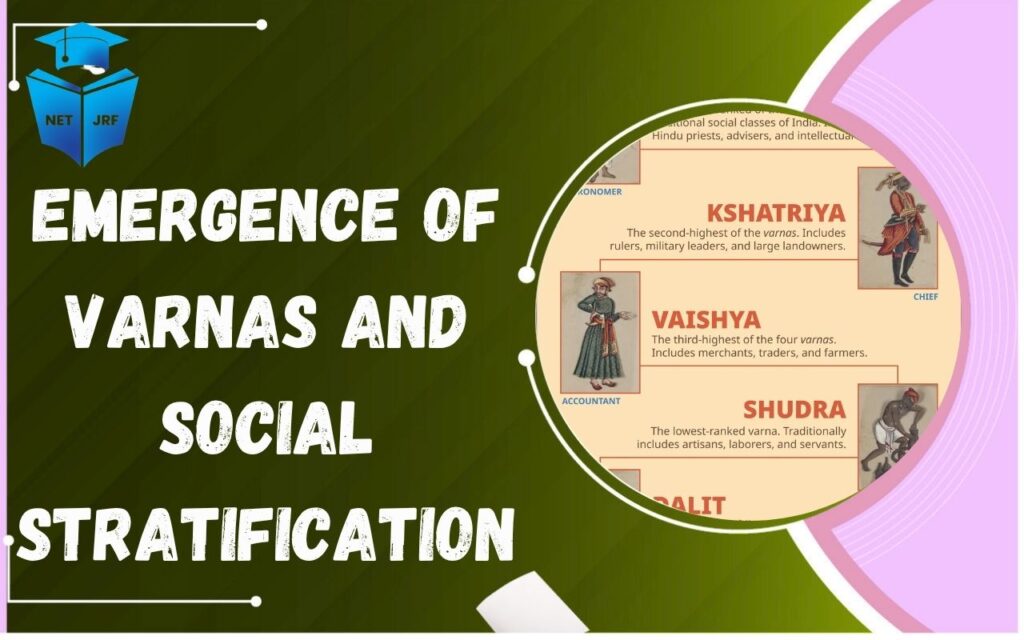

Emergence of Varnas and Social Stratification began during the Vedic period (c. 1500–600 BCE) when ancient Indian society started organising people into broad social groups that later shaped the rigid caste structures known in later history. In this article, we explain why and how the Emergence of Varnas and Social Stratification occurred, how it differed between Early Vedic and Later Vedic periods, what roles each varna performed, how stratification shaped society, and its long-term impacts on Indian social history.

Vedic Social Framework
The Vedic Period and Society
The Vedic period refers to the ancient era in India when sacred texts called Vedas were composed. Society was initially based on clans and tribal units with pastoral and agricultural livelihoods. With time, this broad Vedic culture developed deeper social organization.
The need for order, cooperation, and defined roles led to social classifications that eventually became formal structures known as varnas.
Meaning of Varna and Social Stratification
- Varna literally means class or type, first mentioned in Vedic literature.
- Social stratification refers to the development of layered structures where some groups have higher status, privileges, and authority than others.
The Emergence of Varnas and Social Stratification represents the shift from simple social divisions to more layered hierarchical ordering in ancient Indian society.
Early Vedic Period Flexible Social Division
Occupational Basis of Varna
In the Early Vedic period (c. 1500–1000 BCE), varnas were linked primarily to occupation and qualities rather than fixed birth.
- Brahmins performed rituals, studied sacred hymns, and taught knowledge.
- Kshatriyas protected the community and led in war and governance.
- Vaishyas engaged in agriculture, trade, and cattle rearing.
- Shudras worked as service providers and supported the others in daily tasks.
This occupational stratification allowed social mobility, and a person could theoretically change their role based on skills and contribution.
Tribal and Egalitarian Tendencies
Early Vedic society was still largely tribal with shared responsibilities. While distinctions existed, they did not strictly bind people to one status for life.
Later Vedic Period Rigid Stratification
Birth‑Based Hierarchy
By the Later Vedic period (c. 1000–600 BCE), varnas became more rigid and hereditary. A person’s varna was often determined by birth, reducing social mobility.
The society became more hierarchical as Brahmins and Kshatriyas gained greater influence, and Shudras moved to lower social positions.
Stratification grew deeper with the emergence of jati sub‑groups within varnas, forming complex caste identities.
Sources of Varna Ideas
Purusha Sukta Hymn
The Purusha Sukta in the Rig Veda describes a cosmic being whose body parts symbolically become the four varnas. This mythic idea was used to justify social divisions: mouth for Brahmins, arms for Kshatriyas, thighs for Vaishyas, and feet for Shudras.
While this hymn may have been a later addition, it played a key role in shaping traditional views about social order.
Roles and Functions of the Four Varnas
Brahmins
- Served as priests and scholars who preserved sacred knowledge.
- Conducted rituals and advised rulers.
- Held ritual and intellectual authority in society.
Kshatriyas
- Acted as warriors and rulers maintaining political order.
- Protected society from internal and external threats.
- Ruled and administered local communities.
Vaishyas
- Engaged in agriculture, trade, and commerce.
- Provided economic stability through business activity and farming.
Shudras
- Performed services for the other three groups.
- Represented the working class within the system.
Join UGC NET Offline Classes in Jaipur
How Social Stratification Grew
Factors Contributing to Stratification
- Economic Change: As settled agriculture replaced pastoral life, roles became specialized and fixed.
- Religious Authority: Increased importance of rituals and priests strengthened Brahmin status.
- Population Growth: Larger communities needed order and hierarchy to manage social life.
Over time, varna roles shifted from flexible assignments to predefined birth based occupations and special privileges.

Impact on Society
Hierarchy and Inequality
Social stratification helped distribute tasks and responsibilities, but also created inequalities:
- High status and ritual privileges for Brahmins.
- Kshatriyas controlled political power.
- Vaishyas held economic roles.
- Shudras had limited access to rituals and social mobility.
This structured hierarchy later solidified into more complex caste identities known as jatis.
Emergence of Varnas and Social Stratification
Comparison of Varna Characteristics
| Aspect | Early Vedic Period | Later Vedic Period |
| Basis of Stratification | Function and occupation | Birth and hereditary |
| Social Mobility | Possible | Restricted |
| Role of Women | Participated in rituals and public life | Status declined |
| Ritual Authority | Emerging | Strong influence of Brahmins |
| Social Complexity | Simple | More complex caste identity |

Varnas and Stratification
The idea of varnas influenced later Indian social systems, eventually giving rise to complex caste practices that shaped history, politics, and culture over centuries.
The Emergence of Varnas and Social Stratification marks a key transformation in ancient Indian society. From occupational roles in the Early Vedic period to birth‑based hierarchy in later times, this process helped shape social institutions, cultural practices, and community identities that endured for centuries.
Join UGC NET Offline Coaching in Jaipur
Emergence of Varnas and Social Stratification FAQs

How did the varna system change from early to later Vedic times?
It changed from flexible occupation based roles to rigid birth based hierarchy with limited social mobility.
What was the basis for social stratification in Early Vedic society?
In Early Vedic society, social classification was linked to occupation and contribution, not fixed birth.
Why did stratification become stronger in Later Vedic period?
Population growth, agriculture, and religious authority consolidated social divisions over time.
Did women have roles in early Vedic society?
Women participated in learning and rituals and enjoyed relatively higher status than in later periods.
How did varna stratification affect rituals?
Higher varnas controlled ritual knowledge and access to sacred education as society stratified.
What is the difference between varna and caste?
Varna refers to broad categories in ancient texts, while caste (jati) became a more detailed birth based system.
When did social stratification deepen in India?
It deepened during the Later Vedic period as varna roles became hereditary and rigid.