
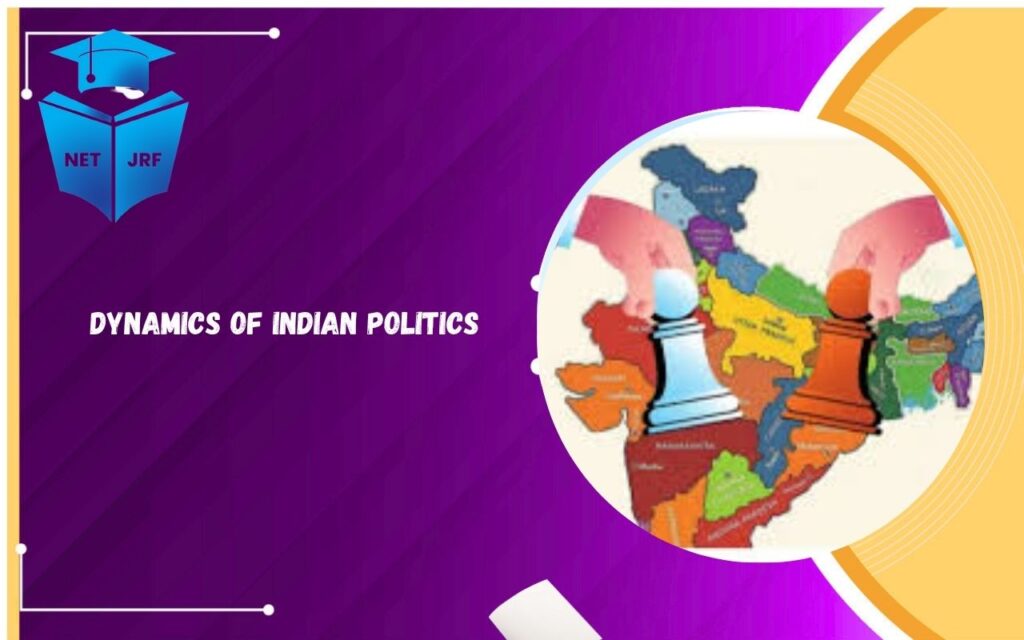
Dynamics of Indian Politics: Check Structure, Political Parties, Elections, and Governance

Dynamics of Indian Politics in this topic you learn how India’s political system functions through federalism political parties elections coalition governments governance institutions policy making social influences media and citizen participation in a democratic framework.

pawan

Dynamics of Indian Politics

Table of Contents

The Dynamics of Indian Politics covers how politics evolves with time, how different institutions and parties influence governance and how citizens shape and respond to political decisions. Indian politics is vibrant and complex due to its diversity, federal system, multiple parties, and coalition governments. 

Study Planner

Political Structure of India

The Constitution and Political Framework

India is a federal republic where powers are divided between the central government and state governments. Each level has its own responsibilities under the Constitution.

  • The President is the ceremonial head of state.
  • The Prime Minister and Council of Ministers run the central government.
  • State governments are led by Chief Ministers and councils.
  • Local bodies like municipalities and panchayats handle grassroots governance.

This multi‑tier system assures that governance responds to national and local needs.

Enroll UGC NET Mock Test Series

Federalism

India’s federal structure gives states power to make decisions in many areas while the central government handles national issues. This balance means states have autonomy on issues like education and health, while national policies cover defence and foreign affairs. The relationship between the centre and states is key in the Dynamics of Indian Politics.

Election Commission Role 

The Election Commission of India is an independent body that conducts free and fair elections at national, state and local levels. It sets rules for political campaigns, voter registration and election conduct. The body ensures democratic choice and competition among parties.

Party System in Indian Politics

Political parties are organized groups that compete in elections, offer policies to voters and form governments. They link citizens to the state and shape public debate. Parties recruit leaders, mobilize public support and formulate policy alternatives.

National and State Parties

India has a multi‑party system with parties of national and state importance.

Numbered List of Party Types:

  1. National Parties: Recognized in multiple states like BJP, Indian National Congress, BSP, CPI(M) and others.
  2. State Parties: Recognized within one state, like DMK in Tamil Nadu or Shiv Sena in Maharashtra.
  3. Unrecognised Parties: Registered with the Election Commission but without reserved symbols.

Political parties in India represent various social interests, regions, and ideologies reflecting the country’s diversity.

Major Political Parties

  • Bharatiya Janata Party (BJP): A right‑leaning party based on nationalism and economic development; it follows a hierarchical organizational structure with national leadership and local committees.
  • Indian National Congress (INC): One of the oldest parties with a centrist view and secular policies; it played a dominant role in early Indian politics and continues to be influential.
  • Regional parties: Parties like DMK, AITC, and others represent local aspirations and have strong influence in their states.

Functions of Political Parties

  • Run in elections and seek to win legislative seats.
  • Form governments and make public policies.
  • Recruit leaders and provide political leadership.
  • Connect citizens with state policies and governance processes.

Enroll UGC NET Foundation Course

Electoral Politics and Campaigns

Elections are the backbone of Indian democracy. Political parties campaign across states to win support. They use manifestos to explain policy plans on jobs, welfare, education and security. Elections involve direct voting by citizens for representatives in the Lok Sabha (lower house) and state assemblies.

App JRF Adda

Coalition Politics

As India’s party system expanded, no single party often won clear majorities. This led to coalition governments where multiple parties work together to form the executive. 

  • Alliances like the National Democratic Alliance (NDA) led by BJP and the Indian National Developmental Inclusive Alliance (INDIA) led by Congress show how coalition politics influence governance.
  • Coalitions require negotiation among diverse parties, which can affect policy outcomes and stability. Cooperation between central and regional parties has shaped governance since the 1990s.

Social Cleavages in Politics

India’s society is diverse with differences in caste, religion, language and region. 

These social cleavages influence political behaviour and party strategies. 

  • Caste and religious identities often affect voting patterns and party alliances.
  • Political parties mobilize voters based on these cleavages, leading to identity politics being a major feature of Indian elections. Understanding these dynamics is essential in the Dynamics of Indian Politics.

Governance and Policy Making

The Prime Minister leads the central government and advises the President. Ministers manage specific ministries like finance, health and education. Policies are made in the parliament and implemented by ministries.

  • Legislative Function

      • The Parliament debates laws proposed by the government. Members of Parliament (MPs) discuss and vote on bills affecting citizens. Law‑making shapes national priorities.
  • Judicial Oversight

    • The judiciary interprets the Constitution and reviews laws to protect rights. It acts as a check on the legislature and executive, ensuring rule of law.

Enroll UGC NET Offline Classes in Jaipur

Challenges in Indian Politics

Indian democracy faces several challenges that impact the Dynamics of Indian Politics:

  • Dynastic Politics: Leadership often stays within political families, reducing internal party democracy.
  • Fragmentation: Many small parties complicate governance and decision‑making.
  • Caste and Religious Mobilization: Identity politics can divide voters and affect national unity.
  • Coalition Instability: Alliances may shift, affecting government stability and long‑term planning.

Key Features of Indian Political System

Feature Explanation
Federal Structure Power split between central and state governments
Multi‑Party System Many political parties with national and regional roles
Election Commission Independent body conducts elections
Coalition Politics Parties form alliances to govern
Social Diversity Influence Caste, religion shape political strategies

Citizen Participation and Civil Society

Democracy thrives when citizens take part in politics. Civil society groups, youth organizations and student wings of parties influence public debate. Voter turnout and activism reflect how engaged citizens are in shaping policies and accountability.

Media and Politics

Mass media and social media shape public opinion, campaign messaging and political narratives. News outlets, debates, and campaign coverage affect how voters perceive parties and leaders.

Join UGC NET Coaching in Jaipur

Future of Indian Politics

The Dynamics of Indian Politics will continue evolving with changing demographics, economic priorities, youth participation, digital campaigning and shifting alliances. Emerging issues like employment, urbanisation, climate change and governance transparency will shape political debates in the coming decades.

JRF Adda Book

Conclusion

In summary the Dynamics of Indian Politics reflects the ongoing interaction between society, parties, institutions and governance mechanisms. It shows how diverse voices compete for influence, how governments form, how policies are made, and how citizens shape the democratic process.

Read UGC NET Notes
1 Archaeological Sources for UGC NET Epigraphy – Study of Inscriptions Meaning of Historical Sources Archaeological
2 Meaning of Historical Sources Archaeological Sources for UGC NET Literary Sources in History Archaeological
3 Exploration in Archaeology Excavation Techniques in Archaeology Dating of Archaeological Sites Archaeological
4 Excavation Techniques in Archaeology Exploration in Archaeology Dating of Archaeological Sites Archaeological
5 Epigraphy – Study of Inscriptions Inscriptions in Reconstructing History Numismatics in History Archaeological
6 Inscriptions in Reconstructing History Epigraphy – Study of Inscriptions Archaeological Sources for UGC NET Archaeological
7 Numismatics in History Importance of Coins in History Epigraphy – Study of Inscriptions Archaeological
8 Importance of Coins in History Numismatics in History Archaeological Sources for UGC NET Archaeological
9 Dating of Archaeological Sites Excavation Techniques in Archaeology Dating Ancient Literary Sources Archaeological
10 Indigenous Literature Literary Sources in History Secular Literature as Historical Source Literary
11 Dating Ancient Literary Sources Literary Sources in History Dating of Archaeological Sites Literary
12 Literary Sources in History Indigenous Literature Foreign Accounts of India Literary
13 Foreign Accounts of India Greek Accounts on Ancient India Chinese Accounts on India Literary
14 Greek Accounts on Ancient India Foreign Accounts of India Chinese Accounts on India Literary
15 Secular Literature as Historical Source Literary Sources in History Indigenous Literature Literary
16 Role of Myths and Legends in Historical Reconstruction Literary Sources in History Secular Literature as Historical Source Literary
17 Chinese Accounts on India Foreign Accounts of India Greek Accounts on Ancient India Literary
18 Arabic Accounts on India Foreign Accounts of India Chinese Accounts on India Literary
19 Neolithic and Chalcolithic Phases Neolithic Revolution in India Chalcolithic Culture in India Neolithic
20 Hunting, Gathering & Food Production Neolithic Revolution in India Neolithic Settlements in India Neolithic
21 Neolithic Revolution in India Neolithic Settlements in India Tools and Technology in Neolithic Period Neolithic
22 Neolithic Settlements in India Distribution of Neolithic Cultures in India Neolithic Revolution in India Neolithic
23 Distribution of Neolithic Cultures in India Neolithic Settlements in India Tools and Technology in Neolithic Period Neolithic
24 Tools and Technology in Neolithic Period Neolithic Revolution in India Chalcolithic Culture in India Neolithic
25 Chalcolithic Culture in India Settlement Pattern & Economy in Chalcolithic Phase Trade & Exchange Networks in Chalcolithic Societies Neolithic
26 Settlement Pattern & Economy – Chalcolithic Phase Chalcolithic Culture in India Trade & Exchange Networks in Chalcolithic Societies Neolithic
27 Trade & Exchange Networks – Chalcolithic Societies Chalcolithic Culture in India IVC Internal & External Trade Neolithic
28 Indus Valley Civilization – UGC NET Major Sites of Indus Civilization Urban Planning in Harappan Civilization IVC
29 IVC Internal & External Trade Internal Trade – Harappan Civilization Craft Specialization in Harappan Civilization IVC
30 Political Organization – Harappan Civilization Social Structure – Indus Civilization Urban Planning in Harappan Civilization IVC
31 Major Sites of Indus Civilization Indus Valley Civilization – UGC NET Urban Planning in Harappan Civilization IVC
32 Urban Planning & Settlement – Harappan Civilization Architecture & Town Planning – Harappan Cities IVC as First Urbanization in India IVC
33 Architecture & Town Planning – Harappan Cities Urban Planning in Harappan Civilization Major Sites of Indus Civilization IVC
34 Craft Specialization & Industrial Activities – Harappan Agriculture & Food Economy – Harappans IVC Internal & External Trade IVC
35 Agriculture & Food Economy – Harappans Craft Specialization in Harappan Civilization Internal Trade – Harappan Civilization IVC
36 Internal Trade – Harappan Civilization IVC Internal & External Trade Craft Specialization in Harappan Civilization IVC
37 Religion & Beliefs – Indus Civilization Social Structure – Indus Civilization Indus Valley Civilization – UGC NET IVC
38 Social Structure – Indus Civilization Political Organization – Harappan Civilization Religion & Beliefs – Indus Civilization IVC
39 Decline of Indus Civilization Indus Valley Civilization – UGC NET IVC as First Urbanization in India IVC
40 IVC as First Urbanization in India Urban Planning in Harappan Civilization Second Urbanization in India IVC
41 Vedic & Later Vedic Periods – Aryan Varna System Early Vedic Society and Economy Later Vedic Society and Economy Vedic
42 Origin of Vedic Civilization Aryan Debate – Migration, Invasion & Indigenous Theories Early Vedic Society and Economy Vedic
43 Aryan Debate – Migration, Invasion & Indigenous Theories Origin of Vedic Civilization Early Vedic Society and Economy Vedic
44 Early Vedic Society and Economy Political Institutions – Early Vedic Period Social Structure – Early Vedic Period Vedic
45 Political Institutions – Early Vedic Period Early Vedic Society and Economy Monarchical States in Ancient India Vedic
46 Social Structure – Early Vedic Period Emergence of Varnas & Social Stratification Early Vedic Society and Economy Vedic
47 Later Vedic Society and Economy Emergence of Varnas & Social Stratification Impact of Iron Technology in India Vedic
48 Emergence of Varnas & Social Stratification Social Structure – Early Vedic Period Later Vedic Society and Economy Vedic
49 Emergence of Heterodox Sects in India Jainism, Buddhism & Ajivikas – Origins & Teachings Later Vedic Society and Economy Vedic
50 Impact of Iron Technology in India Later Vedic Society and Economy Agricultural Expansion & Economic Changes – Ancient India Vedic
51 Religious & Philosophical Vedic Ideas Emergence of Varnas & Social Stratification Emergence of Heterodox Sects in India Vedic
52 Megalithic Culture of South India Neolithic and Chalcolithic Phases Agricultural Expansion & Economic Changes General
53 State System in Ancient India Rise of Mahajanapadas Transition: Tribal Polities to Territorial States General
54 Transition: Tribal Polities to Territorial States Rise of Mahajanapadas Later Vedic Society and Economy General
55 Rise of Mahajanapadas Monarchical States in Ancient India Republican States (Gana-Sanghas) – Ancient India Magadha
56 Monarchical States in Ancient India Rise of Mahajanapadas Emergence of Magadha Magadha
57 Republican States (Gana-Sanghas) – Ancient India Rise of Mahajanapadas Monarchical States in Ancient India Magadha
58 Agricultural Expansion & Economic Changes – Ancient India Second Urbanization in India Impact of Iron Technology in India General
59 Second Urbanization in India IVC as First Urbanization in India Rise of Mahajanapadas General
60 Jainism, Buddhism & Ajivikas – Origins & Teachings Emergence of Heterodox Sects in India Ashoka’s Policy of Dhamma General
61 Emergence of Magadha Geographical Advantages of Magadha Early Rulers of Magadha Magadha
62 Geographical Advantages of Magadha Natural Resources & Economic Strength of Magadha Reasons for Success of Magadha Magadha
63 Natural Resources & Economic Strength of Magadha Geographical Advantages of Magadha Economic Policies of the Nandas Magadha
64 Early Rulers of Magadha Haryanka Dynasty – Rise of Magadha Emergence of Magadha Magadha
65 Haryanka Dynasty – Rise of Magadha Expansion Policy of Bimbisara Early Rulers of Magadha Magadha
66 Expansion Policy of Bimbisara Ajatashatru – Military Reforms Haryanka Dynasty – Rise of Magadha Magadha
67 Ajatashatru – Military Reforms Wars of Ajatashatru Expansion Policy of Bimbisara Magadha
68 Wars of Ajatashatru Ajatashatru – Military Reforms Udayin & Establishment of Pataliputra Magadha
69 Udayin & Establishment of Pataliputra Wars of Ajatashatru Shishunaga Dynasty Magadha
70 Shishunaga Dynasty Administrative Structure of the Shishunagas Nanda Dynasty Magadha
71 Administrative Structure of the Shishunagas Shishunaga Dynasty Central Administration Under Mauryas Magadha
72 Nanda Dynasty Mahapadma Nanda – Imperial Expansion Shishunaga Dynasty Magadha
73 Mahapadma Nanda – Imperial Expansion Military Strength of the Nandas Nanda Dynasty Magadha
74 Economic Policies of the Nandas Nanda Dynasty Taxation System – Mauryan State Magadha
75 Military Strength of the Nandas Mahapadma Nanda – Imperial Expansion Defeat of Nandas & Rise of Mauryan Empire Magadha
76 Reasons for Success of Magadha Geographical Advantages of Magadha Natural Resources & Economic Strength of Magadha Magadha
77 Mahajanapadas to Empire – Evolution & Rise of Magadha Rise of Mahajanapadas Emergence of Magadha Magadha
78 Mauryan Empire – Expansion Rise of Chandragupta Maurya Expansion of Mauryan Empire Maurya
79 Rise of Chandragupta Maurya Role of Chanakya in Rise of Mauryan Empire Defeat of Nandas & Rise of Mauryan Empire Maurya
80 Role of Chanakya in Rise of Mauryan Empire Rise of Chandragupta Maurya Defeat of Nandas & Rise of Mauryan Empire Maurya
81 Defeat of Nandas & Rise of Mauryan Empire Military Strength of the Nandas Rise of Chandragupta Maurya Maurya
82 Chandragupta Maurya – Seleucus Treaty & Diplomacy Expansion of Mauryan Empire Greek Accounts on Ancient India Maurya
83 Expansion of Mauryan Empire Chandragupta Maurya – Seleucus Treaty & Diplomacy Kalinga War Maurya
84 Administration of Chandragupta Maurya Central Administration Under Mauryas Mauryan Bureaucracy Maurya
85 Sources for Mauryan History Archaeological Sources for UGC NET Greek Accounts on Ancient India Maurya
86 Central Administration Under Mauryas Provincial Administration – Mauryan Empire Mauryan Bureaucracy Maurya
87 Provincial Administration – Mauryan Empire Local Administration – Mauryan Empire Central Administration Under Mauryas Maurya
88 Local Administration – Mauryan Empire Provincial Administration – Mauryan Empire Mauryan Bureaucracy Maurya
89 Mauryan Bureaucracy Central Administration Under Mauryas Espionage System – Mauryan Empire Maurya
90 Espionage System – Mauryan Empire Mauryan Bureaucracy Central Administration Under Mauryas Maurya
91 Ancient India – Trade and Commerce Trade and Commerce Under Mauryas Agrarian Economy – Mauryan Period Maurya
92 Agrarian Economy – Mauryan Period Taxation System – Mauryan State Trade and Commerce Under Mauryas Maurya
93 Trade and Commerce Under Mauryas Ancient India – Trade and Commerce Agrarian Economy – Mauryan Period Maurya
94 Taxation System – Mauryan State Agrarian Economy – Mauryan Period Economic Policies of the Nandas Maurya
95 Kalinga War Ashoka’s Policy of Dhamma Expansion of Mauryan Empire Maurya
96 Ashoka’s Policy of Dhamma Nature & Philosophy of Dhamma Kalinga War Maurya
97 Nature & Philosophy of Dhamma Ashoka’s Policy of Dhamma Jainism, Buddhism & Ajivikas Maurya

Dynamics of Indian Politics FAQs

Loader image

 There are national parties, state parties and registered unrecognised parties as classified by the Election Commission.

When multiple parties join forces to form a government due to no single party winning majority votes.

 Federalism splits power between central and state governments, creating negotiation in policy decisions.

Caste identities influence voter preferences and party strategies during elections.

 It conducts elections, sets rules for parties and oversees free and fair polling

Through voting, joining political movements, civil society groups and engaging in public debate.

Internal party democracy often suffers due to dynastic leadership and lack of transparent selection.

Leave a Reply

Recent Posts
Aditi

Aditi Sharma, founder of JRFAdda, is a Computer Science educator with an MCA degree and JRF qualification (99.91 percentile, Dec 2019). Her experience includes roles as an SBI SO (DBA), work at Cognizant, and over 5 years of teaching online and offline. She has also served as a Government Computer Teacher in Rajasthan.