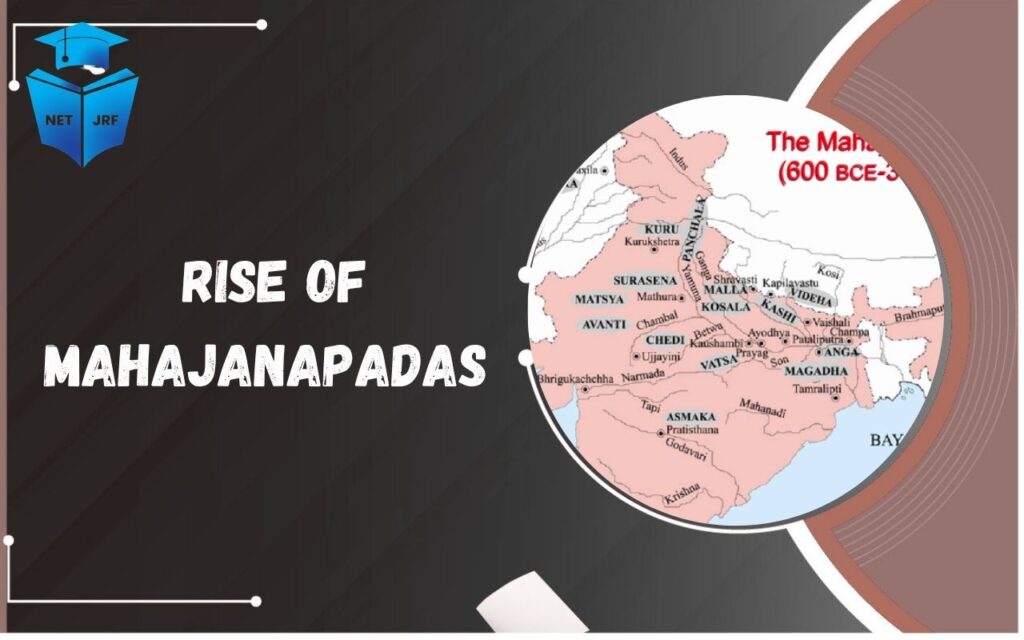
The rise of the Mahajanapadas in the 6th century BCE marks a significant phase in ancient Indian history, characterized by the emergence of large territorial states from earlier tribal polities. This period witnessed major political, economic, and social transformations, including the expansion of agriculture, growth of trade and urban centers, and the development of organized administrative systems. The Mahajanapadas, such as Magadha, Kosala, and Vatsa, played a crucial role in shaping early state formation and laid the foundation for the rise of powerful empires in the Indian subcontinent.

What Are Mahajanapadas?
The Rise of Mahajanapadas marked a significant political transformation in ancient India. Around the 6th century BCE, sixteen major kingdoms, known as Mahajanapadas, emerged across northern India. These kingdoms shaped political structures, trade networks, military organisation and cultural development during the early historic period.
Mahajanapadas were large kingdoms or oligarchic republics. The term means great realms.
- There were 16 Mahajanapadas in total.
- Each Mahajanapada had its own capital, ruler and administrative system.
- They were located mainly in the Ganges basin, north India, and north-western India.
| Mahajanapada | Capital | Type |
| Anga | Champa | Monarchy |
| Magadha | Rajagriha | Monarchy |
| Kashi | Varanasi | Monarchy |
| Kosala | Shravasti | Monarchy |
| Vatsa | Kaushambi | Monarchy |
| Avanti | Ujjayini | Monarchy |
Rise of Mahajanapadas
The rise of the Mahajanapadas was influenced by multiple factors, including agricultural expansion, use of iron technology, surplus production, growth of trade and urbanization, population increase, and the gradual transformation of tribal polities into territorial states.
Political Changes
- Transition from small tribal republics to larger states.
- Kings consolidated power through alliances, marriages, and conquest.
- Examples include Udayana of Vatsa strengthening his kingdom via marital alliances.
Economic Growth
- Growth of trade routes and commerce.
- Urban centres developed, supporting markets and artisans.
- Fertile lands of Ganga-Yamuna plains encouraged agricultural surplus.
Military Strength
- Armies were organised to defend territories and expand influence.
- Powerful monarchies like Avanti under Chandpradyota employed large armies.
- Military campaigns led to annexation of smaller states.
Prominent Mahajanapadas
Vatsa
- Capital: Kaushambi
- King Udayana expanded territory via military campaigns and political marriages.
- Allies included Avanti and Magadha.
- Decline occurred after Udayana’s death, later merging into Magadha Empire.
Avanti
- Capital: Ujjayini
- King Chandpradyota Mahasena was ambitious and aggressive.
- Military power extended influence over neighbouring kingdoms.
- Weak successors led to decline; eventually absorbed by Magadha.
Magadha
- Capital: Rajagriha
- Grew into the most powerful kingdom due to fertile land, strong military and strategic location.
- Became the core of later empires in India.
Social and Cultural Influence
The rise of the Mahajanapadas brought significant changes in the social and cultural life of ancient India.
- As these large states developed, they encouraged urbanisation, leading to the growth of towns and cities as centres of trade, crafts, and cultural activities. With increased economic prosperity, people had more opportunities to engage in arts, literature, and intellectual pursuits.
- This period also saw the flourishing of major religious traditions like Buddhism and Jainism. The teachings of figures such as Gautama Buddha and Mahavira attracted large numbers of followers, and religious communities began to grow and organize themselves. Kings played an important role in this process by patronising religious institutions, scholars, and artists.
- They supported the construction of monasteries, stupas, and other architectural works, which not only promoted religion but also strengthened a shared cultural identity among the people. In this way, the Mahajanapadas became centres of both economic growth and cultural richness.
Administration and Governance
The administrative systems of the Mahajanapadas were more advanced and structured compared to earlier periods. Most of these states followed a centralised monarchy, where the king held supreme authority but was assisted by a group of ministers and officials.
- These officials were responsible for managing different aspects of governance, such as maintaining law and order, collecting taxes, and overseeing resources.
- However, not all Mahajanapadas were monarchies. Some were republics or ganas, where power was shared among a group of leaders rather than a single king.
- In such systems, decisions were taken through assemblies and councils, reflecting a more collective form of governance.
- Regardless of the type of rule, all Mahajanapadas developed systems for law enforcement, taxation, and resource management, which helped maintain stability and support economic activities.
- These administrative practices laid the foundation for more complex governance structures in later Indian empires.

Rise of Trade and Economy
The period of the Mahajanapadas witnessed a remarkable expansion in trade and economic activities, which played a key role in strengthening these early states.
- One of the most important developments was the growth of trade routes that connected different towns, cities, and Mahajanapadas.
- These routes were not just local but often extended over long distances, linking regions across the subcontinent. Goods such as agricultural produce, metals, textiles, and crafted items moved along these routes, creating a network of economic interdependence between regions.
- At the same time, the rise of markets and urban centres made trade more organized and efficient. Markets became important places where merchants, artisans, and farmers exchanged goods.
- This encouraged specialization, where different regions focused on producing specific goods like metal tools, pottery, or textiles. The use of coins further supported trade by making transactions easier and more standardized, reducing the dependence on barter systems.
- Another crucial factor behind economic growth was the strategic location of many Mahajanapadas. States situated along fertile river valleys or major trade routes gained significant advantages.
- Rivers provided water for agriculture, acted as natural transport routes, and supported communication. Similarly, settlements located on important road networks became commercial hubs, attracting traders and boosting local economies. Because of these advantages, certain Mahajanapadas grew more powerful and prosperous than others.
- Overall, the rise of trade and economic activities not only increased wealth but also contributed to urbanisation, social change, and the emergence of stronger political systems in ancient India.
Decline and Legacy
The decline of many Mahajanapadas was mainly due to internal weaknesses and external pressures. In several states, weak or ineffective rulers failed to maintain strong administration and military control.
- This made them vulnerable to internal conflicts, rebellions, and invasions by more powerful neighbours. Military defeats further weakened these states, reducing their political influence and territorial control. As a result, many smaller or less organized Mahajanapadas gradually lost their independence.
- A major turning point came with the rise of powerful kingdoms like Magadha. Due to its strategic location, strong leadership, and efficient administration, Magadha was able to expand rapidly.
- It absorbed many weaker Mahajanapadas and emerged as the dominant power in northern India. This process of consolidation eventually laid the foundation for the rise of the Mauryan Empire, one of the largest and most organized empires in ancient Indian history.
- Despite their decline, the Mahajanapadas left a lasting legacy. The political systems, including centralized monarchy and administrative structures, influenced later empires. Similarly, the economic practices, such as taxation and trade networks, continued to develop in future periods. Cultural and social patterns, including urbanisation, religious growth, and social organization, also shaped the course of Indian history. In this way, even though the Mahajanapadas declined, their contributions remained deeply embedded in the evolution of ancient Indian civilization.
Impact on Indian History
The Mahajanapadas played a foundational role in shaping early Indian history by establishing some of the first organized state systems in the subcontinent. Unlike earlier tribal structures, these states developed clear political boundaries, administrative systems, and governing authorities.
- This marked an important transition from simple social organization to more complex and structured political entities, which later empires would build upon.
- Another major contribution was the growth of urbanisation and craft specialisation. With the rise of towns and cities, economic activities became more diverse and organized. Artisans began to specialize in particular crafts such as pottery, metalwork, and textiles, leading to increased production and trade.
- This not only strengthened the economy but also improved the standard of living and encouraged the development of urban centres as hubs of activity.
- The Mahajanapada period also had a deep impact on religious and cultural developments. It was during this time that new religious movements like Buddhism gained prominence. The teachings of Gautama Buddha found support in many of these states, leading to the growth of early Buddhist communities and institutions. These developments contributed to a rich cultural environment where ideas, beliefs, and philosophies evolved and spread across regions.
- Finally, the Mahajanapadas provided an important model for military and political organisation.
- They developed systems of standing armies, taxation, and governance that were later adopted and expanded by larger empires. Powerful states like Magadha used these systems to expand their influence, eventually leading to the formation of vast empires such as the Mauryan Empire. In this way, the Mahajanapadas laid the groundwork for the political and administrative traditions of ancient India.
Rise of Mahajanapadas in 6th Century BCE FAQs

Which were the largest Mahajanapadas?
Magadha, Kosala, Vatsa, and Avanti were the most prominent and influential kingdoms.
How did Mahajanapadas manage administration?
Monarchies used ministers and officials, while republics or ganas relied on assemblies and councils for governance.
What role did trade play in Mahajanapadas?
Trade connected cities, encouraged economic growth, facilitated craft specialisation, and strengthened political power.
How did Mahajanapadas influence culture?
They promoted urbanisation, arts, literature, religious communities, and architectural developments like monasteries and stupas.
What led to the decline of Mahajanapadas?
Weak rulers, internal conflicts, rebellions, and military defeats caused gradual decline and absorption by stronger states.
Did Mahajanapadas affect later Indian empires?
Yes, their administrative systems, economic networks, and urban centres influenced Mauryan and subsequent empires.
Who was Udayana of Vatsa?
Udayana expanded his kingdom through military campaigns and political marriages, forming alliances with Avanti and Magadha.
Which Mahajanapada had its capital at Ujjayini?
Avanti, ruled by Chandpradyota Mahasena, had Ujjayini as its capital.
What was the significance of the Ganges plain for Mahajanapadas?
It provided fertile land, strategic trade routes, and ideal locations for settlements and urban centres.