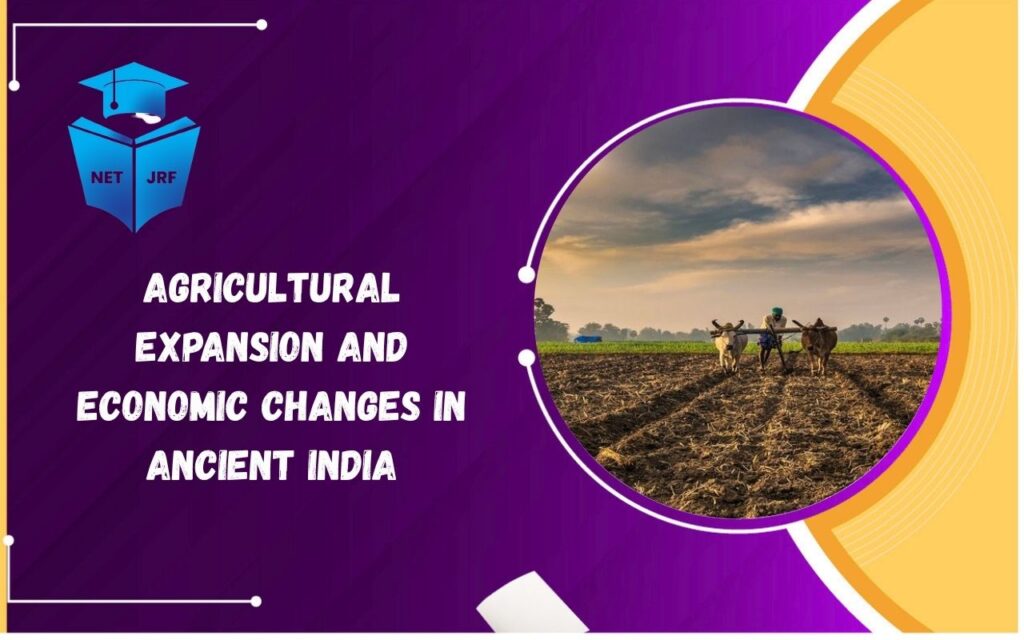
Agricultural Expansion and Economic Changes played a major role in transforming the social and political structure of ancient Indian civilization. The growth of agriculture increased food production which supported population growth, settlements, trade and development of states. During the later Vedic period and the age of the Mahajanapadas major Agricultural Expansion and Economic Changes took place across northern India. New agricultural lands opened in the fertile Gangetic plains which led to the rise of towns, kingdoms, trade networks and complex economic systems.

Historical Background Agricultural Expansion
Early Vedic society depended mainly on pastoral life. Cattle rearing remained the main economic activity during that period.
- Over time communities started clearing forests to cultivate land. The discovery and use of iron tools helped farmers cut dense forests especially in the Gangetic region.
- These developments led to significant Agricultural Expansion and Economic Changes that shaped the structure of ancient Indian society.
- By the sixth century BCE many agricultural villages appeared which later developed into towns and cities.
Top UGC NET Offline Coaching in Jaipur
Agricultural Expansion and Economic Changes
Agricultural Expansion and Economic Changes occurred due to several technological environmental and social developments.
Major Factors Responsible
- Use of iron tools such as ploughshare axe and sickle
- Clearing of forests for cultivation
- Growth of irrigation methods
- Settlement of new farming communities
- Increase in agricultural surplus
These factors increased production which supported population growth and economic activity.
As a result Agricultural Expansion and Economic Changes contributed to the formation of powerful kingdoms during the Mahajanapada period.
Growth of Agriculture
Agriculture gradually became the foundation of the ancient Indian economy.
Important Crops
Farmers cultivated a variety of crops based on regional climate conditions.
- Rice
- Wheat
- Barley
- Pulses
- Oil seeds
Rice cultivation expanded rapidly in eastern India because the region had fertile soil and sufficient rainfall.
The spread of farming activities represents a major stage in Agricultural Expansion and Economic Changes during ancient times.
Use of Iron Technology
The introduction of iron technology brought revolutionary changes in agriculture.
Importance of Iron Tools
- Iron plough helped deep cultivation of soil
- Iron axes helped clear forests quickly
- Strong tools increased farming efficiency
- Large agricultural fields became possible
These technological developments accelerated Agricultural Expansion and Economic Changes across the Gangetic plains.
Farmers could cultivate larger areas which produced greater agricultural surplus.
Top UGC NET Offline Classes in Jaipur
Irrigation and Farming Methods
Ancient farmers also developed irrigation techniques to support agriculture.
Methods of Irrigation
- Use of wells
- River water channels
- Tanks and reservoirs
- Seasonal flood irrigation
Irrigation allowed cultivation even in dry seasons.
Improved farming methods contributed significantly to Agricultural Expansion and Economic Changes in early Indian society.
Rise of Villages
The growth of agriculture led to the establishment of permanent villages.
Features of Agricultural Villages
- Houses built near cultivated land
- Community cooperation in farming
- Storage of grains
- Local markets for exchange
Village communities became the basic unit of rural economy.
The spread of rural settlements formed an important aspect of Agricultural Expansion and Economic Changes in ancient India.
Development of Trade
Agricultural surplus encouraged the development of trade.
Forms of Trade
- Exchange of grains and food products
- Trade in metals tools and craft items
- Long distance trade between regions
Merchants transported goods through land routes and river routes.
This growth of commerce emerged as an important result of Agricultural Expansion and Economic Changes.
Growth of Urban Centers
The increase in trade and agricultural production led to the rise of towns.
Important Urban Centers
- Rajagriha
- Vaishali
- Kaushambi
- Ujjain
- Taxila
These cities became centers of administration, trade and culture.
The emergence of urban settlements demonstrates the wider impact of Agricultural Expansion and Economic Changes on society.
Agricultural Expansion and Economic Changes in Ancient India
The growth of agriculture in ancient India not only transformed rural life but also stimulated craft production, trade networks, and the overall economic structure, laying the foundation for more complex societies
| Agricultural Expansion and Economic Changes | Impact on Society |
| Use of iron tools | Large scale cultivation |
| Forest clearing | Expansion of farming land |
| Irrigation development | Stable agricultural production |
| Agricultural surplus | Growth of trade |
| Rise of towns | Urban economy development |

Economic Transformation
Agriculture formed the base of a wider economic transformation.
Major Economic Developments
- Emergence of craft production
- Growth of trade routes
- Rise of merchant groups
- Circulation of early coinage
These developments strengthened economic networks across regions.
The increasing complexity of the economy reflects the importance of Agricultural Expansion and Economic Changes.
Social Changes
Economic transformation also produced social changes.
Major Social Effects
- Emergence of land owning classes
- Growth of artisan communities
- Development of merchant groups
- Expansion of social hierarchy
Agricultural surplus created economic differences between social groups.
Such transformations represent another important dimension of Agricultural Expansion and Economic Changes.
Top UGC NET Foundation Batch Online
Rise of States
The expansion of agriculture supported the formation of powerful states.
Role in State Formation
- Agricultural revenue supported rulers
- Surplus funded armies
- Villages provided administrative base
These factors strengthened political authority in emerging kingdoms.
The rise of the Mahajanapadas shows the political impact of Agricultural Expansion and Economic Changes.
Impact
The transformation of the agricultural economy continued for several centuries.
Long Term Developments
- Strengthening of rural economy
- Growth of long distance trade networks
- Emergence of urban civilization
- Formation of large empires such as the Mauryan Empire
These developments demonstrate the historical importance of Agricultural Expansion and Economic Changes.

Conclusion
The process of Agricultural Expansion and Economic Changes played a central role in shaping ancient Indian civilization. The use of iron tools, expansion of cultivation, growth of irrigation, development of trade and rise of towns transformed the economy and society.
These changes supported population growth, social differentiation, commercial activity and political development. Powerful states such as the Mahajanapadas emerged partly because of the agricultural surplus generated during this period.
Agricultural Expansion and Economic Changes FAQs

2. Why was iron technology important for agriculture?
Iron tools helped farmers clear forests cultivate deeper soil and increase productivity.
3. How did agricultural growth affect trade?
Agricultural surplus created goods for exchange which encouraged local and long distance trade.
4. What role did villages play in the economy?
Villages served as the main centers of agricultural production and supported the rural economy.
5. How did agriculture lead to urban development?
Surplus food production supported traders craftsmen and administrators which led to the growth of towns.
6. Why is this topic important for UGC NET history?
It explains the economic base of early states and helps understand social and political developments in ancient India.
7. What were the major economic changes during this period?
Important changes included growth of agriculture development of trade emergence of crafts and rise of urban centers.
8. What is Agricultural Expansion and Economic Changes in ancient Indian society?
Agricultural expansion and economic changes describe the transformation of farming trade settlement patterns social structure which shaped early Indian civilization.