

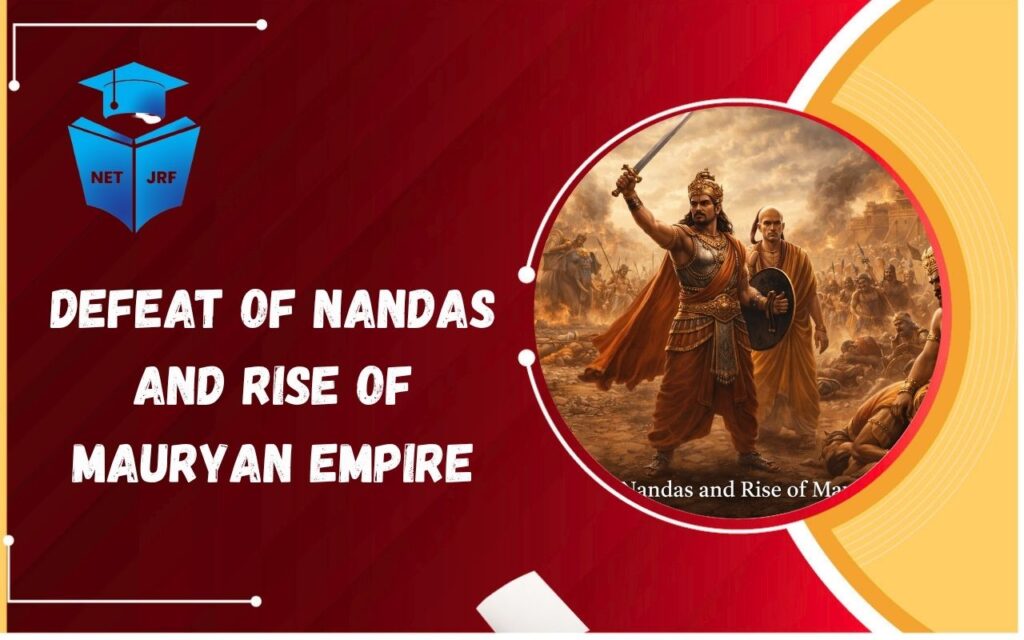
The defeat of the Nanda dynasty marked a major turning point in ancient Indian history. Weaknesses in leadership, heavy taxation, and public dissatisfaction created an opportunity for Chandragupta Maurya. With guidance from Chanakya, he overthrew the Nandas and laid the foundation for the powerful Mauryan Empire.

Background of Nanda Rule
Before examining the defeat of the Nandas, it is important to understand the Nanda dynasty. They ruled Magadha after the Shishunagas and were known for their strong centralized administration, large army, and efficient tax system. Despite their power, heavy taxation and strict policies caused unpopularity among the people, creating conditions for a new ruler to rise.
Causes of Defeat of Nandas
The defeat of the Nanda dynasty was not a sudden event; it was the result of a combination of political, economic, and social factors. Understanding these causes gives insight into how Chandragupta Maurya was able to rise and establish the Mauryan Empire.
Top UGC NET Offline Classes in Jaipur
Unpopular Rule
One of the main reasons the Nandas fell was their unpopularity among the people. Despite their strong army and centralized administration, the Nanda rulers imposed policies that alienated the general public.
- Heavy Taxation Burden: Farmers and traders faced high taxes, often paying a large share of their produce or wealth to the state. This created widespread resentment.
- Harsh Revenue Collection: Officials collected taxes rigorously, leaving little room for flexibility or relief, which made the Nandas appear oppressive.
- Lack of Public Support: The common people had no influence over governance, leading to dissatisfaction.
- Autocratic Rule: Decisions were made centrally by the king, ignoring the needs and voices of citizens. Over time, this weakened the dynasty’s hold over its own kingdom.
Essentially, while the Nandas had power and resources, their rigid and harsh policies created a fertile ground for rebellion and opposition.
Weak Leadership
The later Nanda rulers, especially Dhanananda, lacked the qualities that earlier rulers like Mahapadma Nanda had demonstrated. Weak leadership directly contributed to their downfall.
- Lack of Support: Dhanananda failed to inspire loyalty among ministers, generals, and allies.
- Poor Decision-Making: Strategic mistakes and inability to manage internal administration eroded authority.
- Failure to Maintain Loyalty: Provincial governors and military leaders did not fully support the king, making it easier for opponents like Chandragupta to challenge the throne.
This meant that even though the Nandas had strong armies and wealth, their internal weaknesses made them vulnerable to a well-planned external challenge.
Role of Chanakya
Chanakya, also known as Kautilya or Vishnugupta, was the mastermind behind the fall of the Nandas. He combined intelligence, diplomacy, and strategy to pave the way for Chandragupta Maurya.
- Planned Strategies to Overthrow Nandas: Chanakya carefully analyzed the Nanda administration and identified its weaknesses.
- Training Chandragupta Maurya: He groomed Chandragupta in warfare, administration, and leadership, preparing him for kingship.
- Building Alliances: Chanakya formed strategic alliances with other regional rulers to isolate the Nandas.
- Use of Diplomacy and Intelligence: He deployed spies and diplomats to weaken enemy networks before the final confrontation.
Without Chanakya’s foresight and planning, Chandragupta’s rise and the fall of the Nandas would have been far more difficult.
Rise of Chandragupta Maurya
Chandragupta Maurya was the key figure who capitalized on the weaknesses of the Nandas. His leadership was decisive in ending Nanda rule.
- Organized a Strong Army: Chandragupta gathered a disciplined force, including infantry, cavalry, and war elephants.
- Strategic Attack on Magadha: Using Chanakya’s guidance, he attacked the Nandas in a well-planned campaign rather than a rushed confrontation.
- Gaining Popular Support: By promising relief from heavy taxation and better governance, Chandragupta won the trust of the people.
- Defeated Dhanananda: This victory marked the end of Nanda rule and the beginning of Mauryan supremacy.
Chandragupta’s leadership turned a period of instability into a foundation for a centralized and powerful empire.
Top UGC NET Offline Coaching in Jaipur
Impact of Alexander’s Invasion
The invasion of Alexander the Great in northwestern India indirectly affected the Nandas’ fall.
- Political Instability in Northwest: Alexander’s campaigns weakened several local rulers, creating a power vacuum.
- Weakening of Regional Powers: Neighboring states were destabilized, reducing potential support for the Nandas.
- Opportunity for Expansion: Chandragupta exploited this instability to expand his influence into northwest India.
Thus, external events created conditions that Chandragupta could strategically exploit.
Economic Burden on People
Economic issues were another significant factor contributing to the Nandas’ defeat.
- High Taxes: The Nandas collected revenue aggressively, which drained resources from ordinary citizens.
- Wealth Concentration: Most wealth was concentrated in the royal treasury, leaving little for local development or relief.
- Poor Resource Distribution: Discontent grew among farmers, artisans, and traders who felt overburdened.
Economic dissatisfaction weakened popular support, making it easier for Chandragupta to present himself as a savior of the people.
Establishment of Mauryan Rule
After the defeat of the Nanda dynasty, a new era began in northern India under Chandragupta Maurya. The transition from Nanda rule to Mauryan supremacy was not just a change of rulers but a complete reorganization of governance, economy, and military strength. Each step in establishing the Mauryan Empire was carefully planned, ensuring long-term stability and dominance.
Capture of Magadha
Chandragupta Maurya began by taking control of Magadha, the heart of power in northern India. This region was strategically important due to its fertile land, river access, and strong economic resources.
- By securing Magadha, Chandragupta gained a solid base for further expansion.
- The capture also sent a strong message to neighboring states that a new, well-organized power had emerged.
- It was not just a military victory but also a political statement that old dynasties could be replaced through strategy and leadership.
Top UGC NET Foundation Batch Online

Formation of Centralized Government
One of Chandragupta’s first priorities was to establish a centralized administration. Unlike the Nandas, whose policies were often unpopular despite strong control, Chandragupta, guided by Chanakya, focused on creating a government that was efficient yet strong.
- Officials were appointed to oversee taxation, law enforcement, and provincial governance. Central authority was reinforced, ensuring uniform policies across the empire.
- This system prevented local rebellions and allowed the ruler to maintain control over distant territories.
Expansion of Empire
With Magadha secured, Chandragupta expanded his empire across northern India. His strategy combined military campaigns with diplomacy, often forging alliances with smaller states to integrate them peacefully.
- Territories that were once independent were now brought under the Mauryan banner.
- This expansion not only increased wealth and manpower but also strengthened the empire’s political influence.
- By the end of his campaigns, Chandragupta controlled one of the largest empires in Indian history.
Alliance with Seleucus Nicator
One of the most remarkable achievements was Chandragupta’s victory over Seleucus Nicator, a general of Alexander the Great. By defeating Seleucus, Chandragupta gained key northwestern territories, extending the empire’s boundaries into regions like Punjab and Sindh.
- To stabilize relations, he established a marriage alliance, which also secured trade routes and diplomatic ties.
- This step highlighted his strategic intelligence military success combined with political alliances ensured long-term security.
Role of Chanakya in Mauryan Establishment
The rise of the Mauryan Empire would not have been possible without the guidance of Chanakya. His contributions went beyond mere advice:
- Political Strategy: Chanakya carefully planned the overthrow of the Nandas and guided Chandragupta in conquering rival states.
- Economic Planning: He advised on taxation, trade regulation, and treasury management to support the army and administration.
- Administrative Guidance: Chanakya suggested centralized control, appointment of capable officials, and strict law enforcement to maintain order.
- Arthashastra: His treatise served as a manual for governance, emphasizing spies, intelligence networks, and strategies for internal and external threats.
Chanakya’s insights ensured that the Mauryan Empire had a stable foundation and could withstand internal unrest and external threats.
Features of Mauryan Administration
Under Chandragupta, the Mauryan administration became a model of strong governance:
- Centralized Authority: The king held supreme power, directing officials across provinces.
- Efficient Taxation System: Revenue from agriculture, trade, and artisans funded the empire’s administration and army.
- Organized Bureaucracy: Skilled officers managed law, order, and public services.
- Law Enforcement: A structured legal system maintained peace and minimized rebellion.
This organization allowed the Mauryan Empire to govern a vast population effectively and ensured stability over large territories.
Military Strength of Mauryas
The Mauryan Empire also relied heavily on military power:
- Large Standing Army: Chandragupta maintained a huge army capable of defending the empire and enforcing authority in newly conquered regions.
- Use of Elephants: War elephants were used strategically to intimidate enemies and break enemy lines.
- Advanced Weapons: Soldiers were trained with iron weapons, and cavalry units improved mobility.
- Strategic Warfare: Military campaigns were planned using intelligence, terrain knowledge, and careful logistics.

This combination of strong military and strategic planning helped the Mauryas maintain control over one of the largest empires of the ancient world.
The Defeat of Nandas was not just the fall of a dynasty but the beginning of a powerful empire. It shows how leadership, strategy, and public support can change history.
| Read UGC Notes | ||
| Unit | Topic | Link |
| Archaeological | Archaeological Sources for UGC NET | Open |
| Archaeological | Exploration in Archaeology | Open |
| Archaeological | Excavation Techniques in Archaeology | Open |
| Archaeological | Dating of Archaeological Sites | Open |
| Archaeological | Epigraphy — Study of Inscriptions | Open |
| Archaeological | Inscriptions in Reconstructing History | Open |
| Archaeological | Numismatics in History | Open |
| Archaeological | Importance of Coins in History | Open |
| Literary Sources | Meaning of Historical Sources | Open |
| Literary Sources | Literary Sources in History | Open |
| Literary Sources | Indigenous Literature | Open |
| Literary Sources | Dating Ancient Literary Sources | Open |
| Literary Sources | Secular Literature as Historical Source | Open |
| Literary Sources | Role of Myths & Legends in Historical Reconstruction | Open |
| Foreign Accounts | Foreign Accounts of India — Overview | Open |
| Foreign Accounts | Greek Accounts on Ancient India | Open |
| Foreign Accounts | Chinese Accounts on India | Open |
| Foreign Accounts | Arabic Accounts on India | Open |
| Neolithic & Chalcolithic | Neolithic and Chalcolithic Phases | Open |
| Neolithic & Chalcolithic | Hunting, Gathering & Food Production | Open |
| Neolithic & Chalcolithic | Neolithic Revolution in India | Open |
| Neolithic & Chalcolithic | Neolithic Settlements in India | Open |
| Neolithic & Chalcolithic | Distribution of Neolithic Cultures in India | Open |
| Neolithic & Chalcolithic | Tools and Technology in Neolithic Period | Open |
| Neolithic & Chalcolithic | Chalcolithic Culture in India | Open |
| Neolithic & Chalcolithic | Settlement Pattern & Economy in Chalcolithic Phase | Open |
| Neolithic & Chalcolithic | Trade & Exchange Networks in Chalcolithic Societies | Open |
| Indus Valley | Indus Valley Civilization — Overview | Open |
| Indus Valley | Major Sites of Indus Civilization | Open |
| Indus Valley | Urban Planning in Harappan Civilization | Open |
| Indus Valley | Architecture and Town Planning | Open |
| Indus Valley | Agriculture and Food Economy | Open |
| Indus Valley | Craft Specialization & Industrial Activities | Open |
| Indus Valley | Internal Trade of Harappan Civilization | Open |
| Indus Valley | Internal and External Trade | Open |
| Indus Valley | Social Structure of Indus Civilization | Open |
| Indus Valley | Political Organization of Harappan Civilization | Open |
| Indus Valley | Religion and Beliefs in Indus Civilization | Open |
| Indus Valley | Decline of Indus Civilization | Open |
| Indus Valley | Indus Civilization as First Urbanization | Open |
| Vedic Period | Vedic and Later Vedic Periods — Overview | Open |
| Vedic Period | Origin of Vedic Civilization | Open |
| Vedic Period | Aryan Debate — Migration, Invasion & Indigenous Theories | Open |
| Vedic Period | Early Vedic Society and Economy | Open |
| Vedic Period | Political Institutions in Early Vedic Period | Open |
| Vedic Period | Social Structure in Early Vedic Period | Open |
| Vedic Period | Later Vedic Society and Economy | Open |
| Vedic Period | Emergence of Varnas and Social Stratification | Open |
| Vedic Period | Emergence of Heterodox Sects in India | Open |
| Vedic Period | Impact of Iron Technology in India | Open |
| Miscellaneous | Megalithic Culture of South India | Open |
| Miscellaneous | Religious and Philosophical Vedic Ideas | Open |
| Miscellaneous | State System in Ancient India | Open |
Defeat of Nandas FAQs
It created instability, which helped Chandragupta expand his power.