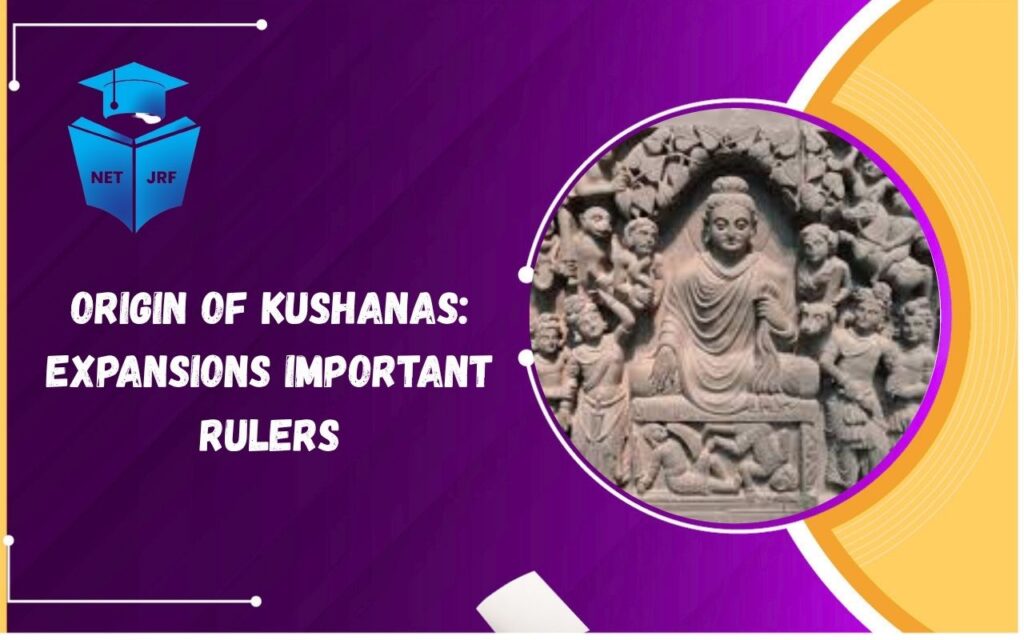
Origin of Kushanas is a very important topic in Ancient Indian History because it explains how a foreign tribe came to India and built a powerful empire. The Kushanas were not originally from India. They came from Central Asia and slowly settled in northwestern India. Over time, they created a strong empire that connected India with Central Asia, China, and Rome. Understanding their origin helps us see how cultures mixed in ancient times.

Enroll UGC NET Online Coaching
Kushanas Historical Background
the origin of Kushanas, we must first know about the Yuezhi tribe. The Yuezhi were a nomadic group living in northwestern China. Around the 2nd century BCE, they were attacked by another tribe called the Xiongnu.
Migration of Yuezhi
- Yuezhi were defeated by Xiongnu
- They moved westward towards Central Asia
- Finally settled in Bactria region
This migration is the starting point of Origin of Kushanas. After settling in Bactria, they divided into five clans.
Origin of Kushanas Yuezhi Connection
One of the five Yuezhi clans became powerful. This clan was known as the Kushanas.
Key Points
- Kushanas were originally one branch of Yuezhi
- They slowly gained control over other clans
- They formed a unified political power
This process clearly explains the Origin of Kushanas as a transformation from a nomadic tribe to an organized empire.
Rise of Kushana Power
After understanding Origin of Kushanas, we must see how they rose to power.
Important Leader: Kujula Kadphises
- First great Kushana ruler
- United the five Yuezhi clans
- Expanded territory into Afghanistan and India
His leadership marked the beginning of Kushana Empire in India.
Kushanas Expansion into India
The Kushanas, originally Central Asian tribes, entered India through the northwestern passes, gradually establishing their power over key regions. Their expansion was marked by strategic conquest, political stability, and cultural influence.
Regions Covered:
- Gandhara – an important cultural and trade center, linking India with Central Asia.
- Punjab – a fertile region that strengthened their economic base.
- Mathura – an emerging religious and commercial hub.
Through control over these regions, the Kushanas created a stable political system, paving the way for trade, cultural exchange, and the spread of Buddhism. Understanding this phase is crucial for studying the origin and establishment of Kushana power in India.
Kushana Empire Important Rulers
The Kushana Empire was shaped and strengthened by several key rulers who expanded territory, promoted trade, and encouraged cultural development.
Kujula Kadphises
- Founder of Kushana power in India.
- United scattered tribes under a single authority.
- Initiated the first phase of territorial expansion, laying the foundation for a larger empire.
Vima Kadphises
- Expanded the empire further into the Gangetic plains and western India.
- Introduced gold coins, which facilitated trade and strengthened economic stability.
Kanishka
- Considered the greatest Kushana ruler.
- Promoted Buddhism, supporting monasteries, stupas, and art.
- Encouraged trade across Central Asia and India, connecting cultural and commercial networks.
- Played a major role in spreading Indian culture to Central Asia, influencing art, religion, and political structures far beyond the subcontinent.

Kushanas Cultural Impact
The Kushana Empire was not just a story of migration and conquest; it was also a period of intense cultural exchange. As they settled in northwestern India, the Kushanas blended Indian, Greek, and Persian influences, creating a unique cultural milieu.
Enroll UGC NET Mock Test Series
Key Cultural Features:
- Promotion of Buddhism: Kushana rulers, especially Kanishka, patronized Buddhism, supporting the construction of monasteries, stupas, and the spread of Buddhist teachings.
- Development of Gandhara Art: The period saw the flourishing of Gandhara art, which combined Indian themes with Hellenistic (Greek) and Persian artistic styles, producing sophisticated sculptures and reliefs.
- Cultural Blending: The Kushana period is notable for its fusion of artistic, religious, and architectural traditions, making it culturally distinct and influential in both India and Central Asia.
Economic Importance of Kushanas
The Kushanas maintained economic strength by controlling key trade routes, which allowed them to dominate commerce and wealth in the region.
Trade Connections:
- Controlled parts of the Silk Route, linking China and Rome.
- Maintained active trade with the Roman Empire, exporting goods like silk, spices, and precious stones, and importing gold, wine, and luxury items.
- This extensive trade network not only brought wealth but also facilitated cultural exchanges, spreading Indian ideas and artistic styles to Central Asia.
Coinage System
Kushana coins are among the most informative sources for understanding their economy and culture.
Features of Kushana Coins:
- Gold coins widely used, reflecting the empire’s wealth and trade connections.
- Display images of kings and gods, showcasing royal authority and religious patronage.
- Inscriptions in Greek and Kharosthi scripts, highlighting cultural diversity and administrative sophistication.
These coins provide a clear picture of the Kushanas’ economic prosperity, political authority, and the blending of cultural influences during their rule.
The Kushana period was remarkable for its cultural synthesis and economic vitality. Through Buddhist patronage, Gandhara art, and coinage, as well as control over Silk Route trade, the Kushanas established a legacy that linked India with Central Asia and the Mediterranean, leaving a lasting imprint on art, religion, and commerce.
Enroll UGC NET Coaching in Jaipur
Religion under the Kushanas
Religion played a central role in Kushana governance, influencing both culture and society. The Kushanas were tolerant rulers, supporting multiple religious traditions while promoting Buddhism in particular.
Religious Practices:
- Support to Buddhism: Rulers, especially Kanishka, patronized Buddhist monasteries, stupas, and educational centers. He is credited with organizing the Fourth Buddhist Council, which helped systematize Buddhist teachings.
- Worship of Multiple Gods: While Buddhism was promoted, the Kushanas also respected local deities and Hindu gods, reflecting a policy of inclusiveness.
- Religious Tolerance: This approach fostered social harmony in a diverse empire with multiple cultural and religious groups.
Administrative System of Kushanas
The Kushanas developed a strong administrative framework to govern their vast and culturally diverse empire.
Key Features:
- Centralized Power: The king held supreme authority, ensuring consistent governance across regions.
- Use of Governors: Local governors were appointed to administer provinces, collect revenue, and maintain law and order.
- Control over Trade Routes: Strategic oversight of internal and external trade routes strengthened both economic stability and political authority.
This system allowed the Kushanas to manage their empire effectively, integrating newly conquered territories while promoting trade, culture, and religious activities.

Challenges in Studying the Origin of Kushanas
Understanding the origin and early history of the Kushanas is not straightforward due to several historical challenges:
Join UGC NET Coaching in Jaipur
- Limited Written Records
Very few indigenous texts from the Kushana period survive, making it difficult to reconstruct their early history from primary sources. - Dependence on Foreign Sources
Much of what we know comes from Greek, Roman, and Chinese accounts, which may be biased or incomplete, offering only a partial view of the Kushanas. - Interpretation Differences
Archaeologists and historians often interpret coins, inscriptions, and foreign texts differently, leading to debates about their migration patterns, tribal origins, and early rulers. - Coins and Inscriptions as Key Sources
Despite these challenges, coins, inscriptions, and archaeological evidence remain the most reliable tools. They provide information about rulers, trade, religion, and cultural influence, helping historians reconstruct the Kushana narrative.
Origin of Kushanas helps us understand how a nomadic tribe transformed into a powerful empire in India. Their journey from Central Asia to India shows the importance of migration, adaptation, and cultural exchange.
Origin of Kushanas FAQs

2. What is the connection between Kushanas and Yuezhi?
The Kushanas were one branch of the Yuezhi, a nomadic tribe from northwestern China.
After being defeated by the Xiongnu, the Yuezhi migrated westward, settled in Bactria, and one clan became the Kushanas.
This migration marked the origin of Kushanas in India.
3. Who was the first great Kushana ruler in India?
Kujula Kadphises was the first major Kushana ruler in India.He united the five Yuezhi clans and expanded their territory into Afghanistan and northwestern India. His leadership laid the foundation of the Kushana Empire in India.
4. Which regions did the Kushanas control in India?
They controlled Gandhara, Punjab, and Mathura.Gandhara was a major cultural and trade center, Punjab strengthened the economy, and Mathura became a religious and commercial hub. These regions helped stabilize the empire and promote trade and culture.
5. Who were other important Kushana rulers?
Vima Kadphises: Expanded territory into the Gangetic plains and introduced gold coins. Kanishka: Considered the greatest ruler; patronized Buddhism, promoted trade, and supported art and culture. They strengthened political authority, economy, and cultural integration.