

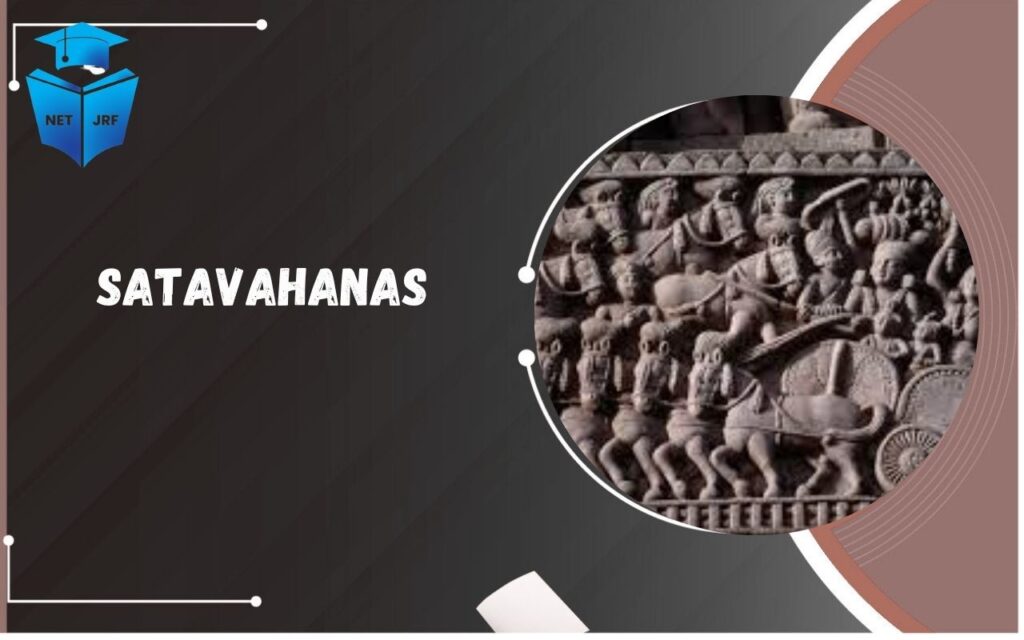
The Origin early history of Satavahanas is a very important topic in ancient Indian history. The Origin and early history of Satavahanas helps us understand how power shifted to the Deccan after the decline of the Mauryan Empire.

Post-Mauryan India Background
After the fall of the Mauryan Empire, India experienced a significant political transformation. The centralized power that had existed under the Mauryas declined, leading to the fragmentation of the empire. This created a period where regional rulers could gain influence and control over territories independently.
Enroll UGC NET Mock Test Series
-
Weakening of Central Power
-
-
- The death of Ashoka marked the decline of the strong centralized Mauryan administration. His successors lacked authority and administrative capability, which led to the weakening of central control. Without a strong central authority, provinces started operating more autonomously, and the unity of the empire gradually disintegrated.
-
-
Rise of Regional Kingdoms
-
-
- As central power declined, regional dynasties and local rulers emerged as important political players. These kingdoms controlled strategic territories and exercised political and military autonomy. This period saw a shift from a single imperial authority to multiple regional powers, each consolidating its influence over its domain
-
-
Expansion of Trade Routes in the Deccan
-
-
- The political decentralization allowed trade routes in the Deccan to expand and flourish. With regional rulers managing key areas, commerce between northern and southern India increased. This facilitated the growth of markets, the exchange of goods, and economic prosperity in the Deccan region.
-
-
Significance for the Satavahanas
-
- The decline of Mauryan power and the rise of regional kingdoms created a favorable environment for the emergence of the Satavahana dynasty. They were able to consolidate power in the Deccan and take advantage of the expanded trade networks. This period laid the foundation for their rise as one of the most important regional powers in early classical India.
Origin and early history of Satavahanas Meaning
The Origin and early history of Satavahanas is studied through different historical sources.
Main Sources
- Inscriptions
-
-
- Nashik inscriptions
- Nanaghat inscriptions
-
- Coins
-
-
- Provide names of rulers
- Show economic activity
-
- Literary Sources
-
-
- Puranas
- Buddhist texts
-
- Foreign Accounts
-
- Indirect references to trade
These sources help historians reconstruct the Origin and early history of Satavahanas.
Origin and Early History of Satavahanas
The origin of the Satavahana dynasty has been a subject of debate among historians. Various sources, including literary texts and inscriptions, provide differing accounts, which makes their exact origin a matter of scholarly discussion.
-
Different Views on Origin
-
-
- Some historians suggest that the Satavahanas originated from the Maharashtra region, citing archaeological evidence and early inscriptions found in that area. Others argue that they were linked to the Andhra region, based on references in the Puranas and regional traditions.
-
-
References in Ancient Texts
-
-
- In the Puranas, the Satavahanas are often referred to as the Andhras, which supports the theory of their connection to the eastern Deccan. These texts indicate that the dynasty was recognized in early Indian literature and held significant political power.
-
-
Scholarly Consensus
-
- Despite the debates, most modern scholars agree that the Satavahanas belonged to the Deccan region. They established control over large parts of central and southern India, consolidating their rule over key trade routes and fertile regions, which laid the foundation for their prominence in post-Mauryan India.
Enroll UGC NET Online Test Series
Satavahanas Early Rulers
The Origin and early history of Satavahanas begins with early kings.
Simuka
- Considered founder of dynasty
- Established control in Deccan
- Laid foundation of rule
Krishna
- Brother of Simuka
- Expanded territory
- Strengthened administration
Satakarni I
- Performed Ashvamedha Yajna
- Expanded kingdom
- Gained political recognition
These rulers are central to the Origin and early history of Satavahanas.

Satavahanas Expansion
The origin and early history of the Satavahana dynasty show that their power grew gradually over time. From their initial base in the Deccan, they expanded to control a significant portion of central and southern India.
-
Regions Controlled
-
-
- The Satavahanas extended their rule over Maharashtra, Andhra Pradesh, and parts of Madhya Pradesh. This allowed them to dominate both the western and eastern Deccan and consolidate their influence over key regions.
-
-
Important Features of Expansion
-
-
- One of the most important aspects of their growth was their control over trade routes, which enhanced their economic power and facilitated connections between northern and southern India. Their strategic location in the Deccan helped them maintain political stability and monitor neighboring regions effectively.
-
-
Conflict with the Shakas
-
- During their expansion, the Satavahanas often came into conflict with the Shakas (Indo-Scythians). These encounters tested their military strength and diplomatic skills. Successfully defending against or negotiating with the Shakas helped strengthen the Satavahanas’ power and legitimacy in the region.
Satavahana History Role of Inscriptions
The origin and early history of the Satavahana dynasty is well-documented through inscriptions. These epigraphic records provide valuable information about the rulers, their policies, and social and religious practices.
-
Important Inscriptions
-
-
- Some of the most significant inscriptions include the Nanaghat inscription by Queen Naganika and the Nashik inscriptions. These records help historians reconstruct the political and cultural history of the Satavahanas.
-
-
What Inscriptions Tell Us
-
- The inscriptions provide details such as the names of rulers, their religious affiliations and practices, and their political achievements. They also shed light on the administrative structure and the extent of Satavahana influence in different regions.
Enroll UGC NET Offline Classes in Jaipur
Satavahanas Economic Base
The growth and stability of the Satavahana dynasty were closely linked to their economic strength. Agriculture, trade, and monetary systems formed the backbone of their prosperity.
-
Key Features of the Economic Base
-
-
- The Satavahanas relied on agriculture in the Deccan plateau, which provided resources and revenue for the state. They also engaged in trade with the Roman Empire, exchanging goods like spices, textiles, and precious metals.
-
-
Role of Coins and Trade
-
- The use of coins facilitated commerce and helped standardize economic transactions. Trade not only enriched the state but also allowed the Satavahanas to expand their political influence, making economic control a key factor in their rise to power.
Satavahanas Religious Background
The origin and early history of the Satavahana dynasty reflects a period of religious diversity. The Satavahanas adopted a policy that accommodated multiple religious traditions, which helped them maintain political stability and social cohesion.
-
Support to Brahmanism
-
-
- The Satavahanas supported Brahmanical institutions and Vedic rituals. This patronage strengthened traditional social hierarchies and reinforced the influence of Brahmins in both religious and political spheres.
-
-
Patronage to Buddhism
-
-
- Alongside Brahmanism, the Satavahanas also patronized Buddhism. They provided resources for the construction of Buddhist stupas, viharas, and monasteries, reflecting their inclusive and balanced religious policy.
-
-
Performance of Vedic Rituals
-
- The kings often performed Vedic rituals to legitimize their authority and demonstrate their adherence to dharma. This practice also helped integrate different communities under a shared cultural framework.
Satavahanas Social Structure
The Satavahana rule significantly influenced the social organization of their regions. Society became more structured, with clearly defined roles, emerging urban centers, and notable contributions from women.
-
Growth of the Caste System
-
-
- During this period, the caste system became more prominent, influencing social interactions, occupational divisions, and political hierarchies. The Brahmins gained social and religious authority, while other groups contributed to the economic and administrative functions of society.
-
-
Role of Women
-
-
- Women, such as Queen Naganika, played an active role in governance and religious patronage. This highlights the recognition of elite women’s influence in both political and social spheres.
-
-
Urban Development
-
- The Satavahana period also saw growth of towns and trade centers. Urbanization facilitated commerce, administration, and cultural exchanges, making society more organized and interconnected.
Satavahanas Administrative Features
The origin and early history of the Satavahana dynasty includes a well-structured governance system that allowed them to control a vast region efficiently. Their administration was designed to balance central authority with local autonomy, which supported their gradual expansion.
-
Decentralized Administration
-
-
- The Satavahana administration was largely decentralized, allowing local governors and officials to manage day-to-day affairs in various regions. This flexibility ensured effective governance over distant areas without overburdening the central authority.
-
-
Role of Local Officials
-
-
- Local officials played a key role in maintaining law and order, collecting taxes, and managing resources. Their participation made administration practical and responsive to regional needs.
-
-
Use of Prakrit Language
-
- The Satavahanas used Prakrit as the official language for inscriptions and administration. This helped in communication across their territories and strengthened governance by making official records accessible to the local population.
Satavahanas Military Strength
Military power was a critical factor in the rise and consolidation of the Satavahana dynasty. A strong army allowed them to maintain control, defend against invasions, and expand their territory.
-
Control over Territory
-
-
- The Satavahanas maintained control over strategic regions in the Deccan and central India. Their military presence ensured stability and deterred rebellions.
-
-
Defense Against Invasions
-
-
- The army played a key role in defending against foreign invasions, particularly from the Shakas and other neighboring powers. Military strength safeguarded the dynasty’s economic and political interests.
-
-
Expansion through Wars
-
- The Satavahanas also used military campaigns to expand their territory, bringing new regions under their control. Successful wars enhanced their authority and legitimacy as rulers.
Satavahanas Cultural Contributions
The Satavahana dynasty had a lasting impact on culture, literature, and art, which flourished under their rule. Their patronage reflected both religious diversity and support for local traditions.
-
Development of Prakrit Literature
-
-
- The Satavahanas promoted Prakrit literature, which became an important medium for religious and political communication. This helped preserve literary traditions accessible to the common people.
-
-
Support to Art and Architecture
-
-
- They actively supported art and architecture, including the construction of stupas, viharas, and other religious monuments. Sculptural work from this period reflects a blend of indigenous and contemporary styles.
-
-
Religious Monuments
-
- The dynasty contributed to religious architecture, particularly Buddhist monuments like the Bharhut and Amaravati stupas. These structures not only served religious purposes but also symbolized political authority and cultural prosperity.
Early Satavahana Rule Strengths
The origin and early history of the Satavahana dynasty highlights several strengths that contributed to the dynasty’s initial stability and growth.
-
Strong Regional Base
-
-
- The Satavahanas established a strong regional base in the Deccan, particularly in Maharashtra and Andhra regions. This foundation allowed them to consolidate power and manage both urban and rural areas effectively.
-
-
Control over Trade
-
-
- Control over key trade routes in the Deccan and connections with the Roman Empire ensured economic prosperity. Trade facilitated wealth accumulation, supported military strength, and helped the dynasty expand its influence.
-
-
Cultural Development
-
- The Satavahanas actively promoted cultural growth, including literature, art, and architecture. Their support of religious monuments, Prakrit literature, and artistic endeavors helped reinforce political legitimacy and unify diverse communities.
Join UGC NET Coaching in Jaipur
Limitations Early Satavahana Rule
Despite their strengths, the early Satavahana rule also had certain weaknesses that affected long-term stability.
-
Regional Conflicts
-
-
- The Satavahanas often faced regional conflicts, both with neighboring powers like the Shakas and among local chieftains. These disputes occasionally disrupted political stability and slowed consolidation.
-
-
Limited Central Control
-
-
- The central authority of the Satavahanas was relatively weak compared to the Mauryans. Much power was delegated to local rulers, which sometimes led to inconsistent governance and challenges in enforcing imperial policies.
-
-
Dependence on Local Rulers
-
- The dynasty relied heavily on local rulers and officials to administer distant territories. While this helped manage the vast region, it also made the empire vulnerable to rebellion and reduced long-term cohesion.

Satavahanas Impact
The origin and early history of the Satavahana dynasty had a significant influence on subsequent Indian history. Their political, cultural, and economic practices shaped the Deccan region and served as a model for later dynasties.
-
Strengthened Deccan Politics
-
-
- By establishing a strong regional base and controlling strategic trade routes, the Satavahanas strengthened political structures in the Deccan. Their governance system created a framework that later rulers could adopt to maintain stability in the region.
-
-
Inspiration for Later Kingdoms
-
-
- The dynasty’s achievements in administration, military organization, and cultural patronage inspired subsequent kingdoms. Later rulers in central and southern India drew lessons from Satavahana policies in governance, trade, and diplomacy.
-
-
Cultural Continuity
-
- The Satavahanas ensured cultural continuity by promoting Prakrit literature, supporting religious monuments, and encouraging art and architecture. Their contributions provided a foundation for enduring cultural and religious traditions in the Deccan, influencing future generations.
The Origin and early history of Satavahanas explains the rise of a powerful regional dynasty in the Deccan. It shows how political power shifted after Mauryas and how trade, culture, and administration developed.
Origin and Early History of Satavahanas FAQs

Why did Satavahanas rise after Mauryan decline?
After Ashoka, central power weakened. Regional rulers gained independence in different areas. This created space for Satavahanas to rise in Deccan.
Who was founder of Satavahana dynasty?
Simuka is considered the founder of dynasty. He established control in Deccan region. He laid foundation of Satavahana rule.
What are main sources of Satavahana history?
Inscriptions like Nanaghat and Nashik are important sources. Coins provide names of rulers and economic data. Literary texts also help in understanding their history.
What do inscriptions tell about Satavahanas?
Inscriptions provide details about rulers and achievements. They show religious practices and donations. They also explain administration and expansion.
Which regions were controlled by Satavahanas?
They ruled over Maharashtra, Andhra Pradesh, and parts of central India. Their control covered both western and eastern Deccan. This helped in political stability.
How did trade help Satavahanas?
Control over trade routes increased their economic strength. Trade with Roman world brought wealth and resources. This supported their political expansion.
What was religious policy of Satavahanas?
They supported both Brahmanism and Buddhism. They performed Vedic rituals for legitimacy. At same time, they funded Buddhist monuments.