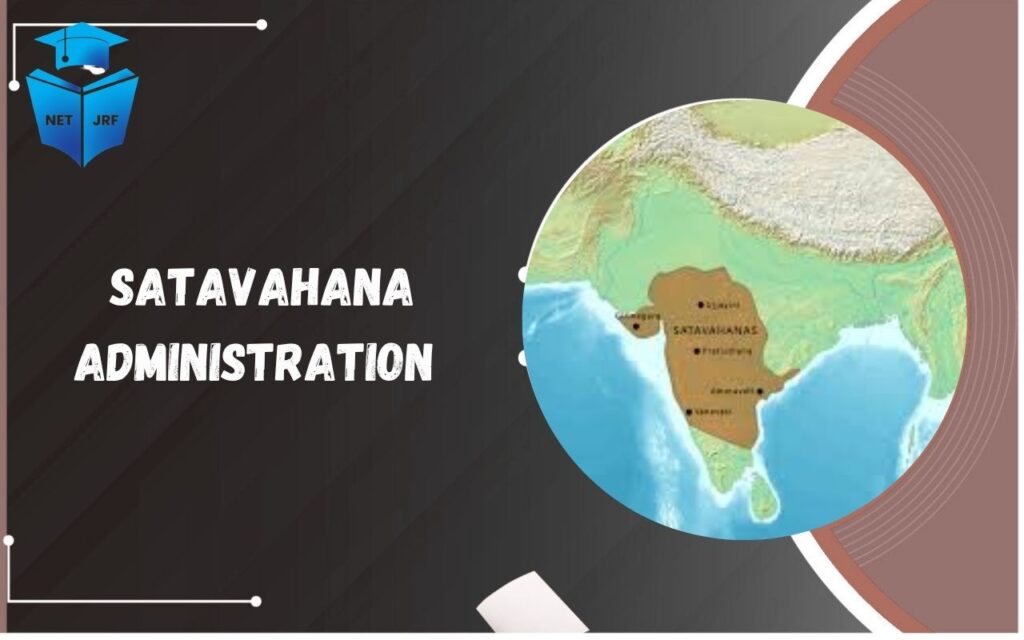
The Satavahana administration was a well-organized system that developed in the Deccan region after the decline of the Mauryan Empire. It combined central authority with local autonomy, making it suitable for a vast and diverse region.
The Satavahanas ruled from around 1st century BCE to 3rd century CE. Their administration was not as centralized as the Mauryas, but it was still effective. It balanced royal authority with the participation of local officials, guilds, and communities. This article explains every aspect in a clear and detailed way.

Features of Satavahana administration
Satavahana administration had unique features that made it different from earlier empires. It was flexible, region-based, and adapted to local conditions.
Key characteristics
- Monarchical system with strong kings
- Decentralized governance structure
- Importance of local officials
- Use of Prakrit language in inscriptions
- Strong role of land revenue
- Support from merchants and guilds
These features show that Satavahana administration focused more on practical governance than strict control.
Enroll UGC NET Online Coaching
Nature of Kingship
The king was the most important authority in Satavahana administration. However, he did not exercise absolute power like some earlier rulers.
Role of the King
- The king was the head of the state
- He was responsible for law, order, and protection
- He controlled military and revenue systems
- He performed religious duties
Kings like Gautamiputra Satakarni played a major role in strengthening the empire. He is known for defeating foreign rulers and restoring Satavahana power.
Titles used by rulers
- Raja (King)
- Maharaja (Great King)
- Dakshinapathapati (Lord of the Deccan)
These titles show both political power and regional importance.
Satavahana Central Administration
Satavahana administration had a central system, but it was not overly complex. It worked through a group of officials who assisted the king.
Important Officials
Amatyas (Ministers)
- They advised the king
- Helped in policy making
Mahamatras
- Looked after administration
- Similar to Mauryan officials
Senapati (Military Head)
- Controlled the army
- Protected the kingdom
Bhandagarika (Treasurer)
- Managed treasury
- Looked after state wealth
These officials ensured smooth functioning of Satavahana administration.
Satavahana Provincial Administration
Satavahana administration divided the empire into provinces for better control.
Structure of Provinces
- Empire divided into Ahara or Rashtra (provinces)
- Governed by officers or royal family members
- Local autonomy was allowed
Role of Governors
- Maintained law and order
- Collected revenue
- Reported to the king
This decentralized system helped manage large territories easily.
Satavahana Local Administration
Local administration formed the backbone of Satavahana administration. Villages were the basic units.
Village Level Governance
- Villages were managed by Gramika (village head)
- Local councils handled disputes
- People participated in governance
Urban Administration
- Towns had officials for trade and taxation
- Merchants had influence in decision-making
This shows that Satavahana administration encouraged local participation.
Satavahana Revenue System
Revenue was the main source of income in Satavahana administration. It supported the army, officials, and development.
Sources of Revenue
- Land tax (main source)
- Trade taxes
- Customs duties
- Fines and penalties
Land Revenue
- Farmers paid a portion of their produce
- Rate varied depending on fertility
Importance of Trade
Trade played a major role in the Satavahana administration because the empire had strong links with Roman trade.
Satavahana administration Structure Overview
The Satavahana administration was designed to manage a vast and diverse empire efficiently while balancing central authority with local autonomy. It combined strong kingship, organized governance, and flexibility, which allowed the dynasty to survive for centuries.
| Aspect | Details |
| Political System | Monarchy |
| Central Authority | King |
| Provinces | Ahara or Rashtra |
| Key Officials | Amatyas, Mahamatras |
| Revenue Source | Land tax, trade |
| Local Governance | Village councils |
| Military | Controlled by Senapati |
Satavahana Military Organization
Military strength was important for maintaining control in Satavahana administration.
Features of Military
- Army included infantry, cavalry, and elephants
- Led by Senapati
- Used for defense and expansion
Kings like Gautamiputra Satakarni used military power effectively to defeat enemies like the Shakas.
Satavahana Judicial System
Satavahana administration had a simple judicial system.
Features of Justice System
- King was the highest judge
- Local disputes handled by village authorities
- Punishments included fines and penalties
Justice was based on customs and traditions.
Satavahana Economic Structure
The Satavahana Empire under rulers like Gautamiputra Satakarni thrived not only because of military and administrative strength but also due to a well-developed economy. Agriculture, trade, and organized guilds formed the backbone of their prosperity.
- Agriculture
For most people, agriculture was the primary occupation. The fertile lands of the Deccan and surrounding regions allowed farmers to cultivate a variety of crops. The Satavahana rulers supported irrigation systems, such as wells, tanks, and canals, to improve crop yields. A strong agricultural base ensured food security and stability for the empire, providing surplus produce for trade and supporting a growing population. - Trade and Commerce
Trade was another pillar of economic strength. The Satavahanas traded extensively with foreign regions, including the Roman Empire. Coastal ports like Kalyan and Sopara played a crucial role in exporting goods like spices, textiles, and precious stones. This international commerce brought wealth, cultural exchange, and prestige to the empire. - Guilds – Organization of Crafts and Trade
Trade and craftsmanship were organized through guilds, which were associations of artisans, merchants, and traders. These guilds controlled production, quality, and pricing in various crafts, ensuring smooth commerce. Interestingly, they also acted as financial institutions, lending money, investing in trade, and supporting economic growth. - Impact on Administration
This strong and organized economy directly supported the success of Satavahana administration. Revenue from agriculture, trade, and guilds funded military campaigns, public works, temples, and infrastructure. A prosperous economy also strengthened the ruler’s authority and helped maintain stability across the empire.
Satavahana Social Structure
Society during Satavahana administration followed traditional patterns but had some flexibility.
Features
- Varna System Existed
The varna system, the traditional social hierarchy of ancient India, continued to guide social organization. Society was divided into groups like Brahmanas (priests), Kshatriyas (warriors), Vaishyas (traders), and Shudras (laborers). This system provided structure and helped maintain order within the empire. - Brahmanas Received Land Grants
Brahmanas, or priestly communities, were granted land by the rulers. These grants were not only a sign of respect for religious authority but also helped integrate Brahmanas into administration and cultural life. By supporting religious leaders, the Satavahanas reinforced social stability and moral authority. - Women Had Some Rights
Women in Satavahana society enjoyed certain rights and freedoms. They could own property, participate in religious rituals, and influence social and political matters indirectly. Their position reflected a society that, while hierarchical, allowed women a degree of respect and agency. - Queens Like Gautami Balashri Played an Important Role
Women of royal families could wield significant influence. Queens such as Gautami Balashri, the mother of Gautamiputra Satakarni, played a prominent role in administration, inscriptions, and political decisions. Their involvement highlights that women in the Satavahana dynasty were not entirely confined to domestic roles but could impact governance and public life. - Queens like Gautami Balashri played an important role, showing women had influence.

Satavahana Role of Land Grants
Land grants were an important feature of governance under the Satavahanas. They served multiple purposes, balancing economic, religious, and social objectives.
Purpose of Land Grants
- Given to Brahmanas
Many land grants were awarded to Brahmanas, or priestly communities. This strengthened ties between the ruling dynasty and religious authorities. By supporting Brahmanas, the Satavahanas reinforced their moral and political legitimacy, as these priests often acted as advisors and intermediaries in society. - Encouraged Agriculture
Land grants were not only symbolic but also practical. By giving land to individuals and communities, the rulers encouraged cultivation and agricultural productivity. Fertile land under productive use increased food supply, supported population growth, and stabilized the rural economy. - Helped in Religious Activities
The recipients of these grants used the land to perform religious rituals, maintain temples, and support Brahmanical education. This strengthened cultural and religious life in the empire and promoted the spread of Brahmanical traditions. - Impact on State Revenue and Society
While these grants reduced immediate revenue for the state, they created long-term benefits. They increased social support, secured loyalty from influential groups, and reinforced the king’s authority as a patron of religion and culture. This trade-off was a strategic move to maintain stability and strengthen governance. - These grants reduced state revenue but increased social support.
Enroll UGC NET Coaching in Jaipur
Satavahana Language and Inscriptions
The Satavahana dynasty left a rich historical record, much of which comes from inscriptions and written documents. Language and script played a central role in administration, culture, and communication.
Key Points
- Prakrit Was Widely Used
The Prakrit language was commonly used for inscriptions and official records. It was accessible to the general population, making it an effective medium for spreading royal decrees, recording grants, and documenting achievements. Using Prakrit helped bridge the gap between the ruler and his subjects. - Brahmi Script Used in Inscriptions
The Brahmi script was employed to write these records. As one of the earliest writing systems in India, Brahmi allowed information to be preserved clearly and systematically. It was used on stone inscriptions, copper plates, and coins, ensuring that important messages and historical events were accurately documented. - Inscriptions Provide Historical Details
Inscriptions are invaluable sources for understanding Satavahana history. They tell us about military victories, land grants, religious patronage, titles, and administrative practices. Famous examples include the Nashik inscription of Gautami Balashri, which records the achievements of Gautamiputra Satakarni.
These sources help historians understand governance clearly.
Satavahana Comparison with Mauryan Administration
The Satavahana administration and the earlier Mauryan system had some similarities in terms of governance, but they also differed in important ways. Understanding these differences highlights the Satavahanas’ unique approach to ruling their empire.
Differences
- Centralization vs. Decentralization
The Mauryas had a highly centralized system, where most power and decision-making were concentrated in the hands of the emperor. In contrast, the Satavahanas practiced decentralization. While the king maintained overall authority, local governors and officials were given considerable autonomy to manage provinces. This allowed for more flexibility in administration, especially in distant regions of the empire. - Bureaucratic Control
The Mauryan bureaucracy was strict and hierarchical, with numerous officials overseeing revenue, law, and justice, leaving little room for local discretion. The Satavahanas, however, permitted more local freedom, relying on provincial leaders, village assemblies, and guilds to handle day-to-day governance. This system encouraged loyalty and reduced the administrative burden on the central authority. - Local Autonomy and Governance
Satavahana rulers recognized that India’s vast and diverse regions could not be controlled entirely from the center. By allowing local rulers, guilds, and communities some autonomy, they maintained order while accommodating regional customs, economic practices, and social structures.
Satavahana administration Strengths
The Satavahana Empire thrived for several centuries due to a combination of flexible governance, economic strength, local participation, and cultural integration. These features helped the dynasty maintain stability and resilience over time.
- Flexible Governance
The Satavahanas practiced a flexible system of administration. While the king maintained overall authority, local governors and communities had some autonomy to manage their regions. This balance between central control and decentralization allowed the empire to adapt to local needs, respond effectively to challenges, and maintain order over a vast territory. - Strong Trade Economy
A prosperous trade network was a key strength. The Satavahanas controlled important trade routes, managed coastal ports like Kalyan and Sopara, and engaged in commerce with foreign regions, including the Roman Empire. This wealth supported the army, funded public works, and strengthened the empire’s political and cultural influence. - Local Participation
The empire encouraged local participation in administration through guilds, village councils, and provincial governors. Artisans, merchants, and community leaders had a say in managing local affairs, which increased loyalty to the state and reduced administrative strain on the central government. - Cultural Integration
The Satavahanas promoted cultural integration by supporting both Brahmanical and Buddhist traditions, encouraging Prakrit language and literature, and fostering art and architecture. By respecting diverse religious and cultural practices, they maintained harmony among their people and strengthened the social fabric of the empire. - These strengths helped the empire survive for a long period.

Satavahana administration Weaknesses
Despite its many strengths, the Satavahana administration also had certain limitations that eventually contributed to the decline of the dynasty.
- Lack of Strong Central Control
The Satavahana system was decentralized, giving local governors and communities considerable autonomy. While this allowed flexibility and local participation, it also meant that the central authority was weaker compared to empires like the Mauryas. In times of internal rebellion or external threat, this lack of strong central control sometimes made coordinated response difficult. - Dependence on Local Officials
The empire relied heavily on local officials, guilds, and provincial governors to manage daily administration. Although this reduced the burden on the king, it also created opportunities for corruption, mismanagement, or disloyalty. Over time, dependence on local leaders weakened central oversight. - Land Grants Reduced Revenue
Land grants to Brahmanas and religious institutions encouraged agriculture and gained social support, but they reduced the state’s revenue. The loss of taxable land meant fewer resources for the army, public works, and administration, which could strain the empire, especially during prolonged military campaigns or economic stress. These weaknesses eventually led to decline.
Satavahana administration was a balanced system that combined royal authority with local governance. It played an important role in shaping early Indian political structure.
Enroll UGC NET Offline Coaching in Jaipur
Satavahana Administration FAQs

Who was the most important ruler of this dynasty?
Gautamiputra Satakarni was the most powerful ruler. He expanded the empire and defeated foreign rulers.
What was the main source of revenue?
Land revenue was the main source. Farmers paid a share of their produce to the state.
How was local administration managed?
Villages were governed by local heads called Gramikas. Councils helped in solving disputes.
What role did trade play in the economy?
Trade was very important. The Satavahanas had strong links with Roman traders.