

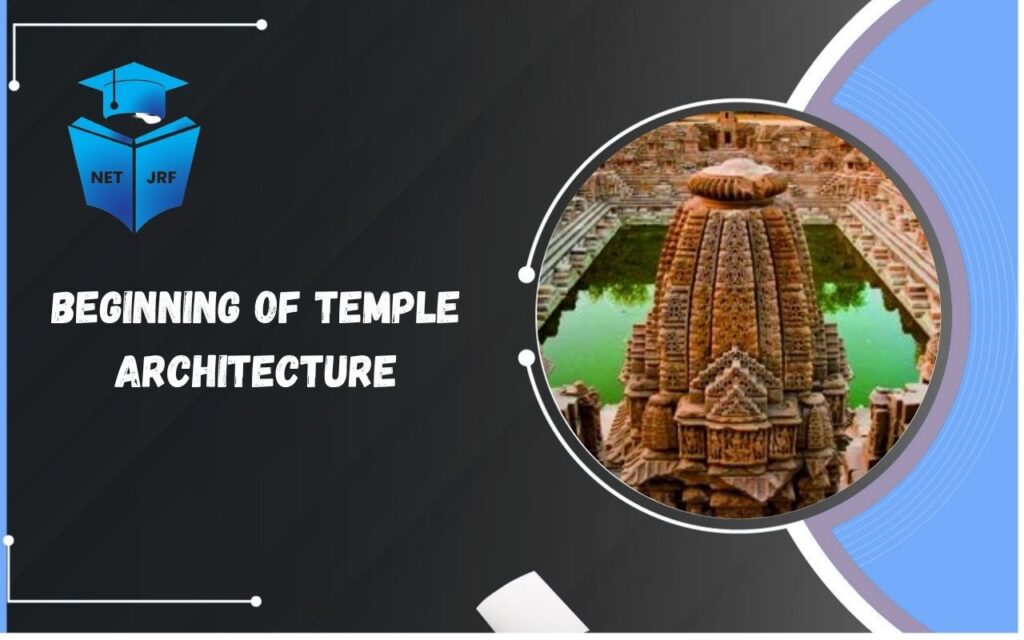
Beginning of temple architecture marks an important phase in Indian history when religious ideas started taking a permanent physical form. Before this period, people mainly used temporary structures or open spaces for worship. But during the Gupta age, we see a clear shift towards building solid temples that could last for a long time.
This change was not sudden. It developed slowly with time, influenced by religion, society, and royal support.

Understanding Beginning of temple Architecture
Beginning of temple architecture refers to the early phase when structured temples were first constructed in India. This period mainly belongs to the Gupta era, often called the golden age of Indian art and culture.Temples during this time were simple in design, but they laid the foundation for later grand structures.
Enroll UGC NET Online Coaching
Historical background
Beginning of temple architecture did not start in isolation. It developed from earlier traditions.
Earlier practices
- Worship in open areas
- Use of wooden structures
- Rock-cut caves like Ajanta
These earlier forms slowly evolved into free-standing temples.
Why temple building started
Beginning of temple architecture happened due to several reasons.
Main causes
The beginning of temple architecture in ancient India, especially during the Gupta period, was not sudden. It developed gradually due to religious, social, and political changes. Temples became important centers of worship, culture, and community life.
Main Causes of Temple Building
Growth of Hindu Religion
- During this period, Hinduism became more organized and widespread.
- Worship of deities like Vishnu, Shiva, and Shakti increased.
This created a need for dedicated places of worship.
Rise of Bhakti Movement
- The Bhakti movement emphasized personal devotion to a god.
- People wanted a direct and emotional connection with their deity.
Temples provided a space for prayer, rituals, and devotion.
Royal Patronage
- Kings supported temple construction to:
- Show their religious faith
- Gain legitimacy and public support
- Temples also displayed the power and wealth of rulers.
Royal support played a major role in the expansion of temple architecture.
Need for Permanent Worship Places
- Earlier worship was often done in temporary structures or open spaces.
- Over time, people felt the need for permanent and well-structured temples.
Temples became fixed centers of religious life.
Key features of early temples
The beginning of temple architecture in ancient India, especially during the Gupta period, shows simple yet meaningful structures. These early temples laid the foundation for the grand and highly decorative temples of later periods.
Garbhagriha (Sanctum)
- The most important part of the temple was the garbhagriha, or inner sanctum.
- It housed the main deity and was considered the sacred core of the temple.
It symbolized the spiritual center where devotees connected with the divine.
Flat Roof in Early Stage
- Early temples generally had flat roofs, unlike the later tall shikharas.
- The architectural style was still in its developing stage.
This shows the evolution of temple design over time.
Simple Entrance
- Entrances were plain and functional, without much decoration.
- The focus was more on religious purpose than artistic display.
Simplicity reflected the early phase of architectural development.
Small Size Structure
- These temples were usually small in size.
- They were built for local communities and limited gatherings.
Unlike later temples, they were not grand or complex.
Overall Nature
- Early temples were:
- Simple in design
- Less decorative
- Highly religious in purpose
Even with minimal decoration, they carried deep spiritual significance.

Materials used in construction
The beginning of temple architecture in ancient India marks an important shift in the use of construction materials. Builders moved from temporary materials to strong and durable ones, ensuring that temples could last for generations.
Common Materials Used
Stone
- Stone became one of the most widely used materials in temple construction.
- It provided strength, durability, and permanence.
Stone temples could survive for centuries, which is why many still exist today.
Brick
- Bricks were also commonly used, especially in regions where stone was less available.
- Some early temples were built entirely of baked bricks.
Brick construction shows the technical skill and adaptability of ancient builders.
Shift from Wooden Structures
- Earlier, religious structures were often made of wood, which was not long-lasting.
- Over time, these were replaced by stone and brick temples.
This shift ensured:
- Longer life of temples
- Better preservation of religious sites
- Development of permanent sacred spaces
Earlier wooden structures were replaced by stronger materials to ensure long life.
Beginning of temple architecture structural elements
| Element | Description |
| Beginning of temple architecture Garbhagriha | Inner sanctum where deity placed |
| Mandapa | Hall for devotees |
| Shikhara | Tower above sanctum |
| Entrance | Simple doorway |
Garbhagriha the core of temple
Beginning of temple architecture gives special importance to garbhagriha.
It is the innermost chamber where the deity is kept. It is usually small, dark, and quiet. This design creates a spiritual atmosphere.
Enroll UGC NET Coaching in Jaipur
Mandapa space for people
Beginning of temple architecture also introduced mandapa.
This is a hall where devotees gather. In early temples, it was small, but later it became larger and more complex.
Shikhara development
Beginning of temple architecture initially had flat roofs.
Later, a tower called shikhara was added. This became an important feature of North Indian temples.
Role of Gupta rulers
The Gupta period is often called a golden age of art and architecture. One of its most important contributions was the growth of temple architecture, which developed significantly under the support of Gupta rulers.
Support for Temple Construction
- Gupta kings actively encouraged the building of temples.
- They provided resources, land, and protection for such activities.
This led to the spread of permanent temple structures across their empire.
Promotion of Art and Culture
- The Guptas were great patrons of art, sculpture, and architecture.
- Temples became centers where artistic skills were expressed, especially in carvings and design.
This resulted in the development of a distinct and refined architectural style.
Encouragement of Religious Activities
- Gupta rulers supported Hinduism and other religions, promoting rituals and worship.
- Temples served as important places for religious gatherings and ceremonies.
Examples of early temples
The beginnings of temple architecture in ancient India can be clearly seen through some important early temples of the Gupta period. These structures reflect the initial stages of design, simplicity, and religious importance that later developed into grand temple styles.
Dashavatara Temple
- One of the earliest known structural Hindu temples.
- Dedicated to Lord Vishnu.
- Shows early features like garbhagriha and simple shikhara beginnings.
It is an important example of the transition from simple to developed temple architecture.
Bhitargaon Temple
- A famous brick temple from the Gupta period.
- Known for its use of baked bricks and terracotta panels.
- Reflects advanced knowledge of construction techniques.
It highlights the importance of brick architecture in early temples.
Tigawa Temple
- A small and simple stone temple.
- Known for its flat roof and plain design.
- Represents the basic form of early temple structures.
It shows the simplicity and functional nature of early temple architecture.
Architectural styles emerging
The beginning of temple architecture in ancient India gradually led to the development of distinct regional styles. Although these styles reached their peak in later periods, their basic features and foundations were laid during the Gupta period.
Two Main Styles of Temple Architecture
Nagara Style (North India)
- Developed in northern India.
- Main feature is the curvilinear shikhara (tower) above the sanctum.
- Temples are generally built on a raised platform with a simple layout.
This style reflects the evolution of early Gupta temple designs into more complex forms.
Dravida Style (South India)
- Developed in southern India.
- Characterized by pyramidal towers (vimana) and large entrance gateways (gopurams in later periods).
- Temples are usually part of large temple complexes.
It shows how temple architecture became more grand and elaborate over time.
Roots in Gupta Period
- Early Gupta temples introduced:
- Garbhagriha (sanctum)
- Simple structural design
- Use of stone and brick
These elements became the foundation for later architectural styles.
Religious significance
The beginning of temple architecture in ancient India was not just an architectural development it was a deep cultural transformation. Temples became centers of religion, art, and social life, influencing every aspect of society.
Religious Significance
- Temples were considered the house of God, not just physical structures.
- The garbhagriha (sanctum) was seen as the most sacred space, where the deity resided.
- Every part of the temple from entrance to tower had a symbolic and spiritual meaning.
Temples created a direct connection between humans and the divine.
Artistic development
The rise of temple architecture gave a major boost to art and craftsmanship.
Artistic Features
- Sculptures on walls: Stories from mythology and religious texts
- Carvings of gods and goddesses: Expressing devotion and belief
- Decorative designs: Enhancing beauty and creativity
Temples became centers of artistic excellence and cultural expression.
Social impact
Beginning of temple architecture affected society.Temples played an important role beyond religion and became community centers.
Changes in Society
- Social centers: People gathered for meetings and discussions
- Festivals and rituals: Celebrations brought communities together
- Economic activity: Markets and trade developed around temples
Economic impact
Beginning of temple architecture also influenced economy.
-
Effects
-
- The beginning of temple architecture in ancient India did not only shape religion and culture it also had a significant economic impact. Over time, this tradition continued to grow and became even more elaborate in the post-Gupta period.
Enroll UGC NET Offline Coaching in Jaipur
Economic Impact of Temple Architecture
Temple construction played an important role in strengthening the local and regional economy.
Key Effects
- Generated Employment:
Building temples required a large number of workers such as laborers, architects, sculptors, and craftsmen. - Encouraged Craftsmanship:
Skilled artisans developed expertise in stone carving, sculpture, and decorative arts. - Increased Trade:
Temples attracted pilgrims, which led to the growth of markets, shops, and trade activities around temple areas.
Thus, temples became centers of economic activity, not just religious places.Temple construction required skilled workers.

Growth after Gupta period
- The temple-building tradition that began in the Gupta period continued and expanded in later centuries.
- Later dynasties:
- Built larger and more complex temples
- Added ornate decorations and sculptures
- Developed grand styles like Nagara and Dravida more fully
This shows how early temple architecture laid the foundation for magnificent temple traditions in medieval India.
The beginning of temple architecture had a lasting economic and developmental impact. It created jobs, promoted skills, and boosted trade, while its continued growth after the Gupta period led to the creation of some of the most impressive temples in Indian history.
Beginning of Temple Architecture FAQs

2. Why did temple architecture begin in India?
Temple architecture began due to the growth of Hindu religion, rise of Bhakti movement, and support from kings. People needed fixed places for worship, rituals, and devotion.
3. What materials were used in early temples?
Early temples were built using stone and brick for strength and durability. This replaced earlier wooden structures, making temples long-lasting.
4. What is garbhagriha in temples?
Garbhagriha is the inner sanctum where the main deity is placed. It is the most sacred part of the temple.
5. What is mandapa in temple architecture?
Mandapa is a hall in front of the sanctum where devotees gather for prayers and rituals. It was small in early temples.