The Kingdoms in Deccan form one of the most fascinating chapters in Indian history. Spread across the vast plateau region between the Vindhya mountains in the north and the river Krishna Tungabhadra in the south, the Deccan gave rise to some of the most powerful and culturally rich kingdoms that South Asia has ever seen. These kingdoms were not isolated political entities. They shaped trade routes connecting northern India to the southern peninsula, patronized art and religion on a grand scale, and often served as a bridge between two very different cultural worlds: the Indo-Gangetic plains and the deep Tamil south.

What is Deccan Region?
Before understanding the kingdoms, it is important to know the geography. The word “Deccan” comes from the Sanskrit word Dakshin, meaning south.
The Deccan plateau is bounded by:
- North: Vindhya and Satpura ranges
- East: Eastern Ghats
- West: Western Ghats
- South: River Krishna and Tungabhadra
Major rivers like the Godavari, Krishna, Bhima, and Tungabhadra flow through this region and supported agriculture, settlement, and trade. The Deccan’s central position made it strategically vital whoever controlled the Deccan could influence both north and south India.
Enroll UGC NET Online Coaching
Major Kingdoms in Deccan Overview
To understand the political history of the Deccan, it is important to look at the major kingdoms that dominated the region over time.
| Kingdom | Period (Approx.) | Capital | Notable Ruler |
| Satavahanas | 1st century BCE – 3rd century CE | Pratishthana (Paithan) | Gautamiputra Satakarni |
| Vakatakas | 3rd – 5th century CE | Nandivardhana, Vatsagulma | Pravarasena I, Rudrasena II |
| Chalukyas of Badami | 6th – 8th century CE | Vatapi (Badami) | Pulakesi II |
| Rashtrakutas | 8th – 10th century CE | Manyakheta (Malkhed) | Dantidurga, Amoghavarsha I |
| Chalukyas of Kalyani | 10th – 12th century CE | Kalyani (Basavakalyan) | Vikramaditya VI |
| Yadavas of Devagiri | 9th – 14th century CE | Devagiri (Daulatabad) | Singhana, Ramachandra |
| Kakatiyas | 12th – 14th century CE | Warangal | Rudrama Devi, Prataparudra II |
| Hoysalas | 11th – 14th century CE | Dwarasamudra (Halebidu) | Vishnuvardhana, Ballala III |
Satavahana Kingdom
The Satavahanas are widely regarded as the first historically documented ruling dynasty of the Deccan.
- They rose to prominence around the 1st century BCE, filling the political vacuum left after the Mauryan Empire’s decline.
- Their original homeland was the region of present-day Andhra Pradesh and Maharashtra, and they gradually expanded their control over large parts of central and southern India.
- Ancient inscriptions, Puranic literature, and coins are the primary sources for Satavahana history.
Capital and Territory
The main capital of the Satavahanas was Pratishthana (modern Paithan in Maharashtra) on the banks of the Godavari river. They also controlled Amaravati and Dhanyakataka in Andhra Pradesh, which served as important administrative and religious centers.
At their peak, Satavahana territory stretched from the Arabian Sea coast in the west to the Bay of Bengal in the east, covering much of the Deccan plateau.
Important Rulers
Simuka is traditionally regarded as the founder of the Satavahana dynasty.
Satakarni I was one of the early powerful rulers who performed Vedic sacrifices like Ashwamedha, which showed royal ambition and political legitimacy.
Gautamiputra Satakarni (c. 106–130 CE) was undoubtedly the greatest Satavahana ruler. He:
- Defeated the Western Kshatrapas (Sakas), especially Nahapana
- Reunited territories that had been lost
- Called himself the destroyer of the pride of Kshatriyas
- His mother Gautami Balashri’s Nashik inscription provides detailed information about his achievements
Vashishthiputra Pulumayi continued the expansion and is associated with the Amaravati school of art.
Yajna Sri Satakarni was the last great ruler, known for his maritime interests, as reflected by ship motifs on his coins.
Political Structure
The Satavahana state was a monarchy with a well-organized administrative system:
- King was the supreme authority, often described as a great warrior and performer of Vedic rituals
- Amatyas (ministers) assisted in governance and policy-making
- Maharathis and Mahabhojas were feudatory chiefs who administered regions under royal supervision
- Gaulmika was an important military-administrative officer in charge of a gaulma (a unit of soldiers and their families settled in villages)
- Villages were the basic administrative units, managed by local headmen called Gramika

Economy
The Satavahana economy was remarkably prosperous.
- Agriculture was the backbone. The Godavari and Krishna river valleys produced surplus rice, cotton, and other crops.
- Trade was extensive and international. The Satavahanas controlled major trade routes both the northern land routes and the coastal sea routes.
- Key exports included: cotton, muslin, spices, pearls, and ivory.
- Ports like Sopara, Bharukacha (Bharuch), and Masulipatnam handled enormous volumes of sea trade with the Roman Empire, Arabia, and Southeast Asia.
- Roman historian Pliny complained that Rome was losing gold to India through this trade, which shows how active the Satavahana commercial network was.
- Guilds (shrenis) played an important role in organizing trade and craft production. Merchants and craftsmen were well-respected in Satavahana society.
Society
Satavahana society showed some unique features:
- Metronymic naming kings identified themselves through their mother’s name (e.g., Gautamiputra = son of Gautami). This shows the importance of women in lineage identification.
- Society was broadly organized on Varna lines, but was flexible in practice.
- Women of royal families were active and respected.
- Inter-marriage between Satavahanas and Saka (Kshatrapa) families also occurred, showing social mixing.
Religion
The Satavahanas followed and patronized multiple religions:
- Brahmanical Hinduism: They performed Vedic rituals, horse sacrifices, and worshipped deities like Vishnu and Shiva.
- Buddhism: They were great patrons of Buddhism. The magnificent Amaravati Stupa and the Karle, Bhaja, and Nasik cave temples were built or supported under their rule.
- The society was broadly tolerant, with Brahmanical and Buddhist traditions coexisting peacefully.
Enroll UGC NET Coaching in Jaipur
Art and Architecture
The Satavahana period produced outstanding art:
- Amaravati School of Art famous for delicately carved limestone sculptures with dynamic compositions. Scenes from the Buddha’s life were depicted with great artistic sensitivity.
- Rock-cut caves at Karle, Bhaja, Bedsa, and Nasik featuring elaborate facades, chaityas (prayer halls), and viharas (monasteries).
- Satavahana coins are art objects in themselves, depicting ships, elephants, and royal symbols.
Language and Literature
- The Satavahanas patronized Prakrit as the official language. Most of their inscriptions are in Prakrit.
- Hala, a Satavahana king, compiled the famous Gathasaptasati an anthology of 700 love poems in Maharashtri Prakrit. This work remains a landmark in Indian literary history.
- Sanskrit also received some patronage, and the grammar text Katanatantra is associated with this period.
Vakataka Kingdom
The Vakatakas rose to power in the 3rd century CE, at a time when the Satavahana kingdom was collapsing. They emerged as the dominant power in the Vidarbha region (eastern Maharashtra) and gradually extended their influence across central Deccan.
The Vakatakas are particularly important because they served as a crucial link between the Gupta Empire of the north and the Deccan kingdoms of the south.
Branches of the Vakatakas
The Vakataka kingdom eventually split into two main branches:
- Main/Nagpur Branch (Nandivardhana line): Based in Vidarbha, this was the principal branch. It had close matrimonial ties with the Gupta dynasty Rudrasena II married Prabhavatigupta, daughter of the Gupta emperor Chandragupta II.
- Vatsagulma Branch: Based in Washim (Maharashtra). This branch was more independent and had its own line of kings.
Important Rulers
- Vindhyashakti is regarded as the founder of the Vakataka dynasty.
- Pravarasena I was the most powerful early ruler. He performed four Ashwamedha sacrifices and took the title of Samrat, indicating supreme sovereignty.
- Rudrasena II formed the famous alliance with the Guptas by marrying Prabhavatigupta. After his early death, Prabhavatigupta ruled as regent on behalf of her minor sons, making Vakataka territory virtually a Gupta protectorate for a period.
- Pravarasena II (son of Prabhavatigupta) was a notable ruler and also a poet; he wrote the Prakrit poem Setubandha (Ravanavaho), describing Rama’s construction of the bridge to Lanka.
- Harishena of the Vatsagulma branch was the king under whose patronage the later caves at Ajanta were excavated.
Administration
- Monarchy was the form of government.
- The kingdom was divided into rashtra (provinces) headed by rashtrapatis.
- Below that were vishaya (districts) administered by vishayapatis.
- Village administration was handled by local headmen.
- The dual influence of Gupta administrative models and local Deccan traditions is visible in Vakataka governance.
Economy
- Agriculture in Vidarbha’s fertile plains was the primary economic base.
- Trade continued along the established Deccan routes.
- Crafts, especially weaving and metallurgy, contributed to economic prosperity.
Religion and Culture
- The Vakatakas were devoted Shaivites Shiva worship was the predominant religious tradition, though they maintained religious tolerance.
- They also patronized Buddhism generously.
- Ajanta Caves The most enduring legacy of the Vakatakas. The famous Phase II paintings at Ajanta (caves 1, 2, 16, 17, 19, etc.) were executed under Vakataka patronage, especially under Harishena. These paintings are among the finest examples of ancient Indian art and are now a UNESCO World Heritage Site.
- The paintings depict Jataka stories, scenes from the Buddha’s life, court scenes, and nature executed with extraordinary skill and emotional depth.
Chalukyas of Badami (Early Western Chalukyas)
The Chalukyas of Badami (also called Early Western Chalukyas or Chalukyas of Vatapi) established one of the most powerful kingdoms in the Deccan during the 6th to 8th centuries CE.
- They rose to prominence under Pulakesi I, who established his capital at Vatapi (modern Badami in Karnataka) around 543 CE.
- Their origins are debated some sources suggest they were local Deccan chiefs, while others trace connections to northern Kshatriya lineages. The Chalukyas themselves claimed descent from the Lunar dynasty.
Important Rulers
- Pulakesi I (543–566 CE): Founder who established the kingdom and performed the Ashwamedha sacrifice.
- Kirtivarman I (566–597 CE): Son of Pulakesi I. Expanded the kingdom by defeating the Nalas, Mauryas of Konkan, and Kadambas.
- Mangalesha (597–609 CE): Brother of Kirtivarman I. He was a great patron of the famous Badami cave temples.
- Pulakesi II (609–642 CE): The greatest Chalukya ruler. His achievements include:
- Defeated the powerful Gurjara-Pratiharas and Latas in the north
- Stopped the southward advance of Harsha of Kannauj at the Battle of Narmada (c. 618–619 CE) a landmark event in Indian history. The Chinese traveler Xuanzang (Hiuen Tsang) visited India during this period and his accounts provide important information.
- Defeated the Pallava king Mahendravarman I in the south
- Received an embassy from the Persian king Khusrau II confirming his international stature
- The famous Aihole inscription by court poet Ravikirti describes his achievements
- Vikramaditya I (655–681 CE): Recovered the kingdom after Pulakesi II was killed by Pallava king Narasimhavarman I, who temporarily captured Vatapi.
- Vikramaditya II (733–745 CE): Led successful military campaigns against the Pallavas and captured Kanchipuram three times.
- Kirtivarman II: The last Chalukya ruler of Badami, overthrown by the Rashtrakuta chief Dantidurga around 753–757 CE.
Administration
- The kingdom was divided into Maharashtra (large provinces) and smaller units.
- Feudatory chiefs called Mahashilanayakas and Mahashilanayikas (female chiefs) administered regions.
- Revenue was collected from agriculture, trade, and tribute.
- The military was powerful infantry, cavalry, elephants, and a naval force were maintained.
Economy
- Agriculture in the Krishna and Malaprabha valleys supported the population.
- Trade through western coastal ports like Bharukacha and Kalyan was active.
- Crafts like textiles and metalwork flourished.
Religion
- The Chalukyas followed Brahmanical Hinduism, particularly Vaishnavism and Shaivism, but also patronized Jainism.
- They showed genuine religious tolerance Hindu temples, Jain temples, and Buddhist monuments were all built under their rule.
Art and Architecture
The Chalukyas made landmark contributions to Indian architecture:
Badami Cave Temples (late 6th–7th century CE):
- Four rock-cut cave temples at Badami three Hindu and one Jain
- Cave 3 (dedicated to Vishnu) is the largest and most impressive, with magnificent sculptures of Vishnu in various forms
Pattadakal Temples:
- A group of temples showing both Nagara (north Indian) and Dravida (south Indian) styles
- The Virupaksha Temple at Pattadakal (built by Queen Lokamahadevi after Vikramaditya II’s victory over the Pallavas) is a masterpiece now a UNESCO World Heritage Site
- The Papanatha Temple shows a fusion of both styles
Aihole:
- Called the “cradle of Indian temple architecture”
- Over 70 temples in various styles, representing early experiments in temple design
- The Durga Temple at Aihole with its apsidal plan is particularly notable
The Chalukyan style blended northern and southern elements into a distinctive regional architecture that later influenced the Rashtrakutas and Hoysalas.
Rashtrakuta Kingdom
The Rashtrakutas were the most powerful Deccan dynasty of the 8th to 10th centuries. They emerged as feudatories under the Chalukyas and overthrew them around 753 CE when Dantidurga defeated the last Chalukya ruler Kirtivarman II.
At their peak, the Rashtrakutas controlled territory from the Ganges in the north to Cape Comorin in the south, and from the Arabian Sea in the west to Cuttack in the east making them one of the largest empires of medieval India.
Arab geographers of the time referred to the Rashtrakuta king as one of the four great kings of the world.
Capital
Manyakheta (modern Malkhed in Karnataka) was the Rashtrakuta capital.
Important Rulers
- Dantidurga (c. 735–756 CE): Founder. Defeated the Chalukyas and established Rashtrakuta supremacy.
- Krishna I (756–773 CE): Built the famous Kailasa Temple at Ellora one of the greatest achievements of Indian rock-cut architecture.
- Dhruva (780–793 CE): Expanded the kingdom northward, defeating both the Gurjara-Pratiharas and the Palas the first Rashtrakuta king to intervene decisively in the three-way struggle for Kanauj.
- Govinda III (793–814 CE): The most militarily successful ruler. Defeated all three major powers Pratiharas, Palas, and Pallavas and extended Rashtrakuta control across much of India.
Amoghavarsha I (814–878 CE): One of the most remarkable rulers in Indian history. He:
- Ruled for an extraordinarily long period of 64 years
- Was a great patron of Kannada literature
- Wrote Kavirajamarga the earliest surviving work of Kannada literary criticism
- Was devoted to Jainism
- Known as Nripatunga (ornament of kings)
- Arabic traveler Suleiman described him as one of the four great kings of the world
Krishna III (939–967 CE): The last great Rashtrakuta ruler. He defeated the Chola king Parantaka I at the Battle of Takkolam and extended Rashtrakuta power to the far south.
Administration
The Rashtrakuta administrative system was well-organized:
- Kingdom was divided into rashtra (provinces), vishaya (districts), and bhukti (sub-districts)
- Rashtrapatis headed provinces; Vishayapatis headed districts
- Feudatory chiefs (Samantas) administered peripheral regions and paid tribute
- Revenue was collected from land tax, trade duties, and tribute
- A strong military with all four traditional divisions was maintained
Economy
- Agriculture in the Deccan plateau, especially the Godavari and Krishna valleys, was productive.
- Trade with Arab merchants was extensive Arab traders frequented ports on the Konkan and Malabar coasts.
- Horse trade with Arab merchants was particularly significant.
- Guilds of merchants (Vanigas) and craftsmen organized commerce.
Religion
The Rashtrakutas showed remarkable religious tolerance:
- Jainism was particularly favored Amoghavarsha I was a Jain devotee and is said to have abdicated for spiritual reasons before returning to rule.
- Shaivism and Vaishnavism were also patronized.
- Islam Arab Muslim traders were allowed to build mosques and practice freely, showing notable pluralism.
Art and Architecture Ellora
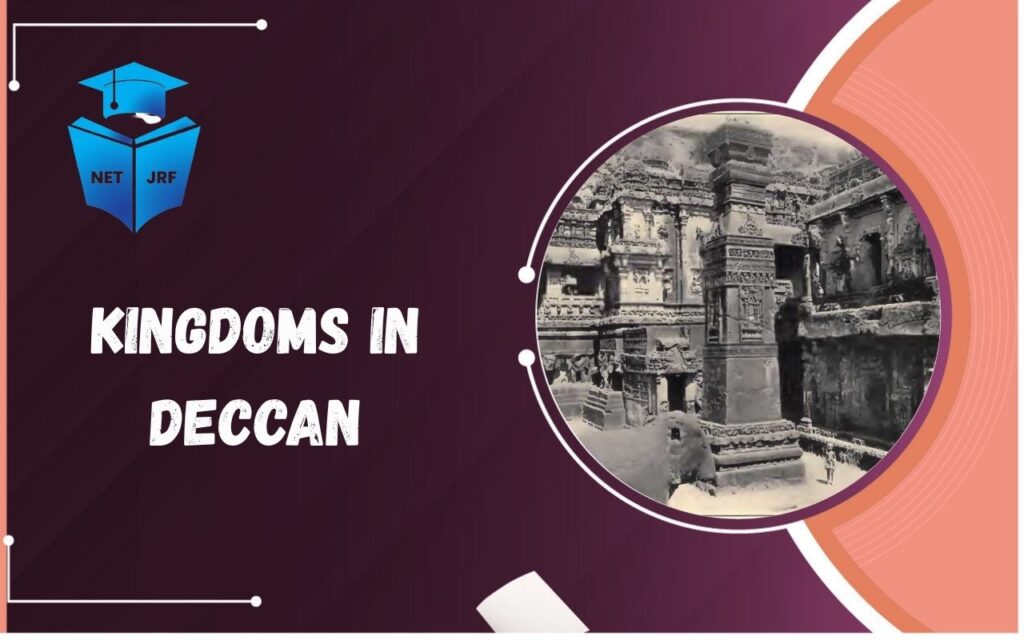
The greatest achievement of the Rashtrakutas in art and architecture is the Kailasa Temple at Ellora (Cave 16).
Built by Krishna I in the 8th century CE, the Kailasa Temple is:
- Carved entirely out of a single rock a monolithic structure cut from top to bottom
- Dedicated to Shiva
- Represents Mount Kailash the abode of Shiva
- Larger than the Parthenon in Athens
- Decorated with magnificent sculptural panels depicting scenes from the Ramayana, Mahabharata, and Puranas
This temple remains one of the greatest architectural achievements in human history.
The Ellora complex as a whole with its Hindu, Buddhist, and Jain caves represents the pluralistic spirit of the era.
Elephanta Caves (near Mumbai) are also associated with Rashtrakuta-period Shaiva art the three-headed Sadashiva (Maheshmurti) sculpture is one of the finest in Indian art.
Literature
The Rashtrakuta period saw the emergence of Kannada literature as a major literary tradition:
- Kavirajamarga by Amoghavarsha I earliest surviving Kannada literary work
- Adipurana and Mahapurana by Pampa and Ponna great Kannada Jain literary works
- Vikramarjuna Vijaya (Pampa Bharata) by Adikavi Pampa a masterpiece of Kannada poetry
- Sanskrit literature also flourished
Enroll UGC NET Offline Coaching in Jaipur
Later Western Chalukyas
After the Rashtrakutas declined in the late 10th century, the Chalukyas of Kalyani (also called Later Western Chalukyas or Tailapa’s Chalukyas) revived Chalukya power in the Deccan.
- Tailapa II (973–997 CE) overthrew the last Rashtrakuta ruler Indra IV and established the new Chalukya kingdom with its capital at Kalyani (present-day Basavakalyan in Karnataka).
Important Rulers
Tailapa II: Founder. Defeated the Rashtrakutas and established control over the Deccan.
Someshvara I (1042–1068 CE): Extended Chalukya power. He composed the encyclopedic Sanskrit text Manasollasa (also called Abhilashitarthachintamani) a remarkable work covering topics from kingship, cooking, music, and games to governance and medicine.
Vikramaditya VI (1076–1126 CE): The greatest ruler of this dynasty. He:
- Started a new calendar era called Vikrama Chalukya Era
- Patronized the scholar Bilhana, who wrote the Sanskrit poem Vikramankadevacharita in his praise
- Patronized Vijnaneshwara, who wrote Mitakshara one of the most important texts on Hindu law, still used as legal authority today
- His reign is considered a golden age of the Later Chalukyas
Someshvara IV: The last ruler, defeated by the Yadavas and Hoysalas in the early 13th century.
Art and Architecture
The Later Chalukyas developed a distinctive architectural style called Kalyani Chalukyan style or Karnataka Dravida style:
- Temples with intricate horizontal moldings called sukhanasi
- Star-shaped (stellate) ground plans
- Rich sculptural decoration
- Notable temples at Lakkundi, Ittagi (Mahadeva Temple called the “Emperor among temples”), and Dambal

Yadavas of Devagiri
The Yadavas (also called Sevunas) rose from being feudatories of the Chalukyas of Kalyani to become an independent power in the 12th century. Their capital was Devagiri (modern Daulatabad in Maharashtra).
Important Rulers
- Bhillama V declared independence from the Chalukyas around 1187 CE and is regarded as the effective founder of the independent Yadava kingdom.
- Singhana (1210–1246 CE): The greatest Yadava ruler. He expanded the kingdom significantly and was known as Singhana the Great.
- Hemadri (also called Hemadpant): A famous minister under later Yadava kings. He wrote the encyclopedic text Chaturvarga Chintamani and is credited with developing a distinctive architectural style using black stone without mortar (Hemadpanthi style).
- Ramachandra (1271–1309 CE): The last significant ruler. He patronized the saint-poet Dnyaneshwar, who wrote the Dnyaneshwari a celebrated Marathi commentary on the Bhagavad Gita.
- Mahadeva: During his reign, the great Marathi saint-poet Namdev began his literary activity.
Decline
The Yadava kingdom came to an end when Alauddin Khalji’s general Malik Kafur raided Devagiri repeatedly between 1296 and 1318 CE. The last Yadava king Ramachandra surrendered and eventually the kingdom was annexed by the Delhi Sultanate.
Cultural Contribution
- The Yadava period was the golden age of Marathi language and literature.
- Saint-poets like Dnyaneshwar, Namdev, and Eknath flourished during or just after this period.
- The Varkari movement, a devotional Bhakti movement centered on the worship of Vitthal (Vithoba) at Pandharpur gained immense momentum.
Kakatiyas of Warangal
The Kakatiyas were a Telugu dynasty that rose to prominence in the 12th century in what is today Telangana. They began as feudatories of the Chalukyas of Kalyani and became independent in the 12th century.Their capital was Warangal (also called Orugallu), which they transformed into a magnificent city.
Important Rulers
- Prola II is credited with asserting Kakatiya independence.
- Rudradeva (c. 1158–1195 CE): First major independent ruler. Built the famous Thousand Pillar Temple at Warangal.
- Ganapati Deva (1199–1262 CE): The greatest Kakatiya ruler. He expanded the kingdom to cover almost the entire Telugu-speaking region, built an efficient administrative system, and was a great patron of Telugu literature.
- Rudrama Devi (c. 1262–1289 CE): One of the very few women rulers in medieval Indian history. She assumed male titles and led military campaigns successfully. Marco Polo, who visited the region, mentioned her favorably.
- Prataparudra II (1289–1323 CE): The last Kakatiya ruler. Despite fighting valiantly, he could not stop the Delhi Sultanate’s invasions. He was eventually captured by Malik Kafur and then by Ulugh Khan (Muhammad bin Tughluq), and the Kakatiya kingdom was annexed in 1323 CE.
Administration
- The kingdom was organized into nayakships military-administrative units controlled by nayakas (chiefs)
- Land revenue was systematically collected
- Trade through the eastern ports was actively promoted
Economy
- The Kakatiyas built an extensive irrigation network of thousands of tanks (reservoirs) across Telangana. This engineering achievement transformed the region into a productive agricultural zone.
- Warangal was a major center of trade, especially for cotton textiles.
- Diamond mining at Golconda (though more famous later) began gaining importance during this period.
Art and Architecture
The Kakatiyas developed a distinctive architectural style characterized by:
- Star-shaped temples with elaborate carvings
- Kakatiya Toranas magnificent decorative gateways
- The Thousand Pillar Temple (Rudreshwara Temple) at Hanamkonda a stunning example of Kakatiya architecture
- The Ramappa Temple (Ramappa Lake area) recently inscribed as a UNESCO World Heritage Site, known for its floating bricks and extraordinary sculptural details
Literature
The Kakatiya period was a golden age of Telugu literature:
- Tikkana Somayaji second of the three great translators of the Mahabharata into Telugu, patronized by Ganapati Deva
- Ketana and Marana other important Telugu poets
Hoysala Kingdom
The Hoysalas were a Kannada-speaking dynasty who rose from the foothills of the Western Ghats to become a major power in the southern Deccan between the 11th and 14th centuries.
Their capital was Dwarasamudra (modern Halebidu in Karnataka).
Important Rulers
Vishnuvardhana (c. 1108–1152 CE): The most important early ruler. He:
- Defeated the Cholas and expanded Hoysala territory into Tamil Nadu
- Was originally a Jain but converted to Vaishnavism under the influence of the philosopher-saint Ramanujacharya
- Built the famous Belur Chennakesava Temple to celebrate his victory over the Cholas
Veera Ballala II (1173–1220 CE): Expanded the kingdom further, making Hoysalas one of the strongest powers in the south.
Veera Ballala III (c. 1292–1342 CE): The last great Hoysala ruler. He bravely resisted Malik Kafur’s raids but could not prevent eventual defeat. He died fighting against the Madurai Sultanate.
Art and Architecture
The Hoysalas made perhaps the most distinctive contribution to Indian temple architecture. The Hoysala style is immediately recognizable:
- Star-shaped (stellate) ground plans temples are built on star-shaped platforms
- Chloritic schite (soft soapstone) the material used, which allowed for incredibly intricate carving
- Horizontal band decoration temples covered from base to top with rows of carved animals, plants, scrolls, and divine figures
- Unique tower (shikhara) design called the turreted tower, with multiple smaller towers clustered together
Key Hoysala Temples:
- Belur Chennakesava Temple (1117 CE): Built by Vishnuvardhana. Known for extraordinarily detailed bracket figures (Salabhanjika) and decorative panels.
- Halebidu (Dwarasamudra) Hoysaleshwara Temple (12th century CE): The finest example of Hoysala art. Despite never having a completed tower, it is covered with thousands of sculptural figures possibly the most densely sculpted temple in India.
- Somanathapura Kesava Temple (1268 CE): A perfectly preserved, smaller but complete Hoysala temple often called the jewel of Hoysala architecture.
Comparative Overview Key Themes Across Deccan Kingdoms
All Deccan kingdoms benefited from their strategic position on trade routes:
- East-west routes crossing the Deccan plateau connected the Coromandel Coast with the Konkan/Malabar Coast
- North-south routes connected the Gangetic plains with the Tamil south
- Maritime trade through western ports (Bharukacha, Kalyan, Sopara) and eastern ports (Masulipatnam) was consistently important
- Arab traders maintained active commercial links with the Deccan from the Rashtrakuta period onward
Religion and Tolerance
A defining feature of most Deccan kingdoms was religious tolerance:
- Satavahanas: Supported both Brahmanical Hinduism and Buddhism
- Vakatakas: Primarily Shaivite but patronized Buddhism (Ajanta)
- Chalukyas of Badami: Patronized Hinduism, Jainism, and Buddhism
- Rashtrakutas: Patronized Jainism heavily but allowed all religions including Islam
- Kakatiyas: Promoted Shaivism but allowed other faiths
- Hoysalas: Transitioned from Jainism to Vaishnavism but built temples for multiple traditions
Women in Deccan History
The Deccan produced notable examples of powerful women:
- Prabhavatigupta (Vakataka): Ruled as regent, effectively governing in the name of Gupta power
- Queen Lokamahadevi (Chalukya): Commissioned the Virupaksha Temple at Pattadakal
- Rudrama Devi (Kakatiya): Ruled as a sovereign queen, led armies, and maintained the kingdom effectively
Language and Literature
The Deccan kingdoms played a crucial role in the development of regional languages:
| Language | Kingdom | Key Works |
| Prakrit | Satavahanas | Gathasaptasati |
| Kannada | Rashtrakutas, Later Chalukyas | Kavirajamarga, Vikramankadevacharita |
| Telugu | Kakatiyas | Mahabharata translation (Tikkana) |
| Marathi | Yadavas | Dnyaneshwari (Dnyaneshwar) |
| Sanskrit | All kingdoms | Manasollasa, Mitakshara |
Significance of Kingdoms in Deccan in Indian History
The Kingdoms in Deccan were not just regional powers they were transformative forces in Indian civilization.
- Political significance: They prevented the complete domination of India by northern empires. Pulakesi II’s defeat of Harsha is a landmark example. The Deccan remained a zone of independent political creativity for over a millennium.
- Economic significance: They kept trade routes open, promoted maritime commerce, built irrigation infrastructure, and contributed to agricultural development across the plateau.
- Cultural significance: The Deccan was a zone of cultural synthesis. Northern traditions met southern ones. Sanskrit met Prakrit and regional languages. Brahmanical Hinduism coexisted with Buddhism, Jainism, and later Islam.
- Architectural significance: From the Ajanta caves to the Kailasa Temple, from Pattadakal to the Hoysala temples the Deccan produced some of the greatest architectural monuments in human history.
- Literary significance: Kannada, Telugu, and Marathi all developed as major literary languages during the Deccan kingdoms’ period of influence.
Kingdoms in Deccan
The Deccan region witnessed the emergence of important kingdoms that acted as a bridge between North and South India.
| Kingdom | Key Contribution | Notable Monument | Important Ruler |
| Satavahanas | Trade, Amaravati art, Buddhism | Amaravati Stupa | Gautamiputra Satakarni |
| Vakatakas | Ajanta paintings, Gupta link | Ajanta Caves | Harishena |
| Chalukyas of Badami | Temple architecture synthesis | Pattadakal, Badami caves | Pulakesi II |
| Rashtrakutas | Kailasa Temple, Kannada literature | Ellora Cave 16 | Amoghavarsha I |
| Later Chalukyas | Telugu/Kannada patronage, law | Ittagi Temple | Vikramaditya VI |
| Yadavas | Marathi literature, Bhakti | Devagiri Fort | Singhana |
| Kakatiyas | Telugu literature, irrigation tanks | Ramappa Temple | Rudrama Devi |
| Hoysalas | Hoysala temple style | Halebidu, Belur | Vishnuvardhana |
The kingdoms of the Deccan, such as the Satavahanas, Chalukyas, and Rashtrakutas, played a vital role in Indian history by acting as a link between North and South India. These kingdoms not only established strong political systems but also encouraged trade, cultural exchange, and artistic development. Their contributions to administration, architecture, and religion left a lasting impact on the region. Overall, the history of the Deccan kingdoms reflects a rich blend of power, prosperity, and cultural growth that continued to influence later Indian dynasties.
Kingdoms in Deccan FAQs

Which was the first major kingdom in the Deccan?
The Satavahanas were the first historically well-documented major kingdom of the Deccan. They ruled from around the 1st century BCE to the 3rd century CE, with their capital at Pratishthana (Paithan). They established trade links with Rome and patronized Buddhism.
Who was the greatest ruler of the Deccan?
Several rulers stand out: Gautamiputra Satakarni (Satavahanas), Pulakesi II (Chalukyas of Badami), and Amoghavarsha I (Rashtrakutas) are among the most celebrated. Pulakesi II's defeat of the mighty Harsha made him particularly famous in pan-Indian history.
What is the significance of Ellora and Ajanta for Deccan history?
Ajanta Caves represent the height of Buddhist art under Vakataka patronage. Ellora represents the pluralistic spirit of the Rashtrakuta era with Hindu, Buddhist, and Jain monuments existing side by side. Together, they are the greatest cultural treasures of the Deccan.
What was the Kailasa Temple and who built it?
The Kailasa Temple at Ellora (Cave 16) was built by the Rashtrakuta king Krishna I in the 8th century CE. It is a monolithic rock-cut temple dedicated to Shiva, carved entirely out of a single hillside. It is one of the greatest architectural achievements in human history.
Who was Rudrama Devi and why is she significant?
Rudrama Devi was a Kakatiya queen who ruled in her own right from approximately 1262 to 1289 CE. She is one of the very few sovereign women rulers in medieval Indian history. She assumed male titles, led military campaigns, and even the Venetian traveler Marco Polo mentioned her in his accounts.
What was the contribution of Deccan kingdoms to regional languages?
The Deccan kingdoms were transformative for regional language development. The Satavahanas patronized Prakrit. The Rashtrakutas and Later Chalukyas promoted Kannada Amoghavarsha I wrote the first major Kannada literary criticism work. The Kakatiyas patronized Telugu literature. The Yadavas patronized Marathi the Dnyaneshwari was written in this period.
What is the Hoysala architectural style?
The Hoysala style is characterized by star-shaped temple plans, intricate carvings on soft soapstone, horizontal decorative bands covering temple walls, and a distinctive turreted tower. Key examples include the Belur Chennakesava Temple, Halebidu Hoysaleshwara Temple, and Somanathapura Kesava Temple.
How did the Deccan kingdoms fall?
The Deccan kingdoms were gradually weakened by mutual conflicts and then decisively ended by Delhi Sultanate invasions. Malik Kafur's raids (1296–1318 CE) destroyed the Yadavas and Kakatiyas. The Hoysalas fell to combined pressure from the Madurai Sultanate and early Vijayanagara forces. The Later Chalukyas were overcome by the Yadavas and