
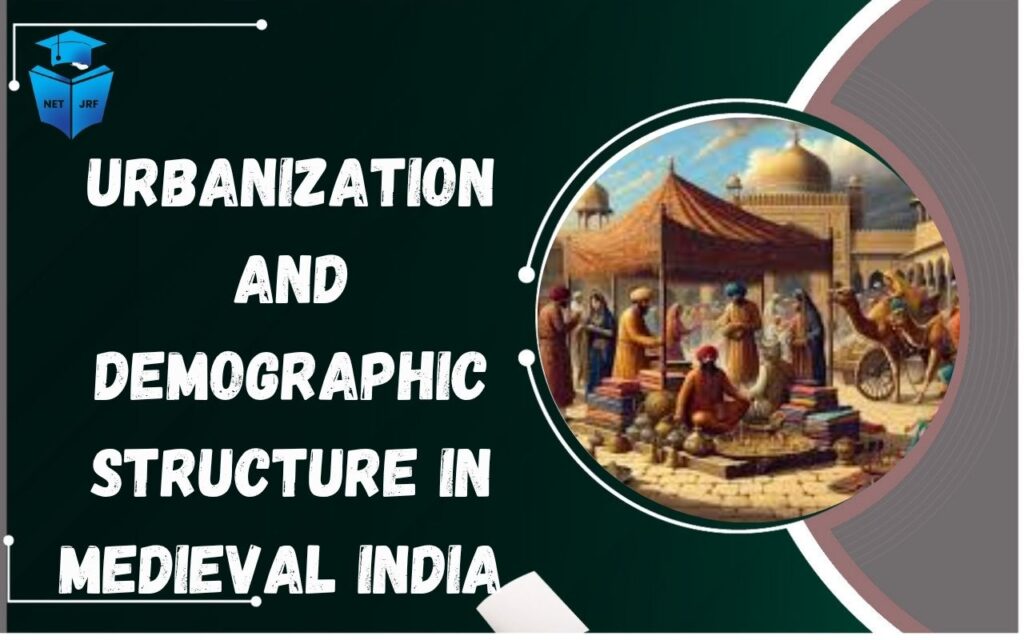

Urbanization and Demographic Structure in Medieval India refers to the growth of settlements from small towns to major urban centres between c. 8th century CE to the early modern period. This period witnessed the rise of political capitals, trade hubs, fortified towns, and cultural cities that shaped population distribution across the subcontinent.

Medieval Urban Growth Introduction
Medieval urban growth refers to the expansion of towns and cities in India roughly between the 8th and 18th centuries. This period saw the rise of political capitals, commercial centres, pilgrimage towns, and craft-production hubs. Urban growth did not occur randomly; it followed patterns shaped by rulers, trade routes, religion, and agriculture.
Enroll UGC NET Foundation Batch Online
Meaning and Features
Medieval urban growth describes the process by which settlements transformed into structured towns with markets, administrative offices, religious buildings, and specialised occupations. Key features included:
- Concentration of population
- Economic specialization
- Administrative importance
- Cultural diversity
Unlike ancient planned cities such as those of the Indus Valley, medieval towns often developed organically around forts, temples, or trade routes.
What is Urbanization in History?
Urbanization means people moving into larger settlements such as towns and cities, forming complex societies focused on trade, governance, religion, and craft. In medieval India, this process was influenced by political change, trade networks, religious movements, cultivation, and administrative needs.
Demographic Structure Explained
Demographic Structure explores how population was distributed in society including caste, occupation, gender ratios, and settlement size influencing city life and growth patterns.
Foundations of Medieval Urbanization
Political Foundations
- Expansion of empires such as the Delhi Sultanate and Vijayanagara Empire created new administrative hubs.
- Capitals like Delhi, Kannauj, Gaur, and Vijayanagara emerged as centres of power and population concentration.
Economic and Trade Drivers
- Trade hubs on coasts and river routes linked India with West Asia, Southeast Asia, and Africa. Cities like Cambay flourished due to maritime commerce.
- Craft production of textiles, metalwork, and ceramics boosted urban commercial activity.
Religious and Cultural Impacts
Temples, mosques, and religious complexes became focal points of towns, acting as centres for settlement, markets, and pilgrim accommodation.
Types of Urban Centres in Medieval India
Below is a structured table that shows different types of settlements during medieval times:
| Type of Town | Features | Examples |
| Political Capitals | Seats of rulers, administration | Delhi, Gaur |
| Trade Hubs | Centres of commerce, markets | Cambay, Mangalore |
| Religious Cities | Built around pilgrimage | Varanasi, Kanchipuram |
| Craft/Industrial Towns | Specialised production | Devagiri, Sonargaon |
Major Urban Centres
Delhi
- Centre of political power under the Delhi Sultanate.
- Attracted nobles, artisans, merchants, and administrators.
- Urban growth reflected administrative needs and strategic planning.
Vijayanagara
- Capital of the Vijayanagara Empire in South India.
- By 1500 CE, one of the largest cities globally with a population around half a million.
- The city’s fortified design combined military security with commercial zones.
Gaur and Pandua
- Capitals of the Bengal Sultanate with advanced urban planning.
- Gaur had canals, gateways, citadels, and urban walls by 1500 CE.
Cambay and Mangalore
- Coastal urban centres that supported international trade.
- Hosted merchant communities of Persian, Arab, and Indian origin.

Demographic Dynamics of Urban Settlements
The population in medieval towns grew due to migration, trade, and political patronage. Therefore, migration played a key role in shaping urban society. Artisans, merchants, and officials settled in cities for better opportunities. As a result, occupational diversity increased in cities. Consequently, urban centres became culturally mixed settlements, reflecting complex demographic structures.
Join UGC NET Offline Coaching in Jaipur
Population Growth
Medieval cities often grew through administrative settlement, migration, and trade attraction. Cities reflected a mix of local agricultural surplus and skilled occupational classes.
Occupational Structure
Population in urban centres was diversified:
- Rulers and Officials
- Artisans and Craft Workers
- Merchants and Traders
- Service Providers
Seasonal and long-term migration influenced demographic mix.
Urban Planning and Settlement Patterns
Urban planning and settlement pattern in medieval towns reflected practical needs rather than strict design principles. Most cities grew gradually around political, religious, or commercial centres. Rulers usually selected sites near rivers, trade routes, or fertile lands so that settlements could sustain large populations. Because of this, geography strongly influenced the structure of towns.
Fortified Towns
Strong defence structures around cities attracted civilians who sought protection during conflict, encouraging urban clustering.
Marketplaces and Streets
- Markets were structured around trade guilds.
- Street forms reflected commercial focus more than rigid grid patterns.
Factors Behind Urban Growth
Numbered list of key drivers:
- Political stability and patronage
- Growth of trade routes (land and sea)
- Craft specialisation
- Religious centres attracting pilgrims
- Agricultural surplus feeding non-farm population
Settlement Size and Scale
Medieval Indian cities varied significantly:
- Small towns with a few thousand inhabitants.
- Large metropolises like Vijayanagara with hundreds of thousands of people.
Urban Social Structures
Caste and Guilds
Caste groups and craft guilds (shrenis) organised much of urban business and production.
Religious Mobility
Diverse religious populations often co-existed and influenced urban cultural landscapes.
Medieval vs Ancient Urban Growth
| Aspect | Ancient (e.g. Harappa) | Medieval India |
| Urban Planning | Highly systematic grids and drainage (Indus) | Organic centres around markets, forts |
| Population Scale | ~30,000–60,000 in Harappa | ~100,000+ in major medieval cities |
| Economic Focus | Trade and agriculture | Diverse: trade, craft, administration |

Challenges in Medieval Urbanization
- Wars and conflicts often disrupted population stability.
- Limited infrastructure compared to ancient planned cities.
- Uneven urban growth — most people still lived in rural areas.
Urbanization Legacy in Indian History
Medieval cities laid foundations for modern urban centres by:
- Introducing specialised trade zones.
- Encouraging diverse population mingling.
- Shaping later colonial and post-colonial urban patterns.
Top UGC NET Coaching in Jaipur
Conclusion
Urbanization and Demographic Structure in Medieval India show how towns evolved from political capitals and trade hubs into complex marketplaces with diverse populations. This transformation influenced Indian history by integrating economic systems, cultural networks, and social structures, leaving a legacy that echoes in later urban evolution.