

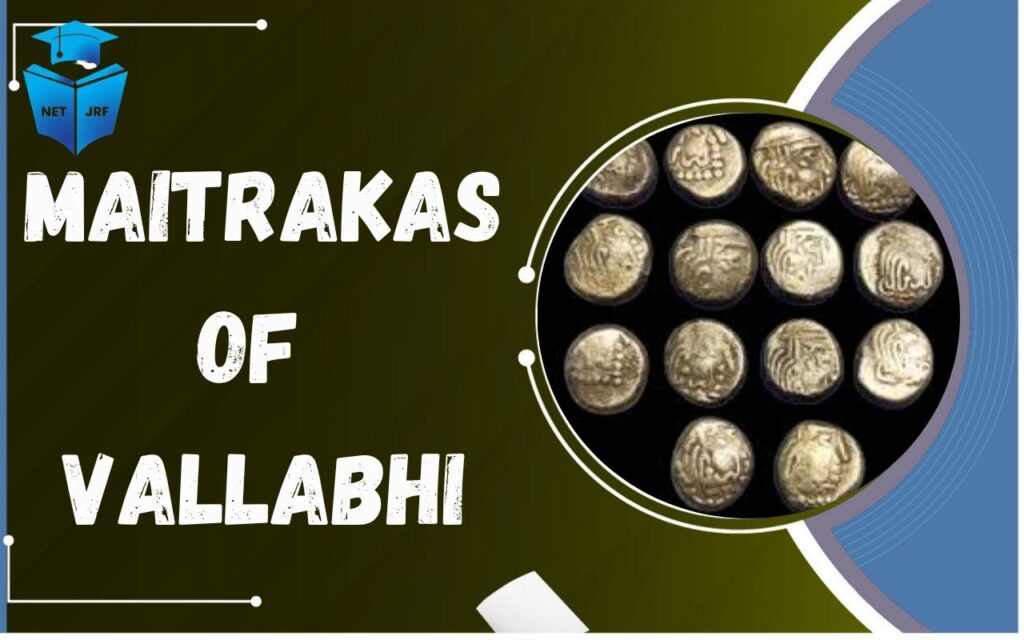
The Maitrakas of Vallabhi were an important regional dynasty that ruled parts of western India from the 6th to the 8th century CE. Their capital, Vallabhi (in present-day Gujarat), emerged as a major political, cultural, and educational center during their reign. The dynasty was founded by Senapati Bhatarka, who initially served as a military governor under the Guptas but later established independent rule after the decline of the Gupta Empire. The Maitraka rulers followed a policy of administrative efficiency and religious tolerance, supporting Hinduism, Buddhism, and Jainism alike. Vallabhi also became famous as a center of learning, often compared to Nalanda University.

Maitrakas of Vallabhi Introduction
The Maitrakas of Vallabhi ruled between the 5th and 8th centuries CE. Their capital was Vallabhi, which became a major center of learning and trade. They started as governors under the Guptas. But after the decline of Gupta power, they became independent and established their own kingdom.
Join UGC NET Foundation Course
-
Ruled Gujarat Region
-
-
- The Maitrakas of Vallabhi mainly ruled over the Gujarat region, which was one of the most important areas in western India during that time. Gujarat had a strong advantage because of its fertile land, which supported agriculture and helped in feeding the population.
- Farmers were able to grow crops regularly, which created economic stability in the kingdom.
- Apart from agriculture, Gujarat was also very important for trade. Its coastal location connected India with foreign regions like West Asia and Southeast Asia. Traders used these routes to exchange goods such as spices, textiles, and other valuable items. Because of this, the Maitrakas were able to build a strong and prosperous economy.
- Their control over Gujarat shows that they understood the importance of both land and trade in maintaining power.
-
-
Capital at Vallabhi
-
-
- The capital of the Maitrakas was Vallabhi, which became one of the most important cities of its time. It was not only a political center but also a place where education and trade flourished together.
- The city was well-developed and attracted people from different parts of India.
- Vallabhi became famous as a center of learning and is often compared to Nalanda University.
- At the same time, Vallabhi was also a busy trade hub. Merchants and traders gathered here, which made the city economically strong.
- The combination of education and commerce made Vallabhi a unique and important center in early medieval India.
-
-
From Gupta Governors to Independent Rulers
-
- In the beginning, the Maitrakas were not independent kings. They served as governors under the powerful Gupta Empire decline.
- Their founder, Senapati Bhatarka, was a military officer who managed the region on behalf of the Guptas.
- However, when the Gupta Empire started weakening, the Maitrakas saw an opportunity to become independent. They gradually took control of the region and established their own kingdom.
- This shift from being governors to rulers shows their political strength and smart decision-making.
- They were able to maintain their rule for several centuries, which proves that they were successful in administration and governance.
- Their rise also reflects a larger pattern in Indian history, where many regional powers emerged after the fall of big empires.
Maitrakas of Vallabhi Origin
The origin of the Maitrakas of Vallabhi is closely connected with the weakening of the powerful Gupta Empire decline.
- When the Gupta Empire was strong, it controlled a large part of northern and western India through governors and officials. However, as the empire started losing its strength due to internal problems and external invasions, its control over distant regions became weak.
- This situation created opportunities for local governors to assert their independence.
- The Maitrakas were one such group who took advantage of this political change. Instead of remaining under a declining authority, they established their own rule. Their origin, therefore, reflects a common historical pattern where strong regional powers emerged after the fall of a central empire.
Founder Bhatarka
The founder of the Maitraka dynasty was Bhatarka, who played a key role in establishing their power.
- He is considered the first ruler of the dynasty and the person who laid its foundation. Bhatarka was not originally a king but a military officer, which shows that his rise was based on ability rather than royal birth.
- His leadership and vision helped transform a small regional authority into a powerful kingdom.
- He is remembered for taking the bold step of declaring independence and setting up a new ruling dynasty in western India.
First Ruler of the Dynasty
- As the first ruler, Bhatarka established the base of Maitraka administration and governance. He organized the kingdom, secured control over the region, and ensured stability.
- Being the first ruler, his role was very important because he had to build everything from the beginning.
- He also set an example for future rulers by maintaining strong control over the territory. His rule created a foundation on which later Maitraka kings could expand and strengthen the kingdom.
Originally a Military Governor
Before becoming an independent ruler, Bhatarka served as a military governor under the Guptas. This position gave him experience in administration, warfare, and leadership.
- He was responsible for maintaining order and protecting the region.
- This background helped him understand how governance worked. It also gave him the confidence and support needed to take control when the right time came.
- His military roots played a major role in his later success as a ruler.
Declared Independence after Gupta Decline
When the Gupta Empire became weak, Bhatarka took advantage of the situation and declared independence.
- This was a turning point in the history of the Maitrakas. Instead of continuing as a subordinate officer, he established himself as an independent king.
- This decision shows his political intelligence and courage. He understood that the declining power of the Guptas created a chance to build his own authority. His successful move marked the beginning of the Maitraka dynasty.
Background Features of the Maitrakas
- Military Roots:
The Maitrakas had a strong military background, as their founder himself was a(commander). This helped them maintain control and defend their kingdom effectively. - Strong Leadership:
Leaders like Bhatarka showed determination and vision. Their ability to take bold decisions helped in establishing and strengthening the dynasty. - Gradual Rise to Independence:
The Maitrakas did not become powerful overnight. Their rise was gradual. They first served under the Guptas, then slowly gained control, and finally became independent rulers. This steady growth made their rule stable and long-lasting.
Early Development
In the early phase of their rule, the Maitrakas of Vallabhi concentrated on building a strong and stable foundation for their kingdom.
- Since they had recently become independent after the weakening of the Gupta Empire decline, their main focus was not rapid expansion but consolidation of power.
- They understood that long-term success required internal strength, proper administration, and economic stability. Therefore, their early rulers took careful and practical steps to secure their position.
Strengthening Control over Gujarat
One of the first priorities of the Maitraka rulers was to firmly establish their control over the Gujarat region.
- This area was very important due to its fertile land and strategic location. However, controlling such a region required maintaining law and order and ensuring loyalty among local chiefs and communities.
- The rulers worked to bring different parts of Gujarat under their authority and prevent rebellions or external interference.
- By doing so, they created a sense of unity and stability within their kingdom. Strong regional control also helped them protect their resources and maintain political power.
Establishing Administrative Systems
Another major step taken by the Maitrakas was the development of an effective administrative system. Good governance was necessary to manage land, collect taxes, and maintain order in the kingdom.
- The rulers organized their administration in a structured way, assigning duties to officials and ensuring that different regions were properly managed.
- This system helped in smooth functioning of the state.
- It also improved communication between the rulers and the people. A well-organized administration made it easier to implement policies, solve local issues, and strengthen the authority of the king.
- This administrative strength became one of the key reasons for the long survival of the Maitraka rule.
Securing Trade Routes
Trade played a very important role in the growth of the Maitraka kingdom. Gujarat had access to important land and sea routes, which connected it to other parts of India and foreign regions.
- The Maitrakas made special efforts to secure these trade routes.
- They ensured safety for merchants by protecting roads and ports from theft or attacks. This encouraged traders to travel freely and carry out business without fear.
- As trade increased, the kingdom became economically stronger. Wealth from trade helped in developing cities, supporting administration, and maintaining the army.
Best UGC NET Coaching in Jaipur
Rise to Power
The rise of the Maitrakas of Vallabhi became more prominent under rulers like Dharasena and Shiladitya.
Key Developments
- Expansion of territory
- Growth of political influence
- Strengthening of central authority
The Maitrakas of Vallabhi became one of the leading powers in western India during this time.
Maitrakas of Vallabhi Political Expansion
The Maitrakas of Vallabhi gradually expanded their kingdom by using a balanced approach of military strength and smart diplomacy. After securing their base, they did not rush blindly into wars. Instead, they carefully chose when to fight and when to form alliances. This practical strategy helped them grow their power while also maintaining stability. Their expansion shows that they were not only strong warriors but also skilled rulers who understood politics very well.
Expansion Areas
-
Gujarat
-
-
- Gujarat remained the core region of the Maitraka kingdom. Even while expanding, they ensured that their control over Gujarat stayed strong and stable. This region provided them with economic strength due to agriculture and trade. By firmly holding Gujarat, they had a secure base from which they could expand further.
-
-
Saurashtra
-
-
- The Maitrakas extended their authority into the Saurashtra region, which was strategically very important because of its coastal location. Control over Saurashtra meant better access to sea routes and ports. This helped them increase trade and strengthen their economic position. It also allowed them to protect coastal areas from external threats.
-
-
Parts of Malwa
-
- The Maitrakas also expanded towards parts of Malwa, a region known for its political and economic importance. Gaining influence in Malwa helped them increase their power in central India. It also improved their connections with inland trade routes, further boosting their overall strength.
Methods of Expansion
-
Military Conquests
-
-
- The Maitrakas used military power when necessary to capture and control new regions. Their strong army, built on their military background, helped them defeat rivals and protect their territory. However, they did not rely only on war; they used it carefully to avoid unnecessary conflicts.
-
-
Strategic Alliances
-
-
- Along with warfare, the Maitrakas also formed alliances with other rulers. These alliances helped them avoid constant battles and maintain peaceful relations with neighboring states. Through diplomacy, they were able to expand their influence without always using force. This approach made their rule more stable and long-lasting.
-
-
Control of Trade Centers
-
- Another important method of expansion was gaining control over key trade centers. By controlling important cities and trade routes, the Maitrakas increased their economic power. Trade brought wealth, and wealth strengthened their kingdom. This economic strategy supported both their political expansion and administrative stability.
Important Rulers
The success of the Maitrakas of Vallabhi was largely due to their capable and visionary rulers. Each ruler contributed in a different way; some laid the foundation, while others strengthened and expanded the kingdom. Their combined efforts helped the dynasty grow into a powerful and stable state in western India.
Bhatarka (Founder)
Bhatarka was the founder of the Maitraka dynasty and the person who laid its foundation.
- He started his career as a military officer under the Gupta Empire decline, which gave him valuable experience in administration and warfare.
- As the Gupta power weakened, Bhatarka took advantage of the situation and declared independence.
- This was a bold and important step that marked the beginning of Maitraka rule.
- He established control over the region and created a stable base for future expansion. His leadership was crucial because he transformed a position of service into one of authority.
Dharasena I & II
- Dharasena I and Dharasena II played an important role in strengthening the kingdom after its foundation. Their main focus was on improving administration and expanding the territory.
- They worked on organizing the administrative system, making governance more efficient and structured.
- This helped in better management of land, resources, and people. At the same time, they also expanded the kingdom by bringing new regions under their control.
- Their efforts ensured that the kingdom did not remain limited but continued to grow. By strengthening internal systems and extending boundaries, they made the Maitraka rule more stable and powerful.
Shiladitya I
Shiladitya I is considered one of the greatest rulers of the Maitraka dynasty.
- During his reign, the kingdom reached a high level of development in terms of culture, religion, and overall prosperity.
- He promoted learning, supported religious institutions, and encouraged cultural activities. Under his rule, Vallabhi became a well-known center of education, often compared to Nalanda University. His policy of religious tolerance allowed different faiths to flourish peacefully.
- Shiladitya I’s reign represents the golden phase of the Maitrakas, where political strength and cultural growth went hand in hand.

Administration System
The Maitrakas of Vallabhi developed a well-organized and effective administrative system to manage their growing kingdom. As their territory expanded across regions like Gujarat and beyond, it became necessary to maintain order, collect revenue, and ensure smooth governance. Their administrative structure was practical and efficient, helping them rule successfully for several centuries.
Key Features of Administration
At the top of the administration was the king, who held supreme power.
- The ruler was responsible for making important decisions related to governance, military actions, and overall policy. All authority flowed from the king, and he acted as the final decision-maker in political and administrative matters.
- The king also played a key role in maintaining law and order and ensuring justice. His leadership determined the strength and stability of the kingdom. A strong ruler meant a strong administration, which is why capable kings were essential for the success of the Maitrakas.
Division into Provinces
- To manage their large territory effectively, the Maitrakas divided their kingdom into smaller administrative units or provinces.
- This division made governance easier, as it allowed better control over distant regions.
- Each province was managed separately, ensuring that local issues could be handled quickly without always depending on the central authority.
- This system improved efficiency and helped in maintaining order across the kingdom.
Local Governance
At the local level, administration was carried out by smaller units such as towns and villages. Local governance ensured that everyday matters like land management, tax collection, and dispute resolution were handled effectively.
- This system allowed the rulers to stay connected with the people. It also ensured that governance was not limited to the capital but reached every part of the kingdom.
- Local administration played a crucial role in maintaining stability and public satisfaction.
Governors
Governors were appointed to manage provinces. They acted as representatives of the king and were responsible for maintaining law and order, implementing policies, and supervising local officials.
- Their role was very important because they ensured that the king’s authority was maintained in all parts of the kingdom.
- Efficient governors helped in smooth administration and prevented unrest.
Military Officers
- Military officers were responsible for the defense of the kingdom.
- They managed the army, protected borders, and maintained internal security. Since the Maitrakas had a strong military background, these officers played a key role in keeping the kingdom safe from external attacks and internal rebellions.
Revenue Collectors
Revenue collectors were in charge of collecting taxes from the people.
- Taxes were the main source of income for the kingdom, which was used for administration, defense, and public welfare.
- These officials ensured that taxes were collected properly and regularly. A strong revenue system helped the Maitrakas maintain economic stability and support their governance.
Economic Structure Maitrakas of Vallabhi
The Maitrakas of Vallabhi built a strong and stable economic system, which became the backbone of their power. Their prosperity did not come from a single source but from a balanced combination of agriculture, trade, and taxation. This well-rounded economic structure allowed them to maintain political stability and support cultural growth.
Main Sources of Economy
-
Agriculture
-
-
- Agriculture was the primary source of income for the Maitraka kingdom. The fertile lands of Gujarat provided good conditions for farming, which helped in producing sufficient food for the population.
- Farmers played a crucial role in sustaining the economy. The rulers ensured that agriculture was protected and supported, as it formed the base of their revenue system. A stable agricultural system also meant food security and social stability.
-
-
Trade
-
-
- Trade was another major pillar of the Maitraka economy. Due to their strategic location, especially in Gujarat and coastal regions, the Maitrakas had access to important trade routes.
- Merchants traded goods such as textiles, spices, and other valuable items both within India and with foreign regions. This exchange of goods brought wealth into the kingdom and strengthened its economic position. Trade also helped in connecting different cultures and regions.
-
-
Taxes
-
- Taxes were an important source of revenue for the state. The Maitraka rulers collected taxes from agriculture, trade, and other economic activities.
- This revenue was used to run the administration, maintain the army, and support public works. A proper taxation system ensured that the kingdom had a steady flow of income, which helped in maintaining stability and growth.
Vallabhi as a Major Trade Center
The capital city, Vallabhi, was a major center of trade and commerce.
- Its location made it an important link between inland regions and coastal trade routes.
- Merchants from different regions gathered in Vallabhi, making it a busy and prosperous city. This economic activity increased the wealth of the kingdom and strengthened its political power. Trade played a key role in making the Maitrakas economically successful.
Cultural Contributions of Maitrakas of Vallabhi
Along with economic strength, the Maitrakas also made important contributions to culture and education. They supported learning, religion, and literature, which made their kingdom culturally rich and advanced.
Education
Vallabhi became famous for its educational importance, especially because of institutions like Vallabhi University.
- It was one of the major centers of learning in ancient India.
- Students from different parts of the country came here to study subjects like philosophy, administration, and religion. The university played a key role in spreading knowledge and intellectual growth.
Religion
-
Support to Hinduism and Buddhism
-
-
- The Maitraka rulers followed a policy of religious tolerance. They supported multiple religions, especially Hinduism and Buddhism, allowing them to flourish peacefully.
- Temples, monasteries, and religious institutions were encouraged and protected by the rulers. This created a harmonious society where people of different beliefs could live together.
-
-
Religious Tolerance
-
- Their inclusive approach helped in maintaining peace and unity within the kingdom. Instead of favoring only one religion, they respected diversity, which added to their cultural richness.
Literature
-
Promotion of Sanskrit
-
-
- The Maitrakas promoted the Sanskrit language, which was widely used for literature, administration, and scholarly works during that time.
-
-
Support to Scholars
-
- They also supported scholars, writers, and intellectuals. This encouragement led to the development of literature and learning. Scholars found a safe and supportive environment under their rule, which helped in the growth of knowledge and culture.
Maitrakas of Vallabhi Key Facts
These key facts provide a quick overview of the rise, development, and significance of the Maitrakas of Vallabhi.
| Feature | Details |
| Dynasty | Maitrakas of Vallabhi |
| Region | Gujarat |
| Period | 5th–8th century CE |
| Founder | Bhatarka |
| Capital | Vallabhi |
Maitrakas of Vallabhi with Other Kingdoms Relations
The Maitrakas of Vallabhi did not remain isolated rulers. They actively maintained relations with other powerful kingdoms of their time. These relations included diplomacy, alliances, and sometimes rivalry. Such interactions helped them strengthen their political position and increased their importance in early medieval India.
Interaction with Harsha
- One of the most important relations of the Maitrakas was with King Harsha, the powerful ruler of northern India.
- Harsha ruled a large empire from Kannauj and was one of the most influential kings of his time.
- The Maitrakas maintained diplomatic relations with him, which helped in avoiding unnecessary conflicts. Instead of constant warfare, both powers showed political understanding and balance.
- This relationship indicates that the Maitrakas were recognized as an important regional power, capable of dealing with a strong ruler like Harsha on equal terms.
- Their interaction also reflects the political environment of the time, where kingdoms often preferred alliances and diplomacy over continuous wars.
Contact with Other Regional Powers
Apart from Harsha, the Maitrakas also maintained relations with other regional kingdoms in western and central India.
- These contacts could include alliances, trade relations, and sometimes conflicts, depending on the situation.
- By staying connected with neighboring powers, the Maitrakas ensured their security and influence. These relationships helped them protect their borders and maintain stability within their kingdom.
- It also allowed them to participate in wider political and economic networks.
- Such interactions show that the Maitrakas were not isolated but actively involved in the political affairs of their time.
Top UGC NET Offline Coaching in Jaipur
Decline of Dynasty
- The decline of the Maitrakas of Vallabhi began around the 8th century CE.
- After several centuries of stable rule, the kingdom started weakening due to a combination of internal and external factors.
- Like many dynasties, their fall was not sudden but gradual, caused by multiple challenges that they could not effectively handle.
Causes of Decline
One of the major reasons for their decline was external invasions.
-
- The most significant among these were the Arab invasions of India, which affected western India during the 8th century.
- These invasions disrupted political stability and weakened the control of the Maitrakas over their territories. Constant threats from outside forces made it difficult for the rulers to maintain peace and security. As a result, their power gradually declined.
-
Weak Rulers
-
-
- After a period of strong leadership, the later Maitraka rulers were not as capable or effective. Weak rulers often failed to manage administration properly or respond to external threats.
- Without strong leadership, the kingdom began to lose its unity and strength. Poor decision-making and lack of control over officials further weakened the state, making it vulnerable to attacks and internal problems.
-
-
Internal Conflicts
-
- Internal conflicts also played a key role in the decline of the Maitrakas. Disputes among nobles, officials, or members of the royal family created instability within the kingdom.
- Such conflicts reduced the efficiency of administration and weakened central authority. When a kingdom faces internal divisions, it becomes easier for external enemies to attack and take advantage of the situation.
Role of Arab Invasions
The Arab invasions are often directly linked to the fall of the Maitrakas of Vallabhi.
- These invasions not only caused military damage but also disrupted trade routes and economic stability.
- Since the Maitrakas depended heavily on trade, especially through Gujarat’s coastal routes, this disruption had a serious impact on their economy. Over time, this contributed significantly to their downfall.
Maitrakas of Vallabhi Political Importance
Despite their decline, the Maitrakas played a very important role in the history of western India. Their contributions helped maintain continuity and development during a period of major political changes.
Key Contributions
-
Maintained Stability after Guptas
-
-
- After the fall of the Gupta Empire declined, many regions faced political instability. The Maitrakas helped maintain order and stability in western India.
- They provided strong governance and prevented chaos, ensuring that the region remained organized and secure.
-
-
Promoted Trade and Education
-
-
- The Maitrakas actively encouraged trade, which brought economic prosperity to their kingdom. Their capital, Vallabhi, became a major center of commerce.
- They also promoted education, with institutions like Vallabhi University becoming famous centers of learning. This helped in the growth of knowledge and culture.
-
-
Strengthened Regional Governance
-
- The Maitrakas developed an effective administrative system that improved governance at both central and local levels. Their model of administration helped in managing large territories efficiently.
- They strengthened regional governance, which later influenced other kingdoms in India. Their approach showed how regional powers could successfully rule after the decline of a major empire.

Conclusion
The Maitrakas of Vallabhi represent an important phase in post-Gupta India. They rose from military origins and built a powerful regional kingdom. Their strong administration, economic growth, and cultural contributions made them a significant force.