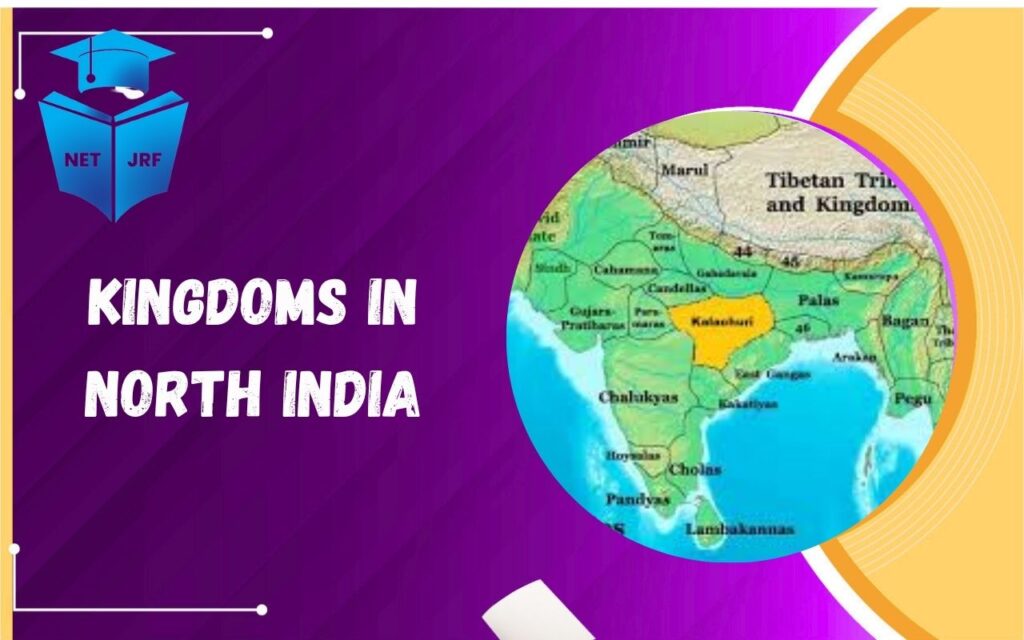
Kingdoms in North India List: Gurjara-Pratiharas, Kalacuri-Chedis, Gahadavalas and Paramaras UGC NET

Kingdoms in North India in this topic you learn how Gurjara Pratiharas Kalacuri Chedis Gahadavalas and Paramaras rose fought for Kannauj used samanta system built temples and shaped political cultural and religious landscape of early medieval India Focus Keyword

vishal

Kingdoms in North India

Table of Contents

Kingdoms in North India represent a vital era of early medieval history that shaped the political landscape of the subcontinent. This period saw the rise of powerful warrior clans who fought for control over the fertile plains of the Ganges and the strategic city of Kannauj. These dynasties did not just fight wars; they built magnificent temples and patronised great scholars. Understanding these Kingdoms in North India helps us grasp the transition from ancient empires to the medieval age.

Study Planner

Rise of Kingdoms in North India UGC NET

The early medieval period in India witnessed a shift toward regional decentralisation. After the decline of the Vardhana Empire under Harshavardhana, several small states emerged as significant powers. 

  • These Kingdoms in North India often claimed descent from the mythical Agnikula (Fire-born) lineage. This claim helped them establish political legitimacy among the masses.
  • The social structure during this time relied heavily on the Samanta system, where local lords provided military support to the central king. This system created a network of loyalties but also led to frequent internal conflicts. 
  • The Kingdoms in North India spent much of their energy competing for the title of “Chakravartin” or universal ruler. This constant competition defined the political culture of the 8th to 12th centuries.
  • Example: The struggle for Kannauj between the Pratiharas, Palas, and Rashtrakutas shows how important symbolic cities were for these Kingdoms in North India:.

Mini Summary: The post-Harsha era saw the rise of regional dynasties that used the Samanta system and mythical origins to maintain power.

Enroll UGC NET Online Coaching

Kingdoms in North India Mighty Gurjara-Pratiharas UGC NET

The Gurjara-Pratiharas stood as the most dominant power among the Kingdoms in North India for over three centuries. Nagabhata I founded the dynasty in the 8th century. He gained fame by stopping Arab invasions from the west, acting as a “door-keeper” for India. The dynasty reached its zenith under Mihira Bhoja and Mahendrapala I.

  • Mihira Bhoja was a great devotee of Vishnu and took the title ‘Adivaraha’. He established a vast empire that stretched from the foothills of the Himalayas to the Narmada River. 
  • The Gurjara-Pratiharas controlled the trade routes and patronised arts. The famous poet Rajashekhara lived in their court and wrote masterpieces like Kapuramanjari.
  • However, the dynasty began to weaken in the 10th century. Attacks from the Rashtrakutas and the rise of local governors eventually broke their power. Despite their fall, they left a lasting legacy in temple architecture, particularly the Maru-Gurjara style.
  •  These Kingdoms in North India  like the Pratiharas provided the much-needed stability against foreign threats for a long time.
  • Example: The Teli ka Mandir in Gwalior reflects the unique architectural style of the Pratihara era.

Kingdoms in North India Kalacuri-Chedis of Tripuri UGC NET

The Kalacuri-Chedis ruled over the Chedi region, which is modern-day Madhya Pradesh. They were one of the oldest Kingdoms in North India with a history that goes back to the early centuries of the common era. 

  • Their capital was at Tripuri, near Jabalpur. Kokalla I was the first significant king who expanded their influence through strategic alliances.
  • Gangeyadeva was another powerful ruler of this dynasty. He assumed the grand title of ‘Trikalingadhipati’ (Lord of three Kalingas). 
  • He even issued gold coins, which was a rare practice during that period. His son, Lakshmi-Karna, was an even more ambitious conqueror. He fought against almost all his neighbours, including the Palas and the Cholas.
  • The Kalacuris were great builders of Shaivite temples. They supported the Mattamayura sect of Shaivism, which focused on monastic life and learning. 
  • While they were militarily strong, constant wars drained their resources. Other Kingdoms in North India eventually overshadowed them by the 12th century.
  • Example: The circular Chausath Yogini temple at Bhedaghat stands as a testimony to Kalacuri architectural skill.

Kingdoms in North India Gahadavalas of Kannauj UGC NET

After the fall of the Pratiharas, the Gahadavalas emerged to fill the power vacuum in the Doab region. Chandradeva founded this dynasty in the late 11th century. They made Kannauj their capital and soon became one of the wealthiest Kingdoms in North India. Their wealth came from controlling the fertile lands and taxing the trade along the Ganges.

  • Govindachandra was the most capable king of the Gahadavala dynasty. He defended his territory against Ghaznavid raids and expanded his influence toward Bihar. His queen, Kumaradevi, was a Buddhist and built a famous monastery at Sarnath. 
  • This shows the religious tolerance prevalent in these Kingdoms in North India.
  • The last major ruler was Jaichandra. He is often remembered in folk legends regarding his rivalry with Prithviraj Chauhan. Unfortunately, the Gahadavala power collapsed after the Battle of Chandawar in 1194 against Muhammad Ghori. 
  • Their fall marked the end of an era for indigenous Kingdoms in North India in the Gangetic heartland.
  • Example: The Gahadavalas imposed a special tax called ‘Turushkadanda’ to fund their wars against the Turks.

Enroll UGC NET Online Course

Kingdoms in North India Paramaras of Malwa UGC NET

The Paramaras ruled the Malwa region with their capital at Dhar. Initially, they served as feudatories to the Rashtrakutas. However, under Siyaka II, they declared independence. The Paramaras became famous among the Kingdoms in North India for their deep love for art, science, and literature.

  • Raja Bhoja is the most celebrated king of this dynasty. He was a polymath who wrote books on medicine, grammar, and architecture.
  •  His work Samarangana Sutradhara is a classic text on Indian architecture. He also established a great college called Bhojshala at Dhar for higher learning.
  • Apart from cultural achievements, the Paramaras fought many battles with the Chalukyas and the Kalacuris. They built the famous Bhojeshwar Temple near Bhopal, which houses one of the largest Shiva lingams in India. Like other Kingdoms in North India
  •  the Paramaras eventually succumbed to the Delhi Sultanate in the early 14th century.
  • Example: The Bhojpur Lake, an engineering marvel of the time, was created by Raja Bhoja to benefit agriculture.

App JRF Adda

Kingdoms in North India  Cultural and Architectural Contributions UGC NET

The Kingdoms in North India were not just about wars and borders. They created a vibrant culture that blended regional traditions with classical Sanskrit learning. These dynasties built thousands of temples, many of which still stand today. The temple architecture moved from simple designs to complex structures with high towers (Shikharas).

  • Literature also flourished during this time. Kings themselves wrote poetry and technical manuals. The court of these Kingdoms in North India became a gathering place for scholars from across the country. Education was provided through temples and monasteries, which received land grants called Agraharas.
  • Religion was another area of significant development. While Puranic Hinduism was dominant, Buddhism and Jainism also received royal support. The bhakti movement began to take root, influencing the way people worshipped. The Kingdoms in North India helped preserve Indian traditions during a time of transition.

The Tripartite Struggle

One of the most famous events involving the Kingdoms in North India was the Tripartite Struggle. This was a long-running conflict between the Pratiharas, the Palas of Bengal, and the Rashtrakutas of the Deccan. The main prize of this struggle was the city of Kannauj.

Kannauj was the symbol of imperial sovereignty. Whoever controlled Kannauj was seen as the master of the North. This struggle lasted for nearly two centuries and weakened all three dynasties. While the Pratiharas eventually won control, the cost was too high. This internal fighting among Kingdoms in North India made it easier for foreign invaders to enter later.

Enroll UGC NET Coaching in Jaipur

Kingdoms in North India

Dynasty Founder Major Capital Primary Region
Gurjara-Pratiharas Nagabhata I Kannauj Rajasthan & Doab
Kalacuri-Chedis Kokalla I Tripuri Central India
Gahadavalas Chandradeva Kannauj Varanasi & Kannauj
Paramaras Upendra Dhar Malwa

Features of Kingdoms in North India

Feature Description Importance
Samanta System Feudal hierarchy of lords Defined military structure
Agnikula Legend Myth of fire-born origin Established political status
Agrahara Grants Tax-free land to scholars Supported education and religion
Nagara Style Temple architecture style Created iconic Indian landmarks

Enroll UGC NET Offline Coaching in Jaipur

Read UGC NET Notes
1 Archaeological Sources for UGC NET Epigraphy – Study of Inscriptions Meaning of Historical Sources Archaeological
2 Meaning of Historical Sources Archaeological Sources for UGC NET Literary Sources in History Archaeological
3 Exploration in Archaeology Excavation Techniques in Archaeology Dating of Archaeological Sites Archaeological
4 Excavation Techniques in Archaeology Exploration in Archaeology Dating of Archaeological Sites Archaeological
5 Epigraphy – Study of Inscriptions Inscriptions in Reconstructing History Numismatics in History Archaeological
6 Inscriptions in Reconstructing History Epigraphy – Study of Inscriptions Archaeological Sources for UGC NET Archaeological
7 Numismatics in History Importance of Coins in History Epigraphy – Study of Inscriptions Archaeological
8 Importance of Coins in History Numismatics in History Archaeological Sources for UGC NET Archaeological
9 Dating of Archaeological Sites Excavation Techniques in Archaeology Dating Ancient Literary Sources Archaeological
10 Indigenous Literature Literary Sources in History Secular Literature as Historical Source Literary
11 Dating Ancient Literary Sources Literary Sources in History Dating of Archaeological Sites Literary
12 Literary Sources in History Indigenous Literature Foreign Accounts of India Literary
13 Foreign Accounts of India Greek Accounts on Ancient India Chinese Accounts on India Literary
14 Greek Accounts on Ancient India Foreign Accounts of India Chinese Accounts on India Literary
15 Secular Literature as Historical Source Literary Sources in History Indigenous Literature Literary
16 Role of Myths and Legends in Historical Reconstruction Literary Sources in History Secular Literature as Historical Source Literary
17 Chinese Accounts on India Foreign Accounts of India Greek Accounts on Ancient India Literary
18 Arabic Accounts on India Foreign Accounts of India Chinese Accounts on India Literary
19 Neolithic and Chalcolithic Phases Neolithic Revolution in India Chalcolithic Culture in India Neolithic
20 Hunting, Gathering & Food Production Neolithic Revolution in India Neolithic Settlements in India Neolithic
21 Neolithic Revolution in India Neolithic Settlements in India Tools and Technology in Neolithic Period Neolithic
22 Neolithic Settlements in India Distribution of Neolithic Cultures in India Neolithic Revolution in India Neolithic
23 Distribution of Neolithic Cultures in India Neolithic Settlements in India Tools and Technology in Neolithic Period Neolithic
24 Tools and Technology in Neolithic Period Neolithic Revolution in India Chalcolithic Culture in India Neolithic
25 Chalcolithic Culture in India Settlement Pattern & Economy in Chalcolithic Phase Trade & Exchange Networks in Chalcolithic Societies Neolithic
26 Settlement Pattern & Economy – Chalcolithic Phase Chalcolithic Culture in India Trade & Exchange Networks in Chalcolithic Societies Neolithic
27 Trade & Exchange Networks – Chalcolithic Societies Chalcolithic Culture in India IVC Internal & External Trade Neolithic
28 Indus Valley Civilization – UGC NET Major Sites of Indus Civilization Urban Planning in Harappan Civilization IVC
29 IVC Internal & External Trade Internal Trade – Harappan Civilization Craft Specialization in Harappan Civilization IVC
30 Political Organization – Harappan Civilization Social Structure – Indus Civilization Urban Planning in Harappan Civilization IVC
31 Major Sites of Indus Civilization Indus Valley Civilization – UGC NET Urban Planning in Harappan Civilization IVC
32 Urban Planning & Settlement – Harappan Civilization Architecture & Town Planning – Harappan Cities IVC as First Urbanization in India IVC
33 Architecture & Town Planning – Harappan Cities Urban Planning in Harappan Civilization Major Sites of Indus Civilization IVC
34 Craft Specialization & Industrial Activities – Harappan Agriculture & Food Economy – Harappans IVC Internal & External Trade IVC
35 Agriculture & Food Economy – Harappans Craft Specialization in Harappan Civilization Internal Trade – Harappan Civilization IVC
36 Internal Trade – Harappan Civilization IVC Internal & External Trade Craft Specialization in Harappan Civilization IVC
37 Religion & Beliefs – Indus Civilization Social Structure – Indus Civilization Indus Valley Civilization – UGC NET IVC
38 Social Structure – Indus Civilization Political Organization – Harappan Civilization Religion & Beliefs – Indus Civilization IVC
39 Decline of Indus Civilization Indus Valley Civilization – UGC NET IVC as First Urbanization in India IVC
40 IVC as First Urbanization in India Urban Planning in Harappan Civilization Second Urbanization in India IVC
41 Vedic & Later Vedic Periods – Aryan Varna System Early Vedic Society and Economy Later Vedic Society and Economy Vedic
42 Origin of Vedic Civilization Aryan Debate – Migration, Invasion & Indigenous Theories Early Vedic Society and Economy Vedic
43 Aryan Debate – Migration, Invasion & Indigenous Theories Origin of Vedic Civilization Early Vedic Society and Economy Vedic
44 Early Vedic Society and Economy Political Institutions – Early Vedic Period Social Structure – Early Vedic Period Vedic
45 Political Institutions – Early Vedic Period Early Vedic Society and Economy Monarchical States in Ancient India Vedic
46 Social Structure – Early Vedic Period Emergence of Varnas & Social Stratification Early Vedic Society and Economy Vedic
47 Later Vedic Society and Economy Emergence of Varnas & Social Stratification Impact of Iron Technology in India Vedic
48 Emergence of Varnas & Social Stratification Social Structure – Early Vedic Period Later Vedic Society and Economy Vedic
49 Emergence of Heterodox Sects in India Jainism, Buddhism & Ajivikas – Origins & Teachings Later Vedic Society and Economy Vedic
50 Impact of Iron Technology in India Later Vedic Society and Economy Agricultural Expansion & Economic Changes – Ancient India Vedic
51 Religious & Philosophical Vedic Ideas Emergence of Varnas & Social Stratification Emergence of Heterodox Sects in India Vedic
52 Megalithic Culture of South India Neolithic and Chalcolithic Phases Agricultural Expansion & Economic Changes General
53 State System in Ancient India Rise of Mahajanapadas Transition: Tribal Polities to Territorial States General
54 Transition: Tribal Polities to Territorial States Rise of Mahajanapadas Later Vedic Society and Economy General
55 Rise of Mahajanapadas Monarchical States in Ancient India Republican States (Gana-Sanghas) – Ancient India Magadha
56 Monarchical States in Ancient India Rise of Mahajanapadas Emergence of Magadha Magadha
57 Republican States (Gana-Sanghas) – Ancient India Rise of Mahajanapadas Monarchical States in Ancient India Magadha
58 Agricultural Expansion & Economic Changes – Ancient India Second Urbanization in India Impact of Iron Technology in India General
59 Second Urbanization in India IVC as First Urbanization in India Rise of Mahajanapadas General
60 Jainism, Buddhism & Ajivikas – Origins & Teachings Emergence of Heterodox Sects in India Ashoka’s Policy of Dhamma General
61 Emergence of Magadha Geographical Advantages of Magadha Early Rulers of Magadha Magadha
62 Geographical Advantages of Magadha Natural Resources & Economic Strength of Magadha Reasons for Success of Magadha Magadha
63 Natural Resources & Economic Strength of Magadha Geographical Advantages of Magadha Economic Policies of the Nandas Magadha
64 Early Rulers of Magadha Haryanka Dynasty – Rise of Magadha Emergence of Magadha Magadha
65 Haryanka Dynasty – Rise of Magadha Expansion Policy of Bimbisara Early Rulers of Magadha Magadha
66 Expansion Policy of Bimbisara Ajatashatru – Military Reforms Haryanka Dynasty – Rise of Magadha Magadha
67 Ajatashatru – Military Reforms Wars of Ajatashatru Expansion Policy of Bimbisara Magadha
68 Wars of Ajatashatru Ajatashatru – Military Reforms Udayin & Establishment of Pataliputra Magadha
69 Udayin & Establishment of Pataliputra Wars of Ajatashatru Shishunaga Dynasty Magadha
70 Shishunaga Dynasty Administrative Structure of the Shishunagas Nanda Dynasty Magadha
71 Administrative Structure of the Shishunagas Shishunaga Dynasty Central Administration Under Mauryas Magadha
72 Nanda Dynasty Mahapadma Nanda – Imperial Expansion Shishunaga Dynasty Magadha
73 Mahapadma Nanda – Imperial Expansion Military Strength of the Nandas Nanda Dynasty Magadha
74 Economic Policies of the Nandas Nanda Dynasty Taxation System – Mauryan State Magadha
75 Military Strength of the Nandas Mahapadma Nanda – Imperial Expansion Defeat of Nandas & Rise of Mauryan Empire Magadha
76 Reasons for Success of Magadha Geographical Advantages of Magadha Natural Resources & Economic Strength of Magadha Magadha
77 Mahajanapadas to Empire – Evolution & Rise of Magadha Rise of Mahajanapadas Emergence of Magadha Magadha
78 Mauryan Empire – Expansion Rise of Chandragupta Maurya Expansion of Mauryan Empire Maurya
79 Rise of Chandragupta Maurya Role of Chanakya in Rise of Mauryan Empire Defeat of Nandas & Rise of Mauryan Empire Maurya
80 Role of Chanakya in Rise of Mauryan Empire Rise of Chandragupta Maurya Defeat of Nandas & Rise of Mauryan Empire Maurya
81 Defeat of Nandas & Rise of Mauryan Empire Military Strength of the Nandas Rise of Chandragupta Maurya Maurya
82 Chandragupta Maurya – Seleucus Treaty & Diplomacy Expansion of Mauryan Empire Greek Accounts on Ancient India Maurya
83 Expansion of Mauryan Empire Chandragupta Maurya – Seleucus Treaty & Diplomacy Kalinga War Maurya
84 Administration of Chandragupta Maurya Central Administration Under Mauryas Mauryan Bureaucracy Maurya
85 Sources for Mauryan History Archaeological Sources for UGC NET Greek Accounts on Ancient India Maurya
86 Central Administration Under Mauryas Provincial Administration – Mauryan Empire Mauryan Bureaucracy Maurya
87 Provincial Administration – Mauryan Empire Local Administration – Mauryan Empire Central Administration Under Mauryas Maurya
88 Local Administration – Mauryan Empire Provincial Administration – Mauryan Empire Mauryan Bureaucracy Maurya
89 Mauryan Bureaucracy Central Administration Under Mauryas Espionage System – Mauryan Empire Maurya
90 Espionage System – Mauryan Empire Mauryan Bureaucracy Central Administration Under Mauryas Maurya
91 Ancient India – Trade and Commerce Trade and Commerce Under Mauryas Agrarian Economy – Mauryan Period Maurya
92 Agrarian Economy – Mauryan Period Taxation System – Mauryan State Trade and Commerce Under Mauryas Maurya
93 Trade and Commerce Under Mauryas Ancient India – Trade and Commerce Agrarian Economy – Mauryan Period Maurya
94 Taxation System – Mauryan State Agrarian Economy – Mauryan Period Economic Policies of the Nandas Maurya
95 Kalinga War Ashoka’s Policy of Dhamma Expansion of Mauryan Empire Maurya
96 Ashoka’s Policy of Dhamma Nature & Philosophy of Dhamma Kalinga War Maurya
97 Nature & Philosophy of Dhamma Ashoka’s Policy of Dhamma Jainism, Buddhism & Ajivikas Maurya

Conclusion

The study of Kingdoms in North India  reveals a period of intense political rivalry but also great cultural achievement. These dynasties formed the backbone of regional resistance against foreign invasions for centuries. While their internal conflicts, like the Tripartite struggle, eventually weakened them, their contributions to art, literature, and governance remain immortal. Students must focus on the unique administrative features and architectural styles of these dynasties to excel in their exams.

JRF Adda Book

Kingdoms in North India FAQs

Loader image

The city of Kannauj was the main prize for which major powers fought.

 It is a legend that certain Rajput clans were born from a sacrificial fire-pit on Mount Abu.

Raja Bhoja was the most famous scholar-king known for his books on various sciences.

 It means "Lord of the Three Kalingas," a title used by Kalacuri kings like Gangeyadeva.

It led to the defeat of Jaichandra and the end of Gahadavala rule in North India.

 Many regional kingdoms existed, but the Pratiharas, Gahadavalas, Kalacuris, and Paramaras were among the most prominent.


Leave a Reply

Recent Posts
Aditi

Aditi Sharma, founder of JRFAdda, is a Computer Science educator with an MCA degree and JRF qualification (99.91 percentile, Dec 2019). Her experience includes roles as an SBI SO (DBA), work at Cognizant, and over 5 years of teaching online and offline. She has also served as a Government Computer Teacher in Rajasthan.