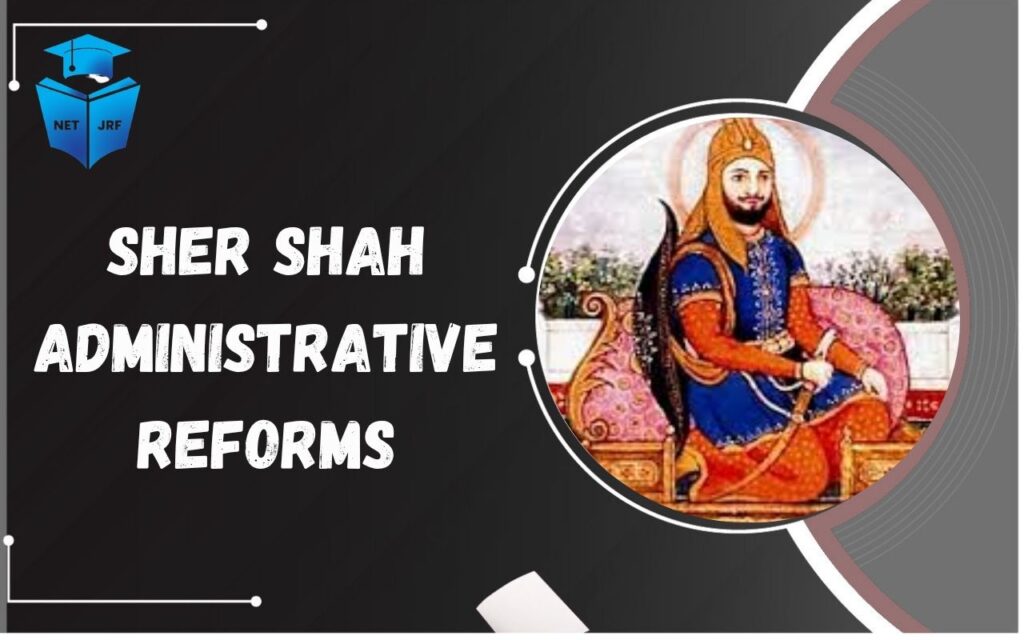
Sher Shah’s Administrative Reforms created a strong foundation for governance that influenced Indian rulers for centuries. Sher Shah Suri, born as Farid Khan in Sasaram, Bihar, founded the Sur Dynasty after defeating the Mughal Emperor Humayun. Even though he ruled for only five short years from 1540 to 1545, his vision changed the subcontinent forever. He successfully combined the best parts of previous systems with his own unique ideas to create a peaceful and wealthy empire.

Sher Shah Central Structure
Sher Shah held absolute power as the head of the state, serving as the chief lawmaker and military commander. He did not believe in sharing his ultimate authority, but he knew he needed expert help to manage the daily work. He established four major ministries at the center to handle different parts of the government. This central setup ensured that the ruler stayed informed about every part of his kingdom.
Each department had a specific leader who reported directly to Sher Shah. This clear chain of command reduced confusion and made the government much faster. The king chose his ministers based on their talent and loyalty rather than just their family background. This focus on merit helped the empire grow strong even while facing threats from enemies.
The Four Main Central Departments
- Diwan-i-Wizarat: The Wazir led this finance department. He managed the state’s income and watched over all expenditures.
- Diwan-i-Ariz: This department looked after the army. The minister in charge handled recruitment, training, and salary payments.
- Diwan-i-Rasalat: This acted as the foreign ministry. It managed relations with other kingdoms and handled diplomatic letters.
- Diwan-i-Insha: This office focused on communication. It drafted royal orders and sent them to local officials throughout the empire.
Sher Shah’s Administrative Reforms Core Features
The division of the empire into smaller units remains one of the most famous parts of Sher Shah’s Administrative Reforms. He knew he could not govern everything from the capital city. Therefore, he split his empire into 47 large districts called Sarkars. Each Sarkar had its own set of officers to keep the peace and collect taxes. This decentralized approach allowed local problems to find local solutions.
Below the Sarkar, Sher Shah created smaller units called Parganas. Each Pargana consisted of several villages. This hierarchy ensured that the government reached every corner of the country. By placing specific officials in every district and sub-district, Sher Shah made sure that no one could hide from the law or avoid paying their fair share of taxes.
Sarkar and Pargana Levels
- In every Sarkar, two high-ranking officers held power.
- The Shiqdar-i-Shiqdaran maintained military control and law and order.
- The Munsif-i-Munsifan served as the chief judge and supervised the land revenue collection.
- At the Pargana level, the Shiqdar (military) and Amin (revenue) performed similar roles on a smaller scale.
- Other officials like the Fotedar (treasurer) and Karkuns (accountants) kept careful records of every coin the state received.
Best UGC NET Online Test Series
Sher Shah Revolutionary Land Revenue Systems
Sher Shah realized that a stable empire needs a happy farming community. He introduced a systematic land survey to make tax collection fair. His officers measured all cultivable land and classified it based on how much it could produce. They labeled land as good, middle, or bad to determine the correct tax rate.
- This replaced the old system where officials often guessed the tax amount.
- The state usually demanded one-third of the average produce as tax. Farmers could pay this in cash or with a share of their crops, which gave them flexibility.
Sher Shah also introduced two important documents:
- the Patta and the Qabuliyat.
- The Patta gave the farmer a title to his land, and the Qabuliyat was the farmer’s agreement to pay the tax. This system protected the poor from being cheated by greedy local collectors.

Sur Dynasty Currency and Trade Improvements
Before the Sur Dynasty, the money system in India was a mess. Sher Shah solved this by standardizing the currency. He introduced a beautiful silver coin called the Rupiya, which weighed 178 grains. He also brought in copper coins called Dam for smaller everyday purchases. These coins were so well-made that they became the basis for the modern Indian Rupee.
To help trade grow, Sher Shah removed many of the annoying local taxes that merchants had to pay while traveling. He only collected taxes when goods entered the country or when people sold them in the market. This made goods cheaper and encouraged traders to move their products across the empire. The economy flourished because merchants finally felt safe and supported by the state.
Join UGC NET Offline Coaching in Jaipur
Sher Shah Dynasty Military
Sher Shah maintained a powerful and loyal army to protect his borders. He borrowed several smart ideas from earlier rulers like Alauddin Khalji to keep his troops honest. He insisted on the Dagh system, where officials branded every royal horse with a special mark. This prevented soldiers from replacing high-quality horses with weak ones.
He also kept a Chehra, which was a detailed written description of every soldier in the army. This list prevented ghost soldiers, where officers claimed salary for men who did not exist. Sher Shah paid his soldiers well and often in cash, which made them very loyal to him. He personally inspected the troops and made sure they stayed ready for battle at all times.
Grand Trunk Road Infrastructure
A great empire needs great roads. Sher Shah built four major highways to connect the different parts of his kingdom. The most famous one ran from Sonargaon in Bengal all the way to the Indus River in the west.
- People today still know this massive road as the Grand Trunk Road.
- He planted trees on both sides of these roads to provide shade for tired travelers.
- Along these highways, he built about 1,700 sarais, or rest houses.
- These sarais provided free food and water to travelers of all religions.
- They also served as post offices and police stations. Because of these safe roads, news and soldiers could move quickly across the land.
- This infrastructure was a key part of the success of Sher Shah’s Administrative Reforms.
Sher Shah Dynasty Justice and Police System
Sher Shah believed that a king’s primary duty is to provide justice. He followed a very strict policy for keeping the peace. He made the local village officials responsible for any crimes committed in their area. If someone committed a robbery and the police could not find the thief, the local headman had to pay for the loss or find the criminal himself.
This local responsibility system made the roads incredibly safe. People said that an old woman carrying a basket of gold could travel safely at night without any fear. Sher Shah appointed a Muhtasib to check on public morals and make sure merchants did not cheat their customers. He also served as the highest judge and listened to the complaints of even the poorest citizens.
Comparison of Administrative Units
| Level | Chief Executive | Chief Financial Officer | Function |
| Sarkar (District) | Shiqdar-i-Shiqdaran | Munsif-i-Munsifan | Law and Regional Survey |
| Pargana (Sub-district) | Shiqdar | Amin/Amil | Local Order and Tax Collection |
| Village (Local) | Muqaddam | Patwari | Local Affairs and Records |
| Treasury | Fotedar | Karkuns (Accountants) | Managing Local Cash and Books |
Top UGC NET Coaching in Jaipur
Numbered List of Implementation Steps
Sher Shah’s administrative reforms were implemented through a systematic sequence of practical steps, each designed to strengthen governance, regulate revenue, and promote economic stability across his empire.
- Initial Conquest: Sher Shah first secured his borders in North India to create a stable environment for change.
- Survey Initiation: He ordered a complete measurement of all cultivable land using a standardized rope called a jarib.
- Classification: Officers divided the land into Polaj, Parauti, Chachar, and Banjar based on fertility.
- Tax Fixation: The state fixed the tax at one-third of the average yield to prevent over-taxation.
- Documentation: He issued Pattas to farmers to prove their land ownership and collected Qabuliyats to ensure tax loyalty.
- Infrastructure Launch: He began the construction of the Grand Trunk Road and the 1,700 sarais to boost trade.
- Currency Standardization: He minted the silver Rupiya and copper Dam to stabilize the market economy.
Points Section
- Merit-Based Jobs: He hired Hindus and Muslims alike based on their skills rather than their religion.
- Police Efficiency: The local responsibility system nearly eliminated theft and highway robbery.
- Postal System: The sarais acted as hubs for a very fast horse-courier mail service.
- Architectural Legacy: He built the Purana Qila in Delhi and his own magnificent tomb in Sasaram.
- Market Control: He ensured that standard weights and measures were used in every market.
- Welfare Acts: He constructed wells, hospitals, and kitchens for the poor within the sarais.
- Future Foundation: His systems served as the primary blueprint for the Mughal Emperor Akbar.
The legacy of the Sur Dynasty is far greater than its short duration suggests. Through Sher Shah’s Administrative Reforms, India saw its first truly organized land revenue system and a standardized currency that lasted for centuries. He successfully proved that a ruler could manage a diverse population by being fair, strict, and focused on public welfare. His roads and sarais connected people, while his tax reforms protected the backbone of the Indian economy, the humble farmer.

Sher Shah’s Administrative Reforms FAQs

2. What is the Grand Trunk Road?
It is a massive highway built by Sher Shah that connected Bengal to the Indus River, facilitating trade and communication across North India.
3. What is the difference between a Patta and a Qabuliyat?
The Patta is a document given by the state to the farmer showing land ownership, while the Qabuliyat is the farmer's written agreement to pay taxes.
4. How did Sher Shah change the currency of India?
He introduced the silver Rupiya and the copper Dam, which standardized the value of money and helped trade flourish.
5. Who were the four main ministers in the central government?
They were the Wazir (Finance), the Ariz-i-Mamalik (Army), the Foreign Minister (Rasalat), and the Minister of Communications (Insha).
6. What was the Dagh system in the army?
The Dagh system involved branding horses with a royal mark to prevent soldiers from replacing them with inferior animals.
7. How were the districts divided in the Sur Empire?
The empire was divided into 47 Sarkars, which were further split into Parganas and then into villages.
8. What was the "local responsibility" rule for the police?
It meant that if a crime happened in a village, the headman had to either find the thief or pay for the stolen items himself.
9. How did Sher Shah measure land?
He used a standardized rope called a jarib and a measurement unit called a Gaz (about 33 inches) to survey all farms.