
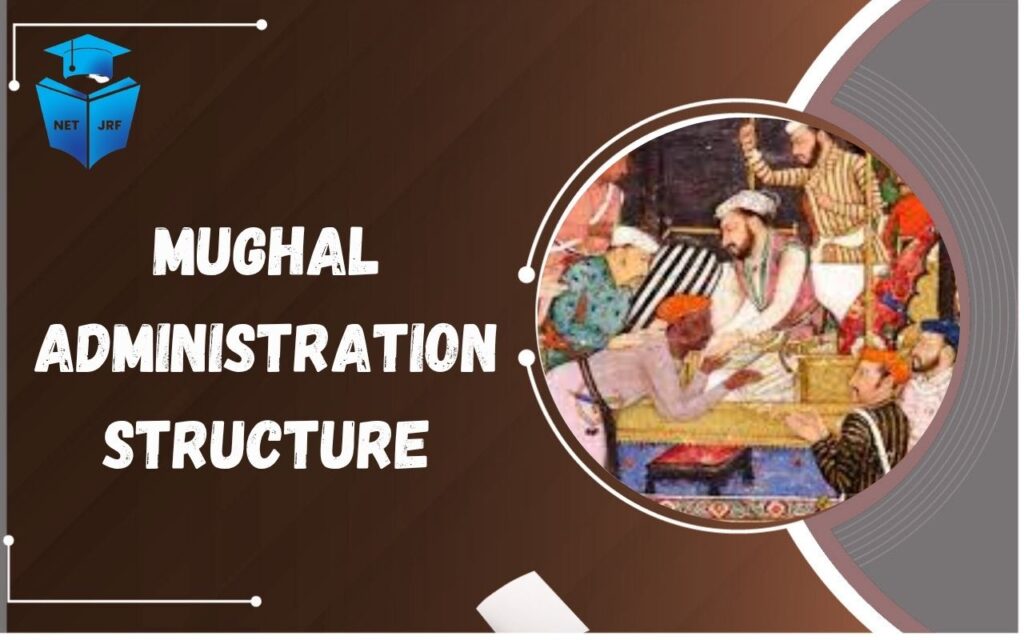
Mughal Administration was a highly centralised bureaucracy that primarily took shape during the reign of Emperor Akbar. While the earlier Sultans of Delhi followed a theocratic model, the Mughals refined these systems into a sophisticated machine of governance. The Emperor sat at the very top of this structure, holding absolute power over political, military, and judicial matters.

Mughal Administration Emperor
The Mughal Emperor, often called the Padshah, served as the ultimate authority in the empire.
- commander-in-chief
-
-
- He acted as the chief executive, the primary lawmaker, the commander-in-chief of the armed forces, and the final dispenser of justice.
- Unlike the Sultans before them, the Mughal rulers did not accept the nominal authority of any foreign power like the Caliph. They believed in the Divine Right of Kings, with Akbar even claiming to be the Shadow of God or God’s representative on Earth.
-
- Jharokha Darshan
-
-
- Despite having unlimited power, the great Mughal emperors believed that their prime duty was the welfare of their subjects. Akbar personally listened to the complaints of the people through practices like Jharokha Darshan, where he appeared before the public every morning.
-
- Tula-dan
-
- He also practiced Tula-dan, which involved weighing himself against precious metals and distributing them to the poor. These rituals helped build a direct emotional bond between the ruler and the ruled.
Enroll UGC NET Foundation Course
Departments in Mughal Administration
The Emperor did not work alone; he relied on a council of ministers and several specialized departments to manage the state’s affairs. Each minister was typically a high-ranking Mansabdar who could also lead troops in the army if needed. These central departments formed the core of the Mughal Administration and ensured that the Emperor’s orders reached every corner of the realm.
The Four Main Central Ministries
The central government functioned through four primary ministries, each headed by a senior official:
- The Wazir or Diwan: He was the Prime Minister and the head of the revenue department. He supervised all income and expenditure, controlled state lands (Khalisa), and managed land grants (Jagirs).
- The Mir Bakhshi: This official served as the paymaster of the empire and supervised the military administration. He handled the recruitment of soldiers, the branding of horses (Dagh system), and the Mansabdari rankings.
- The Sadr-us-Sudr: He was the minister in charge of religious matters and charities. He managed religious education, recommended stipends for scholars, and appointed judges (Qazis) across the provinces.
- The Khan-i-Saman: He looked after the imperial household establishment. His duties included managing the royal family’s needs and supervising the state factories known as Karkhanas.
Other Significant Central Officials
- Qazi-ul-Quzat: The highest judicial officer who administered justice according to Islamic law.
- The Muhtasib: An official who monitored public morals and checked for illegal activities like gambling or public drinking.
- Daroga-i-dak-chauki: The head of the intelligence and post department, who collected news from across the empire to keep the Emperor informed.
- Mir-i-atish: The officer in charge of the imperial artillery.
Provincial Governance: The Subah System
To make governance easier, the Mughal Empire was divided into large provinces known as Subahs. During Akbar’s time, there were 15 such Subahs, including Agra, Delhi, Bengal, and Bihar. Each province was a smaller version of the central government, with its own set of officials who reported back to the capital.
The head of the province was the Subahdar (also called Sipah Salar), who represented the Emperor’s authority at the regional level. He commanded the provincial military forces and was responsible for maintaining law and order. To prevent the Subahdar from becoming an independent ruler, the Emperor also appointed a provincial Diwan. This Diwan managed the province’s finances and reported directly to the central Wazir, creating an effective system of checks and balances.
Mughal Administration Departments
| Department Level | Chief Official | Primary Function | Key Responsibility |
| Central | Wazir / Diwan | Finance & Revenue | Managing State Income and Expenditure |
| Central | Mir Bakhshi | Military Admin | Army Recruitment and Mansabdar Oversight |
| Provincial | Subahdar | Executive Head | Provincial Law, Order, and Military |
| District | Faujdar | Local Executive | Maintaining Peace and Enforcing Imperial Law |
| Sub-District | Shiqdar | Executive Officer | Local Law Enforcement and Security |

Local Administration Sarkars and Parganas
Each Subah was further divided into districts known as Sarkars. The government at the Sarkar level focused on two main goals: maintaining security and collecting land revenue. Two key officers led each district:
- The Faujdar: He was the chief executive and military officer of the Sarkar. His job was to enforce the Emperor’s laws and handle rebellions.
- The Amalguzar: He served as the revenue collector. He surveyed the land and ensured that taxes were collected fairly from the farmers.
Below the district level was the Pargana, which consisted of a group of villages. The Shiqdar served as the chief executive of the Pargana, while the Amil handled the financial work. The Qanungo kept the agricultural records, and the Fotedar acted as the local treasurer. This layered approach ensured that the Mughal Administration remained connected to the needs of its people while maintaining central control.
Village Level Governance and Panchayat
The village was the smallest but most important unit of the administrative hierarchy. While the central government appointed officials at the district and sub-district levels, village life was largely self-governed. A Village Council or Panchayat managed local affairs like sanitation, irrigation, education, and minor legal disputes.
The two most vital figures at the village level were:
- Muqaddam: He was the village headman responsible for maintaining order and acting as the link between the villagers and the state.
- Patwari: He was the village accountant who kept detailed records of land ownership and revenue payments.
Mughal Administration Mansabdari System
One of the most innovative parts of the Mughal Administration was the Mansabdari system, introduced by Emperor Akbar. Every official in the Mughal service, whether they were a general, a judge, or a governor held a specific rank called a Mansab. This system combined the civil and military branches of government into a single hierarchy.
Mansabdar’s rank was determined by two numbers: Zat and Sawar.
- Zat: This number denoted the officer’s personal status, salary, and position in the official court hierarchy.
- Sawar: This number indicated how many cavalrymen and horses the officer had to maintain for the Emperor’s service.
Mansabdars were paid either in cash (Naqdi) or through land grants (Jagirs). It is important to note that these positions were not hereditary; when a Mansabdar died, their rank and land returned to the state. This prevented the rise of a permanent landed aristocracy that could challenge the Emperor’s power.
Top UGC NET Coaching in Jaipur
Mughal Administration Land Revenue and Dahshala System
Agriculture provided the primary income for the Mughal state, making revenue collection a top priority. Under the guidance of Raja Todar Mal, Akbar introduced the Dahshala system (also known as the Zabti system) in 1582. This system was based on a careful survey and measurement of all cultivable lands using a standardized rope called a jarib.
Land was classified into four categories based on how often it was cultivated:
- Polaj: Land cultivated annually for every crop.
- Parauti: Land left fallow for a short time to recover its fertility.
- Chachar: Land lying fallow for three to four years.
- Banjar: Land not cultivated for five years or more.
The state typically claimed one-third of the average produce as its share. Farmers were encouraged to pay their taxes in cash, which promoted a growing market economy and expanded internal trade.
Mughal Empire Judicial Structure
The Mughal legal system followed the Sunni Hanafi school of jurisprudence. The Emperor was the highest judge in the land, but he appointed a hierarchy of Qazis to handle daily legal matters. The Qazi-ul-Quzat served as the chief justice at the center, while provincial and district Qazis managed local courts.
These courts handled both civil and criminal cases, including disputes over inheritance and property. While Muslims followed Sharia law, the Mughals also respected local customs and traditions for their non-Muslim subjects. In villages, the Panchayats continued to dispense justice based on customary laws. Emperor Jahangir even installed a “Chain of Justice” at the Agra Fort, allowing any subject to pull it and directly grab the Emperor’s attention for their grievances.
Numbered List of Administrative Features
- Centralization: The Emperor held absolute power and was the source of all authority in the state.
- Bureaucracy: A detailed hierarchy of officials managed every level of governance, from finance to the military.
- Mansabdari System: A unique ranking framework that integrated military and civil services.
- Provincial Divisions: The empire was split into Subahs to ensure efficient regional control.
- Checks and Balances: Provincial Diwans reported to the center to prevent governors from rebelling.
- Revenue Surveys: Systematic land measurements ensured fair and stable tax collection.
- Local Autonomy: Villages remained largely self-governing through their own Panchayats and headmen.
The Mughal Administration stands as a landmark in Indian history for its balance of central authority and local efficiency. By creating a professional bureaucracy and a fair revenue system, rulers like Akbar provided the stability needed for trade and culture to flourish. The layers of governance Central, Provincial, and Local ensured that the state could respond to challenges across a massive subcontinent. Although the system eventually weakened under later rulers due to the shortage of Jagirs and frequent wars, its core features influenced the administrative frameworks of later Indian states.
Best UGC NET Coaching in Jaipur

Mughal Administration FAQs

Who was the Mir Bakhshi?
The Mir Bakhshi was the head of the military department and supervised the Mansabdari system and army payroll.
What is the difference between Zat and Sawar?
Zat represents an official's personal rank and salary, while Sawar represents the number of cavalrymen they must maintain.
Who introduced the Dahshala revenue system?
Raja Todar Mal, the finance minister of Emperor Akbar, introduced this systematic land revenue system.
What was the role of the Faujdar?
The Faujdar was the district-level executive officer responsible for maintaining law, order, and regional security.