
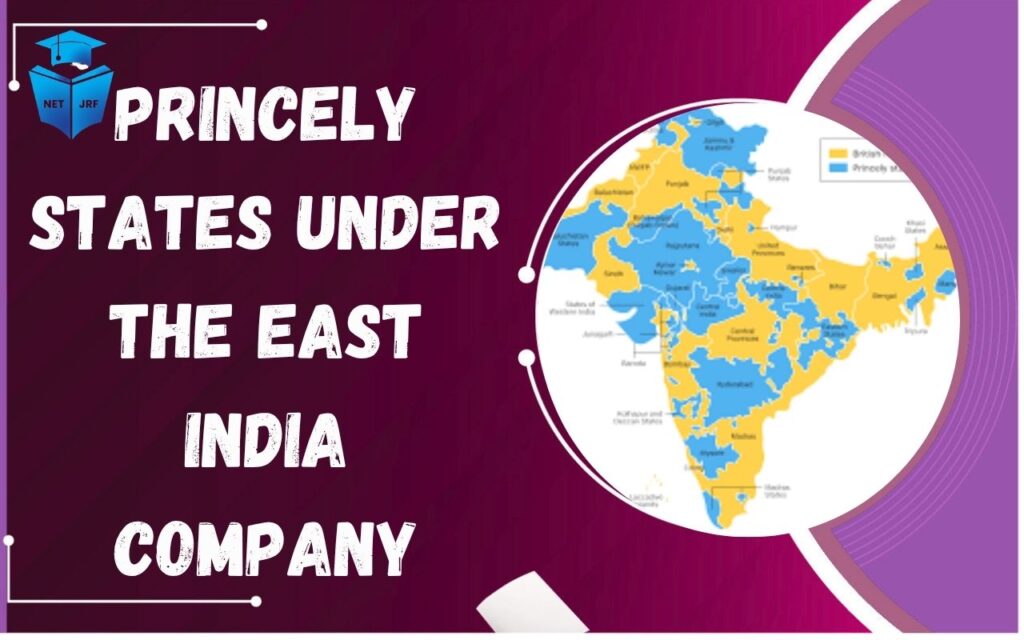

Princely States under the East India Company: Check Treaties, Alliances and Control

Princely States under the East India Company in this topic you learn how treaties subsidiary alliances Residents and annexation policies helped the British control semi independent kingdoms across India

vishal

Princely States under the East India Company

Table of Contents

Princely States under the East India Company represented a unique part of India’s colonial history. While the British ruled many areas directly, they left hundreds of states under local kings. These rulers kept their titles but lost their true power. The British used a system called “indirect rule” to manage these regions. This allowed the Company to control vast lands without spending too much money on daily tasks.

Study Planner

Understanding the status of these states helps us see how the British Empire grew. They did not just use soldiers to win wars. They used clever laws and treaties to trap local monarchs. These states occupied nearly one-third of the Indian landmass. Their relationship with the British changed many times between 1757 and 1858.

Join UGC NET Online Course

Early Phase of Princely States under East India Company Rule

The Princely States under the East India Company first appeared during the decline of the Mughal Empire. As the central power in Delhi weakened, local governors became independent nawabs and rajas. The East India Company initially saw these rulers as trade partners. However, after the Battle of Plassey in 1757, the Company started interfering in their internal politics.

  • During this early stage, the Company followed a Ring Fence policy. They wanted to create a buffer zone around their own territories. 
  • They defended these neighbor states to keep their own borders safe. 
  • This was the first step in building a network of Princely States under the East India Company
  • The British provided military help in exchange for money or land.
  • This period saw the Company moving from a trading role to a political one. 
  • They realized that controlling a local king was easier than fighting him.
  •  By keeping a friendly ruler on the throne, the British could collect revenue and resources. This created a complex web of alliances that defined the Indian map for a century.

Subsidiary Alliance System

Lord Wellesley played a major role in shaping the Princely States under the East India Company. He introduced the Subsidiary Alliance system. This was a master plan to bring Indian states under British control. Under this system, a ruler had to dismantle his own army. In its place, he had to pay for a British-led force.

A ruler who joined this alliance lost his freedom to deal with other foreign powers. He could not employ Europeans from other nations without British permission. This system turned many independent kingdoms into Princely States under the East India Company. Hyderabad was the first major state to accept these terms in 1798.

The Subsidiary Alliance had several key features:

  • The British promised to protect the state from external enemies.
  • The ruler accepted a British official, called a Resident, at his court.
  • The state paid for the maintenance of the British army.
  • The ruler could not wage war without British consent.

Role of British Resident

The Resident was the most powerful figure in the Princely States under the East India Company. On paper, he was just a diplomat. In reality, he controlled the king’s every move. He gave advice on administration, taxes, and succession. If a king did not listen, the Resident would report him to the Governor-General.

  • The presence of a Resident changed the nature of Princely States under the East India Company. Local rulers became lazy or irresponsible because they no longer feared internal revolts. They knew the British army would protect them from their own people. 
  • This often led to bad governance and high taxes for the peasants.
  • Over time, the Resident moved from the sidelines to the center of power. He controlled who became the next king. 
  • He also monitored the state’s wealth. This indirect rule was very effective for the British. It allowed them to enjoy the benefits of power without the headache of local administration.

Join UGC NET Online Test Series

Annexation and Princely States under the East India Company

The British did not always want to keep the kings in power. Sometimes, they wanted to take the land directly. This led to the policy of annexation. Lord Dalhousie was the most famous leader for this strategy. He wanted to unify British holdings in India. This aggressive stance threatened many Princely States under the East India Company.

  • Dalhousie used the Doctrine of Lapse to expand British territory. If an Indian ruler died without a natural male heir, his state “lapsed” to the British.
  •  The Company refused to recognize adopted sons as legal heirs for the throne. 
  • This policy caused great anger among the royal families of India.
  • Many famous states fell because of this rule. Satara, Sambalpur, and Jhansi were all annexed by the British. The annexation of Awadh in 1856 was even more controversial. The British claimed the Nawab was ruling poorly. This move shocked the Indian people and became a major cause of the 1857 revolt.

Paramountcy and Sovereignty

The concept of “Paramountcy” defined the legal status of Princely States under the East India Company. It meant that the British power was the ultimate authority in India. No Indian ruler was equal to the British Governor-General. Even if a state was “independent” by treaty, it still had to follow British orders.

The Company asserted its paramountcy in several ways:

  1. Issuing “Sanads” (certificates) to recognize a ruler’s right to his throne.
  2. Settling disputes between different princely states.
  3. Intervening in cases of extreme “misrule” or corruption.
  4. Controlling the state’s communication and postal systems.

This sense of superiority created a hierarchy. The Princely States under the East India Company were at the bottom, and the British Parliament was at the top. The British gradually stripped away the kings’ sovereign rights until they were mere figureheads.

Administration and Economy in States

The internal administration of Princely States under the East India Company varied greatly. Some states, like Mysore or Travancore, were known for good governance. They built schools and hospitals. Others were poorly managed. The British generally did not care about the people’s welfare as long as the revenue kept coming in.

Best UGC NET Offline Classes in Jaipur

  • Economically, these states were tied to the British system. They had to use British currency in many cases. Their trade was often restricted to favor British merchants. 
  • This was part of the shift from a mercantile interest to a colonial state. The wealth of the princely states often flowed into British hands through military payments.
  • Socially, the princely courts became centers of culture. Since the kings had no wars to fight, they spent money on art, music, and architecture. 
  • However, this luxury often came from the hard work of poor farmers. The heavy demands of the British Subsidiary Alliance forced kings to squeeze every penny from their subjects.

App JRF Adda

Comparison of Rule Types

Feature Directly Ruled Provinces Princely States under the East India Company
Highest Authority Governor-General / Governor Local Raja or Nawab
Legal System British Courts and Laws Traditional Laws / British Resident Advice
Military British Indian Army Subsidiary Forces / Small State Guard
Revenue Collected by British Officers Collected by King for British Payments
Political Status British Territory Semi-Sovereign / Indirect Rule

Timeline of Key Events for Princely States

Year Event Impact on Princely States
1765 Diwani Rights Granted Start of political interference in Bengal
1798 Hyderabad Alliance First major state joins Subsidiary system
1848 Doctrine of Lapse Aggressive annexation policy begins
1856 Annexation of Awadh Massive unrest among local rulers
1858 Government of India Act End of Company rule; Crown takes over

Strategic Importance of the States

The Princely States under the East India Company served as breakwaters in the storm of rebellion. The British relied on these kings to stay loyal during times of trouble. During the 1857 revolt, many rulers supported the British instead of the rebels. This loyalty helped the British survive and keep their hold on India.

  • The states also provided a place for the British to recruit soldiers. Many princely armies were eventually integrated into the larger British military structure.
  •  The states acted as partners in the colonial project. They helped maintain order in remote areas where the British had few officials.
  • However, this partnership was never one of equals. 
  • The British always kept the upper hand. They used the states to balance power. By supporting one king against another, they prevented any single Indian power from becoming too strong. This “divide and rule” tactic was a cornerstone of British policy.

Steps in the Expansion of British Control

The expansion of British control in India was not sudden. It followed a series of strategic steps involving wars, treaties, and administrative policies.

  1. Trading Treaties: The Company first asks for trade rights and factory space.
  2. Military Alliances: The Company offers soldiers to help a king fight his neighbors.
  3. Revenue Sharing: The Company demands land or money (Diwani) to pay for the soldiers.
  4. Resident Appointment: A British official moves into the palace to “advise” the king.
  5. Subsidiary Alliance: The king loses his army and becomes fully dependent on the British.
  6. Direct Annexation: If the king fails or has no heir, the British take the land entirely.

The story of Princely States under the East India Company is one of survival and loss. These states allowed the British to build an empire with fewer resources. By using local kings as puppets, the Company controlled the people without appearing to be the enemy. However, the aggressive policies of Dalhousie eventually pushed the rulers to their breaking point. The transition from Company rule to Crown rule in 1858 changed this relationship once again. The British realized that keeping the kings happy was better for stability. Thus, the Princely States under the East India Company remained until India finally gained its independence. This era left a deep mark on India’s geography and its political soul. Future leaders had to work hard to unite these different pieces into a single nation. Looking back, we see how the Company’s administrative evolution shaped the modern map of India.

Top UGC NET Coaching in Jaipur

JRF Adda Book

Read UGC NET Notes
1 Archaeological Sources for UGC NET Epigraphy – Study of Inscriptions Meaning of Historical Sources Archaeological
2 Meaning of Historical Sources Archaeological Sources for UGC NET Literary Sources in History Archaeological
3 Exploration in Archaeology Excavation Techniques in Archaeology Dating of Archaeological Sites Archaeological
4 Excavation Techniques in Archaeology Exploration in Archaeology Dating of Archaeological Sites Archaeological
5 Epigraphy – Study of Inscriptions Inscriptions in Reconstructing History Numismatics in History Archaeological
6 Inscriptions in Reconstructing History Epigraphy – Study of Inscriptions Archaeological Sources for UGC NET Archaeological
7 Numismatics in History Importance of Coins in History Epigraphy – Study of Inscriptions Archaeological
8 Importance of Coins in History Numismatics in History Archaeological Sources for UGC NET Archaeological
9 Dating of Archaeological Sites Excavation Techniques in Archaeology Dating Ancient Literary Sources Archaeological
10 Indigenous Literature Literary Sources in History Secular Literature as Historical Source Literary
11 Dating Ancient Literary Sources Literary Sources in History Dating of Archaeological Sites Literary
12 Literary Sources in History Indigenous Literature Foreign Accounts of India Literary
13 Foreign Accounts of India Greek Accounts on Ancient India Chinese Accounts on India Literary
14 Greek Accounts on Ancient India Foreign Accounts of India Chinese Accounts on India Literary
15 Secular Literature as Historical Source Literary Sources in History Indigenous Literature Literary
16 Role of Myths and Legends in Historical Reconstruction Literary Sources in History Secular Literature as Historical Source Literary
17 Chinese Accounts on India Foreign Accounts of India Greek Accounts on Ancient India Literary
18 Arabic Accounts on India Foreign Accounts of India Chinese Accounts on India Literary
19 Neolithic and Chalcolithic Phases Neolithic Revolution in India Chalcolithic Culture in India Neolithic
20 Hunting, Gathering & Food Production Neolithic Revolution in India Neolithic Settlements in India Neolithic
21 Neolithic Revolution in India Neolithic Settlements in India Tools and Technology in Neolithic Period Neolithic
22 Neolithic Settlements in India Distribution of Neolithic Cultures in India Neolithic Revolution in India Neolithic
23 Distribution of Neolithic Cultures in India Neolithic Settlements in India Tools and Technology in Neolithic Period Neolithic
24 Tools and Technology in Neolithic Period Neolithic Revolution in India Chalcolithic Culture in India Neolithic
25 Chalcolithic Culture in India Settlement Pattern & Economy in Chalcolithic Phase Trade & Exchange Networks in Chalcolithic Societies Neolithic
26 Settlement Pattern & Economy – Chalcolithic Phase Chalcolithic Culture in India Trade & Exchange Networks in Chalcolithic Societies Neolithic
27 Trade & Exchange Networks – Chalcolithic Societies Chalcolithic Culture in India IVC Internal & External Trade Neolithic
28 Indus Valley Civilization – UGC NET Major Sites of Indus Civilization Urban Planning in Harappan Civilization IVC
29 IVC Internal & External Trade Internal Trade – Harappan Civilization Craft Specialization in Harappan Civilization IVC
30 Political Organization – Harappan Civilization Social Structure – Indus Civilization Urban Planning in Harappan Civilization IVC
31 Major Sites of Indus Civilization Indus Valley Civilization – UGC NET Urban Planning in Harappan Civilization IVC
32 Urban Planning & Settlement – Harappan Civilization Architecture & Town Planning – Harappan Cities IVC as First Urbanization in India IVC
33 Architecture & Town Planning – Harappan Cities Urban Planning in Harappan Civilization Major Sites of Indus Civilization IVC
34 Craft Specialization & Industrial Activities – Harappan Agriculture & Food Economy – Harappans IVC Internal & External Trade IVC
35 Agriculture & Food Economy – Harappans Craft Specialization in Harappan Civilization Internal Trade – Harappan Civilization IVC
36 Internal Trade – Harappan Civilization IVC Internal & External Trade Craft Specialization in Harappan Civilization IVC
37 Religion & Beliefs – Indus Civilization Social Structure – Indus Civilization Indus Valley Civilization – UGC NET IVC
38 Social Structure – Indus Civilization Political Organization – Harappan Civilization Religion & Beliefs – Indus Civilization IVC
39 Decline of Indus Civilization Indus Valley Civilization – UGC NET IVC as First Urbanization in India IVC
40 IVC as First Urbanization in India Urban Planning in Harappan Civilization Second Urbanization in India IVC
41 Vedic & Later Vedic Periods – Aryan Varna System Early Vedic Society and Economy Later Vedic Society and Economy Vedic
42 Origin of Vedic Civilization Aryan Debate – Migration, Invasion & Indigenous Theories Early Vedic Society and Economy Vedic
43 Aryan Debate – Migration, Invasion & Indigenous Theories Origin of Vedic Civilization Early Vedic Society and Economy Vedic
44 Early Vedic Society and Economy Political Institutions – Early Vedic Period Social Structure – Early Vedic Period Vedic
45 Political Institutions – Early Vedic Period Early Vedic Society and Economy Monarchical States in Ancient India Vedic
46 Social Structure – Early Vedic Period Emergence of Varnas & Social Stratification Early Vedic Society and Economy Vedic
47 Later Vedic Society and Economy Emergence of Varnas & Social Stratification Impact of Iron Technology in India Vedic
48 Emergence of Varnas & Social Stratification Social Structure – Early Vedic Period Later Vedic Society and Economy Vedic
49 Emergence of Heterodox Sects in India Jainism, Buddhism & Ajivikas – Origins & Teachings Later Vedic Society and Economy Vedic
50 Impact of Iron Technology in India Later Vedic Society and Economy Agricultural Expansion & Economic Changes – Ancient India Vedic
51 Religious & Philosophical Vedic Ideas Emergence of Varnas & Social Stratification Emergence of Heterodox Sects in India Vedic
52 Megalithic Culture of South India Neolithic and Chalcolithic Phases Agricultural Expansion & Economic Changes General
53 State System in Ancient India Rise of Mahajanapadas Transition: Tribal Polities to Territorial States General
54 Transition: Tribal Polities to Territorial States Rise of Mahajanapadas Later Vedic Society and Economy General
55 Rise of Mahajanapadas Monarchical States in Ancient India Republican States (Gana-Sanghas) – Ancient India Magadha
56 Monarchical States in Ancient India Rise of Mahajanapadas Emergence of Magadha Magadha
57 Republican States (Gana-Sanghas) – Ancient India Rise of Mahajanapadas Monarchical States in Ancient India Magadha
58 Agricultural Expansion & Economic Changes – Ancient India Second Urbanization in India Impact of Iron Technology in India General
59 Second Urbanization in India IVC as First Urbanization in India Rise of Mahajanapadas General
60 Jainism, Buddhism & Ajivikas – Origins & Teachings Emergence of Heterodox Sects in India Ashoka’s Policy of Dhamma General
61 Emergence of Magadha Geographical Advantages of Magadha Early Rulers of Magadha Magadha
62 Geographical Advantages of Magadha Natural Resources & Economic Strength of Magadha Reasons for Success of Magadha Magadha
63 Natural Resources & Economic Strength of Magadha Geographical Advantages of Magadha Economic Policies of the Nandas Magadha
64 Early Rulers of Magadha Haryanka Dynasty – Rise of Magadha Emergence of Magadha Magadha
65 Haryanka Dynasty – Rise of Magadha Expansion Policy of Bimbisara Early Rulers of Magadha Magadha
66 Expansion Policy of Bimbisara Ajatashatru – Military Reforms Haryanka Dynasty – Rise of Magadha Magadha
67 Ajatashatru – Military Reforms Wars of Ajatashatru Expansion Policy of Bimbisara Magadha
68 Wars of Ajatashatru Ajatashatru – Military Reforms Udayin & Establishment of Pataliputra Magadha
69 Udayin & Establishment of Pataliputra Wars of Ajatashatru Shishunaga Dynasty Magadha
70 Shishunaga Dynasty Administrative Structure of the Shishunagas Nanda Dynasty Magadha
71 Administrative Structure of the Shishunagas Shishunaga Dynasty Central Administration Under Mauryas Magadha
72 Nanda Dynasty Mahapadma Nanda – Imperial Expansion Shishunaga Dynasty Magadha
73 Mahapadma Nanda – Imperial Expansion Military Strength of the Nandas Nanda Dynasty Magadha
74 Economic Policies of the Nandas Nanda Dynasty Taxation System – Mauryan State Magadha
75 Military Strength of the Nandas Mahapadma Nanda – Imperial Expansion Defeat of Nandas & Rise of Mauryan Empire Magadha
76 Reasons for Success of Magadha Geographical Advantages of Magadha Natural Resources & Economic Strength of Magadha Magadha
77 Mahajanapadas to Empire – Evolution & Rise of Magadha Rise of Mahajanapadas Emergence of Magadha Magadha
78 Mauryan Empire – Expansion Rise of Chandragupta Maurya Expansion of Mauryan Empire Maurya
79 Rise of Chandragupta Maurya Role of Chanakya in Rise of Mauryan Empire Defeat of Nandas & Rise of Mauryan Empire Maurya
80 Role of Chanakya in Rise of Mauryan Empire Rise of Chandragupta Maurya Defeat of Nandas & Rise of Mauryan Empire Maurya
81 Defeat of Nandas & Rise of Mauryan Empire Military Strength of the Nandas Rise of Chandragupta Maurya Maurya
82 Chandragupta Maurya – Seleucus Treaty & Diplomacy Expansion of Mauryan Empire Greek Accounts on Ancient India Maurya
83 Expansion of Mauryan Empire Chandragupta Maurya – Seleucus Treaty & Diplomacy Kalinga War Maurya
84 Administration of Chandragupta Maurya Central Administration Under Mauryas Mauryan Bureaucracy Maurya
85 Sources for Mauryan History Archaeological Sources for UGC NET Greek Accounts on Ancient India Maurya
86 Central Administration Under Mauryas Provincial Administration – Mauryan Empire Mauryan Bureaucracy Maurya
87 Provincial Administration – Mauryan Empire Local Administration – Mauryan Empire Central Administration Under Mauryas Maurya
88 Local Administration – Mauryan Empire Provincial Administration – Mauryan Empire Mauryan Bureaucracy Maurya
89 Mauryan Bureaucracy Central Administration Under Mauryas Espionage System – Mauryan Empire Maurya
90 Espionage System – Mauryan Empire Mauryan Bureaucracy Central Administration Under Mauryas Maurya
91 Ancient India – Trade and Commerce Trade and Commerce Under Mauryas Agrarian Economy – Mauryan Period Maurya
92 Agrarian Economy – Mauryan Period Taxation System – Mauryan State Trade and Commerce Under Mauryas Maurya
93 Trade and Commerce Under Mauryas Ancient India – Trade and Commerce Agrarian Economy – Mauryan Period Maurya
94 Taxation System – Mauryan State Agrarian Economy – Mauryan Period Economic Policies of the Nandas Maurya
95 Kalinga War Ashoka’s Policy of Dhamma Expansion of Mauryan Empire Maurya
96 Ashoka’s Policy of Dhamma Nature & Philosophy of Dhamma Kalinga War Maurya
97 Nature & Philosophy of Dhamma Ashoka’s Policy of Dhamma Jainism, Buddhism & Ajivikas Maurya

Princely States under the East India Company FAQs 

Loader image

There were over 500 princely states of various sizes across the Indian subcontinent.

It was a treaty where an Indian ruler accepted a British army in his territory. In return, the ruler had to pay the British and accept their Resident.

Lord Dalhousie introduced this policy. It stated that a kingdom would go to the British if the ruler died without a biological male heir.

Keeping the states was cheaper. It also provided loyal allies who could help stop internal rebellions against British rule.

The Resident was an official who lived in the king's court. He monitored the state's affairs and ensured the ruler followed British interests.

The Nizam of Hyderabad was the first major ruler to sign the Subsidiary Alliance in 1798.

The British claimed that the Nawab was not ruling his people well. This "misrule" gave them an excuse to take the wealthy province.

Most were forced to disband their large armies. They were allowed to keep small guards for ceremony and internal peace.

After the 1857 revolt, the British Crown took over from the Company. The Crown promised to stop annexing states and respected the rulers' rights more.

Leave a Reply

Recent Posts
Aditi

Aditi Sharma, founder of JRFAdda, is a Computer Science educator with an MCA degree and JRF qualification (99.91 percentile, Dec 2019). Her experience includes roles as an SBI SO (DBA), work at Cognizant, and over 5 years of teaching online and offline. She has also served as a Government Computer Teacher in Rajasthan.