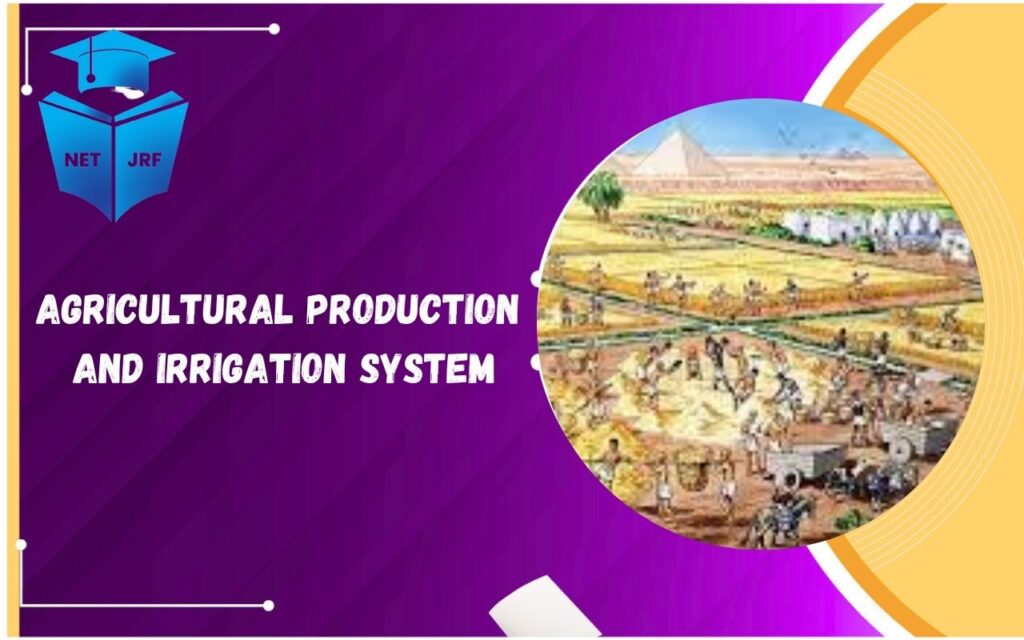
Agricultural Production and Irrigation System in Medieval India Economy and Farming

Agricultural Production and Irrigation System in medieval India in this topic you learn how farming irrigation methods land revenue systems crop patterns rural economy and trade growth shaped Sultanate and Mughal economic stability and administration

vishal

Agricultural Production and Irrigation System

Table of Contents

Agricultural Production and Irrigation System in medieval India formed the backbone of the economy during the Delhi Sultanate and Mughal period. Nearly the entire rural population depended on cultivation for livelihood. Since rulers collected land revenue from agricultural produce, farming directly influenced political power, military strength, and administrative stability.

Study Planner
In medieval India, agriculture was not just an occupation  it was the foundation of economic life, social hierarchy, and state finance. A strong harvest strengthened the empire. A weak monsoon could destabilize it.

Agricultural Production and Irrigation System in medieval india Historical Background

Medieval India broadly covers the 13th to 18th centuries. This period includes:

  • Delhi Sultanate (1206–1526)
  • Mughal Empire (1526–1707 and later)

Both regimes relied heavily on agriculture for survival of the state. Unlike modern industrial economies, medieval India had very limited manufacturing revenue. Therefore, agricultural surplus became the main financial resource of rulers.

Enroll UGC NET Online Test Series

Why Agriculture Was So Important

  • 80–85% of people lived in villages
  • Majority worked as peasants or agricultural laborers
  • Land revenue contributed nearly 80–90% of state income
  • Trade depended on surplus agricultural production

Agriculture shaped political stability. Efficient irrigation meant prosperity. Crop failure meant famine.

Structure of Rural Economy

The village served as the basic economic unit. It functioned almost independently.

Key Elements of Village System

  • Peasants cultivated land
  • Zamindars supervised collection
  • Artisans provided tools
  • Village headman managed local disputes
  • State officials collected revenue

This self-sufficient structure ensured continuity of the Agricultural Production and Irrigation System across centuries.

Major Crops in Medieval India

Medieval agriculture showed diversification. Farmers cultivated food crops for survival and cash crops for trade.

1. Food Crops

Crop Type Major Crops Regions Season
Food grains Wheat Punjab, Doab Rabi
Rice Bengal, Bihar Kharif
Millets Deccan plateau Kharif
Pulses All regions Rabi

Rice dominated eastern India due to high rainfall. Wheat dominated north-western plains.

2. Cash Crops

Crop Use Region Economic Impact
Cotton Textile production Gujarat, Deccan Boosted export trade
Indigo Blue dye Bihar European demand
Sugarcane Sugar making Doab region Urban consumption
Opium Trade Malwa Revenue generation

Under Mughal rule, foreign trade expanded. European traders demanded cotton textiles and indigo. This demand increased commercial agriculture.

Irrigation Techniques in Medieval India

The Agricultural Production and Irrigation System depended heavily on irrigation because monsoon remained uncertain. Rulers invested in artificial water supply systems to reduce risk.

Major Irrigation Methods

  • Wells
  • Persian Wheel (Rahat)
  • Tanks
  • Canals
  • River-based irrigation

Wells

Wells remained the most common irrigation source. Individual farmers often owned private wells.

Advantages:

  • Reliable
  • Suitable for small fields
  • Controlled water supply

Persian Wheel (Rahat)

The Persian wheel used animal power to lift water. It increased water flow from wells.

Impact:

  • Irrigated larger areas
  • Increased crop intensity
  • Reduced manual labor

This innovation strengthened the Agricultural Production and Irrigation System significantly.

Tank Irrigation

Tank irrigation dominated South India. Rulers and temples built large water reservoirs.

Features:

  • Stored rainwater
  • Supported dry regions
  • Required community maintenance

Temple authorities often supervised tank management.

Join UGC NET Online Coaching

Canal Irrigation

Important canals were built under:

  • Firoz Shah Tughlaq
  • Shah Jahan

Canals diverted river water into fields. This method expanded cultivation in northern plains.

App JRF Adda

Sultanate vs Mughal Agricultural Policies

The Mughal system appeared more organized and predictable.

Feature Delhi Sultanate Mughal Empire
Revenue Structure Iqta system Zabti system
Land Measurement Limited Scientific measurement
Tax Rate High and variable More standardized
Record Keeping Less systematic Detailed documentation
Crop Expansion Moderate Diversified and commercial

Land Revenue System

The Agricultural Production and Irrigation System is closely connected with taxation.

Under Delhi Sultanate

  • Iqta holders collected revenue
  • State share sometimes reached 50%
  • Heavy taxation burdened peasants
  • Measurement was irregular

Under Mughal Empire

Akbar introduced revenue reforms.

Zabti System Features

  • Land measured in bigha
  • Average produce calculated over 10 years
  • Cash payment encouraged
  • Revenue fixed based on productivity

Raja Todar Mal improved administration through systematic record keeping.

These reforms increased agricultural stability.

Join UGC NET Coaching in Jaipur

Agricultural Seasons

Medieval farming followed two main crop cycles:

Kharif Crops (Monsoon)

  • Rice
  • Millets
  • Cotton

Rabi Crops (Winter)

  • Wheat
  • Barley
  • Pulses

Seasonal variation influenced the Agricultural Production and Irrigation System.

Agricultural Production and Irrigation System Characteristics

The Agricultural Production and Irrigation System did not function in isolation; it directly influenced revenue policies, rural hierarchy, trade expansion, and political stability in medieval India.

Aspect Description
Economic Base Agriculture
Revenue Source Land tax
Irrigation Types Wells, tanks, canals
Technology Simple iron tools
Social Impact Village hierarchy
Trade Link Cash crop expansion

Role of Technology

Medieval agricultural tools were simple but effective.

Tools Used

  • Wooden plough
  • Iron ploughshare
  • Sickle
  • Hoe
  • Bullocks

Iron tools improved soil penetration. Animal power increased efficiency.

Though technology remained basic, irrigation innovations improved productivity.

Regional Variations

India’s geography created diverse agricultural patterns.

North India

  • Fertile alluvial soil
  • Wheat cultivation
  • Canal irrigation

Eastern India

  • Heavy rainfall
  • Rice dominance
  • River irrigation

Deccan

  • Millets
  • Tank irrigation
  • Dry farming

South India

  • Rice fields
  • Large water tanks
  • Temple management

Regional diversity strengthened overall agricultural resilience.

Agricultural Trade Expansion

During Mughal rule:

  • Cotton textiles exported globally
  • Indigo supplied European markets
  • Sugar consumed in urban centers

Improved irrigation increased surplus production. Surplus supported urban growth.

Join UGC NET Offline Classes in Jaipur

Famine and Agricultural Crisis

Despite irrigation improvements, agriculture remained monsoon-dependent.

Causes of Crisis

  • Drought
  • Flood
  • War disruption
  • Excess taxation
  • Lack of transport

Poor communication delayed relief efforts.

JRF Adda Book

Contribution to Mughal Economy

The Agricultural Production and Irrigation System generated nearly 80–90% of Mughal state revenue. A strong harvest strengthened military expansion and palace administration.

Stable taxation encouraged peasants to expand cultivation. Commercial crops increased monetary circulation.

The Agricultural Production and Irrigation System remained the foundation of medieval India’s economic structure. Efficient irrigation methods, organized revenue reforms, crop diversification, and regional adaptations ensured agricultural continuity. Mughal administrative improvements made the system more systematic than earlier Sultanate practices. 

Read UGC NET Notes
1 Archaeological Sources for UGC NET Epigraphy – Study of Inscriptions Meaning of Historical Sources Archaeological
2 Meaning of Historical Sources Archaeological Sources for UGC NET Literary Sources in History Archaeological
3 Exploration in Archaeology Excavation Techniques in Archaeology Dating of Archaeological Sites Archaeological
4 Excavation Techniques in Archaeology Exploration in Archaeology Dating of Archaeological Sites Archaeological
5 Epigraphy – Study of Inscriptions Inscriptions in Reconstructing History Numismatics in History Archaeological
6 Inscriptions in Reconstructing History Epigraphy – Study of Inscriptions Archaeological Sources for UGC NET Archaeological
7 Numismatics in History Importance of Coins in History Epigraphy – Study of Inscriptions Archaeological
8 Importance of Coins in History Numismatics in History Archaeological Sources for UGC NET Archaeological
9 Dating of Archaeological Sites Excavation Techniques in Archaeology Dating Ancient Literary Sources Archaeological
10 Indigenous Literature Literary Sources in History Secular Literature as Historical Source Literary
11 Dating Ancient Literary Sources Literary Sources in History Dating of Archaeological Sites Literary
12 Literary Sources in History Indigenous Literature Foreign Accounts of India Literary
13 Foreign Accounts of India Greek Accounts on Ancient India Chinese Accounts on India Literary
14 Greek Accounts on Ancient India Foreign Accounts of India Chinese Accounts on India Literary
15 Secular Literature as Historical Source Literary Sources in History Indigenous Literature Literary
16 Role of Myths and Legends in Historical Reconstruction Literary Sources in History Secular Literature as Historical Source Literary
17 Chinese Accounts on India Foreign Accounts of India Greek Accounts on Ancient India Literary
18 Arabic Accounts on India Foreign Accounts of India Chinese Accounts on India Literary
19 Neolithic and Chalcolithic Phases Neolithic Revolution in India Chalcolithic Culture in India Neolithic
20 Hunting, Gathering & Food Production Neolithic Revolution in India Neolithic Settlements in India Neolithic
21 Neolithic Revolution in India Neolithic Settlements in India Tools and Technology in Neolithic Period Neolithic
22 Neolithic Settlements in India Distribution of Neolithic Cultures in India Neolithic Revolution in India Neolithic
23 Distribution of Neolithic Cultures in India Neolithic Settlements in India Tools and Technology in Neolithic Period Neolithic
24 Tools and Technology in Neolithic Period Neolithic Revolution in India Chalcolithic Culture in India Neolithic
25 Chalcolithic Culture in India Settlement Pattern & Economy in Chalcolithic Phase Trade & Exchange Networks in Chalcolithic Societies Neolithic
26 Settlement Pattern & Economy – Chalcolithic Phase Chalcolithic Culture in India Trade & Exchange Networks in Chalcolithic Societies Neolithic
27 Trade & Exchange Networks – Chalcolithic Societies Chalcolithic Culture in India IVC Internal & External Trade Neolithic
28 Indus Valley Civilization – UGC NET Major Sites of Indus Civilization Urban Planning in Harappan Civilization IVC
29 IVC Internal & External Trade Internal Trade – Harappan Civilization Craft Specialization in Harappan Civilization IVC
30 Political Organization – Harappan Civilization Social Structure – Indus Civilization Urban Planning in Harappan Civilization IVC
31 Major Sites of Indus Civilization Indus Valley Civilization – UGC NET Urban Planning in Harappan Civilization IVC
32 Urban Planning & Settlement – Harappan Civilization Architecture & Town Planning – Harappan Cities IVC as First Urbanization in India IVC
33 Architecture & Town Planning – Harappan Cities Urban Planning in Harappan Civilization Major Sites of Indus Civilization IVC
34 Craft Specialization & Industrial Activities – Harappan Agriculture & Food Economy – Harappans IVC Internal & External Trade IVC
35 Agriculture & Food Economy – Harappans Craft Specialization in Harappan Civilization Internal Trade – Harappan Civilization IVC
36 Internal Trade – Harappan Civilization IVC Internal & External Trade Craft Specialization in Harappan Civilization IVC
37 Religion & Beliefs – Indus Civilization Social Structure – Indus Civilization Indus Valley Civilization – UGC NET IVC
38 Social Structure – Indus Civilization Political Organization – Harappan Civilization Religion & Beliefs – Indus Civilization IVC
39 Decline of Indus Civilization Indus Valley Civilization – UGC NET IVC as First Urbanization in India IVC
40 IVC as First Urbanization in India Urban Planning in Harappan Civilization Second Urbanization in India IVC
41 Vedic & Later Vedic Periods – Aryan Varna System Early Vedic Society and Economy Later Vedic Society and Economy Vedic
42 Origin of Vedic Civilization Aryan Debate – Migration, Invasion & Indigenous Theories Early Vedic Society and Economy Vedic
43 Aryan Debate – Migration, Invasion & Indigenous Theories Origin of Vedic Civilization Early Vedic Society and Economy Vedic
44 Early Vedic Society and Economy Political Institutions – Early Vedic Period Social Structure – Early Vedic Period Vedic
45 Political Institutions – Early Vedic Period Early Vedic Society and Economy Monarchical States in Ancient India Vedic
46 Social Structure – Early Vedic Period Emergence of Varnas & Social Stratification Early Vedic Society and Economy Vedic
47 Later Vedic Society and Economy Emergence of Varnas & Social Stratification Impact of Iron Technology in India Vedic
48 Emergence of Varnas & Social Stratification Social Structure – Early Vedic Period Later Vedic Society and Economy Vedic
49 Emergence of Heterodox Sects in India Jainism, Buddhism & Ajivikas – Origins & Teachings Later Vedic Society and Economy Vedic
50 Impact of Iron Technology in India Later Vedic Society and Economy Agricultural Expansion & Economic Changes – Ancient India Vedic
51 Religious & Philosophical Vedic Ideas Emergence of Varnas & Social Stratification Emergence of Heterodox Sects in India Vedic
52 Megalithic Culture of South India Neolithic and Chalcolithic Phases Agricultural Expansion & Economic Changes General
53 State System in Ancient India Rise of Mahajanapadas Transition: Tribal Polities to Territorial States General
54 Transition: Tribal Polities to Territorial States Rise of Mahajanapadas Later Vedic Society and Economy General
55 Rise of Mahajanapadas Monarchical States in Ancient India Republican States (Gana-Sanghas) – Ancient India Magadha
56 Monarchical States in Ancient India Rise of Mahajanapadas Emergence of Magadha Magadha
57 Republican States (Gana-Sanghas) – Ancient India Rise of Mahajanapadas Monarchical States in Ancient India Magadha
58 Agricultural Expansion & Economic Changes – Ancient India Second Urbanization in India Impact of Iron Technology in India General
59 Second Urbanization in India IVC as First Urbanization in India Rise of Mahajanapadas General
60 Jainism, Buddhism & Ajivikas – Origins & Teachings Emergence of Heterodox Sects in India Ashoka’s Policy of Dhamma General
61 Emergence of Magadha Geographical Advantages of Magadha Early Rulers of Magadha Magadha
62 Geographical Advantages of Magadha Natural Resources & Economic Strength of Magadha Reasons for Success of Magadha Magadha
63 Natural Resources & Economic Strength of Magadha Geographical Advantages of Magadha Economic Policies of the Nandas Magadha
64 Early Rulers of Magadha Haryanka Dynasty – Rise of Magadha Emergence of Magadha Magadha
65 Haryanka Dynasty – Rise of Magadha Expansion Policy of Bimbisara Early Rulers of Magadha Magadha
66 Expansion Policy of Bimbisara Ajatashatru – Military Reforms Haryanka Dynasty – Rise of Magadha Magadha
67 Ajatashatru – Military Reforms Wars of Ajatashatru Expansion Policy of Bimbisara Magadha
68 Wars of Ajatashatru Ajatashatru – Military Reforms Udayin & Establishment of Pataliputra Magadha
69 Udayin & Establishment of Pataliputra Wars of Ajatashatru Shishunaga Dynasty Magadha
70 Shishunaga Dynasty Administrative Structure of the Shishunagas Nanda Dynasty Magadha
71 Administrative Structure of the Shishunagas Shishunaga Dynasty Central Administration Under Mauryas Magadha
72 Nanda Dynasty Mahapadma Nanda – Imperial Expansion Shishunaga Dynasty Magadha
73 Mahapadma Nanda – Imperial Expansion Military Strength of the Nandas Nanda Dynasty Magadha
74 Economic Policies of the Nandas Nanda Dynasty Taxation System – Mauryan State Magadha
75 Military Strength of the Nandas Mahapadma Nanda – Imperial Expansion Defeat of Nandas & Rise of Mauryan Empire Magadha
76 Reasons for Success of Magadha Geographical Advantages of Magadha Natural Resources & Economic Strength of Magadha Magadha
77 Mahajanapadas to Empire – Evolution & Rise of Magadha Rise of Mahajanapadas Emergence of Magadha Magadha
78 Mauryan Empire – Expansion Rise of Chandragupta Maurya Expansion of Mauryan Empire Maurya
79 Rise of Chandragupta Maurya Role of Chanakya in Rise of Mauryan Empire Defeat of Nandas & Rise of Mauryan Empire Maurya
80 Role of Chanakya in Rise of Mauryan Empire Rise of Chandragupta Maurya Defeat of Nandas & Rise of Mauryan Empire Maurya
81 Defeat of Nandas & Rise of Mauryan Empire Military Strength of the Nandas Rise of Chandragupta Maurya Maurya
82 Chandragupta Maurya – Seleucus Treaty & Diplomacy Expansion of Mauryan Empire Greek Accounts on Ancient India Maurya
83 Expansion of Mauryan Empire Chandragupta Maurya – Seleucus Treaty & Diplomacy Kalinga War Maurya
84 Administration of Chandragupta Maurya Central Administration Under Mauryas Mauryan Bureaucracy Maurya
85 Sources for Mauryan History Archaeological Sources for UGC NET Greek Accounts on Ancient India Maurya
86 Central Administration Under Mauryas Provincial Administration – Mauryan Empire Mauryan Bureaucracy Maurya
87 Provincial Administration – Mauryan Empire Local Administration – Mauryan Empire Central Administration Under Mauryas Maurya
88 Local Administration – Mauryan Empire Provincial Administration – Mauryan Empire Mauryan Bureaucracy Maurya
89 Mauryan Bureaucracy Central Administration Under Mauryas Espionage System – Mauryan Empire Maurya
90 Espionage System – Mauryan Empire Mauryan Bureaucracy Central Administration Under Mauryas Maurya
91 Ancient India – Trade and Commerce Trade and Commerce Under Mauryas Agrarian Economy – Mauryan Period Maurya
92 Agrarian Economy – Mauryan Period Taxation System – Mauryan State Trade and Commerce Under Mauryas Maurya
93 Trade and Commerce Under Mauryas Ancient India – Trade and Commerce Agrarian Economy – Mauryan Period Maurya
94 Taxation System – Mauryan State Agrarian Economy – Mauryan Period Economic Policies of the Nandas Maurya
95 Kalinga War Ashoka’s Policy of Dhamma Expansion of Mauryan Empire Maurya
96 Ashoka’s Policy of Dhamma Nature & Philosophy of Dhamma Kalinga War Maurya
97 Nature & Philosophy of Dhamma Ashoka’s Policy of Dhamma Jainism, Buddhism & Ajivikas Maurya

Agricultural Production and Irrigation System in medieval india FAQs

Loader image

Wells were the most common irrigation source throughout medieval India because they provided a reliable water supply. Farmers frequently used the Persian wheel (Rahat) to lift water more efficiently using animal power. This method allowed irrigation of larger fields and increased overall agricultural productivity.

Mughal agriculture expanded due to stable revenue policies and systematic land measurement introduced by the administration. Growing demand for cash crops like cotton, indigo, and sugarcane in domestic and foreign markets encouraged commercial cultivation. Improved irrigation facilities also helped increase surplus production.

Akbar introduced the Zabti system, which involved accurate land measurement and assessment based on average produce over several years. He fixed standardized tax rates to reduce exploitation and bring uniformity in revenue collection. These reforms created financial stability for the empire and encouraged peasants to cultivate more land.

Rice dominated eastern India because of heavy rainfall and fertile river plains, while wheat became the main crop of northern India. Millets were common in the Deccan region due to dry conditions. Cotton and indigo gained importance as commercial crops because of expanding trade networks.


 

Leave a Reply

Recent Posts
Aditi

Aditi Sharma, founder of JRFAdda, is a Computer Science educator with an MCA degree and JRF qualification (99.91 percentile, Dec 2019). Her experience includes roles as an SBI SO (DBA), work at Cognizant, and over 5 years of teaching online and offline. She has also served as a Government Computer Teacher in Rajasthan.