

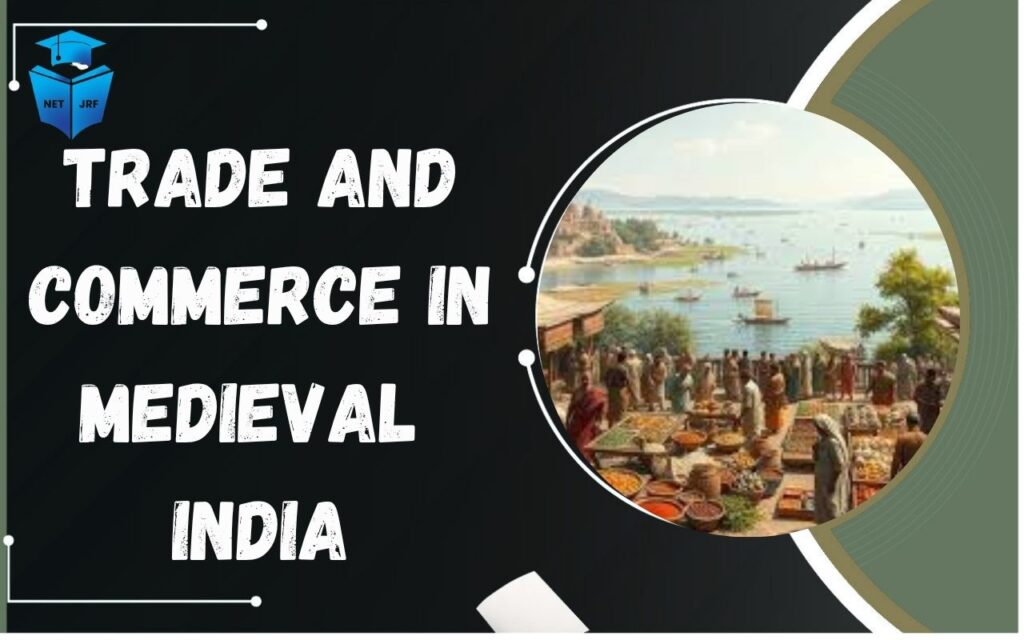
Trade and Commerce was central to medieval states because rulers used trade systems to build wealth, control markets, set rules and support political power. Trade routes spread goods far across regions, while markets, tariffs, guilds, ports and money systems shaped how people bought and sold products.

Trade and Commerce Meaning
Trade and Commerce refers to the exchange of goods and services between people, towns and regions. Trade involved farmers, artisans, merchants and rulers. Commerce included systems of buying, selling, storing and transporting goods. In medieval history, state policies shaped how trade worked and who benefited most.
Enroll UGC NET Foundation Course
Importance of Trade and Commerce in Medieval States
Trade brought wealth to kingdoms and connected distant places. States used trade systems to earn revenue through taxes and control prices. Commerce helped towns grow into economic centres by linking producers with buyers. Trade also spread culture, ideas and technology across regions.
State Policies on Trade
State policies on trade determined how rulers regulated markets, collected taxes, secured routes, controlled prices, and guided economic exchange across regions.
Taxation and Tariff Rules
Rulers collected tariffs and levies on goods as they moved through towns or crossed borders. These taxes provided income for the state. Some policies fixed duties on imports and exports to protect local producers.
Market Regulations
Kings appointed officials to manage markets, enforce weights and measures and prevent fraud. Markets operated under rules that ensured fair trade and standard quality of goods.
Protection of Trade Routes
Trade routes required security. States protected roads, river paths and coastal channels. Safe trade routes encouraged merchants to travel longer distances with valuable goods.
Major Trade Goods in Medieval Times
Major trade goods in medieval times included valuable commodities that drove commerce, influenced state revenue, and linked local markets with global trade routes.
Different regions specialised in products that shaped trade patterns.
| Product | Region | Use |
| Spices | South India | Food flavouring exports |
| Textiles | Gujarat, Bengal | Cloth exports |
| Metals | Central India | Tools weapons jewellery |
| Grain | North India | Food supply |
| Horses | Central Asia | Cavalry in armies |
Trade Routes and Connectivity
Trade routes and connectivity shaped commercial expansion by linking production centres, markets, ports, and political regions through organized networks of transport.
Land Routes
Caravan tracks linked cities with deserts, hills and plains. Merchants used pack animals to carry goods long distances.
River Routes
Rivers like the Ganges served as trade highways for heavy goods. Boats carried grains, salt, wood and metal goods between towns.
Town Market Networks
Towns located at crossroads or riverbanks became famous trading hubs where goods from many places met.
Join UGC NET Online Test Series
Currency and Money Systems
In medieval times, states recognized that trade could not grow efficiently with barter alone. To solve this, rulers introduced standardized coins and money systems. These coins were made from metals like gold, silver, copper, or bronze, and each coin had a fixed weight and value. By issuing coins, states created a common medium of exchange that merchants could trust, which simplified buying, selling, and long-distance trade.
A standard currency also helped in pricing goods uniformly. For example, a merchant in Delhi could trade with another in Gujarat without confusion over the value of cotton, spices, or textiles. Coins reduced disputes that often arose when people used different types of barter goods.
Some key aspects of medieval money systems include:
- State Authority: Only the ruling king or sultan could issue official coins. This control ensured authenticity and reduced counterfeit currency.
- Metal Value: Coins made of precious metals carried intrinsic value, which made them acceptable even across borders.
- Trade Promotion: Standard coins encouraged inter-regional and international trade because foreign merchants trusted the currency.
- Revenue for the State: Minting coins also allowed states to earn revenue through taxes, trade levies, and seigniorage (profit from issuing currency).
Merchant Guilds and Corporate Groups
Merchant guilds were groups of traders who worked together for common interests. They protected trade caravans, settled price disputes, supported members’ families and sometimes negotiated with rulers for lower taxes.
| Feature | Small Local Exchanges | Long Distance Trade |
| Scope | Towns villages | Regions empires |
| Goods | Food crafts | Spices textiles metals |
| Transport | Carts pack animals | Boats caravans |
| Profit | Small | Large |
| State Role | Local rules | Tariffs protections |
Role of Ports in Trade
In medieval times, ports played a central role in trade, acting as hubs where goods, ideas, and people converged. Ports were usually located at river mouths or along the coast, allowing easy access for ships and boats. These locations connected inland markets with distant regions and facilitated both domestic and international commerce.
Enroll UGC NET Offline Classes in Jaipur
Key Functions of Ports:
- Gateways for Foreign Merchants: Coastal ports like Calicut, Cambay, and Surat became entry points for foreign traders, including Arabs, Chinese, and Europeans. These merchants brought valuable goods such as silk, spices, and precious metals, which enriched local markets.
- Centers for Export: Local products such as textiles, salt, spices, and grains were collected at ports and shipped to foreign markets. Ports acted as collection and distribution points, linking local producers with global demand.
- Import of New Goods: Ports allowed the inflow of foreign commodities, technologies, and luxury items. This exchange introduced new products into inland towns and villages, creating variety and stimulating demand.
- Trade Revenue: States often levied taxes and duties at ports, making them important sources of state income. Port authorities controlled customs, storage, and market regulations.
- Communication and Connectivity: Ports also became centers of information exchange, helping merchants learn about prices, demand, and market trends from distant regions.
Examples of Prominent Medieval Ports:
| Port Name | Location | Significance |
| Calicut | Kerala | Spice trade, gateway for Arab merchants |
| Cambay | Gujarat | Textile exports, connected inland markets |
| Surat | Gujarat | Major Mughal port, trade with Europeans |
| Masulipatnam | Andhra Pradesh | Cotton and textile export hub |
Impact on Inland Trade:
Goods arriving at ports were transported along rivers, roads, and caravan routes to interior markets. This integration ensured that coastal commerce directly influenced inland economies, promoting the growth of towns, crafts, and industries.
Structured Patterns of Trade
In medieval times, trade did not happen randomly; it followed well-defined structures enforced by state policies. These patterns ensured smooth, reliable, and predictable exchange of goods, which was essential for both merchants and local economies.
Key Features of Structured Trade:
- Standardised Weights and Measures:
Rulers introduced uniform units for weight, length, and volume. Standardisation reduced disputes between buyers and sellers, helped in pricing goods fairly, and increased trust in markets. For example, grain, cotton, and spices were sold using fixed measures set by the state. - Collection of Tolls and Taxes:
Merchants paid tolls at city gates, river crossings, or checkpoints along trade routes. These revenues helped the state maintain roads, bridges, and security for caravans. Toll systems also regulated trade by ensuring that merchants contributed to local infrastructure. - Storage and Warehousing:
States and guilds set up warehouses, granaries, and storehouses near towns, ports, and trade hubs. These facilities allowed traders to safely store goods, protect them from theft, and manage supply according to seasonal demand. - Assigned Market Days:
Markets often had fixed schedules, such as weekly or monthly fairs. This system ensured that traders knew when and where to sell goods. Special trade fairs attracted merchants from distant regions, boosting local economies and facilitating long-distance trade. - Guilds and Trade Associations:
Merchant guilds regulated trade within towns. They fixed prices, monitored quality, trained apprentices, and even resolved disputes. Guilds worked with state authorities to maintain orderly commerce.

Impact of Structured Trade:
- Reduced conflicts between merchants and buyers
- Created predictable income for states through taxes
- Encouraged growth of towns and trade centers
- Supported the circulation of currency and standardized exchang
State Support for Commerce
Rulers built infrastructure such as bridges to help movement of goods. Some states offered protection to caravans and ensured that roads remained usable. By supporting infrastructure, states improved trade productivity.
Trade Policies under Different Medieval States
Delhi Sultanate
The state regulated markets closely, collected revenues through market fees, protected key trade routes and kept currency standards to encourage trade across North India.
Mughal Empire
The Mughals expanded long-distance trade by stabilising internal markets, issuing uniform coins and building road networks. They supported caravanserais where merchants could rest on long journeys.
Challenges in Medieval Trade
Medieval trade thrived under structured policies, yet it faced multiple risks and obstacles. Merchants, states, and local markets had to overcome these challenges to maintain smooth commerce.
- Threats from Bandits and Pirates:
Caravans transporting goods along land routes often faced attacks by bandits. Coastal traders risked piracy at sea. These threats could result in loss of merchandise, delayed shipments, and higher costs for protection. To mitigate this, states patrolled trade routes, established forts, and hired guards. - Natural Disasters and Climate Hazards:
Floods, droughts, or storms could block rivers, damage ports, or destroy storage facilities. For example, heavy rains might make inland roads impassable, halting the movement of goods. States developed flood management systems, maintained roads, and repaired bridges to reduce trade disruptions. - Market Disputes and Price Volatility:
Merchants often faced disagreements over prices, weights, and quality of goods. Market shortages or oversupply could cause rapid price changes. Rulers introduced price controls, fixed measures, and guild supervision to stabilize markets. - Long-Distance Trade Risks:
International trade carried additional challenges such as unpredictable demand, foreign regulations, and tariffs. Foreign merchants often required safe harbors, diplomatic protection, and standardized contracts to facilitate business. - Financial Constraints:
Access to capital was limited. Merchants often depended on moneylenders or state credit systems to fund long journeys, purchase goods, or pay customs duties. Lack of funds could prevent expansion of trade networks. - Infrastructure Limitations:
Poor roads, inadequate bridges, and weak port facilities restricted trade efficiency. States invested in infrastructure development, such as building fortified roads, granaries, and port warehouses, to support commerce.
Best UGC NET Offline Coaching in Jaipur
Effects of Trade and Commerce
Despite the challenges faced in medieval trade, the systematic regulation of commerce and the growth of trade networks led to significant positive and negative effects on economy, society, and state formation.
| Effects Type | Positive Impacts | Negative Impacts |
| Economic | Wealth creation, state revenue | Local producers faced competition |
| Urbanisation | Growth of towns and markets | Overcrowding and inequality in cities |
| Cultural Exchange | Spread of knowledge, art, and religion | Cultural domination by foreign traders |
| Skill Development | Innovation in crafts, transport, production | Dependency on foreign markets |
| Political Strength | Revenue supported armies and governance | Elites controlled trade limiting common access |

Conclusion
Trade and Commerce – in medieval history shaped economic systems, supported political power, encouraged travel and cultural exchange. Rulers used tariffs, market structures, currencies, infrastructure and guild negotiations to build stable commerce systems. These policies created stronger states and supported the growth of towns and long-distance networks, making trade a key pillar of medieval economies.
Trade and Commerce in medieval history FAQs

How did medieval states use trade to generate revenue?
Medieval states collected taxes and duties on goods sold in markets and at borders. These revenues funded administration, armies, and public works. Trade thus became a key source of state income.
What role did currency play in medieval commerce?
Currency assigned standard value to goods and simplified trade across regions. Coins reduced dependence on barter, speeding up transactions. Well-accepted currency also encouraged long-distance trade and merchant trust.
Why were merchant guilds important?
Guilds protected traders from unfair practices, resolved disputes, and regulated quality standards. They sometimes negotiated with rulers for favorable policies. Guilds also organized collective security for caravans and marketplaces.
How did states protect trade routes?
States provided armed escorts, maintained roads, and built rest stops for traders. Patrols guarded against bandits, while checkpoints ensured safe passage. This security encouraged merchants to travel longer distances.