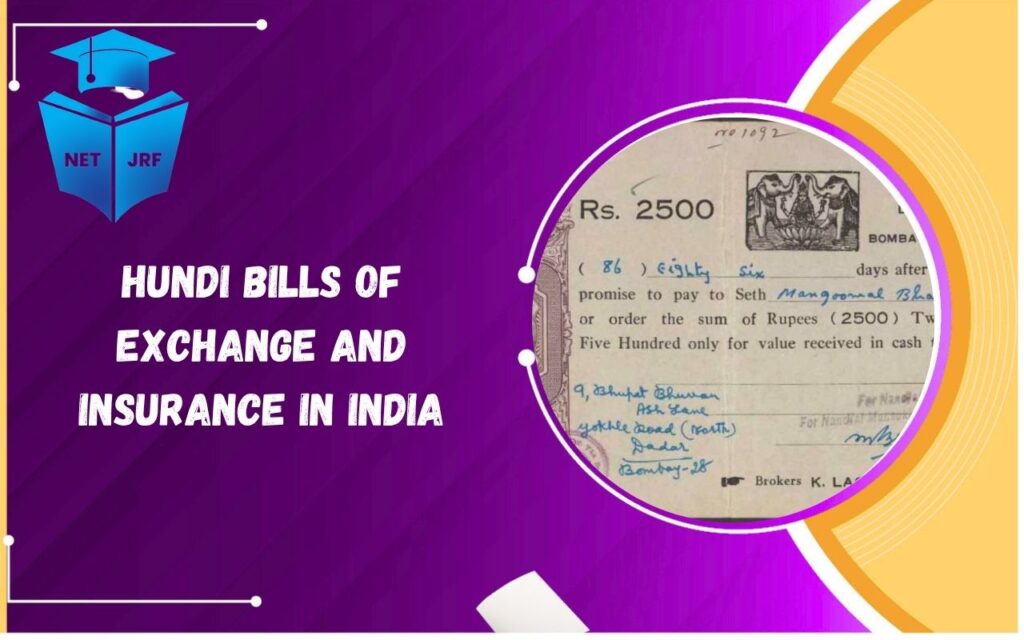
Hundi (Bills of Exchange) and Insurance formed the backbone of traditional commercial finance in India long before modern banking systems developed. Merchants across medieval and early modern India relied on these financial tools to transfer money, settle debts, finance trade, and protect goods during long-distance trade journeys.
Enroll UGC NET Coaching in Jaipur
For UGC NET history and commerce examinations, understanding this topic is important because it explains how Indian traders managed credit, trust, and risk before the arrival of modern banking institutions. Indigenous bankers, traders, and moneylenders created a sophisticated financial system that supported domestic and international trade.

Historical Background of Indigenous Financial Systems
Indian trade networks developed strong financial mechanisms to support commercial activities across cities, ports, and rural markets. Merchants often transported valuable goods such as spices, textiles, and metals across long distances.
- Carrying large amounts of cash was risky due to theft, political instability, and travel difficulties. To solve this problem, traders developed credit instruments like Hundi (Bills of Exchange) and Insurance that allowed secure money transfer without physical cash.
- Indigenous bankers called Shroffs, Sahukars, and Mahajans played a key role in this system. They issued hundis, guaranteed payments, and also provided risk protection for goods during transportation.
- Because of their reliability, these instruments gained wide acceptance across trade centers such as Surat, Agra, Banaras, Delhi, and Calcutta.
Hundi and Insurance Indian Commerce
The system of Hundi (Bills of Exchange) and Insurance operated as an informal but highly trusted financial mechanism used by merchants, bankers, and traders.
What is a Hundi?
A Hundi is a traditional financial document used in India that works similar to a modern bill of exchange. It is a written order that directs a person to pay a certain amount of money to another person.
Key features include:
- Written financial order
- Transfer of funds without physical money
- Based on trust and reputation
- Used widely in trade transactions
- Accepted across different regions
Merchants used Hundi (Bills of Exchange) and Insurance to conduct trade safely and efficiently, especially when dealing with partners located far away.
Hundi Transaction
A hundi transaction usually involved several participants who played specific roles.
Main Parties Involved
| Party | Role |
| Drawer | Person who writes the hundi |
| Drawee | Person who must make payment |
| Payee | Person who receives the payment |
| Endorser | Person who transfers the hundi |
| Banker | Financial intermediary |
These roles helped traders maintain trust in Hundi (Bills of Exchange) and Insurance transactions.
Enroll UGC NET Offline Coaching in Jaipur
Types of Hundis Used in Indian Trade
Different types of hundis existed depending on trade needs and payment conditions.
Major Types of Hundis
| Type of Hundi | Meaning | Usage |
| Darshani Hundi | Payable immediately | Used for quick payments |
| Muddati Hundi | Payable after a fixed time | Used for credit transactions |
| Shah Jog Hundi | Payable to a respectable person | Based on reputation |
| Nam Jog Hundi | Payable to a named person | Secure payment |
| Jokhmi Hundi | Used in risky trade | Linked with insurance |
Merchants frequently combined these instruments with Hundi (Bills of Exchange) and Insurance practices to reduce commercial risk.

Hundi and Insurance in Trade Systems
| Feature | Hundi | Insurance |
| Purpose | Transfer of money | Protection against loss |
| Nature | Credit instrument | Risk management tool |
| Users | Merchants, bankers | Traders, transporters |
| Function | Payment settlement | Compensation for damage |
| Role in trade | Facilitates commerce | Reduces uncertainty |
The system of Hundi (Bills of Exchange) and Insurance helped merchants operate confidently in long-distance trade.
Functions of Hundis in Commercial Activities
Hundis performed several important financial functions.
1. Money Transfer
Hundis allowed traders to send money from one city to another without carrying physical cash. This reduced robbery risks during travel.
2. Credit Creation
Merchants could buy goods on credit using hundis. The payment could be made later according to agreed conditions.
3. Trade Financing
Large trade transactions required financial support. Hundis helped traders manage working capital.
4. Banking Alternative
Before modern banks existed, Hundi (Bills of Exchange) and Insurance served as the primary financial infrastructure for commercial exchange.
5. Record of Commercial Agreement
A hundi acted as written proof of payment obligation between merchants.
Enroll UGC NET Online Coaching
Insurance Practices in Traditional Indian Trade
Along with hundis, traders also developed early forms of insurance to protect goods during transport.
Transporting goods through land routes or sea routes involved several dangers such as:
- Robbery
- Shipwreck
- Fire
- Weather damage
- Political instability
To protect themselves, merchants created systems similar to modern insurance.
These practices gradually evolved together with Hundi (Bills of Exchange) and Insurance to support trade security.
Early Forms of Commercial Insurance
Traditional Indian merchants used different methods to manage risk.
Common Insurance Methods
- Jokhmi Hundi
This special hundi included risk-sharing arrangements. Payment depended on the safe arrival of goods.
- Community Risk Sharing
Merchant communities collectively shared risks of loss.
- Trade Guild Support
Guilds sometimes compensated members if goods were lost during trade journeys.
- Maritime Risk Coverage
Goods transported by sea were often insured through agreements among traders.
These mechanisms illustrate how Hundi (Bills of Exchange) and Insurance supported trade stability.
Importance in Long Distance Trade
Indian traders conducted extensive trade across Asia, Africa, and the Middle East.
Important trade routes included:
- Silk routes
- Indian Ocean trade routes
- Inland caravan routes
Merchants used Hundi (Bills of Exchange) and Insurance to safely conduct these transactions across large distances.
Advantages for Traders
- Reduced need for carrying cash
- Increased trust in transactions
- Faster trade settlements
- Reduced risk of financial loss
- Promotion of commercial networks
Because of these advantages, the system became widely accepted across Indian markets.
Role of Indigenous Bankers
Traditional bankers known as Sahukars, Shroffs, and Mahajans managed hundi operations.
Their responsibilities included:
- Issuing hundis
- Guaranteeing payments
- Settling disputes
- Maintaining merchant accounts
These bankers maintained reputation-based financial networks that strengthened Hundi (Bills of Exchange) and Insurance systems.
Trust played a crucial role because most transactions depended on the credibility of the banker issuing the document.
Difference Between Modern Bills of Exchange and Hundis
Although hundis resemble modern bills of exchange, there are several differences.
Comparison Table
| Feature | Hundi | Modern Bill of Exchange |
| Origin | Indigenous Indian system | Western banking system |
| Legal status | Based on custom | Governed by law |
| Language | Local languages | Formal commercial language |
| Trust basis | Reputation | Legal enforcement |
| Usage | Traditional trade | Modern banking |
Even after modern banking developed during British rule, Hundi (Bills of Exchange) and Insurance continued to influence Indian commercial practices.
Relevance for UGC NET Examination
For UGC NET History and Commerce, this topic appears under economic history and indigenous banking systems.
Students should remember:
Important Exam Points
- Definition of hundi
- Types of hundis
- Role of indigenous bankers
- Function in trade networks
- Link with insurance practices
- Difference from modern banking
Many scholars studying Indian economic history highlight the efficiency of Hundi (Bills of Exchange) and Insurance in supporting large trade networks before colonial banking institutions appeared.

Decline Traditional Hundi System
During the colonial period, British banking institutions introduced formal banking regulations and modern financial instruments.
Reasons for decline include:
- Expansion of modern banks
- Legal financial instruments
- Standardized banking procedures
- Colonial financial reforms
However, Hundi (Bills of Exchange) and Insurance continued to exist in informal trade networks even during the early twentieth century.
Today, similar concepts survive in modern financial instruments such as:
- Bank drafts
- Promissory notes
- Bills of exchange
- Trade credit systems
Conclusion
The system of Hundi (Bills of Exchange) and Insurance represents one of the most sophisticated indigenous financial mechanisms developed in pre-modern India. It allowed traders to transfer money, obtain credit, finance trade, and protect goods from commercial risks.
Long before modern banks appeared, Indian merchants built strong trust-based financial networks that supported domestic and international trade. Indigenous bankers played a central role in issuing hundis and maintaining commercial credibility.
Hundi (Bills of Exchange) and Insurance UGC NET FAQs

2. Why were hundis important for merchants?
Hundis helped merchants send money safely across cities. They reduced theft risk and allowed trade to continue smoothly.
3. What role did indigenous bankers play?
Indigenous bankers issued hundis, guaranteed payments, and maintained trust between merchants. They acted like early banking institutions.
4. What is Jokhmi Hundi?
Jokhmi hundi was used in risky trade journeys. Payment depended on the safe arrival of goods, which made it similar to early insurance.
5. How were goods insured in traditional trade?
Merchants created agreements to compensate losses during transport. These arrangements worked like early commercial insurance systems.
6. How did hundis support long-distance trade?
Hundis allowed merchants to conduct transactions across regions without carrying cash. This encouraged safe and efficient trade.
7. Did the hundi system disappear completely?
No. Although modern banking replaced most traditional systems, some informal trade networks still use similar credit instruments.