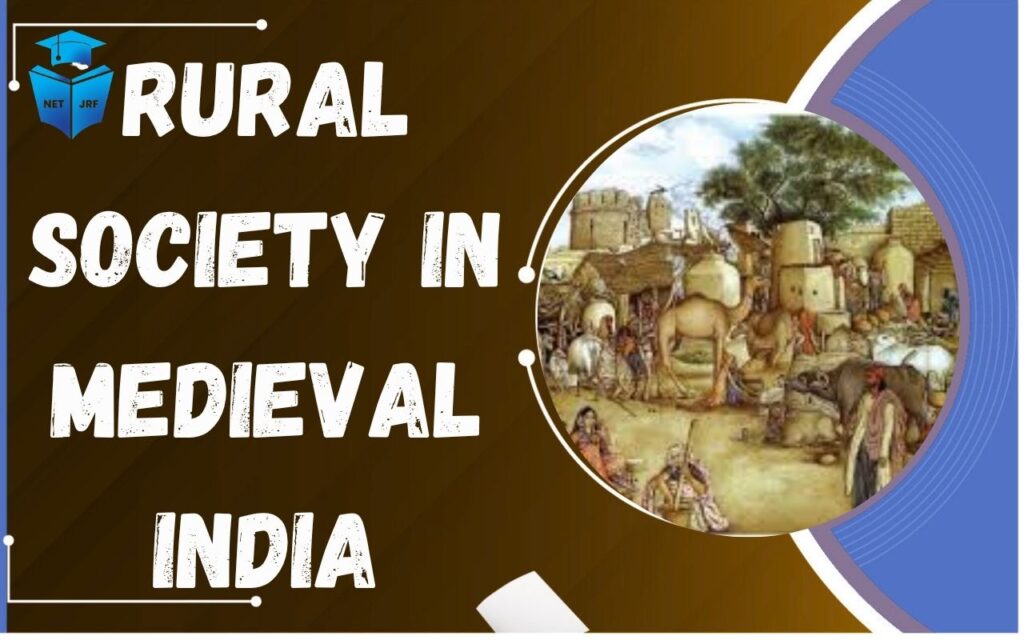
Rural Society formed the foundation of medieval India because nearly 85 percent of the population lived in villages. Agriculture shaped daily life, economic activity, social relations, and village governance. Every village functioned like a small world where cultivators, artisans, service providers, traders, local officials performed different roles.

The structure of the village economy created a clear hierarchy. Land ownership, caste status, agricultural resources, crop patterns determined the position of each group. Scholars studying medieval India often focus on this system because it reveals how rural communities sustained the economy of large empires such as the Mughal Empire.
Rural Society Features
The rural society was mainly based on agriculture. Most people were farmers and depended on cultivation for their livelihood. Crops like wheat, rice, barley, and pulses were commonly grown.
-
Population Structure
-
-
- The majority of people lived in villages during the medieval period. Rural settlements formed the core of economic life. Cities depended heavily on agricultural production from these villages.
- Villages usually contained cultivators, artisans, service providers, merchants, priests, village officials. These groups created a self-sufficient economic unit where most daily needs were produced locally.
-
-
Stratified Social Order
-
-
- Medieval villages displayed clear inequality between social groups. Wealth, caste status, land ownership created visible divisions. Some households possessed large landholdings while others worked as tenants or labourers.
- The social gap between rich peasants, poor peasants, artisans, landholders became visible in revenue obligations, housing patterns, access to resources.
-
-
Importance of Agriculture
-
- Agriculture served as the backbone of the rural economy. Farmers cultivated grains, pulses, oilseeds, cash crops using traditional methods. Irrigation wells, oxen, ploughs, seeds formed essential agricultural resources.
- The prosperity of a village depended on rainfall, irrigation facilities, crop diversity.
Rural Society Factors in Villages
Many factors shaped the hierarchy inside Rural Society. These factors determined economic power, social prestige, and political influence.
1. Resource Availability
Agricultural production required tools, animals, and irrigation sources.
Farmers with oxen, ploughs, and irrigation wells produced larger harvests. Poor farmers without these resources depended on richer cultivators or landlords.
Important resources included:
- Seeds
- Oxen for ploughing
- Agricultural tools
- Persian wheel irrigation systems
- Water wells
Possession of these resources increased agricultural productivity.
Top UGC NET Online Test Series
2. Role of Caste
Caste strongly influenced the hierarchy of Rural Society. Higher castes often controlled land, administration, and religious authority. Lower castes performed manual labour, service occupations.
Typical high-status groups included:
- Brahmans
- Rajputs
- Banias
- Charans
These groups usually did not cultivate land themselves. They employed labourers or used the begar system, a form of unpaid labour.
3. Crop Patterns
Crop types also influenced economic differences. Farmers growing cash crops earned higher income.
Common crops included:
| Crop Type | Economic Importance | Revenue Payment |
| Rice | Staple food crop | Grain revenue |
| Wheat | Major food crop | Grain revenue |
| Cotton | Textile production | Cash revenue |
| Indigo | Dye production | Cash revenue |
| Sugarcane | Sugar industry | Cash revenue |
Farmers cultivating cotton or indigo often gained more wealth than those producing food grains.

Agricultural Diversity in Medieval India
Agricultural diversity played a major role in shaping Rural Society. Indian agriculture produced a wide range of crops due to varied climatic conditions.
Cash Crops
Some crops required revenue payment in cash. These crops held high commercial value.
Examples include:
- Cotton
- Indigo
- Sugarcane
- Oil seeds
- Chay (red dye)
These crops connected villages to regional markets.
New Crops Introduction
During the medieval period, new crops entered the agricultural system.
| Century | Newly Introduced Crops |
| 17th Century | Tobacco, Maize |
| 18th Century | Potato, Red Chillies |
Farmers adopted these crops gradually because they improved profits.
Agricultural Exports
India exported agricultural products to international markets through ports connected to the Indian Ocean trade network.
Exported goods included:
- Rice
- Sugar
- Textile crops
Trade strengthened rural commercial activity.
Enroll UGC NET Offline Classes in Jaipur
Types of Peasants in Villages
The peasantry formed the largest section of Rural Society. However, peasants did not form a uniform group. Their status depended on land ownership, residence, resources.
Peasant Categories
| Peasant Type | Description | Local Names |
| Khud-Kasht | Resident landowners cultivating own land | Gharu-hala, Mirasdar |
| Pahi-Kasht | Non-resident cultivators renting land | Tenant cultivators |
| Raiyati Muzarian | Landless cultivators dependent on others | Agricultural labour |
-
Khud-Kasht Peasants
-
-
- These cultivators lived permanently in the village. They owned land, plough animals, agricultural tools.
- Because of their stable position, they paid lower revenue rates. Village administration often depended on them.
-
-
Pahi-Kasht Cultivators
-
-
- These cultivators came from outside villages. They rented land from local landowners.
- Sometimes they lived in the same village. In other cases they stayed in nearby villages while cultivating land.
-
-
Raiyati Muzarian
-
- This group lacked land, tools, animals. They worked for richer peasants.
Two forms existed:
- Tenants-at-will
- Hereditary tenants
Their economic condition remained weak.
Service Classes in Villages
Apart from cultivators, Rural Society included several occupational groups providing essential services.
These groups maintained the functioning of village life.
Major Artisan Groups
- Blacksmith
- Carpenter
- Potter
- Weaver
- Leather worker
- Rope maker
These artisans produced tools required for agriculture.
Balutedar System
In the Deccan region, especially in Maharashtra, village artisans formed a system known as Balutedars.
They received a fixed share of agricultural produce known as baluta.
| Artisan | Role in Village Economy |
| Blacksmith | Agricultural tools |
| Carpenter | Wooden implements |
| Potter | Storage pots |
| Barber | Grooming services |
| Washerman | Laundry services |
This system ensured that essential services remained available within villages.
Alutedars
Another group called Alutedars existed in some Deccan villages.
They included:
- Tailors
- Priests
- Musicians
- Gardeners
- Water carriers
- Goldsmiths
They received smaller payments compared to balutedars.
Village Administration
Village governance formed an important element of Rural Society. Local institutions managed disputes, tax collection, irrigation, social order.
-
Panchayat System
-
-
- Village panchayats played a central role in administration. These councils usually consisted of respected cultivators or village elders.
- Functions included:
- Settling disputes
- Maintaining irrigation
- Supervising village property
- Supporting revenue collection
-
-
Land Ownership System
-
- Land ownership did not belong to the village community collectively. Individual households possessed land plots assessed separately for revenue.
- However, if a cultivator failed to pay revenue, the entire body of resident cultivators could be held responsible.
- This rule prevented peasants from leaving villages to escape tax obligations.
Role of Zamindars
Zamindars acted as intermediaries between peasants and the state during the rule of the Akbar in the Mughal Empire.
Their responsibilities included:
- Revenue collection
- Maintaining law order
- Supporting imperial administration
During the eighteenth century, the power of zamindars increased because the central government weakened.
As their authority grew, village cultivators lost some influence over internal administration.
Commercialization of Villages
Markets gradually expanded in medieval India. Increased trade allowed farmers to sell crops beyond local areas.
Pedlars travelled between villages carrying goods. Merchants bought grain from cultivators for revenue payments.
This commercial growth created new economic opportunities. Some peasants accumulated wealth, while others remained poor.
Commercialization also encouraged crop diversification.
Social Mobility in Villages
Although caste created rigid hierarchies, social mobility still occurred in Rural Society.
Factors promoting mobility included:
- Agricultural prosperity
- Trade connections
- Land acquisition
- State patronage
Some lower-status groups improved their position through economic success.
Everyday Life of Peasants
Peasant life involved continuous labour throughout the agricultural cycle.
Important activities included:
- Ploughing land
- Sowing seeds
- Irrigation management
- Harvesting crops
- Paying land revenue
Despite hardships, peasants generally produced enough food for survival. Most families met basic needs like food, clothing, shelter.
Best UGC NET Offline Coaching in Jaipur
Impact of State Policies
Medieval states relied heavily on land revenue from villages. Therefore, rulers attempted to keep peasants tied to land.
Peasants were rarely evicted as long as they paid revenue. This policy ensured stable agricultural production.
Strong state supervision also helped maintain irrigation systems, market connections.

Conclusion
The structure of Rural Society in medieval India reveals a complex system built on agriculture, caste hierarchy, occupational specialization, village administration. Peasants formed the backbone of the economy while artisans, service providers, merchants supported village life.
Rural Society in Medieval Period FAQs

2. Who were Khud-Kasht peasants?
Khud-Kasht peasants were permanent farmers of the village. They owned land and farming tools and usually paid lower land revenue.
3. Who were Pahi-Kasht cultivators?
Pahi-Kasht peasants were non-resident farmers who came from other villages to cultivate land on rent or lease.
4. What was the Balutedar system?
The Balutedar system was a village service system in the Deccan region. Artisans and service providers received a share of crops instead of money for their services.
5. What role did caste play in rural villages?
Caste decided occupation, social status, and access to land. Higher castes often controlled land and administration, while lower castes did service and labor work.