
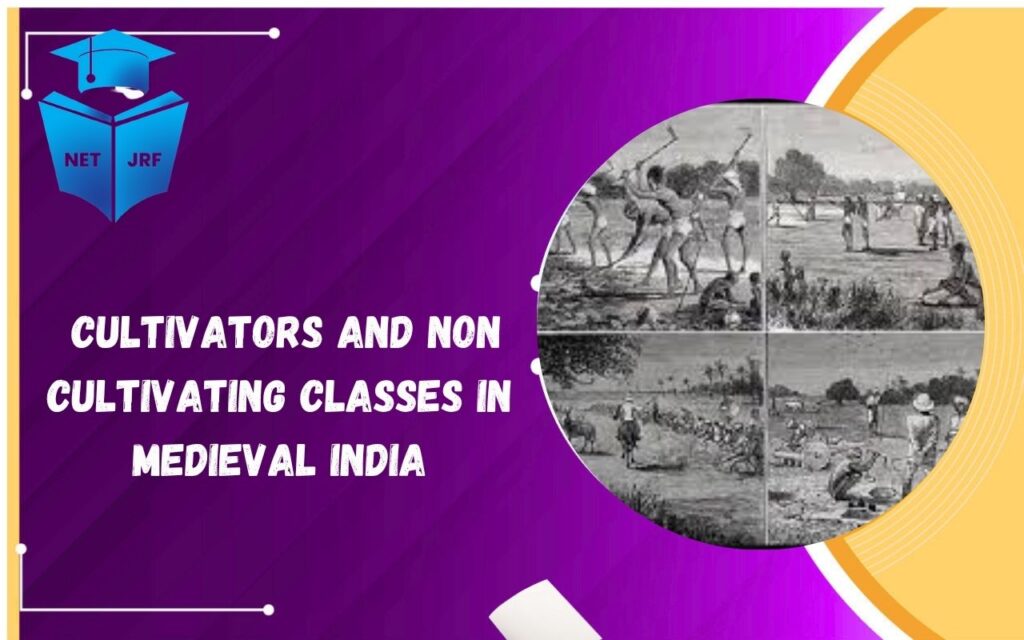

Cultivators and Non Cultivating Classes in Medieval India Rural Economy Structure

Cultivators and Non Cultivating Classes in Medieval India in this topic you learn how rural society functioned through farming communities peasant groups artisans crop production village occupations service systems and agricultural economy in medieval India

vishal

Cultivators and Non Cultivating Classes

Table of Contents

Cultivators formed the backbone of rural life in medieval India. Agriculture supported most people because nearly eighty-five percent of the population lived in villages. Farming communities produced food grains, commercial crops, raw materials that sustained the economy of large empires such as the Mughal Empire.

Village society did not consist only of farmers. It also included several non-cultivating groups such as priests, merchants, artisans, administrators, labourers. These groups depended on agricultural production for survival..

Study Planner

Cultivators Foundation of Rural Economy

Agriculture formed the primary economic activity of medieval villages. Farmers ploughed fields, sowed crops, harvested produce, and paid land revenue to the state. Their labour ensured food security for society.

  • Most villages organized agricultural work around seasonal cycles. Farmers depended heavily on monsoon rainfall as well as irrigation wells or tanks. 
  • Successful harvests improved village prosperity while crop failure created hardship.
  • Agricultural production also supported trade because surplus crops entered local markets.

Enroll UGC NET Online Coaching

Types of Peasant Groups

Medieval villages contained several categories of peasants depending on land ownership, residence status, economic resources.

Major Peasant Categories

Peasant Category Description Regional Names
Khud-Kasht Resident landowning farmers Mirasdar, Gharu-hala
Pahi-Kasht Non-resident tenant farmers Tenant cultivators
Raiyati Muzarian Landless peasants dependent on others Agricultural labour
  • Khud-Kasht Farmers

      • Khud-Kasht peasants lived permanently within the village. They owned agricultural land, plough animals, farming tools. Their stable presence gave them social respect within village society.
      • Because they possessed resources, they usually paid lower rates of land revenue compared to other groups.
  • Pahi-Kasht Peasants

      • Pahi-Kasht farmers came from outside villages. They cultivated land that belonged to local landowners or richer peasants.
      • Some stayed temporarily in the same village while others travelled from nearby settlements to farm rented plots.
  • Raiyati Muzarian

      • This group represented the poorest peasants. They lacked land, oxen, tools required for agriculture. As a result they worked under wealthier farmers.
  • Two common forms existed:
  1. Tenants-at-will who could be removed anytime
  2. Hereditary tenants who cultivated the same land for generations

Agricultural Resources Used by Farmers

Agriculture required several essential resources. Farmers possessing these resources achieved better productivity.

Important resources included:

  • Oxen for ploughing
  • Seeds for crop cultivation
  • Iron agricultural tools
  • Irrigation wells
  • Persian wheel water system

Access to these resources influenced economic status among farming communities.

Enroll UGC NET Online Course

Crop Patterns in Medieval Villages

Indian agriculture produced diverse crops due to varied climatic conditions. Farmers cultivated both subsistence crops and commercial crops.

Major Food Crops

Crop Use
Rice Staple food
Wheat Major grain
Pulses Protein source
Barley Animal feed

Food crops ensured survival of village communities.

App JRF Adda

Major Cash Crops

Crop Economic Value
Cotton Textile production
Indigo Dye industry
Sugarcane Sugar manufacturing
Oil seeds Oil extraction

These crops required revenue payment in cash. Farmers producing them often gained higher income.

New Crops Introduction 

Agricultural patterns changed gradually during the medieval period. New crops arrived through global trade networks.

Century Newly Introduced Crops
17th Century Tobacco, Maize
18th Century Potato, Red Chillies

Farmers adopted these crops because they improved profits or adapted to local conditions.

Non-Cultivating Classes in Rural Society

Villages included many people who did not directly farm land but depended on agricultural production.

These groups performed important economic or social functions.

Major Non-Cultivating Groups

  • Priests performing religious rituals
  • Traders selling agricultural goods
  • Moneylenders providing loans
  • Village officials managing administration
  • Artisans producing tools

Their activities supported the rural economy.

Artisan Communities

Artisans formed an important non-cultivating group. They produced tools, household goods necessary for agricultural work.

Common artisan professions included:

  • Blacksmith
  • Carpenter
  • Potter
  • Weaver
  • Leather worker

These occupations required specialized skills.

Enroll UGC NET Coaching in Jaipur

Deccan Villages Balutedar System

In the Deccan region especially in Maharashtra, rural society developed a service system called Balutedar.

Under this system artisans received a fixed share of agricultural produce known as baluta.

Balutedar Occupations

Artisan Service
Blacksmith Agricultural tools
Carpenter Wooden equipment
Barber Grooming services
Washerman Laundry work
Potter Earthen vessels

This arrangement ensured that essential services remained available in every village.

Alutedar Service Groups

Apart from balutedars, some villages also had Alutedar communities. These occupations did not appear in every settlement.

Examples include:

  • Tailors
  • Musicians
  • Gardeners
  • Goldsmiths
  • Betel nut sellers

They usually received smaller shares of produce or land strips.

Relationship Between Farmers and Service Groups

Village life depended on cooperation between agricultural producers and service providers.

Farmers provided grain payments while artisans supplied tools or services.

This economic exchange created mutual dependence within villages.

Forms of Payment

  • Grain shares from harvest
  • Small land grants
  • Occasional cash payments

These arrangements ensured stable rural economic relations.

Social Hierarchy in Villages

Village society displayed a strong hierarchy influenced by caste status, land ownership, occupation.

Social Structure

  1. Landowning peasants
  2. Tenant farmers
  3. Artisan communities
  4. Landless labourers

Higher caste groups usually held land ownership while lower castes performed manual labour.

Commercialization of Agriculture

Trade expanded gradually during the medieval period. Farmers began selling crops beyond local markets.

Merchants visited villages to purchase agricultural produce. Pedlars travelled between rural settlements carrying goods.

This commercial growth created new economic opportunities.

Some farmers accumulated wealth through commercial agriculture.

Village Governance and Peasant Life

Village administration involved headmen, accountants, watchmen. These officials supervised land records, tax collection.

  • Peasants paid land revenue to support state administration. The state rarely removed farmers from land if revenue payments continued.
  • This policy encouraged stable agricultural production.

Agricultural Life Cycle

Peasant life followed seasonal agricultural cycles.

Farming Activities

  1. Land preparation using plough
  2. Sowing seeds before monsoon
  3. Irrigation management
  4. Crop protection
  5. Harvesting

Each step required cooperation among village families.

Enroll UGC NET Offline Coaching in Jaipur

Challenges Faced by Peasant Communities

Peasant life often involved economic challenges.

Major difficulties included:

  • Crop failure due to drought
  • Heavy land revenue demands
  • Dependence on monsoon rains
  • Debt from moneylenders

Despite these challenges, most villages maintained stable agricultural production.

The structure of Cultivators in medieval India reveals a complex rural economy based on agriculture, occupational specialization, and social hierarchy. Farmers formed the core productive class while artisans, traders, priests supported village life.

JRF Adda Book

Read UGC NET Notes
1 Archaeological Sources for UGC NET Epigraphy – Study of Inscriptions Meaning of Historical Sources Archaeological
2 Meaning of Historical Sources Archaeological Sources for UGC NET Literary Sources in History Archaeological
3 Exploration in Archaeology Excavation Techniques in Archaeology Dating of Archaeological Sites Archaeological
4 Excavation Techniques in Archaeology Exploration in Archaeology Dating of Archaeological Sites Archaeological
5 Epigraphy – Study of Inscriptions Inscriptions in Reconstructing History Numismatics in History Archaeological
6 Inscriptions in Reconstructing History Epigraphy – Study of Inscriptions Archaeological Sources for UGC NET Archaeological
7 Numismatics in History Importance of Coins in History Epigraphy – Study of Inscriptions Archaeological
8 Importance of Coins in History Numismatics in History Archaeological Sources for UGC NET Archaeological
9 Dating of Archaeological Sites Excavation Techniques in Archaeology Dating Ancient Literary Sources Archaeological
10 Indigenous Literature Literary Sources in History Secular Literature as Historical Source Literary
11 Dating Ancient Literary Sources Literary Sources in History Dating of Archaeological Sites Literary
12 Literary Sources in History Indigenous Literature Foreign Accounts of India Literary
13 Foreign Accounts of India Greek Accounts on Ancient India Chinese Accounts on India Literary
14 Greek Accounts on Ancient India Foreign Accounts of India Chinese Accounts on India Literary
15 Secular Literature as Historical Source Literary Sources in History Indigenous Literature Literary
16 Role of Myths and Legends in Historical Reconstruction Literary Sources in History Secular Literature as Historical Source Literary
17 Chinese Accounts on India Foreign Accounts of India Greek Accounts on Ancient India Literary
18 Arabic Accounts on India Foreign Accounts of India Chinese Accounts on India Literary
19 Neolithic and Chalcolithic Phases Neolithic Revolution in India Chalcolithic Culture in India Neolithic
20 Hunting, Gathering & Food Production Neolithic Revolution in India Neolithic Settlements in India Neolithic
21 Neolithic Revolution in India Neolithic Settlements in India Tools and Technology in Neolithic Period Neolithic
22 Neolithic Settlements in India Distribution of Neolithic Cultures in India Neolithic Revolution in India Neolithic
23 Distribution of Neolithic Cultures in India Neolithic Settlements in India Tools and Technology in Neolithic Period Neolithic
24 Tools and Technology in Neolithic Period Neolithic Revolution in India Chalcolithic Culture in India Neolithic
25 Chalcolithic Culture in India Settlement Pattern & Economy in Chalcolithic Phase Trade & Exchange Networks in Chalcolithic Societies Neolithic
26 Settlement Pattern & Economy – Chalcolithic Phase Chalcolithic Culture in India Trade & Exchange Networks in Chalcolithic Societies Neolithic
27 Trade & Exchange Networks – Chalcolithic Societies Chalcolithic Culture in India IVC Internal & External Trade Neolithic
28 Indus Valley Civilization – UGC NET Major Sites of Indus Civilization Urban Planning in Harappan Civilization IVC
29 IVC Internal & External Trade Internal Trade – Harappan Civilization Craft Specialization in Harappan Civilization IVC
30 Political Organization – Harappan Civilization Social Structure – Indus Civilization Urban Planning in Harappan Civilization IVC
31 Major Sites of Indus Civilization Indus Valley Civilization – UGC NET Urban Planning in Harappan Civilization IVC
32 Urban Planning & Settlement – Harappan Civilization Architecture & Town Planning – Harappan Cities IVC as First Urbanization in India IVC
33 Architecture & Town Planning – Harappan Cities Urban Planning in Harappan Civilization Major Sites of Indus Civilization IVC
34 Craft Specialization & Industrial Activities – Harappan Agriculture & Food Economy – Harappans IVC Internal & External Trade IVC
35 Agriculture & Food Economy – Harappans Craft Specialization in Harappan Civilization Internal Trade – Harappan Civilization IVC
36 Internal Trade – Harappan Civilization IVC Internal & External Trade Craft Specialization in Harappan Civilization IVC
37 Religion & Beliefs – Indus Civilization Social Structure – Indus Civilization Indus Valley Civilization – UGC NET IVC
38 Social Structure – Indus Civilization Political Organization – Harappan Civilization Religion & Beliefs – Indus Civilization IVC
39 Decline of Indus Civilization Indus Valley Civilization – UGC NET IVC as First Urbanization in India IVC
40 IVC as First Urbanization in India Urban Planning in Harappan Civilization Second Urbanization in India IVC
41 Vedic & Later Vedic Periods – Aryan Varna System Early Vedic Society and Economy Later Vedic Society and Economy Vedic
42 Origin of Vedic Civilization Aryan Debate – Migration, Invasion & Indigenous Theories Early Vedic Society and Economy Vedic
43 Aryan Debate – Migration, Invasion & Indigenous Theories Origin of Vedic Civilization Early Vedic Society and Economy Vedic
44 Early Vedic Society and Economy Political Institutions – Early Vedic Period Social Structure – Early Vedic Period Vedic
45 Political Institutions – Early Vedic Period Early Vedic Society and Economy Monarchical States in Ancient India Vedic
46 Social Structure – Early Vedic Period Emergence of Varnas & Social Stratification Early Vedic Society and Economy Vedic
47 Later Vedic Society and Economy Emergence of Varnas & Social Stratification Impact of Iron Technology in India Vedic
48 Emergence of Varnas & Social Stratification Social Structure – Early Vedic Period Later Vedic Society and Economy Vedic
49 Emergence of Heterodox Sects in India Jainism, Buddhism & Ajivikas – Origins & Teachings Later Vedic Society and Economy Vedic
50 Impact of Iron Technology in India Later Vedic Society and Economy Agricultural Expansion & Economic Changes – Ancient India Vedic
51 Religious & Philosophical Vedic Ideas Emergence of Varnas & Social Stratification Emergence of Heterodox Sects in India Vedic
52 Megalithic Culture of South India Neolithic and Chalcolithic Phases Agricultural Expansion & Economic Changes General
53 State System in Ancient India Rise of Mahajanapadas Transition: Tribal Polities to Territorial States General
54 Transition: Tribal Polities to Territorial States Rise of Mahajanapadas Later Vedic Society and Economy General
55 Rise of Mahajanapadas Monarchical States in Ancient India Republican States (Gana-Sanghas) – Ancient India Magadha
56 Monarchical States in Ancient India Rise of Mahajanapadas Emergence of Magadha Magadha
57 Republican States (Gana-Sanghas) – Ancient India Rise of Mahajanapadas Monarchical States in Ancient India Magadha
58 Agricultural Expansion & Economic Changes – Ancient India Second Urbanization in India Impact of Iron Technology in India General
59 Second Urbanization in India IVC as First Urbanization in India Rise of Mahajanapadas General
60 Jainism, Buddhism & Ajivikas – Origins & Teachings Emergence of Heterodox Sects in India Ashoka’s Policy of Dhamma General
61 Emergence of Magadha Geographical Advantages of Magadha Early Rulers of Magadha Magadha
62 Geographical Advantages of Magadha Natural Resources & Economic Strength of Magadha Reasons for Success of Magadha Magadha
63 Natural Resources & Economic Strength of Magadha Geographical Advantages of Magadha Economic Policies of the Nandas Magadha
64 Early Rulers of Magadha Haryanka Dynasty – Rise of Magadha Emergence of Magadha Magadha
65 Haryanka Dynasty – Rise of Magadha Expansion Policy of Bimbisara Early Rulers of Magadha Magadha
66 Expansion Policy of Bimbisara Ajatashatru – Military Reforms Haryanka Dynasty – Rise of Magadha Magadha
67 Ajatashatru – Military Reforms Wars of Ajatashatru Expansion Policy of Bimbisara Magadha
68 Wars of Ajatashatru Ajatashatru – Military Reforms Udayin & Establishment of Pataliputra Magadha
69 Udayin & Establishment of Pataliputra Wars of Ajatashatru Shishunaga Dynasty Magadha
70 Shishunaga Dynasty Administrative Structure of the Shishunagas Nanda Dynasty Magadha
71 Administrative Structure of the Shishunagas Shishunaga Dynasty Central Administration Under Mauryas Magadha
72 Nanda Dynasty Mahapadma Nanda – Imperial Expansion Shishunaga Dynasty Magadha
73 Mahapadma Nanda – Imperial Expansion Military Strength of the Nandas Nanda Dynasty Magadha
74 Economic Policies of the Nandas Nanda Dynasty Taxation System – Mauryan State Magadha
75 Military Strength of the Nandas Mahapadma Nanda – Imperial Expansion Defeat of Nandas & Rise of Mauryan Empire Magadha
76 Reasons for Success of Magadha Geographical Advantages of Magadha Natural Resources & Economic Strength of Magadha Magadha
77 Mahajanapadas to Empire – Evolution & Rise of Magadha Rise of Mahajanapadas Emergence of Magadha Magadha
78 Mauryan Empire – Expansion Rise of Chandragupta Maurya Expansion of Mauryan Empire Maurya
79 Rise of Chandragupta Maurya Role of Chanakya in Rise of Mauryan Empire Defeat of Nandas & Rise of Mauryan Empire Maurya
80 Role of Chanakya in Rise of Mauryan Empire Rise of Chandragupta Maurya Defeat of Nandas & Rise of Mauryan Empire Maurya
81 Defeat of Nandas & Rise of Mauryan Empire Military Strength of the Nandas Rise of Chandragupta Maurya Maurya
82 Chandragupta Maurya – Seleucus Treaty & Diplomacy Expansion of Mauryan Empire Greek Accounts on Ancient India Maurya
83 Expansion of Mauryan Empire Chandragupta Maurya – Seleucus Treaty & Diplomacy Kalinga War Maurya
84 Administration of Chandragupta Maurya Central Administration Under Mauryas Mauryan Bureaucracy Maurya
85 Sources for Mauryan History Archaeological Sources for UGC NET Greek Accounts on Ancient India Maurya
86 Central Administration Under Mauryas Provincial Administration – Mauryan Empire Mauryan Bureaucracy Maurya
87 Provincial Administration – Mauryan Empire Local Administration – Mauryan Empire Central Administration Under Mauryas Maurya
88 Local Administration – Mauryan Empire Provincial Administration – Mauryan Empire Mauryan Bureaucracy Maurya
89 Mauryan Bureaucracy Central Administration Under Mauryas Espionage System – Mauryan Empire Maurya
90 Espionage System – Mauryan Empire Mauryan Bureaucracy Central Administration Under Mauryas Maurya
91 Ancient India – Trade and Commerce Trade and Commerce Under Mauryas Agrarian Economy – Mauryan Period Maurya
92 Agrarian Economy – Mauryan Period Taxation System – Mauryan State Trade and Commerce Under Mauryas Maurya
93 Trade and Commerce Under Mauryas Ancient India – Trade and Commerce Agrarian Economy – Mauryan Period Maurya
94 Taxation System – Mauryan State Agrarian Economy – Mauryan Period Economic Policies of the Nandas Maurya
95 Kalinga War Ashoka’s Policy of Dhamma Expansion of Mauryan Empire Maurya
96 Ashoka’s Policy of Dhamma Nature & Philosophy of Dhamma Kalinga War Maurya
97 Nature & Philosophy of Dhamma Ashoka’s Policy of Dhamma Jainism, Buddhism & Ajivikas Maurya

Cultivators and Non-Cultivating Classes in Medieval India FAQs

Loader image

The main types were Khud-Kasht farmers (resident cultivators), Pahi-Kasht tenants (non-resident farmers), and Raiyati Muzarian labourers who worked on others’ land.

Artisans made tools, farming equipment, and household goods, which supported agricultural and village life.

The Balutedar system was a village service system where artisans received a fixed share of grain from farmers for their services.

Crop patterns affected farmers’ income because cash crops like cotton or indigo brought higher revenue.

Yes. Many service groups depended on grain payments from farmers for their livelihood.

Villages maintained balance through cooperation between farmers, artisans, and service groups, where each group supported the others.

Leave a Reply

Recent Posts
Aditi

Aditi Sharma, founder of JRFAdda, is a Computer Science educator with an MCA degree and JRF qualification (99.91 percentile, Dec 2019). Her experience includes roles as an SBI SO (DBA), work at Cognizant, and over 5 years of teaching online and offline. She has also served as a Government Computer Teacher in Rajasthan.