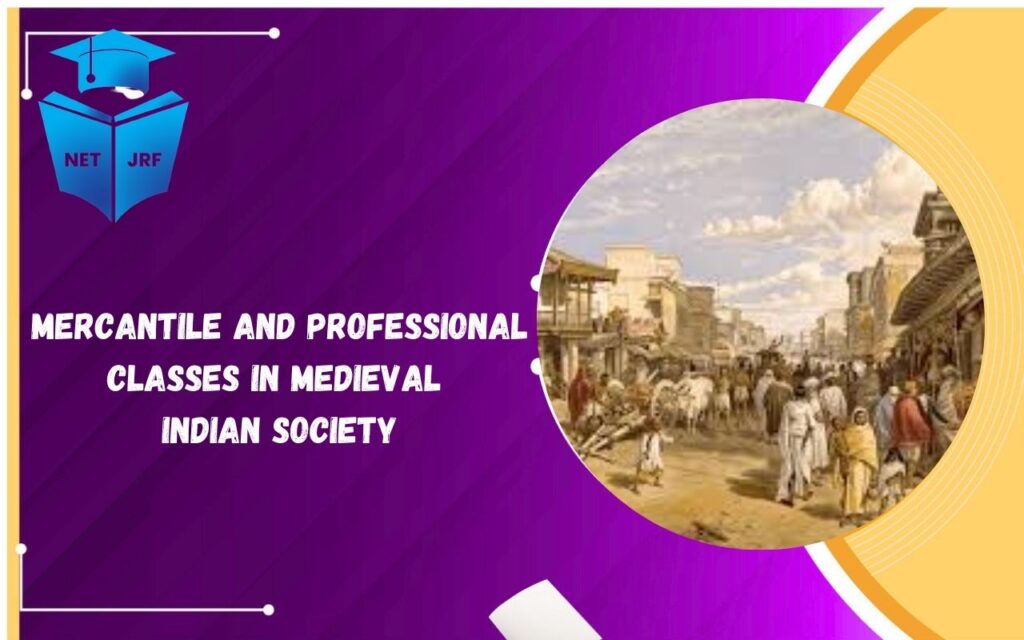
Mercantile and Professional Classes played a central role in the economic and social structure of medieval India. These groups shaped commerce, education, administration, and These groups included traders, bankers, teachers, accountants, physicians, scribes, and legal experts. Their work connected rural production with urban markets. Their services also supported administration, education, and governance.
Medieval society required economic organization and specialized knowledge. Merchants managed trade networks, while professionals handled administration, medicine, education, and law.

Mercantile and Professional Classes in Medieval Indian Society
The term Mercantile and Professional Classes refers to two important groups within the social structure of medieval India.
- The mercantile class consisted of people engaged in trade and financial activity. The professional class consisted of individuals with specialized knowledge or skills that served society.
- These groups gained importance as trade expanded across regions during the medieval period.
Mercantile Groups
Mercantile groups formed the commercial backbone of medieval society. These people handled trade, finance, and distribution of goods. Their work connected producers, markets, and consumers across regions.
Enroll UGC NET Online Test Series
Traders Dealing with Goods Across Regions
- Traders played a central role in moving goods from one region to another. They purchased products from rural areas or craft centers and sold them in urban markets or distant regions.
- For example, merchants transported:
- Textiles from weaving centers
- Spices from coastal regions
- Metals and tools from mining areas
- Agricultural products such as grains and sugar
- These traders used road networks, river routes, and caravan paths to move goods. Their activity helped integrate local markets into larger regional trade systems.
Moneylenders Providing Financial Credit
- Moneylenders provided financial support to traders, farmers, and sometimes rulers. Trade often required large amounts of capital for purchasing goods, arranging transportation, and paying taxes.
Moneylenders offered:
- Loans for commercial investment
- Credit to merchants during long journeys
- Financial assistance to peasants during difficult seasons
In many medieval towns, wealthy merchant families also acted as bankers. These financiers helped maintain economic circulation by providing credit whenever required.
Market Organizers
Markets did not operate automatically. Merchants played a key role in organizing and maintaining markets.
Their responsibilities included:
- Managing stalls and shops
- Coordinating supply of goods
- Fixing prices through negotiation
- Ensuring regular trade activity
Large market towns often developed because merchant communities established stable trading centers. These towns later grew into important urban centers of economic activity.
Caravan Traders Involved in Long-Distance Trade
Caravan traders specialized in long-distance trade across difficult terrains. They traveled in groups called caravans for safety and efficiency.
These caravans transported valuable goods such as:
- Silk and fine textiles
- Spices and perfumes
- Precious stones
- Horses and luxury items
Traveling together protected traders from robbers and natural dangers. Caravan routes connected major trade regions across Asia, the Middle East, and India.
Professional Groups
Professional groups consisted of people with specialized knowledge and technical skills. Their expertise helped maintain administration, education, and social order.
Teachers and Scholars
Teachers and scholars played an important role in spreading knowledge and preserving intellectual traditions. They worked in educational institutions such as temple schools or Madrasa.
Their duties included:
- Teaching religious texts and philosophy
- Training future administrators and scholars
- Writing books and commentaries
- Guiding society through intellectual leadership
Through education, scholars influenced cultural and social development.

Physicians and Healers
Physicians were responsible for medical care. They studied traditional systems of medicine and treated patients using herbal remedies, dietary practices, and medical knowledge.
Their responsibilities included:
- Diagnosing illnesses
Preparing medicines from natural ingredients - Advising patients on diet and health practices
- Treating injuries and diseases
Medical practitioners were respected because they contributed to public health and community well-being.
Accountants and Record Keepers
Accountants maintained financial records for merchants, temples, and royal administrations. Their work required strong mathematical and administrative skills.
They handled tasks such as:
- Recording trade transactions
- Maintaining revenue accounts
- Calculating taxes and payments
- Preparing administrative reports
Because accurate financial records were essential for governance, accountants became important officials in many medieval states.
Join UGC NET Coaching in Jaipur
Legal Experts and Advisors
Legal experts interpreted laws and settled disputes within society. They advised rulers and communities on matters related to justice, property, and contracts.
Their duties included:
- Resolving disputes between merchants
- Interpreting legal traditions
- Preparing legal documents
- Advising rulers on judicial matters
Many legal scholars served as judges in courts or as advisors to rulers. Their knowledge ensured that laws were applied fairly.
Mercantile and Professional Classes Economic Role
The Mercantile and Professional Classes supported economic growth across many regions of medieval India.
Merchants connected production centers with markets. They transported goods such as textiles, spices, grains, metals, and precious stones.
Professionals ensured that trade and administration worked smoothly. Accountants recorded financial transactions, while legal experts resolved disputes related to property and trade.
Economic Contributions
- Development of market towns
- Creation of credit networks
- Expansion of long distance trade
- Maintenance of economic records
Merchants also helped rulers collect revenue because trade increased taxable wealth.
Professionals such as scribes and accountants helped rulers maintain records of land revenue, trade taxes, and administrative documents.
Mercantile and Professional Classes Social Structure
The Mercantile and Professional Classes occupied an important position within medieval social hierarchy.
Although they did not hold military power like kings or warriors, their economic influence made them respected members of society.
Merchants often belonged to organized communities that controlled trade routes and commercial practices. Many merchant families accumulated large wealth.
Professionals gained respect through education and specialized knowledge.
Social Roles
- Supporting religious institutions
- Funding temples or educational institutions
- Advising rulers on administration
- Providing social leadership in towns
Many merchant communities sponsored religious buildings, charitable works, and educational institutions.
Mercantile and Professional Classes Education Systems
Education played a key role in shaping the Mercantile and Professional Classes.
Scholars taught students in institutions such as Madrasa or temple schools. These centers trained future administrators, teachers, and legal experts.
Students studied subjects such as:
- Logic
- Mathematics
- Religious texts
- Law
- Philosophy
Education allowed individuals from non-royal backgrounds to gain social mobility.
A student who mastered legal or administrative knowledge could become a respected judge or advisor in royal courts.
Mercantile and Professional Classes Economic Functions
| Economic Activity | Mercantile Groups | Professional Groups |
| Trade management | Organized markets, trade routes | Recorded transactions |
| Financial services | Provided credit, loans | Managed accounts |
| Administrative support | Paid taxes, supported trade revenue | Maintained records |
| Legal assistance | Participated in commercial agreements | Provided legal interpretation |
how the Mercantile and Professional Classes supported economic systems through both trade activity and specialized services.
Join UGC NET Offline Coaching in Jaipur
Mercantile and Professional Classes Political Influence
The Mercantile and Professional Classes also exercised political influence in many regions.
- Merchants often financed rulers during wars or construction projects. Because of their wealth, kings valued their support.
- Professionals such as legal scholars or advisors helped rulers make decisions regarding governance.
- In some cases, merchant leaders represented local communities in discussions with rulers.
Examples of Political Influence
- Financial loans to rulers
- Advising on administrative policy
- Supporting local governance
- Maintaining legal systems
This relationship between rulers and economic groups created a balanced structure of authority.
Mercantile and Professional Classes Educational Institutions
Education institutions trained the Mercantile and Professional Classes to perform their roles effectively.
These institutions followed structured curricula that combined religious knowledge with rational sciences.
Key Subjects
- Accounting methods
- Commercial mathematics
- Legal studies
- Administrative procedures
Such education produced capable officials who could manage taxation, documentation, and trade agreements.
Mercantile and Professional Classes Social Role
Beyond economic activities, the Mercantile and Professional Classes also influenced social relations, community organization, and cultural development in medieval India.
| Social Function | Mercantile Groups | Professional Groups |
| Community leadership | Merchant guild leaders | Scholars, teachers |
| Religious patronage | Funding temples, charities | Teaching religious texts |
| Urban development | Creating markets | Providing services |
| Knowledge systems | Supporting trade literacy | Producing scholarly works |
Mercantile and Professional Classes Stepwise Development
The growth of the Mercantile and Professional Classes occurred gradually across centuries.
Step 1: Growth of Regional Trade
Expansion of trade networks created demand for merchants and financial intermediaries.
Step 2: Rise of Market Towns
Urban markets required accountants, administrators, and legal experts.
Step 3: Institutional Education
Schools trained individuals in law, commerce, and administration.
Step 4: Political Recognition
Rulers began granting privileges to merchants and professionals.
Step 5: Expansion of Influence
These groups gained social prestige due to their economic importance.

Conclusion
The study of medieval society becomes clearer when historians analyze economic groups rather than only rulers. Merchants expanded trade networks while professionals maintained administration, education, and law. Their combined influence shaped social stability, economic growth, urban development..
Mercantile and Professional Classes in medieval India FAQs

What professions existed within the professional class?
Professions included teachers, scribes, physicians, legal advisors, accountants who provided specialized knowledge.
How did merchants influence medieval economies?
Merchants organized markets, trade networks, financial systems that supported regional economic growth.
Did rulers depend on mercantile groups?
Yes. Many rulers relied on merchants for financial support, tax revenue, and economic stability.
What institutions educate professional classes?
Educational centers such as madrasas, temple schools, trained scholars, administrators, legal experts.