
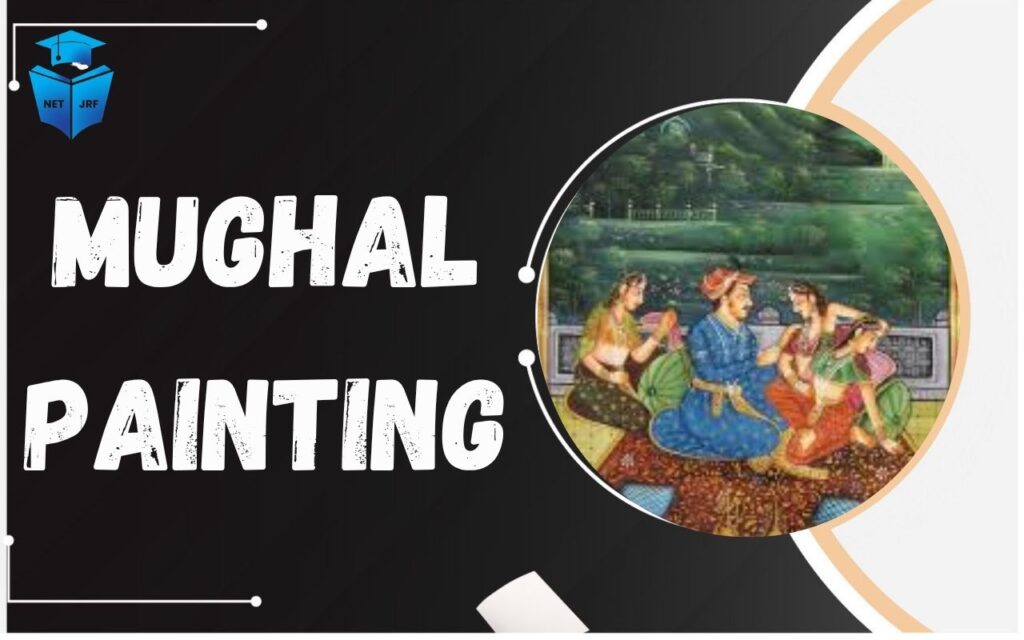
Mughal painting is a classical style of miniature art that developed during the Mughal period in India. It combines Persian artistic traditions with Indian themes and realistic details. These paintings were mainly created on paper and depicted royal courts, battles, nature, and daily life. Mughal paintings are known for their fine brushwork, rich colors, and intricate detailing. Artists focused on realism and symmetry, giving the artworks a refined and elegant appearance. Emperor Akbar encouraged this art form and established workshops where skilled painters created manuscripts and illustrations. Common themes in Mughal paintings include court scenes, hunting expeditions, portraits of emperors, and floral designs. The use of gold and vibrant pigments enhanced the beauty of these artworks.

Persian Roots Foundations
The story of the Mughal dynasty begins with Babur, a prince from Central Asia who invaded Hindustan in 1526. Although his reign was short, he brought a deep love for Persian culture and gardens. He recorded his life in the Baburnama, describing the flora and fauna of India in great detail.
- This focus on the natural world eventually became a core element of the artistic style.
- His son, Humayun, spent years in exile at the Safavid court in Iran. When he returned to India to reclaim his throne, he brought two great Persian masters, Mir Sayyid Ali and Abd al-Samad, with him.
- These artists established the first royal workshops, known as the Ketabkhana or House of Books.
- This set the stage for the explosion of creativity that would follow under his son, Akbar.
Akbar Mughal Style
Under Emperor Akbar, the royal workshop transformed into a massive institution. He recruited artists from all over India, including many Hindu painters who brought their local styles to the court.
- This mix of talent created a radically new and rapidly evolving style of art. Akbar’s reign was a time of immense curiosity and religious tolerance, which he reflected in the manuscripts he commissioned.
- One of the first major projects was the Hamzanama, an epic series of paintings on cotton. It took 15 years to complete and involved hundreds of illustrations.
- These early works were full of action, featuring bright colors and dramatic compositions. They depicted the legendary adventures of Amir Hamza, fighting witches, demons, and supernatural forces.
Development of Mughal Painting under Akbar
The official language of the court was Persian, but the artists were a diverse group. To bridge cultural gaps, Akbar established a translation bureau called the Maktabkhana. Here, great Indian epics like the Mahabharata and Ramayana were translated into Persian and illustrated. The Persian version of the Mahabharata is known as the Razmnama or Book of War.
This period also saw the rise of historical documentation. The Akbarnama, written by Abu’l Fazl, chronicled Akbar’s reign with stunning illustrations. The paintings often followed a collaborative process:
- Tarh: A senior artist designed the basic composition.
- Amal: A junior artist filled in the colors.
- Chehra Nami: A specialist portraitist painted the faces of important figures.
Join UGC NET Online Test Series
European Influence and Realism
In the late 16th century, the Mughal court came into contact with European art. Jesuit missions brought Christian paintings and engravings to Akbar.
- These works introduced Mughal artists to new concepts like scientific perspective and atmospheric depth.
- While they did not copy European styles exactly, they adopted a sense of realism in their backgrounds and landscapes.
- Artists like Farrukh Beg and Masud Deccani began incorporating these Western elements into their work. You can see this in paintings where distant hills look smaller and faded, creating a 3D effect.
- This openness to global influences is a key reason why the art of this period remains so respected by scholars today.
Jahangir – Golden Age of Naturalism
When Jahangir became emperor, he shifted the focus of art from grand epic stories to individual portraits and nature studies.
- He was a deeply passionate patron who believed he could identify the hand of any artist just by looking at a painting. Portraiture reached an “unprecedented level of naturalism” during his reign.
- Jahangir had a scientific mind and often ordered his artists to record rare animals and plants. The most famous nature artist of this time was Ustad Mansur, whom the emperor called Nadir-al-Asr (Wonder of the Age).
- Mansur painted a famous African zebra that a delegation brought to the court in 1621. These paintings were not just art; they were accurate scientific records of the natural world.
| Feature | Akbar’s Era | Jahangir’s Era |
| Main Focus | Epic stories and history | Portraits and nature |
| Painting Style | Full of action and drama | Calm and highly detailed |
| Perspective | Developing depth | High level of realism |
| Famous Artist | Basawan and Daswant | Mansur and Abu’l Hasan |

Jahangir Era
The emperor also loved collecting his paintings and calligraphic specimens in lavish albums called Muraqqas.
- These albums featured beautiful borders decorated with golden flowers and animals.
- The borders were often as detailed as the central paintings themselves. Jahangir’s own memoirs, the Jahangirnama, were also beautifully illustrated, though no complete intact volume survives today.
- During this time, the style moved away from the crowded compositions of Akbar’s era. Instead, paintings became more focused, often showing a single person or animal against a simple green or gold background.
- This allowed the viewer to appreciate the fine details of the subject’s clothing, jewelry, and expression.
Enroll UGC NET Offline Classes in Jaipur
Shah Jahan: Elegance and Architecture
Shah Jahan is best known for building the Taj Mahal, but his influence on Mughal,. Painting was equally significant. His reign focused on opulence, order, and floral beauty.
- The chaotic energy of earlier periods was replaced by a sense of formal grandeur. Every painting had to reflect the absolute power and majesty of the emperor.
- The defining style of this era was the use of rows of flowering plants.
- This motif appeared in everything from the marble walls of his palaces to the borders of his manuscripts. Artists like Bichitr and Govardhan painted portraits of the emperor holding jewels or standing on a globe to show his worldly power.
Timeline of Mughal – Painting Development
The evolution of this art form follows the reigns of the great emperors. Each ruler added a new layer of complexity to the tradition.
- 1526–1530: Babur introduces Persian influence and a love for nature.
- 1530–1556: Humayun brings Persian masters to India, starting the royal workshop.
- 1556–1605: Akbar fuses Indian and Persian styles, creating the first true Mughal school.
- 1562–1577: The massive Hamzanama project establishes the early style.
- 1580: Jesuit missions introduce European perspective and Christian themes.
- 1605–1627: Jahangir promotes extreme naturalism and scientific nature studies.
- 1628–1658: Shah Jahan emphasizes floral decoration and formal courtly grandeur.
Students preparing for competitive exams should pay close attention to the specific terms and techniques used in the royal workshops. These details are frequently asked in academic assessments.
- Materials: Paintings were usually done on paper or cotton (like the Hamzanama).
- Pigments: Artists made colors from crushed minerals, stones, and gold.
- Siyahi Qalam: A technique using fine black ink for sketching or finished drawings.
- Nim Qalam: A style of painting using very light or half-coloring.
- Kundan: While a jewelry technique, it influenced the depiction of jeweled objects in paintings.
- Pietre Dure: The Italian stone inlay technique that influenced Shah Jahan’s floral motifs.
Important Manuscripts and Works
The history of this period is preserved in several key manuscripts. These books were the most valuable items in the imperial library.
- Hamzanama: The earliest major work, painted on large cotton sheets.
- Baburnama: Illustrated versions of Babur’s memoirs showing Indian landscapes.
- Razmnama: The Persian translation of the Mahabharata.
- Akbarnama: The official history of Akbar’s reign with detailed court scenes.
- Padshahnama: A chronicle of Shah Jahan’s reign, showing his grand ceremonies.
- Jahangirnama: The personal memoirs of Jahangir, focusing on his observations.
Join UGC NET Offline Coaching in Jaipur
The legacy of Mughal Painting remains one of the most vital chapters in the story of global art. It successfully merged the artistic genius of different cultures to create something entirely new and sophisticated. From the bold, energetic illustrations of the Hamzanama to the delicate, realistic portraits of Jahangir’s court, this tradition showed a constant desire for excellence. Even after the central empire weakened, the techniques and styles of the Mughal masters continued to influence regional Indian art for centuries.

Mughal Painting FAQs

2. Which emperor is known for the Golden Age of naturalism?
Jahangir is considered the patron of naturalism. He commissioned artists to paint realistic portraits and accurate studies of birds and animals.
3. What was the first major project of the Mughal school?
The Hamzanama was the first major project. It consisted of 14 bound volumes with 1,400 paintings done on cotton, taking about 15 years to finish.
4. How did European art influence these paintings?
Jesuit missionaries brought prints and oil paintings to the court. This introduced Mughal artists to depth, shading, and the use of distant landscapes.
5. Who was the most famous nature artist at the court?
Ustad Mansur was the most famous nature artist. He was highly skilled at painting rare animals and plants, such as the zebra and Siberian crane.
6. What is the difference between Tarh and Amal?
In the royal workshop, Tarh referred to the initial sketch or design of a painting, while Amal was the process of filling in the colors.
7. Why are floral motifs so common in the later period?
Under Shah Jahan, floral patterns became the defining style. This was inspired by a love for nature and the influence of European pietre dure stone work.
8. What happened to the art style after Aurangzeb?
As Aurangzeb spent his wealth on long military campaigns, the central court's power declined. Many artists left the imperial workshop to find work in smaller regional courts.
9. What materials were used for these paintings?
Artists used handmade paper or cotton as a base. They created pigments from ground minerals, vegetables, and even precious metals like gold and silver.
10. What is a Muraqqa?
A Muraqqa is an imperial album. It contains a collection of paintings and calligraphy specimens, often with highly decorated borders.