
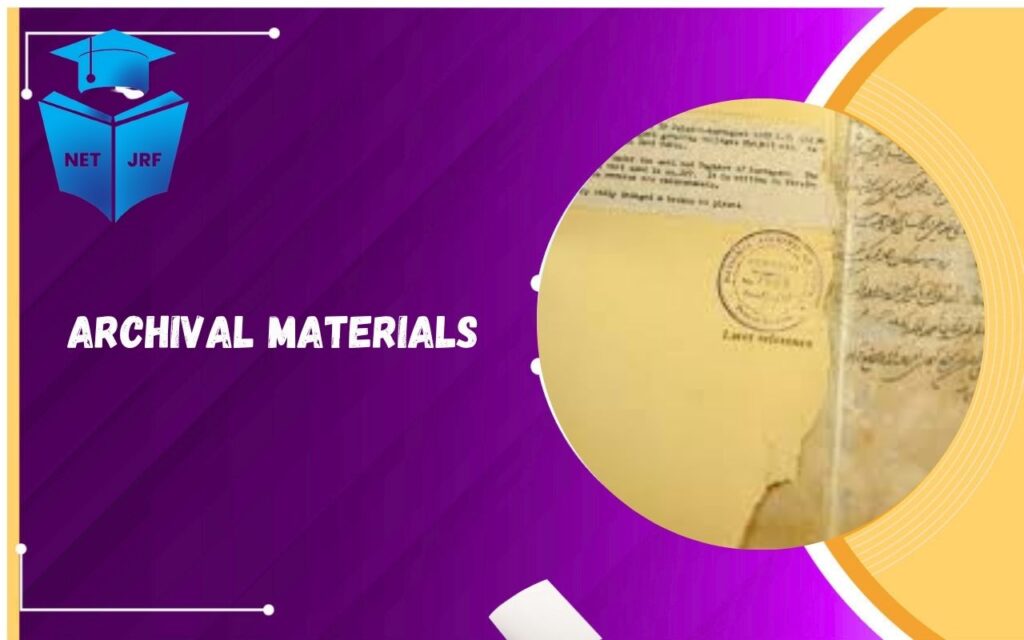
Archieval Materials provide the most authentic evidence for reconstructing the story of modern India. History is not just a collection of stories or legends. It is a scientific study of the past based on solid proof. When we look at the period from the 18th century to the mid-20th century, we find a treasure of written documents. These documents help us understand how a trading company became a mighty empire. They also show the long struggle of millions of Indians for their freedom.

Archieval Materials in India Foundation
To understand history, we must first define what we mean by archives. Archives are collections of historical documents or records. These records provide information about a place, institution, or group of people.
- In the context of modern India, these materials include official government files, letters, and reports. The British administration believed in the culture of documentation. They recorded every decision, meeting, and policy.
- This habit of keeping records created a massive bulk of papers. Today, these papers are the primary Archieval Materials for any researcher.
- They tell us about the administrative, social, and economic conditions of India. We learn about land revenue systems like the Permanent Settlement. We also discover the details of the colonial wars and diplomatic treaties.
- Modern historians do not just look at what the government wrote.
- They also look for gaps in the records. They try to find the voices of common people, farmers, and women.
Enroll UGC NET Online Coaching
Central Government Archives Significance
The National Archives of India (NAI) in New Delhi houses the most important records. The British established the Imperial Record Department in 1891. After independence, it became the National Archives. It contains records of the Government of India from the mid-18th century onwards. These files cover various departments like Home, Foreign, and Finance.
-
- The Home Department records are particularly useful. They contain information about internal politics and the national movement.
- For example, you can find files on the arrest of Mahatma Gandhi or the Salt Satyagraha. The Foreign Department records explain India’s relations with its neighbors. They show how the British managed the Great Game in Central Asia.
- These central archives also store the records of the East India Company. Before 1858, the Company ruled large parts of India.
- Their commercial and political records provide a glimpse into early colonial expansion.
-
East India Company Records
-
-
- The Company kept meticulous accounts of its trade. These records show how they exported Indian textiles and spices. They also record the transition of the Company into a political power. The records of the Board of Control and the Court of Directors are essential here. They reveal the debates happening in London regarding Indian affairs.
-
-
Public Department Records
-
- These records deal with the day-to-day administration. They include information about education, health, and public works. You can find reports on the development of the Indian Railways. These documents show how the British built infrastructure to suit their own interests. They remain a vital source for economic historians.
State Government Archives and Regional History
Apart from the central government, each state has its own archive. These state archives are very important for regional history. The records in Madras, Bombay, and Bengal are especially rich. They contain documents from the early days of the British presidencies. These files offer a more local perspective than the central records.
- For instance, the Madras Record Office (now Tamil Nadu Archives) contains files in multiple languages. You can find records in English, Dutch, Danish, and Persian.
- These documents show the interaction between European powers and South Indian rulers. They provide details about the Carnatic Wars and the fall of Tipu Sultan.
- Similarly, the West Bengal State Archives provide deep insights into the history of Bengal. Since Bengal was the first major territory the British conquered, its records are unique.
- They explain the impact of the 1770 famine and the growth of the Brahmo Samaj. State archives act as the local Archieval Materials that fill the gaps left by central records.
- They are a goldmine for researchers focusing on specific provinces.
Judicial Records
Judicial records offer a different view of society. They are not just about laws; they are about people. The records of the Mayor’s Courts, the Supreme Courts, and the High Courts are available in India. These files contain details of civil and criminal cases. They show how people interacted with the colonial legal system.
- Court cases often reveal social tensions. For example, a property dispute might show the changing status of women. A criminal case might highlight the resistance of local tribes. Historians use these records to study the social history of modern India. These judicial Archieval Materials show the implementation of British law on Indian soil.
- The records of the Sadar Diwani and Sadar Nizamat Adalats are also important. These were the highest courts for civil and criminal justice in the provinces. Their judgments reflect the colonial state’s attempt to regulate Indian society. By reading these cases, we understand the evolution of the modern Indian legal framework.
Enroll UGC NET Coaching in Jaipur
Role of Private Archives and Personal Papers
Official records often represent the government’s point of view. To get a balanced picture, we must look at private archives. These include the personal papers of leaders, thinkers, and business houses. Organizations like the Indian National Congress also maintained their own records.
- The Nehru Memorial Museum and Library in New Delhi is a major center for private papers. It houses the letters and diaries of hundreds of freedom fighters. Reading the personal letters of Sardar Patel or Sarojini Naidu gives us a human perspective. We learn about their fears, hopes, and internal disagreements. These private Archieval Materials provide the insider’s view of the freedom struggle.
- Business houses like the Tatas and Birlas also have archives. These records show the growth of Indian industry. They explain how Indian entrepreneurs navigated the colonial economy. These papers are essential for understanding the rise of the Indian middle class and the industrial base of modern India.

Study of Archieval Materials
| Type of Archive | Location/Primary Source | Main Focus |
| Central Archives | National Archives, Delhi | National Policy, Defense, Foreign Affairs |
| State Archives | State Capitals (e.g., Chennai, Kolkata) | Regional Administration, Land Revenue |
| Judicial Archives | High Courts, Supreme Court | Legal History, Social Disputes |
| Private Archives | Museums, Libraries, Business Houses | Personal Lives, Political Movements |
| Foreign Archives | London, Paris, Lisbon, The Hague | Colonial Policy, International Trade |
Foreign Repositories and Their Value
Not all Indian history is stored in India. Many important documents reside in foreign countries. The most famous is the India Office Records in London. This collection contains the records of the East India Company and the India Office. It is a massive archive that covers almost every aspect of Indian life under British rule.
- French archives in Paris and Pondicherry provide information about the French in India. Portuguese records in Lisbon and Goa tell us about the early European arrivals. These foreign Archieval Materials offer a comparative perspective. We can see how different European powers managed their colonies.
- These repositories also contain maps and charts. These visual records are vital for studying the geography of the past. Researchers often travel abroad to find documents that the British took with them when they left India. These international sources complete the puzzle of modern Indian history.
Cartographic Records and Published Materials
Cartographic records mean maps and plans. The Survey of India was a major project of the British. They wanted to map every inch of the Indian subcontinent. These maps show the changing boundaries of princely states. They also show the growth of cities like Calcutta, Bombay, and Madras.
Maps are not just geographical tools; they are political ones. They show how the British visualized their empire. Published materials also fall into the category of archives. These include census reports, gazetteers, and parliamentary papers. The Census of India, which started in 1881, provides huge amounts of data on population and caste.
Gazetteers provide a detailed description of each district. They include information on history, geography, and local customs. These published Archieval Materials are very useful for students. They provide a summary of vast amounts of research. They help us understand the diversity and complexity of the Indian landscape.
Enroll UGC NET Offline Coaching in Jaipur
Timeline of Key Archive Developments in India
| Year | Milestone Event | Description |
| 1781 | Establishment of the Mayor’s Court Records | Start of organized judicial record keeping. |
| 1858 | Transfer of Power to the Crown | Shift in the nature of official documentation. |
| 1881 | First Synchronous Census of India | Start of massive demographic record keeping. |
| 1891 | Imperial Record Department Founded | Official birth of centralized archives in India. |
| 1911 | Transfer of Capital to New Delhi | Shift of central archives from Calcutta to Delhi. |
| 1947 | National Archives of India | Reorganization of archives for a free nation. |
How to Research Using Historical Archives
Choose a specific event or person to study in modern history.
- Locate the Archive: Find out if the records are in the National Archives or a State Archive.
- Check the Catalogs: Look at the indices and finding aids to identify specific file numbers.
- Request the Material: Fill out the necessary forms to view the Archieval Materials in the reading room.
- Examine the Physical Condition: Be careful with old documents as they are often fragile.
- Take Detailed Notes: Record the date, department, and file number for every document you read.
- Cross-Reference: Compare the government records with private papers to find different views.
- Analyze the Language: Look for colonial biases or hidden meanings in the text.
- Synthesize Your Findings: Combine all the evidence to write your historical account.
- Cite Your Sources: Always give credit to the archive where you found the information.
Key Points for Quick Revision
Places where original historical documents are stored.
- National Archives of India: The main repository in New Delhi, founded in 1891.
- Primary Source: Direct evidence from the time of the event.
- Judicial Records: Court files that reveal social and legal history.
- Cartography: The study of maps and surveys as historical evidence.
- Public Records: Government files dealing with administration and policy.
- Private Papers: Letters and diaries of individuals or political groups.
- Gazetteers: Comprehensive district-level reports published by the British.
- India Office Records: British-held records essential for Indian history.
- Historical Accuracy: Archives help historians prove facts and debunk myths.
Studying the past requires more than just reading stories. It requires a deep dive into the documents that witnessed history. Archieval Materials offer us this opportunity. They act as a bridge between our world and the world of our ancestors. We see the strategies of the rulers and the struggles of the ruled. These records ensure that the sacrifices of the freedom fighters are never forgotten. By preserving these papers, we preserve the identity of our nation. As technology advances, these archives will become even more accessible to students worldwide.

Archieval Materials FAQs

Where is the National Archives of India?
The National Archives of India is located at the intersection of Janpath and Rajpath in New Delhi.
Why did the British keep so many records?
The British believed that a written record allowed them to govern systematically and refer back to previous decisions.
Can students visit the archives?
Yes, students and researchers can visit archives after getting the necessary permissions and showing identification.
What are the earliest records available in the National Archives?
The earliest records date back to the 18th century, focusing on the East India Company's early activities.
How do private papers differ from official records?
Official records show the government's stance, while private papers reveal personal thoughts and unofficial strategies.
Are digital archives available for Indian history?
Yes, the National Archives and other institutions are slowly digitizing their collections for online access.
What is the importance of judicial records?
Judicial records provide a look at common people's lives and their interaction with colonial laws.
What can we learn from the Census of India records?
The Census provides data on population growth, literacy, religion, and the economic status of different groups.
How do historians deal with bias in archives?
Historians compare multiple sources, like matching a British report with an Indian newspaper, to find the truth.