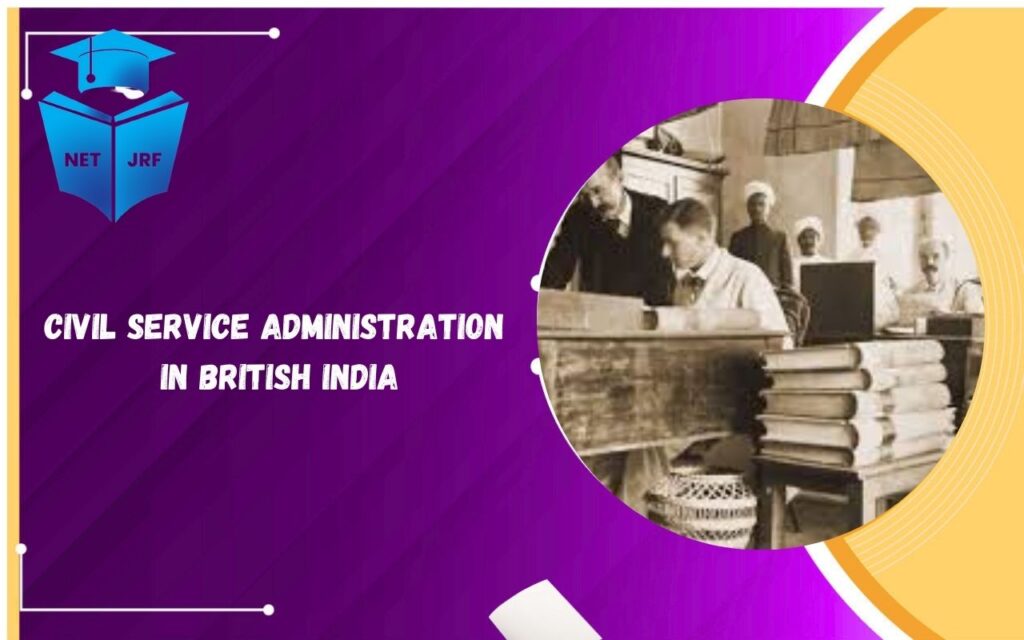
Civil Service Administration in British India formed the backbone of colonial governance during British rule. The British designed a highly structured bureaucracy to control territory, collect revenue, maintain law, implement policy across a vast subcontinent. This administrative system later shaped modern Indian bureaucracy.
The British East India Company first created civil services to manage its commercial empire. After 1858 the British Crown reorganized the system through the Indian Civil Service (ICS). These officers controlled administration at provincial, district, local levels.

How Civil Service Developed in British India
The development of the civil service took place in stages. Initially the East India Company appointed its own officials. Later the British government created a centralized administrative system.
Early Company Administration
- In the early phase, the East India Company governed through its own employees called Company servants. They managed trade, taxation, local governance. Senior officials were known as Covenanted Civil Servants because they signed agreements with the Company.
- These officials held the highest administrative positions. Indians were largely excluded from senior posts during this period.
Enroll UGC NET Online Coaching
Cornwallis Reforms
A major administrative reform took place under Charles Cornwallis during the late eighteenth century.
The Cornwallis Code reorganized civil administration into clear branches.
Main features included:
- Revenue administration
- Judicial administration
- Commercial administration
These reforms introduced rules for salaries, discipline, corruption control, promotion. The system improved bureaucratic efficiency.
Transition to Imperial Civil Service
- After the Indian Rebellion of 1857, the British Crown replaced the East India Company.
- The Indian Civil Service became the highest administrative body in India.
- This service was often called the “steel frame of British administration” because it maintained colonial control over India.
Structure of Civil Service Administration in British India
The colonial bureaucracy followed a hierarchical administrative structure.
Administrative Levels
| Level | Administrative Authority | Main Function |
| Central Government | Governor-General | Policy making |
| Provincial Government | Governors | Provincial administration |
| District Administration | District Collector | Revenue law order |
| Local Administration | Deputy Magistrate | Local governance |
The district became the most important administrative unit.
Role of District Collector
The office of District Collector was introduced by Warren Hastings in 1772.
Collectors performed multiple roles:
- Revenue collection
- Law enforcement
- Judicial administration
- Local governance
This concentration of power made ICS officers extremely influential.
Recruitment System in Civil Service Administration in British India
The recruitment process for the civil services in British India evolved gradually, reflecting the changing priorities of the colonial administration. Initially, the system favored British officials, but over time, merit-based elements were introduced, although Indians faced many obstacles.
Early Nomination System:
In the early days, the East India Company relied heavily on patronage. Young British men were nominated by the Company’s directors and trained before being sent to India. Training took place at specialized institutions such as Haileybury College in London and Fort William College in Calcutta, where they learned administrative skills, law, languages, and governance. This system ensured that most civil servants were British and loyal to Company interests.
Introduction of Competitive Examination System:
The Charter Act of 1853 marked a turning point by introducing open competitive examinations. Key features of this system included:
- Examinations conducted in London, which limited Indian participation.
- Subjects covered English literature, history, mathematics, and modern languages.
- Emphasis on high educational standards and merit-based recruitment.
Despite its merit-based nature, the system had practical barriers for Indians:
- Exams are held only in Britain, making travel expensive and time-consuming.
- Age limits and physical requirements were often unfavorable.
- The syllabus was heavily European-oriented, disregarding Indian knowledge and contexts.
Entry of Indians:
Over time, some Indians managed to enter the Indian Civil Service (ICS), breaking the European monopoly. Satyendranath Tagore became the first Indian to successfully pass the ICS exam in 1863. Gradually, political pressure from Indian nationalists led to more opportunities for educated Indians to join the service, though they remained a minority for many decades.

Types of Civil Services in Colonial India
Civil services were divided into multiple categories.
Categories of Civil Services
| Type of Service | Description | Recruitment |
| Covenanted Service | Highest administrative posts | Mainly British |
| Uncovenanted Service | Lower administrative roles | Mostly Indians |
| Special Services | Technical departments | Mixed recruitment |
These categories reflected the racial hierarchy of colonial administration.
Administrative Powers of ICS Officers
ICS officers exercised enormous authority.
They functioned as:
- District administrators
- Revenue collectors
- Magistrates
- Policy implementers
Their responsibilities included taxation law enforcement infrastructure management.
Major Responsibilities
- Revenue collection
- Maintenance of law order
- Judicial administration
- Policy implementation
- Communication between colonial government local society
These officers governed vast districts with limited supervision.
Revenue Administration in Civil Service Administration in British India
Revenue collection formed the core objective of colonial administration.
The British relied heavily on land taxes to finance their government.
Revenue Systems
| Revenue System | Region | Key Feature |
| Permanent Settlement | Bengal | Fixed land revenue |
| Ryotwari System | Madras Bombay | Direct tax on peasants |
| Mahalwari System | North India | Village based revenue |
- ICS officers supervised these systems.
- They ensured that taxes were collected regularly from farmers landowners.
- Failure to pay taxes could result in land confiscation.
- Revenue administration therefore played a central role in colonial governance.
Role of Civil Service Administration in British India in Governance
In British India, civil servants were the backbone of colonial administration, acting as the main instruments through which the British controlled the vast and diverse population. Despite the small number of British officials, the civil service ensured effective governance across the subcontinent.
Functions in Colonial Governance:
Civil servants were responsible for a wide range of administrative and political tasks, including:
- Implementing British laws: Ensuring that legislation passed by the colonial government was enforced across provinces and districts.
- Maintaining law and order: Supervising policing and controlling disturbances to prevent uprisings or unrest.
- Suppressing rebellions: Acting decisively during local revolts or resistance movements to maintain British authority.
- Promoting colonial economic policies: Collecting revenue, managing land settlements, and enforcing trade regulations that favored British interests.
- Administering justice: Overseeing courts and legal proceedings to enforce laws fairly, though always within the framework of colonial priorities.
Because of these responsibilities, officers of the Indian Civil Service (ICS) often held near-complete control over local administration, shaping both policy and day-to-day governance.
Political Influence:
The civil service acted as a crucial intermediary between the British government and Indian society. Officers supervised education systems, public works, policing, and local administration, influencing development and governance in almost every sector. Their decisions affected social, economic, and political life, making them one of the most powerful groups in colonial India.
Company Administration vs Crown Administration
The transition from Company to Crown administration marked a shift from commercial-driven control to formalized colonial governance, with stronger bureaucracy, legal frameworks, and political supervision.
| Feature | Company Administration | Crown Administration |
| Authority | East India Company | British Crown (Government of India) |
| Period | 1757–1858 | 1858–1947 |
| Governance Style | Focused on trade and revenue collection; Company officials managed both administration and military | More formalized bureaucracy with separation of executive, legislative, and military powers; Governor-General represented Crown |
| Control over Princely States | Indirect through treaties, alliances, and Residents; Paramountcy began to develop | Paramountcy formalized; Residents supervised rulers; Doctrine of Lapse abandoned; princes assured protection |
| Revenue Collection | Revenue-focused, often harsh; zamindari and ryotwari systems developed | Systematized revenue administration with stronger legal framework; emphasis on law and order |
| Military Role | Company armies under Company control | British Indian Army under Crown; stronger integration with imperial strategy |
| Key Changes | Expansion through subsidiary alliances and Doctrine of Lapse | Direct control, structured bureaucracy, emphasis on administrative reforms, political loyalty of princely states |
Importance of Civil Service Administration in British India
The civil service administration was central to the British colonial project in India, creating an organized system that allowed the empire to govern efficiently and maintain control over a vast population. Its influence shaped both administrative practices and political structures that lasted well beyond British rule.
Administrative Significance:
The civil service contributed significantly to the structure and functioning of governance in India:
- Creation of Centralized Governance: Power was concentrated in the hands of trained officials, ensuring uniformity and control across provinces.
- Standardized Administrative Rules: Civil servants established clear procedures for revenue collection, law enforcement, and judicial administration.
- Development of District Administration: India was divided into districts with officers overseeing revenue, policing, and local administration, allowing effective management at the local level.
- Establishment of Bureaucratic Hierarchy: A well-defined hierarchy ensured accountability, discipline, and smooth functioning of the administration.
Service to Colonial Objectives:
Despite these achievements, the civil service primarily served British imperial interests rather than local needs:
- Protection of British Trade: Officers enforced policies favorable to British merchants and shipping.
- Extraction of Indian Resources: Revenue collection and management of agricultural production prioritized the British economy.
- Maintenance of Colonial Authority: Civil servants ensured political stability, suppressing resistance and enforcing British laws.
Enroll UGC NET Coaching in Jaipur
Legacy of Civil Service Administration in British India
The civil service administration of British India left a lasting imprint on governance, many aspects of which continued even after independence. The Indian Civil Service (ICS) set the foundation for India’s modern bureaucratic structures, shaping both administrative processes and institutional frameworks.
Key Legacies:
- Evolution into Indian Administrative Service (IAS):
After independence, the ICS was reorganized into the Indian Administrative Service (IAS), retaining its focus on merit-based recruitment, training, and hierarchical organization. - District Administration:
The colonial model of dividing territories into districts with officers responsible for revenue, law and order, and local governance remains the backbone of India’s administrative structure today. - Civil Service Examinations:
Competitive examinations introduced under British rule continue to be the primary method for selecting civil servants, ensuring merit-based entry into the bureaucracy. - Bureaucratic Hierarchy:
The structured chain of command, clear roles, and responsibilities in colonial administration influenced the design of modern government offices, ensuring efficiency and accountability.

Major Milestones in Civil Service Administration in British India
The civil service administration in British India evolved through several key milestones that shaped recruitment, governance, and the legacy of bureaucracy
| Year | Event | Significance |
| 1772 | District Collector introduced | Revenue administration begins |
| 1793 | Cornwallis Code | Administrative reforms |
| 1853 | Competitive exams introduced | Merit recruitment |
| 1858 | Crown rule begins | ICS strengthened |
| 1922 | ICS exams held in India | Indian participation increased |
Enroll UGC NET Offline Coaching in Jaipur
Conclusion
Civil Service Administration in British India played a decisive role in shaping colonial governance. The Indian Civil Service created a centralized bureaucratic system that allowed a small number of British officials to control a vast territory. Although the system introduced administrative efficiency, it primarily served imperial interests.
Civil Service Administration in British India FAQs

Why was the ICS called the steel frame of the British administration?
The service maintained administrative stability across India. British leaders believed that without ICS officers the colonial government could not function effectively.
How were civil servants recruited during British rule?
Recruitment initially used nomination by East India Company directors. After 1853 open competitive examinations were introduced.
Who was the first Indian ICS officer?
Satyendranath Tagore became the first Indian to pass the ICS examination in 1863. His entry symbolized early Indian participation in colonial bureaucracy.
What was the main role of district collectors?
District collectors supervised revenue collection law enforcement judicial administration local governance within districts.
How did the Civil Service Administration in British India support colonial rule?
Civil servants implemented British policies, collected taxes, maintained order controlled local administration ensuring political economic dominance.
Why were Indians underrepresented in the ICS?
Exams were conducted in England syllabus favored European education age limits disadvantaged Indian candidates.