
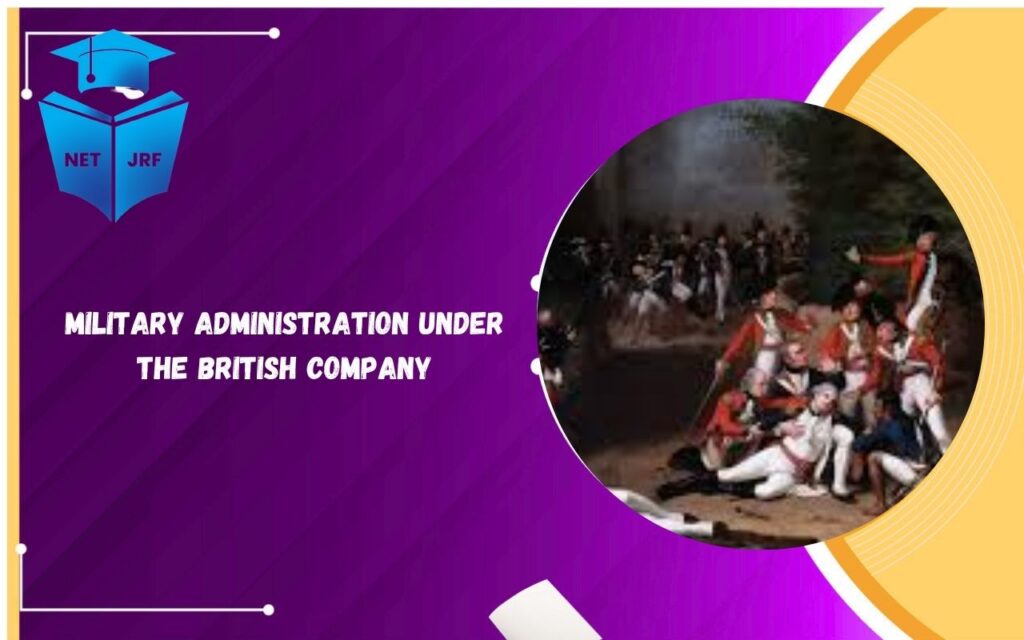
Military Administration played a decisive role in the expansion and consolidation of British rule in India. When the East India Company moved from a trading organization to a political power, it required a strong military system to control territories and defeat rival powers.

The Company gradually created a structured army with European officers and Indian soldiers known as sepoys. Through wars, alliances, and military reforms, the British strengthened their political authority across the subcontinent.
Military in Early Company Rule Background
During the early seventeenth century, the East India Company did not possess a large army. It relied mainly on small security forces to protect trading settlements.
- However, the political situation changed after the Battle of Plassey (1757) and the Battle of Buxar (1764). These victories gave the Company control over large territories.
- As a result, the Company began developing a formal military structure. The emerging Military Administration helped the British defend their territories and expand political influence.
Enroll UGC NET Foundation Course
Military Administration Structure
The Military Administration of the East India Company was organized through three presidency armies. Each presidency governed a large region and maintained its own military force.
Three Presidency Armies
| Presidency | Headquarters |
| Bengal Army | Calcutta |
| Madras Army | Madras |
| Bombay Army | Bombay |
These armies functioned independently but ultimately served the Company’s interests.
The Military Administration relied on these armies for territorial expansion and internal security.
Composition of Company Army
The Company army consisted of both European soldiers and Indian recruits.
Main Components
- European officers
- Indian sepoys
- Artillery units
- Cavalry regiments
The Military Administration ensured that senior command positions remained under British officers.
Company Army Recruitment and Organization
The British East India Company created a well-structured army to maintain control over India and protect its territories. Unlike traditional Indian armies, which were often temporary or based on local levies, the Company’s military was professional, disciplined, and organized systematically.
- Recruited from Different Regions of India
The British recruited soldiers, called sepoys, from various parts of India. They primarily enlisted men from regions like Bengal, Awadh, Bihar, and the Punjab, often selecting communities considered loyal or martial. This regional diversity helped the British reduce the risk of collective rebellion while ensuring a steady supply of soldiers. It also allowed the army to deploy troops effectively across different territories without relying solely on European soldiers. - Trained in European Military Techniques
Once recruited, soldiers were trained in European-style military methods. Training included proper formation drills, use of modern firearms, artillery tactics, and battlefield discipline. This professional training gave Indian sepoys an edge over traditional armies that relied on older combat methods, allowing the British to maintain military superiority in both offensive campaigns and internal security operations. - Paid Regular Salaries
Unlike many traditional armies, where soldiers were often paid irregularly or through land grants, sepoys received regular salaries. This system ensured loyalty, discipline, and stability within the ranks. It also made military service a professional career for Indians, creating a dependable force for the Company’s administrative and military needs. - Organized into Regiments
The army was divided into regiments, each with a specific number of soldiers, officers, and administrative hierarchy. Each regiment had clearly defined responsibilities, including maintaining law and order, defending forts, or participating in campaigns. This organizational structure made the army highly efficient, easy to manage, and capable of rapid mobilization whenever required.

Recruitment Policy
Recruitment played an important role in shaping the Military Administration.
Recruitment Regions
The British often recruited soldiers from specific regions known for martial traditions.
| Region | Contribution |
| Bengal | Large number of infantry sepoys |
| Awadh | Important recruitment area |
| Madras region | Southern regiments |
| Bombay region | Western regiments |
Recruitment policies later influenced events such as the Revolt of 1857.
Military Hierarchy
The Company army followed a strict hierarchical structure.
Command Structure
- Commander-in-Chief
- British officers
- Subordinate officers
- Indian sepoys
The Military Administration maintained discipline through strict military rules and training.
Role of Military Power in Expansion
Military victories allowed the British to expand their influence across India.
Important Wars
- Anglo-Mysore Wars
- Anglo-Maratha Wars
- Anglo-Sikh Wars
Join UGC NET Coaching in Jaipur
Role of Military Power in Expansion
Military power was the backbone of British expansion in India. The East India Company used a strong, disciplined army to enforce its authority, suppress opposition, and expand territorial control. Their success was not just due to superior numbers but also better organization, training, and strategy.
- Anglo-Mysore Wars (1767–1799)
The Anglo-Mysore Wars were fought between the British East India Company and the kingdom of Mysore under rulers like Hyder Ali and Tipu Sultan. These wars were crucial because Mysore was one of the strongest Indian states resisting British dominance. Through victories in these wars, the British weakened Mysore’s military and gained control of strategic territories in southern India. The success of these campaigns demonstrated the effectiveness of European-style military strategy, disciplined infantry, and artillery, giving the British a strong foothold in South India. - Anglo-Maratha Wars (1775–1818)
The Maratha Confederacy was a major power in central and western India. The British fought three successive Anglo-Maratha Wars to subdue them. These wars were complex due to the Marathas’ decentralized but powerful forces. British military organization, disciplined troops, and alliances with some Maratha factions helped them defeat the Marathas. By the end of 1818, the British had brought almost all Maratha territories under Company control. This expansion helped the British consolidate central India and secure revenue-rich regions. - Anglo-Sikh Wars (1845–1849)
The Sikh Empire in Punjab was another powerful kingdom challenging British authority. Two Anglo-Sikh Wars resulted in the annexation of Punjab after 1849. The British used superior training, modern artillery, and better coordination between infantry and cavalry to defeat the Sikhs. This victory gave the British access to fertile lands, key trade routes, and strategic positions in northern India, strengthening their hold over the subcontinent. - Strengthening the Military Administration
Through these wars, the British realized the importance of a professional army. They restructured regiments, reduced reliance on Indian soldiers for sensitive positions, and increased European troop deployment. This allowed them to maintain discipline, enforce colonial policies, and prevent large-scale rebellions. The military became not only a tool of conquest but also an instrument for sustaining colonial authority. - Expansion of Territorial Control
Military victories allowed the British to bring vast regions under their control, including South India, central India, and Punjab. This expansion ensured access to important resources, trade routes, and revenue. It also reduced the power of Indian rulers and made local kingdoms dependent on British political and military support. - Political and Economic Influence
Conquering territories through military success gave the British political leverage over princely states. They could impose treaties, control succession, and extract taxes efficiently. The military also protected trade and commerce by securing key ports, rivers, and roads, which was vital for Company profits and later British economic interests.
Military Technology and Training
The British introduced modern military techniques in India.
Major Innovations
- The British brought modern military techniques to India, transforming the structure and efficiency of the army. They introduced European-style infantry drills that emphasized discipline, coordination, and battlefield tactics.
- Advanced artillery units and standardized weapons improved the army’s firepower and reliability compared to traditional Indian forces.
- To support these innovations, the British also established military training schools, where soldiers learned strategy, weapon handling, and organized formations.
- This systematic training created a professional army capable of enforcing colonial rule, suppressing rebellions, and protecting British interests.
- The combination of technology, standardized weapons, and formal training made the Company’s military far more effective than traditional Indian armies, laying the foundation for later colonial and modern Indian military institutions.
Military Administration under the British Company Presidency Armies
Alongside centralized recruitment and training, the British East India Company maintained separate presidency armies, which formed the backbone of military administration in India.
| Army | Strength | Role |
| Bengal Army | Largest army | Expansion in North India |
| Madras Army | Moderate strength | Control in South India |
| Bombay Army | Smaller force | Western campaigns |
This structure ensured regional control while strengthening the overall Military Administration.
Military Administration and Internal Security
Apart from external wars, the army also played a role in maintaining internal stability.
Functions of the Company Military
- The military under the British East India Company played a crucial role in maintaining colonial control. One of its primary functions was the suppression of rebellions, ensuring that local uprisings or resistance movements did not threaten Company authority. It also protected trade routes, safeguarding the movement of goods and securing British commercial interests across the subcontinent.
- In addition to these security roles, the military supported civil administration by assisting district officials and maintaining order during tax collection, law enforcement, and public works.
- It also enforced colonial policies, ensuring that directives from Company authorities were implemented effectively throughout territories.
- Through these combined functions, the Company military became an essential instrument for both political dominance and economic control in India.
The Military Administration thus served as a key pillar of British rule.
Revolt of 1857 Military
The Revolt of 1857 exposed critical weaknesses in the British colonial military system in India. The uprising was not just a spontaneous rebellion but the result of deep-rooted discontent among the sepoys, who were the Indian soldiers serving under the British East India Company. Many soldiers were dissatisfied with their pay, service conditions, and the lack of opportunities for promotion.
- Cultural and religious grievances also played a major role. Indian soldiers feared that their religious and social customs were being undermined by the British. A notable trigger was the introduction of the new Enfield rifle cartridges, which were rumored to be greased with cow and pig fat offensive to Hindus and Muslims respectively.
- This incident intensified distrust and resentment towards the British.
- In response to the revolt, the British undertook significant reforms in the military to prevent such uprisings in the future.
- The number of European troops in India was increased to reduce dependence on Indian sepoys. The composition of regiments was reorganized to ensure that no single community dominated a regiment, reducing the risk of collective rebellion.
- The British also emphasized better training, loyalty incentives, and closer supervision of Indian soldiers.
- These changes strengthened British military control in India, ensuring a more reliable and disciplined army under direct British authority.
- The post-1857 reforms highlighted the colonial government’s determination to maintain supremacy through both military and administrative restructuring, making the army a central instrument of British power in India.
Join UGC NET Offline Classes in Jaipur
Long-Term Impact of Company Military System
The Military Administration introduced new military traditions in India.
Key Impacts
- Development of modern army structure
- Introduction of professional training
- Establishment of centralized command
- Influence on later Indian military institutions
Long-Term Impact of the Company Military System
- The British East India Company’s military administration left a lasting mark on India’s armed forces. By establishing a professional army, the Company introduced new military traditions that influenced the organization and functioning of armed forces in the subcontinent.
- Key impacts included the development of a modern army structure, where clear hierarchies and ranks were defined, ensuring discipline and efficiency.
- Professional training programs were introduced to improve the skills of soldiers and officers, laying the foundation for systematic military education.
- The establishment of a centralized command strengthened coordination and control across different regions, enabling rapid response to internal disturbances and external threats.
- These reforms and structures provided a blueprint for later military institutions in India. Even after independence, many elements of the modern Indian army, including regimental organization, training methods, and administrative systems, can trace their origins back to the military practices established under the Company.
- The colonial military system, therefore, not only served immediate British interests but also shaped the evolution of India’s armed forces in the long term.

Conclusion
The Military Administration of the East India Company formed a powerful instrument of colonial expansion. Through presidency armies, sepoy recruitment, and modern military techniques, the British established control over large parts of India.
Military victories against regional powers and the suppression of revolts ensured the survival of British rule for many decades. Although the system faced challenges such as the Revolt of 1857, it remained a crucial pillar of colonial governance.
Military Administration under the BRITISH Company FAQs

What were the presidency armies?
The Company maintained three regional armies:
- Bengal Army – Northern India, largest force.
- Madras Army – Southern India, medium strength.
- Bombay Army – Western India, smaller force.
Each army managed regional security and supported Company campaigns.
Who were sepoys?
Indian soldiers recruited into the Company army. They were trained in European tactics, paid salaries, and organized into regiments under British officers, forming the backbone of the army.
Why was the Company army important?
It helped defeat Indian kingdoms, expand territories, maintain law and order, protect trade routes, and support civil administration. It was essential for British political and economic control.
How did the Revolt of 1857 affect the army?
The revolt exposed weaknesses like low loyalty and cultural grievances. After 1857, the British increased European troops, reorganized regiments, improved training, and strengthened supervision to prevent future uprisings.