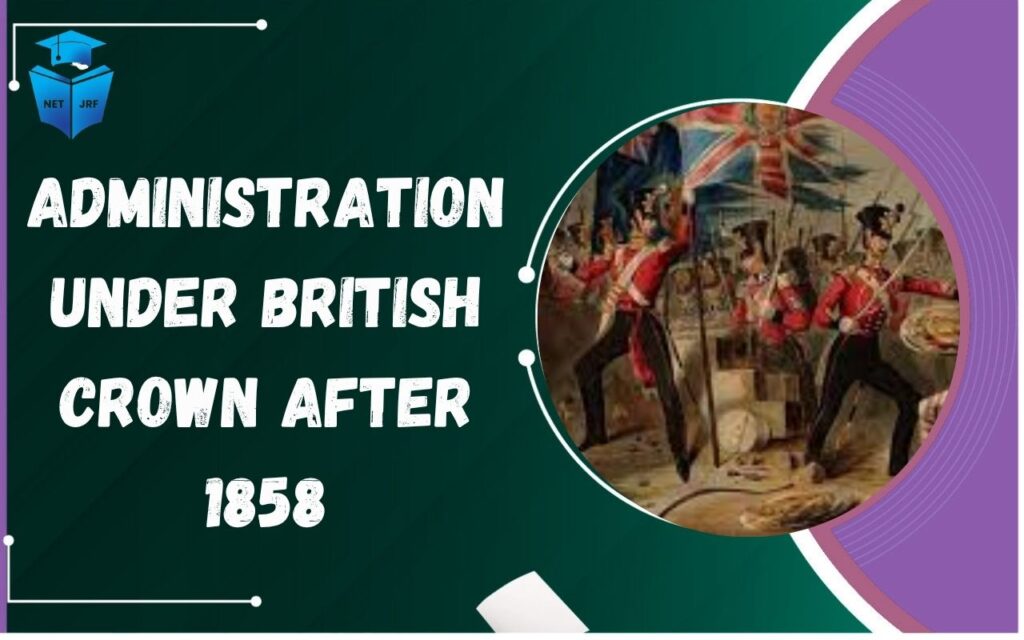
Administration under the British Crown started in 1858 after the Great Revolt of 1857 shook the foundation of British power in India. This revolt, often called the Sepoy Mutiny or the First War of Independence, forced the British Parliament to end the East India Company’s rule. The British Crown assumed direct control over Indian territories, marking the beginning of the British Raj. This era lasted until India finally achieved independence in 1947.

British Crown Administration in India
The Administration under the British Crown refers to the direct rule of the British monarch over the Indian subcontinent. Before 1858, the East India Company managed Indian territories under the supervision of the British Parliament.
Join UGC NET Foundation Course
- However, the 1857 uprising convinced British leaders that the Company could no longer govern such a massive and diverse population. Consequently, Queen Victoria issued a proclamation that transferred all governing powers to the Crown.
- This shift meant that the British government took full responsibility for Indian governance, revenue, and military.
- The Crown aimed to create a more stable and professional administrative system to prevent future rebellions. They introduced English education, western legal codes, and massive infrastructure projects like railways.
- These steps helped the British consolidate their hold while also modernizing parts of the Indian economy.
- Despite these developments, the administration often faced criticism for being exploitative. While the British built telegraph lines and schools, they primarily focused on promoting British interests.
- Over time, Indian nationalists began demanding more participation in their own government. This pressure led to a series of reforms that slowly expanded the role of Indians in legislative processes.
Good Government of India 1858 Act
The Government of India Act of 1858 officially launched the Administration under the British Crown. This landmark legislation replaced the Company’s dual governance system, which involved the Board of Control and the Court of Directors. The Act established a new high-ranking office known as the Secretary of State for India. This official sat in the British Cabinet and held complete authority over Indian affairs.
- To assist the Secretary of State, the Act created a 15-member Council of India. This council acted as an advisory body, providing expertise on Indian administration and finance. Meanwhile, the Governor-General of India received the new title of “Viceroy”. The Viceroy served as the direct representative of the British monarch on Indian soil.
- Lord Canning became the first Viceroy under this new system. The administration now functioned “in the name of Her Majesty,” emphasizing a direct link between the Crown and its subjects. This act focused more on improving the administrative machinery than on providing political rights to Indians. It aimed to create a centralized, efficient, and loyal bureaucracy that could maintain order across the subcontinent.
Early Constitutional Steps- Acts of 1861 and 1892
The Indian Councils Act of 1861 introduced the first representative institutions under the Administration under the British Crown. It required the Viceroy to nominate Indians as non-official members of his legislative council. This act also decentralized power by restoring legislative authority to the Bombay and Madras Presidencies. This reversed the centralizing trend that had dominated since the late 18th century.
- Lord Canning also introduced the portfolio system during this period.
- This system allowed individual members of the executive council to oversee specific departments, similar to a modern cabinet. Furthermore, the Act authorized the Viceroy to issue ordinances during emergencies without council approval.
- These ordinances remained valid for six months, giving the executive significant power.
- As the Indian national movement grew, the British passed the Indian Councils Act of 1892. This act responded to demands from the newly formed Indian National Congress.
- It expanded the size of legislative councils and allowed members to discuss the annual budget. For the first time, members could ask questions to the executive, laying the groundwork for a parliamentary style of government.
Best UGC NET Online Test Series
Morley-Minto Reforms 1909
The Administration under the British Crown faced new challenges as radical nationalism emerged in the early 20th century. To appease moderates and create divisions, the British introduced the Indian Councils Act of 1909. Also known as the Morley-Minto Reforms, it significantly increased the size of legislative councils. It allowed non-official majorities in provincial legislatures for the first time.
- A critical feature of this act was the introduction of communal representation for Muslims. It established “separate electorates,” where Muslim candidates were elected only by Muslim voters. Lord Minto became known as the “Father of the Communal Electorate” because this policy legalized communalism in Indian politics. This move aimed to weaken the united national front against British rule.
- The Act also allowed Indians to join the executive councils of the Viceroy and Governors. Satyendra Prasad Sinha became the first Indian member of the Viceroy’s Executive Council. While these reforms gave Indians more voice, the British still held the real power in the Central Legislative Council. The deliberative powers of the councils grew, but they remained advisory in many key areas.
Government of India Act 1919 Dyarchy
The British introduced the Government of India Act of 1919, or the Montagu-Chelmsford Reforms, to address rising Indian demands for self-rule. This act significantly altered the Administration under the British Crown by introducing “dyarchy” in the provinces. Dyarchy means “double rule,” where provincial subjects were divided into two categories: “transferred” and “reserved”.
In this system, the Governor managed “transferred” subjects, like education and health, with the help of ministers. These ministers were accountable to the legislative council. On the other hand, the Governor and his executive council controlled “reserved” subjects, like police and finance, without any accountability to the legislature. This complex system gave Indians limited power over local matters while the British kept control of critical sectors.
The 1919 Act also introduced bicameralism at the center, creating a Council of State and a Legislative Assembly. It expanded communal representation to include Sikhs, Indian Christians, Anglo-Indians, and Europeans. Additionally, it established the office of the High Commissioner for India in London. This act also separated the provincial budget from the central budget for the first time, giving provinces more financial flexibility.

Government of India Act 1935 Federalism
The Government of India Act of 1935 remains one of the most detailed documents in the history of the Administration under the British Crown. It contained 321 sections and ten schedules, aiming for a fully accountable government. The Act proposed an “All India Federation” consisting of British provinces and Princely States. It divided powers between the center and the units using three lists: Federal, Provincial, and Concurrent.
Join UGC NET Coaching in Jaipur
- One of the most significant changes was the abolition of dyarchy in the provinces. In its place, the British introduced “provincial autonomy”.
- Provinces became autonomous administrative units, and the Governor had to act on the advice of ministers responsible to the provincial legislature. However, the Federation never came into being because the Princely States refused to join.
- The Act also introduced bicameralism in several provinces and expanded the franchise to about 10% of the total population.
- It established the Reserve Bank of India to control the country’s currency and credit. Furthermore, it provided for the creation of a Federal Court and various Public Service Commissions. While comprehensive, the Act still left residuary powers with the Viceroy, ensuring ultimate British control.
Indian Independence Act 1947
The Administration under the British Crown finally ended with the Indian Independence Act of 1947. British Prime Minister Clement Atlee announced that British rule would conclude by mid-1947.
- This act was based on the Mountbatten Plan, which both the Congress and the Muslim League accepted. It turned India into a sovereign and independent state on August 15, 1947.
- The Act provided for the partition of India into two independent dominions: India and Pakistan. It abolished the office of the Secretary of State for India and transferred his duties to the Secretary of State for Commonwealth Affairs.
- Both dominions received the authority to frame their own constitutions through their respective Constituent Assemblies. The British monarch’s title of “Emperor of India” was dropped.
- Until the new constitutions were ready, the Governor-General and provincial governors served as constitutional heads.
- The Act also ended British supremacy over the Princely States, giving them the choice to join either dominion or remain independent.
- This final piece of legislation marked the end of nearly a century of direct royal rule. It cleared the way for the birth of two new nations and the start of a democratic era in the region.
Summary Tables of British Administration
Below are structured tables summarizing the key milestones and features of the Administration under the British Crown.
Key Acts under the Administration under the British Crown
| Year | Act Name | Major Feature | Impact |
| 1858 | Government of India Act | Secretary of State established | Direct rule by the Crown |
| 1861 | Indian Councils Act | Portfolio System | Decentralization begins |
| 1892 | Indian Councils Act | Budget Discussion | Start of parliamentary style |
| 1909 | Indian Councils Act | Communal Electorate | Legalized communalism |
| 1919 | Government of India Act | Dyarchy in Provinces | Divided provincial subjects |
| 1935 | Government of India Act | Provincial Autonomy | All India Federation proposed |
| 1947 | Indian Independence Act | Partition of India | Sovereign independence |
Key Features of British Governance
The key features of British governance highlight how the Crown structured power, laws, and administration to control India efficiently.
- Centralization and Decentralization:
- The 1858 Act created a highly centralized structure under the Secretary of State.
- The 1861 Act reversed this by giving powers back to Bombay and Madras.
- The 1935 Act finally granted autonomy to provinces.
- Introduction of Representative Institutions:
- The 1861 Act added Indians as non-official members.
- The 1892 Act allowed discussions on the budget.
- The 1909 Act increased the number of elected members.
- Communal Representation Policies:
- Separate electorates for Muslims began in 1909.
- This was extended to Sikhs and Christians in 1919.
- The 1935 Act further expanded these divisions.
- Administrative Machinery:
- The British developed the Indian Civil Service (ICS).
- They established High Courts and a Federal Court.
- The 1919 Act created the Public Service Commission.
Top UGC NET Coaching in Jaipur
Independence (1858–1947)
- The 1858 Transition: The Crown takes direct control after the 1857 Revolt.
- Nomination Phase: Indians are nominated to councils under the 1861 Act.
- Expansion Phase: Council sizes increase and budget debates start in 1892.
- Communal Phase: Separate electorates were introduced in 1909.
- Dyarchy Phase: Power was split between British and Indian ministers in 1919.
- Autonomy Phase: Provinces gain administrative independence in 1935.
- Final Phase: The 1947 Act partitions the subcontinent and grants sovereignty.
The Administration under the British Crown shaped India’s legal and political system after 1857. While mainly serving colonial interests, reforms like the Acts of 1909, 1919, and 1935 gradually increased Indian participation. By 1947, the foundations of a modern democratic state were in place.

Administration under British Crown After 1858 FAQs

2. Who was the first Viceroy of India?
Lord Canning became the first Viceroy of India in 1858.
3. What was the role of the Secretary of State for India?
The Secretary of State was a British Cabinet member with full authority and control over the Indian government.
4. What is dyarchy in the context of British rule?
Dyarchy was a system of "double rule" introduced in 1919, where provincial subjects were divided into transferred and reserved categories.
5. Which act introduced communal electorates for the first time?
The Indian Councils Act of 1909 (Morley-Minto Reforms) introduced communal electorates for Muslims.
6. When was provincial autonomy introduced?
Provincial autonomy was introduced by the Government of India Act of 1935.
7. What happened to the East India Company after 1858?
The 1858 Act abolished the Company's rule and transferred its territories and revenues to the British Crown.
8. What was the 15-member Council of India?
It was an advisory body established in 1858 to assist the Secretary of State in managing Indian affairs.
9. How did the 1947 Act affect the Princely States?
It ended British supremacy over them, allowing them to join India or Pakistan or stay independent.
10. What was the significance of the 1892 Act?
It laid the foundation for a parliamentary system by allowing members to debate the budget and ask questions.