
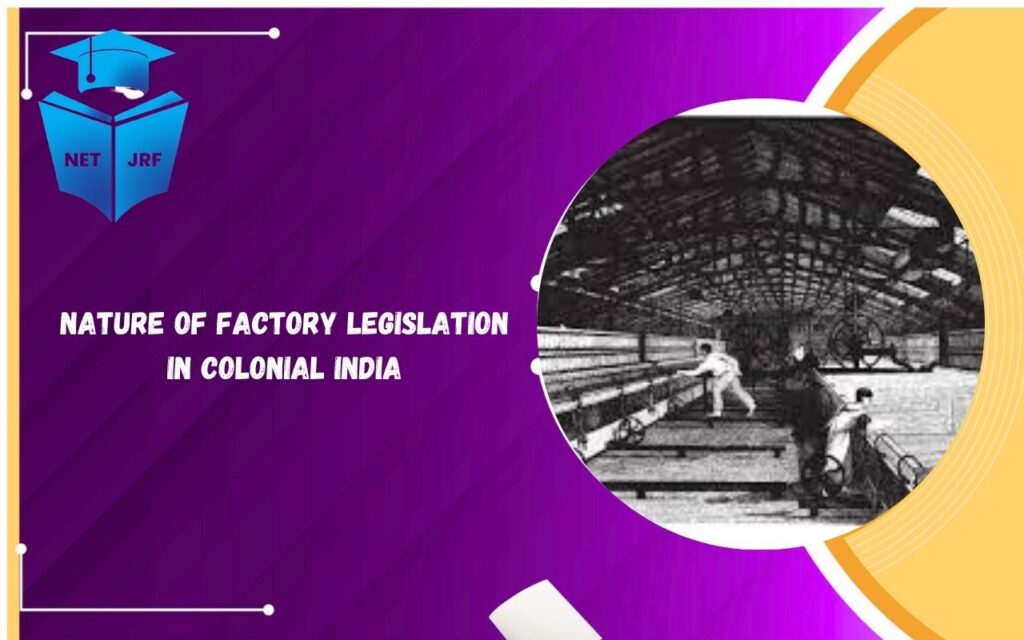
Nature of Factory Legislation in Colonial India Labour Laws and Factory Reforms

Nature of Factory Legislation in Colonial India in this topic you learn how factory laws regulated labour working hours child labour safety rules factory inspections and industrial reforms during British rule in India

pawan

Nature of Factory Legislation in Colonial India

Table of Contents

The nature of Factory Legislation formed an important aspect of labour policy during the colonial period in India. Industrialization created new factory workplaces where labourers faced long working hours, poor safety conditions, and exploitation by factory owners.

To address these problems, the colonial government introduced several factory laws to regulate working conditions. These laws attempted to limit child labour, reduce working hours, and improve workplace safety.

Study Planner

Enroll UGC NET Foundation Course

Factory Legislation in Industrial India Concept 

The concept Nature of Factory Legislation refers to the characteristics and objectives of laws that regulated industrial labour in factories during the colonial period.

Factory legislation aimed to establish rules governing working hours, employment of women and children, safety standards, and factory inspections.

Main Features

Regulation of Working Hours

  • Laws were introduced to limit the number of hours workers could be made to work in factories.
  • The aim was to reduce overwork and improve worker health.

Restrictions on Child Labour

  • Children were prohibited from working long hours or in dangerous conditions.
  • The legislation sought to protect children from exploitation and promote education.

Protection of Women Workers

  • Special rules were enacted for women, including limits on night work and heavy labor.
  • These laws aimed to safeguard women’s health and working conditions.

Introduction of Factory Inspection Systems

  • Inspectors were appointed to ensure compliance with labor laws.
  • Factory inspections helped monitor working conditions, hygiene, and safety.

These policies marked the early development of labour regulation in India.

Enroll UGC NET Foundation Batch Online

Factory Legislation in Colonial India Nature 

The Nature of Factory Legislation in colonial India reflected both humanitarian concerns and economic interests.

  • British industrialists feared competition from Indian factories that used cheap labour. Pressure from these groups influenced the colonial government to introduce labour laws that regulated factory work in India.
  • These laws gradually introduced labour protections but often remained limited in scope.

Historical Background of Factory Laws

Industrial development in India began during the nineteenth century. Textile mills and other factories appeared in cities such as Bombay, Calcutta, and Madras.

Factory workers included men, women, and children who worked long hours in difficult conditions.

Early Labour Conditions

Before legislation workers faced several problems:

Extremely Long Working Hours

  • Workers often labored 12–16 hours a day, leading to fatigue and poor health.

Unsafe Working Environments

  • Factories lacked proper ventilation, sanitation, and safety measures.
  • Accidents were common due to unguarded machinery and unsafe conditions.

Employment of Young Children

  • Children as young as 5–6 years were employed in textile mills, factories, and workshops.
  • They performed hazardous tasks for very low wages.

Lack of Labour Rights

  • Workers had no legal protections, unions, or mechanisms to raise grievances.
  • Exploitation was widespread, and workers had little bargaining power.

Response

  • Growing public awareness and pressure eventually led to the introduction of labor legislation, including regulation of working hours, protection of women, restrictions on child labor, and factory inspections.

Public pressure eventually led to the introduction of labour reforms.

Enroll UGC NET Offline Classes in Jaipur

Nature of Factory Legislation 

Factory legislation in colonial India was introduced mainly to regulate working conditions in factories during the rule of the British Empire.

Feature Explanation
Labour regulation Laws governed factory employment
Worker protection Safety rules introduced
Child labour limits Restrictions placed on child workers
Factory inspection Officials monitored workplaces

Major Factory Acts in Colonial India

Several laws illustrate the Nature of Factory Legislation introduced during colonial rule.

  • Factory Act of 1881

      • The first factory law in India aimed to regulate working conditions for children in textile factories.
      • Main provisions included limits on working hours for child labourers and requirements for basic safety measures.
  • Factory Act of 1891

      • The 1891 Act expanded labour protection by reducing working hours for women and children.
      • It also introduced weekly holidays for workers.
  • Factory Act of 1911

      • This act strengthened labour regulation and expanded government authority over factories.
      • It also improved inspection systems.
  • Factory Act of 1934

    • The 1934 law introduced further regulations on safety, working hours, and employment conditions.

App JRF Adda

Important Factory Acts in India

To regulate industrial work and improve labor conditions, the colonial government introduced several factory laws during the rule of the British Empire.

Year Major Provision
1881 First factory law regulating child labour
1891 Reduced working hours for women
1911 Strengthened inspection system
1934 Expanded safety regulations

Main Objectives of Factory Legislation in India

The Nature of Factory Legislation reveals several policy objectives.

Reducing Exploitation

  • Laws were introduced to prevent extreme exploitation of workers in factories.
  • This included protections for women, children, and regular workers.

Regulation of Labour Conditions

  • Governments established rules for working hours, breaks, wages, and employment practices.
  • The aim was to improve safety, health, and fairness in factories.

Industrial Stability

  • Proper labour regulation helped prevent unrest and strikes.
  • It contributed to stability in rapidly growing industrial sectors, ensuring consistent production.

Working Conditions in Early Factories

The Nature of Factory Legislation becomes clearer when we examine early factory conditions.

Main Features

  • Long Working Hours – Workers often worked 10–16 hours a day with very few breaks.
  • Low Wages – Factory laborers were paid very small salaries for long hours of work.
  • Child and Women Labour – Many women and children were employed in factories.
  • Unsafe Environment – Factories had poor ventilation, overcrowding, and unsafe machines.
  • Lack of Worker Rights – There were very few labor laws to protect workers in the early stages.

Key Provisions of Factory Laws

Factory legislation introduced several important rules.

Limitation of Working Hours

  • Laws restricted the maximum number of hours a worker could be employed per day.
  • This reduced overwork and fatigue, especially in textile mills and factories.

Minimum Age Requirement for Workers

  • Children below a certain age were prohibited from working in factories.
  • This aimed to protect children from exploitation and encourage schooling.

Weekly Rest Days

  • Workers were entitled to at least one day off per week.
  • This provided time for rest and recovery, improving productivity and health.

Workplace Safety Standards

  • Factories were required to maintain proper ventilation, lighting, sanitation, and safe machinery.
  • Inspections ensured compliance with safety regulations.

Join UGC NET Offline Coaching in Jaipur

Criticism of Colonial Factory Legislation

Historians argue that the Nature of Factory Legislation often reflected colonial economic interests rather than genuine labour welfare.

  • Limited Coverage

      • Early factory laws applied mainly to large industrial establishments. Many workers in small workshops remained unprotected.
  • Weak Enforcement

      • Inspection systems remained limited and often ineffective.
  • Economic Motives

    • Some historians believe that British industrialists supported labour laws in India to reduce competition from Indian industries.

Social Impact of Factory Legislation

The Nature of Factory Legislation influenced social and economic developments in colonial India.

  • Growth of Labour Awareness
      • Factory legislation made workers more conscious of their rights, working hours, and safety standards.
      • This awareness laid the foundation for organized labor activism.
  • Emergence of Labour Movements
      • Workers started forming unions and associations to demand better wages, shorter hours, and safer working conditions.
      • Early labor movements began in textile mills, jute factories, and railways.
  • Improvement in Working Conditions
    • While limited in scope, factory laws reduced extreme exploitation, regulated child labor, and improved safety standards.
    • This marked the beginning of formal labor protection in India.

Development of Factory Legislation

The evolution of labour laws followed a gradual pattern.

Industrial Growth Created Factory Employment

  • Expansion of textile, jute, and other industries led to a growing factory workforce.

Harsh Labour Conditions

  • Workers faced long hours, unsafe environments, child labor, and low wages.
  • Exploitation was widespread, prompting concern among reformers and the public.

Public Pressure Demanded Labour Reform

  • Social reformers, journalists, and political leaders highlighted worker hardships, pushing for legal protections.

Introduction of Factory Laws

  • The colonial government enacted factory legislation to regulate working hours, child labor, women’s employment, and workplace safety.

Gradual Expansion of Worker Protections

  • Over time, laws improved labor conditions, introduced inspections, and laid the foundation of organized labor rights in India.

Long-Term Impact of Factory Laws

The Nature of Factory Legislation influenced later labour policy development in India.

Foundation of Labour Rights

  • Colonial factory laws established the first framework for protecting workers’ rights, including working hours, child labor restrictions, and safety measures.

Modern Labour Regulation

  • Independent India expanded and strengthened labor legislation, drawing on the principles of colonial factory laws.
  • Laws now cover minimum wages, social security, maternity benefits, and industrial safety.

Industrial Workforce Protection

  • Modern labor policies protect workers across industries, ensuring fair wages, safer working conditions, and legal remedies.
  • These policies trace their roots to early colonial factory legislation.

JRF Adda Book

Conclusion

The Nature of Factory Legislation reflects the early attempt to regulate industrial labour during the colonial period. Factory laws introduced limits on working hours, restrictions on child labour, and safety regulations in industrial workplaces.

Read UGC NET Notes
1 Archaeological Sources for UGC NET Epigraphy – Study of Inscriptions Meaning of Historical Sources Archaeological
2 Meaning of Historical Sources Archaeological Sources for UGC NET Literary Sources in History Archaeological
3 Exploration in Archaeology Excavation Techniques in Archaeology Dating of Archaeological Sites Archaeological
4 Excavation Techniques in Archaeology Exploration in Archaeology Dating of Archaeological Sites Archaeological
5 Epigraphy – Study of Inscriptions Inscriptions in Reconstructing History Numismatics in History Archaeological
6 Inscriptions in Reconstructing History Epigraphy – Study of Inscriptions Archaeological Sources for UGC NET Archaeological
7 Numismatics in History Importance of Coins in History Epigraphy – Study of Inscriptions Archaeological
8 Importance of Coins in History Numismatics in History Archaeological Sources for UGC NET Archaeological
9 Dating of Archaeological Sites Excavation Techniques in Archaeology Dating Ancient Literary Sources Archaeological
10 Indigenous Literature Literary Sources in History Secular Literature as Historical Source Literary
11 Dating Ancient Literary Sources Literary Sources in History Dating of Archaeological Sites Literary
12 Literary Sources in History Indigenous Literature Foreign Accounts of India Literary
13 Foreign Accounts of India Greek Accounts on Ancient India Chinese Accounts on India Literary
14 Greek Accounts on Ancient India Foreign Accounts of India Chinese Accounts on India Literary
15 Secular Literature as Historical Source Literary Sources in History Indigenous Literature Literary
16 Role of Myths and Legends in Historical Reconstruction Literary Sources in History Secular Literature as Historical Source Literary
17 Chinese Accounts on India Foreign Accounts of India Greek Accounts on Ancient India Literary
18 Arabic Accounts on India Foreign Accounts of India Chinese Accounts on India Literary
19 Neolithic and Chalcolithic Phases Neolithic Revolution in India Chalcolithic Culture in India Neolithic
20 Hunting, Gathering & Food Production Neolithic Revolution in India Neolithic Settlements in India Neolithic
21 Neolithic Revolution in India Neolithic Settlements in India Tools and Technology in Neolithic Period Neolithic
22 Neolithic Settlements in India Distribution of Neolithic Cultures in India Neolithic Revolution in India Neolithic
23 Distribution of Neolithic Cultures in India Neolithic Settlements in India Tools and Technology in Neolithic Period Neolithic
24 Tools and Technology in Neolithic Period Neolithic Revolution in India Chalcolithic Culture in India Neolithic
25 Chalcolithic Culture in India Settlement Pattern & Economy in Chalcolithic Phase Trade & Exchange Networks in Chalcolithic Societies Neolithic
26 Settlement Pattern & Economy – Chalcolithic Phase Chalcolithic Culture in India Trade & Exchange Networks in Chalcolithic Societies Neolithic
27 Trade & Exchange Networks – Chalcolithic Societies Chalcolithic Culture in India IVC Internal & External Trade Neolithic
28 Indus Valley Civilization – UGC NET Major Sites of Indus Civilization Urban Planning in Harappan Civilization IVC
29 IVC Internal & External Trade Internal Trade – Harappan Civilization Craft Specialization in Harappan Civilization IVC
30 Political Organization – Harappan Civilization Social Structure – Indus Civilization Urban Planning in Harappan Civilization IVC
31 Major Sites of Indus Civilization Indus Valley Civilization – UGC NET Urban Planning in Harappan Civilization IVC
32 Urban Planning & Settlement – Harappan Civilization Architecture & Town Planning – Harappan Cities IVC as First Urbanization in India IVC
33 Architecture & Town Planning – Harappan Cities Urban Planning in Harappan Civilization Major Sites of Indus Civilization IVC
34 Craft Specialization & Industrial Activities – Harappan Agriculture & Food Economy – Harappans IVC Internal & External Trade IVC
35 Agriculture & Food Economy – Harappans Craft Specialization in Harappan Civilization Internal Trade – Harappan Civilization IVC
36 Internal Trade – Harappan Civilization IVC Internal & External Trade Craft Specialization in Harappan Civilization IVC
37 Religion & Beliefs – Indus Civilization Social Structure – Indus Civilization Indus Valley Civilization – UGC NET IVC
38 Social Structure – Indus Civilization Political Organization – Harappan Civilization Religion & Beliefs – Indus Civilization IVC
39 Decline of Indus Civilization Indus Valley Civilization – UGC NET IVC as First Urbanization in India IVC
40 IVC as First Urbanization in India Urban Planning in Harappan Civilization Second Urbanization in India IVC
41 Vedic & Later Vedic Periods – Aryan Varna System Early Vedic Society and Economy Later Vedic Society and Economy Vedic
42 Origin of Vedic Civilization Aryan Debate – Migration, Invasion & Indigenous Theories Early Vedic Society and Economy Vedic
43 Aryan Debate – Migration, Invasion & Indigenous Theories Origin of Vedic Civilization Early Vedic Society and Economy Vedic
44 Early Vedic Society and Economy Political Institutions – Early Vedic Period Social Structure – Early Vedic Period Vedic
45 Political Institutions – Early Vedic Period Early Vedic Society and Economy Monarchical States in Ancient India Vedic
46 Social Structure – Early Vedic Period Emergence of Varnas & Social Stratification Early Vedic Society and Economy Vedic
47 Later Vedic Society and Economy Emergence of Varnas & Social Stratification Impact of Iron Technology in India Vedic
48 Emergence of Varnas & Social Stratification Social Structure – Early Vedic Period Later Vedic Society and Economy Vedic
49 Emergence of Heterodox Sects in India Jainism, Buddhism & Ajivikas – Origins & Teachings Later Vedic Society and Economy Vedic
50 Impact of Iron Technology in India Later Vedic Society and Economy Agricultural Expansion & Economic Changes – Ancient India Vedic
51 Religious & Philosophical Vedic Ideas Emergence of Varnas & Social Stratification Emergence of Heterodox Sects in India Vedic
52 Megalithic Culture of South India Neolithic and Chalcolithic Phases Agricultural Expansion & Economic Changes General
53 State System in Ancient India Rise of Mahajanapadas Transition: Tribal Polities to Territorial States General
54 Transition: Tribal Polities to Territorial States Rise of Mahajanapadas Later Vedic Society and Economy General
55 Rise of Mahajanapadas Monarchical States in Ancient India Republican States (Gana-Sanghas) – Ancient India Magadha
56 Monarchical States in Ancient India Rise of Mahajanapadas Emergence of Magadha Magadha
57 Republican States (Gana-Sanghas) – Ancient India Rise of Mahajanapadas Monarchical States in Ancient India Magadha
58 Agricultural Expansion & Economic Changes – Ancient India Second Urbanization in India Impact of Iron Technology in India General
59 Second Urbanization in India IVC as First Urbanization in India Rise of Mahajanapadas General
60 Jainism, Buddhism & Ajivikas – Origins & Teachings Emergence of Heterodox Sects in India Ashoka’s Policy of Dhamma General
61 Emergence of Magadha Geographical Advantages of Magadha Early Rulers of Magadha Magadha
62 Geographical Advantages of Magadha Natural Resources & Economic Strength of Magadha Reasons for Success of Magadha Magadha
63 Natural Resources & Economic Strength of Magadha Geographical Advantages of Magadha Economic Policies of the Nandas Magadha
64 Early Rulers of Magadha Haryanka Dynasty – Rise of Magadha Emergence of Magadha Magadha
65 Haryanka Dynasty – Rise of Magadha Expansion Policy of Bimbisara Early Rulers of Magadha Magadha
66 Expansion Policy of Bimbisara Ajatashatru – Military Reforms Haryanka Dynasty – Rise of Magadha Magadha
67 Ajatashatru – Military Reforms Wars of Ajatashatru Expansion Policy of Bimbisara Magadha
68 Wars of Ajatashatru Ajatashatru – Military Reforms Udayin & Establishment of Pataliputra Magadha
69 Udayin & Establishment of Pataliputra Wars of Ajatashatru Shishunaga Dynasty Magadha
70 Shishunaga Dynasty Administrative Structure of the Shishunagas Nanda Dynasty Magadha
71 Administrative Structure of the Shishunagas Shishunaga Dynasty Central Administration Under Mauryas Magadha
72 Nanda Dynasty Mahapadma Nanda – Imperial Expansion Shishunaga Dynasty Magadha
73 Mahapadma Nanda – Imperial Expansion Military Strength of the Nandas Nanda Dynasty Magadha
74 Economic Policies of the Nandas Nanda Dynasty Taxation System – Mauryan State Magadha
75 Military Strength of the Nandas Mahapadma Nanda – Imperial Expansion Defeat of Nandas & Rise of Mauryan Empire Magadha
76 Reasons for Success of Magadha Geographical Advantages of Magadha Natural Resources & Economic Strength of Magadha Magadha
77 Mahajanapadas to Empire – Evolution & Rise of Magadha Rise of Mahajanapadas Emergence of Magadha Magadha
78 Mauryan Empire – Expansion Rise of Chandragupta Maurya Expansion of Mauryan Empire Maurya
79 Rise of Chandragupta Maurya Role of Chanakya in Rise of Mauryan Empire Defeat of Nandas & Rise of Mauryan Empire Maurya
80 Role of Chanakya in Rise of Mauryan Empire Rise of Chandragupta Maurya Defeat of Nandas & Rise of Mauryan Empire Maurya
81 Defeat of Nandas & Rise of Mauryan Empire Military Strength of the Nandas Rise of Chandragupta Maurya Maurya
82 Chandragupta Maurya – Seleucus Treaty & Diplomacy Expansion of Mauryan Empire Greek Accounts on Ancient India Maurya
83 Expansion of Mauryan Empire Chandragupta Maurya – Seleucus Treaty & Diplomacy Kalinga War Maurya
84 Administration of Chandragupta Maurya Central Administration Under Mauryas Mauryan Bureaucracy Maurya
85 Sources for Mauryan History Archaeological Sources for UGC NET Greek Accounts on Ancient India Maurya
86 Central Administration Under Mauryas Provincial Administration – Mauryan Empire Mauryan Bureaucracy Maurya
87 Provincial Administration – Mauryan Empire Local Administration – Mauryan Empire Central Administration Under Mauryas Maurya
88 Local Administration – Mauryan Empire Provincial Administration – Mauryan Empire Mauryan Bureaucracy Maurya
89 Mauryan Bureaucracy Central Administration Under Mauryas Espionage System – Mauryan Empire Maurya
90 Espionage System – Mauryan Empire Mauryan Bureaucracy Central Administration Under Mauryas Maurya
91 Ancient India – Trade and Commerce Trade and Commerce Under Mauryas Agrarian Economy – Mauryan Period Maurya
92 Agrarian Economy – Mauryan Period Taxation System – Mauryan State Trade and Commerce Under Mauryas Maurya
93 Trade and Commerce Under Mauryas Ancient India – Trade and Commerce Agrarian Economy – Mauryan Period Maurya
94 Taxation System – Mauryan State Agrarian Economy – Mauryan Period Economic Policies of the Nandas Maurya
95 Kalinga War Ashoka’s Policy of Dhamma Expansion of Mauryan Empire Maurya
96 Ashoka’s Policy of Dhamma Nature & Philosophy of Dhamma Kalinga War Maurya
97 Nature & Philosophy of Dhamma Ashoka’s Policy of Dhamma Jainism, Buddhism & Ajivikas Maurya

Nature of Factory Legislation in Colonial India FAQs

Loader image

Factory laws aimed to improve working conditions, limit child labour, and regulate industrial employment practices.

The Factory Act of 1881 was the first law in India regulating working hours for children in factories.

Factory legislation introduced limits on working hours and basic safety regulations for workers.

Historians argue that colonial factory laws often served British economic interests rather than fully protecting workers.

They introduced restrictions on child labour, limits on working hours, and basic safety standards.

It represents the beginning of labour regulation and worker protection in industrial India.

 

Leave a Reply

Recent Posts

Aditi

Aditi Sharma, founder of JRFAdda, is a Computer Science educator with an MCA degree and JRF qualification (99.91 percentile, Dec 2019). Her experience includes roles as an SBI SO (DBA), work at Cognizant, and over 5 years of teaching online and offline. She has also served as a Government Computer Teacher in Rajasthan.

Check Our Recommended Course