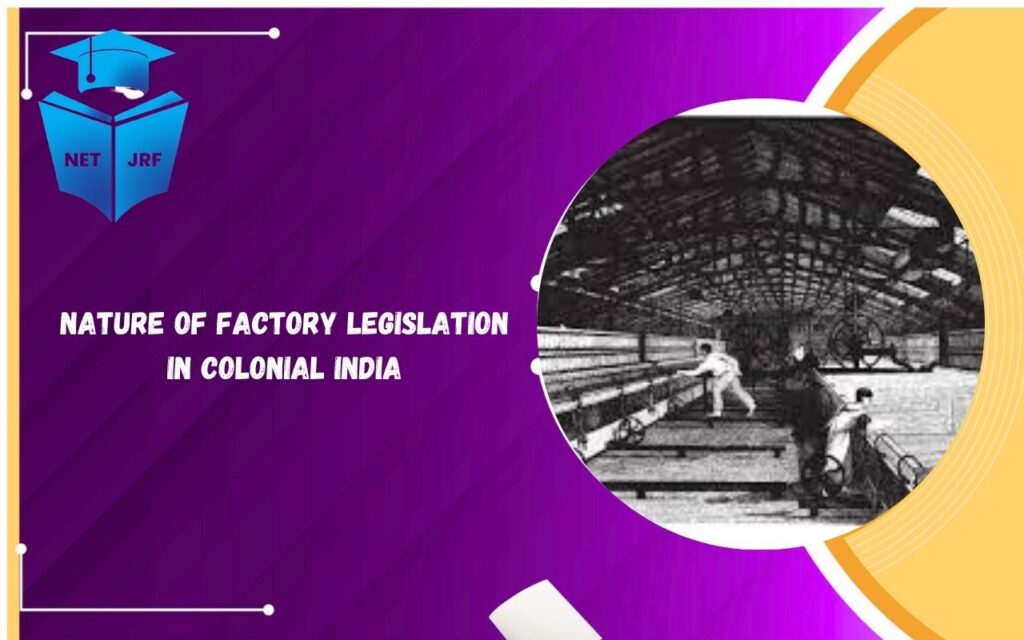
The nature of Factory Legislation formed an important aspect of labour policy during the colonial period in India. Industrialization created new factory workplaces where labourers faced long working hours, poor safety conditions, and exploitation by factory owners.
To address these problems, the colonial government introduced several factory laws to regulate working conditions. These laws attempted to limit child labour, reduce working hours, and improve workplace safety.

Enroll UGC NET Foundation Course
Factory Legislation in Industrial India Concept
The concept Nature of Factory Legislation refers to the characteristics and objectives of laws that regulated industrial labour in factories during the colonial period.
Factory legislation aimed to establish rules governing working hours, employment of women and children, safety standards, and factory inspections.
Main Features
Regulation of Working Hours
- Laws were introduced to limit the number of hours workers could be made to work in factories.
- The aim was to reduce overwork and improve worker health.
Restrictions on Child Labour
- Children were prohibited from working long hours or in dangerous conditions.
- The legislation sought to protect children from exploitation and promote education.
Protection of Women Workers
- Special rules were enacted for women, including limits on night work and heavy labor.
- These laws aimed to safeguard women’s health and working conditions.
Introduction of Factory Inspection Systems
- Inspectors were appointed to ensure compliance with labor laws.
- Factory inspections helped monitor working conditions, hygiene, and safety.
These policies marked the early development of labour regulation in India.
Enroll UGC NET Foundation Batch Online
Factory Legislation in Colonial India Nature
The Nature of Factory Legislation in colonial India reflected both humanitarian concerns and economic interests.
- British industrialists feared competition from Indian factories that used cheap labour. Pressure from these groups influenced the colonial government to introduce labour laws that regulated factory work in India.
- These laws gradually introduced labour protections but often remained limited in scope.
Historical Background of Factory Laws
Industrial development in India began during the nineteenth century. Textile mills and other factories appeared in cities such as Bombay, Calcutta, and Madras.
Factory workers included men, women, and children who worked long hours in difficult conditions.
Early Labour Conditions
Before legislation workers faced several problems:
Extremely Long Working Hours
- Workers often labored 12–16 hours a day, leading to fatigue and poor health.
Unsafe Working Environments
- Factories lacked proper ventilation, sanitation, and safety measures.
- Accidents were common due to unguarded machinery and unsafe conditions.
Employment of Young Children
- Children as young as 5–6 years were employed in textile mills, factories, and workshops.
- They performed hazardous tasks for very low wages.
Lack of Labour Rights
- Workers had no legal protections, unions, or mechanisms to raise grievances.
- Exploitation was widespread, and workers had little bargaining power.
Response
- Growing public awareness and pressure eventually led to the introduction of labor legislation, including regulation of working hours, protection of women, restrictions on child labor, and factory inspections.
Public pressure eventually led to the introduction of labour reforms.
Enroll UGC NET Offline Classes in Jaipur
Nature of Factory Legislation
Factory legislation in colonial India was introduced mainly to regulate working conditions in factories during the rule of the British Empire.
| Feature | Explanation |
| Labour regulation | Laws governed factory employment |
| Worker protection | Safety rules introduced |
| Child labour limits | Restrictions placed on child workers |
| Factory inspection | Officials monitored workplaces |
Major Factory Acts in Colonial India
Several laws illustrate the Nature of Factory Legislation introduced during colonial rule.
-
Factory Act of 1881
-
-
- The first factory law in India aimed to regulate working conditions for children in textile factories.
- Main provisions included limits on working hours for child labourers and requirements for basic safety measures.
-
-
Factory Act of 1891
-
-
- The 1891 Act expanded labour protection by reducing working hours for women and children.
- It also introduced weekly holidays for workers.
-
-
Factory Act of 1911
-
-
- This act strengthened labour regulation and expanded government authority over factories.
- It also improved inspection systems.
-
-
Factory Act of 1934
-
- The 1934 law introduced further regulations on safety, working hours, and employment conditions.

Important Factory Acts in India
To regulate industrial work and improve labor conditions, the colonial government introduced several factory laws during the rule of the British Empire.
| Year | Major Provision |
| 1881 | First factory law regulating child labour |
| 1891 | Reduced working hours for women |
| 1911 | Strengthened inspection system |
| 1934 | Expanded safety regulations |
Main Objectives of Factory Legislation in India
The Nature of Factory Legislation reveals several policy objectives.
Reducing Exploitation
- Laws were introduced to prevent extreme exploitation of workers in factories.
- This included protections for women, children, and regular workers.
Regulation of Labour Conditions
- Governments established rules for working hours, breaks, wages, and employment practices.
- The aim was to improve safety, health, and fairness in factories.
Industrial Stability
- Proper labour regulation helped prevent unrest and strikes.
- It contributed to stability in rapidly growing industrial sectors, ensuring consistent production.
Working Conditions in Early Factories
The Nature of Factory Legislation becomes clearer when we examine early factory conditions.
Main Features
- Long Working Hours – Workers often worked 10–16 hours a day with very few breaks.
- Low Wages – Factory laborers were paid very small salaries for long hours of work.
- Child and Women Labour – Many women and children were employed in factories.
- Unsafe Environment – Factories had poor ventilation, overcrowding, and unsafe machines.
- Lack of Worker Rights – There were very few labor laws to protect workers in the early stages.
Key Provisions of Factory Laws
Factory legislation introduced several important rules.
Limitation of Working Hours
- Laws restricted the maximum number of hours a worker could be employed per day.
- This reduced overwork and fatigue, especially in textile mills and factories.
Minimum Age Requirement for Workers
- Children below a certain age were prohibited from working in factories.
- This aimed to protect children from exploitation and encourage schooling.
Weekly Rest Days
- Workers were entitled to at least one day off per week.
- This provided time for rest and recovery, improving productivity and health.
Workplace Safety Standards
- Factories were required to maintain proper ventilation, lighting, sanitation, and safe machinery.
- Inspections ensured compliance with safety regulations.
Join UGC NET Offline Coaching in Jaipur
Criticism of Colonial Factory Legislation
Historians argue that the Nature of Factory Legislation often reflected colonial economic interests rather than genuine labour welfare.
-
Limited Coverage
-
-
- Early factory laws applied mainly to large industrial establishments. Many workers in small workshops remained unprotected.
-
-
Weak Enforcement
-
-
- Inspection systems remained limited and often ineffective.
-
-
Economic Motives
-
- Some historians believe that British industrialists supported labour laws in India to reduce competition from Indian industries.
Social Impact of Factory Legislation
The Nature of Factory Legislation influenced social and economic developments in colonial India.
- Growth of Labour Awareness
-
-
- Factory legislation made workers more conscious of their rights, working hours, and safety standards.
- This awareness laid the foundation for organized labor activism.
-
- Emergence of Labour Movements
-
-
- Workers started forming unions and associations to demand better wages, shorter hours, and safer working conditions.
- Early labor movements began in textile mills, jute factories, and railways.
-
- Improvement in Working Conditions
-
- While limited in scope, factory laws reduced extreme exploitation, regulated child labor, and improved safety standards.
- This marked the beginning of formal labor protection in India.
Development of Factory Legislation
The evolution of labour laws followed a gradual pattern.
Industrial Growth Created Factory Employment
- Expansion of textile, jute, and other industries led to a growing factory workforce.
Harsh Labour Conditions
- Workers faced long hours, unsafe environments, child labor, and low wages.
- Exploitation was widespread, prompting concern among reformers and the public.
Public Pressure Demanded Labour Reform
- Social reformers, journalists, and political leaders highlighted worker hardships, pushing for legal protections.
Introduction of Factory Laws
- The colonial government enacted factory legislation to regulate working hours, child labor, women’s employment, and workplace safety.
Gradual Expansion of Worker Protections
- Over time, laws improved labor conditions, introduced inspections, and laid the foundation of organized labor rights in India.
Long-Term Impact of Factory Laws
The Nature of Factory Legislation influenced later labour policy development in India.
Foundation of Labour Rights
- Colonial factory laws established the first framework for protecting workers’ rights, including working hours, child labor restrictions, and safety measures.
Modern Labour Regulation
- Independent India expanded and strengthened labor legislation, drawing on the principles of colonial factory laws.
- Laws now cover minimum wages, social security, maternity benefits, and industrial safety.
Industrial Workforce Protection
- Modern labor policies protect workers across industries, ensuring fair wages, safer working conditions, and legal remedies.
- These policies trace their roots to early colonial factory legislation.

Conclusion
The Nature of Factory Legislation reflects the early attempt to regulate industrial labour during the colonial period. Factory laws introduced limits on working hours, restrictions on child labour, and safety regulations in industrial workplaces.
Nature of Factory Legislation in Colonial India FAQs

Why were factory laws introduced in colonial India?
Factory laws aimed to improve working conditions, limit child labour, and regulate industrial employment practices.
What was the Factory Act of 1881?
The Factory Act of 1881 was the first law in India regulating working hours for children in factories.
How did factory legislation affect workers?
Factory legislation introduced limits on working hours and basic safety regulations for workers.
Why do historians criticize colonial labour laws?
Historians argue that colonial factory laws often served British economic interests rather than fully protecting workers.
What protections did factory laws introduce?
They introduced restrictions on child labour, limits on working hours, and basic safety standards.
What is the significance of Nature of Factory Legislation in labour history?
It represents the beginning of labour regulation and worker protection in industrial India.