
The birth of the Indian National Congress marks a turning point in modern Indian history. It represents the beginning of organized political activity against colonial rule. During the late nineteenth century, educated Indians started forming political groups to express grievances against the British administration. The Birth of Indian National Congress in 1885 created the first national political platform where leaders from different regions of India discussed political rights, administrative reforms, economic issues. Over time, this organization became the central force of the Indian freedom movement.

Indian National Congress Birth History
The Birth of Indian National Congress did not occur suddenly. Several social, economic, political developments during the nineteenth century prepared the ground for its formation.
British colonial rule introduced modern education, communication networks, and administrative systems. These changes created a new class of educated Indians who understood Western political ideas such as liberty, equality, representation.
At the same time, colonial policies caused economic exploitation, political exclusion. Educated Indians wanted a platform to present their demands. This situation gradually created conditions for the Birth of Indian National Congress.
Enroll UGC NET Online Coaching
Growth of Political Awareness
Political awareness increased during the late nineteenth century due to several factors:
- Spread of English education
- Growth of Indian press
- Social reform movements
- Development of railways telegraph
- Economic hardships under colonial rule
These factors helped Indians communicate political ideas across regions. As awareness grew, leaders began demanding greater participation in governance. This atmosphere encouraged the Birth of Indian National Congress as a national political forum.
Role of A.O. Hume in Formation
Allan Octavian Hume, a retired British civil servant, played a significant role in organizing the early nationalist leadership. He believed that educated Indians required a platform to express political grievances.
- Hume communicated with Indian leaders from different provinces. He proposed creating a national political organization that could represent Indian interests before the British government.
- His efforts contributed directly to the Birth of Indian National Congress, which held its first session in December 1885.
First Session of Congress
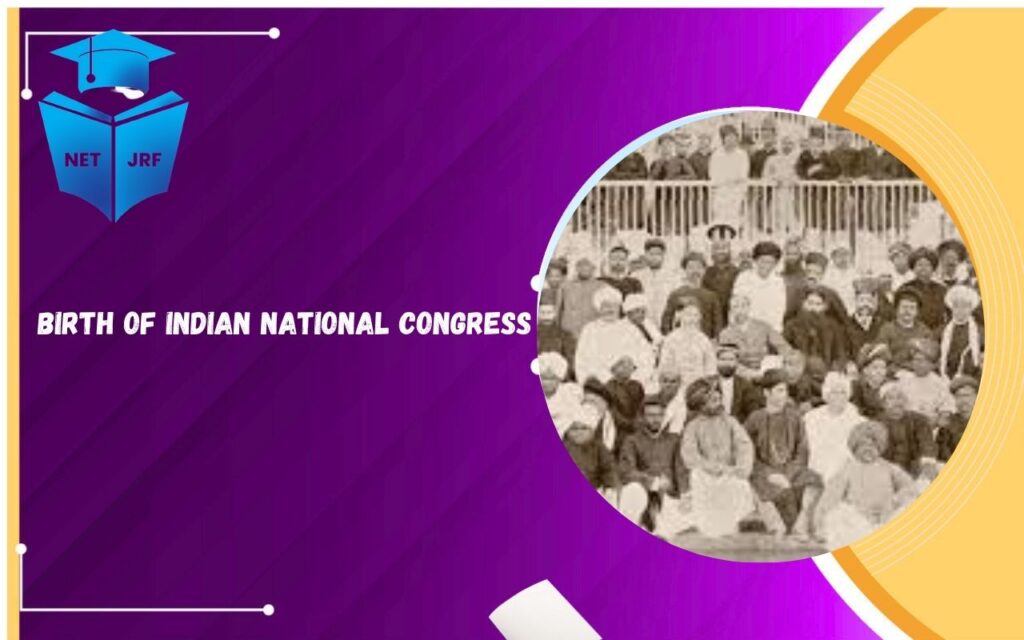
The first session took place in Bombay in December 1885. Womesh Chandra Bonnerjee served as the first president.
- About seventy two delegates attended this meeting. They represented different regions, communities, professions. The gathering discussed political reforms, administrative improvements, representation of Indians in government services.
- This historic meeting officially marked the Birth of Indian National Congress as the first national political organization in India.
Birth of Indian National Congress Important Facts
The Birth of Indian National Congress therefore introduced organized political discussion in colonial India.
| Birth of Indian National Congress Key Details | Information |
| Year of formation | 1885 |
| Founder initiative | A.O. Hume |
| First session location | Bombay |
| First President | Womesh Chandra Bonnerjee |
| Number of delegates | 72 |
| Nature of organization | National political platform |
Early Congress Objectives
In its initial phase, the organization focused on moderate political goals. Leaders aimed to achieve administrative reforms through constitutional methods.
Main objectives included:
- Create political dialogue between Indian leaders from different regions
- Present Indian grievances before British government
- Promote national unity among educated Indians
- Demand civil rights administrative reforms
- Expand representation of Indians in legislative councils
Through these goals, the Birth of Indian National Congress helped establish a foundation for future nationalist movements.
Congress Leadership Social Background
The early leadership mainly came from the educated middle class.
This group included:
- Lawyers
- Teachers
- Journalists
- Government employees
- Professionals
They possessed modern education exposure to Western political ideas. These leaders believed constitutional reform could gradually improve Indian governance.
Their participation further strengthened the Birth of Indian National Congress as a political platform representing educated Indian opinion.
Political Conditions Before Congress Formation
Several political developments during the nineteenth century increased dissatisfaction among Indians. Before the establishment of the Indian National Congress in 1885, the political atmosphere in India was gradually becoming tense and dissatisfied. During the nineteenth century, many educated Indians started realizing that the British administration was not working in the interest of the Indian population.
- Several political, economic, and social factors created a sense of frustration among Indians and encouraged the demand for a national political organization.
- These growing concerns prepared the ground for the formation of a political platform where Indians could express their grievances and demand reforms. The creation of the Indian National Congress was largely a response to these changing political conditions.
Racial Discrimination
One of the major reasons for political dissatisfaction was racial discrimination in the colonial administration. British officials often considered themselves superior to Indians and treated them with prejudice.
- Even highly educated Indians were rarely given equal respect or authority within the government system.
- Most of the important administrative positions were reserved for British officers. Indians were allowed to work only in lower or middle-level posts.
- Even when Indians had the required qualifications, they faced barriers in promotion and appointment to higher positions.
- This discriminatory attitude created resentment among the educated middle class.
- Many Indian leaders felt that the colonial government did not trust Indians with responsibility and intentionally kept them away from decision-making roles.
Economic Exploitation
Another major issue was the economic exploitation of India under British rule. Colonial economic policies were designed mainly to benefit Britain rather than India. The British administration encouraged the export of raw materials such as cotton, jute, and indigo from India to British industries.
- At the same time, British manufactured goods were imported into Indian markets in large quantities. These products were often cheaper because they were produced through industrial machines in Britain. As a result, traditional Indian industries and handicrafts began to decline.
- Many Indian artisans and small producers lost their livelihoods. The economic condition of large sections of the population deteriorated. Nationalist thinkers like Dadabhai Naoroji highlighted this exploitation through the concept of the economic drain of wealth from India to Britain. Such economic hardships increased criticism of colonial rule.

Lack of Political Representation
The absence of Indian participation in political institutions was another important cause of dissatisfaction.
- During the nineteenth century, legislative councils existed in India, but their powers were very limited. Most members were British officials, and Indians had very little influence in these bodies.
- Important political decisions were made by the colonial government without consulting Indian representatives.
- Even when a few Indians were nominated to legislative councils, their role was mostly advisory, and they could not significantly influence policy decisions.
- Educated Indians began demanding greater representation in governance.
- They believed that Indians should participate in legislative bodies so that they could raise issues affecting the people of the country.
Enroll UGC NET Coaching in Jaipur
Growing Political Awareness
At the same time, several other developments helped increase political awareness among Indians.
- The spread of modern education, the growth of newspapers, and the development of railways and communication networks allowed people from different regions to share ideas and discuss national issues.
- Educated Indians started forming political associations in cities such as Calcutta, Bombay, and Madras.
- These regional organizations discussed political reforms and demanded greater rights for Indians. However, leaders soon realized that a national organization was needed to unite these efforts.
Emergence of a National Political Platform
All these problems racial discrimination, economic exploitation, and lack of political representation created a strong demand for a political body that could represent Indian interests at the national level.
- The birth of the Indian National Congress provided such a platform. It allowed leaders from different regions, communities, and professions to come together and discuss the problems faced by the country.
- Through meetings, debates, and petitions, they began presenting Indian grievances before the British government.
- In this way, the political conditions of the nineteenth century played a crucial role in shaping the emergence of the Indian National Congress.
- The organization became the starting point for organized political activity against colonial rule and later developed into the leading force of the Indian national movement.
Early Moderate Phase of Congress
During the first two decades, Congress leaders followed moderate political strategies.
They believed:
- British rule could be reformed through dialogue
- Constitutional methods would bring gradual political progress
- Cooperation with British administration could produce reforms
Methods used by moderates included:
- Petitions
- Resolutions
- Public meetings
- Memorandums to British Parliament
This moderate approach shaped the early phase after the Birth of Indian National Congress.
Role in Growth of Nationalism
Although early demands were moderate, the organization played an important role in developing national consciousness.
The Birth of Indian National Congress helped create:
- Political unity among Indians
- Awareness of colonial exploitation
- National level political discussions
- Leadership training for future freedom fighters
It connected leaders from Bengal, Bombay, Madras, Punjab, and other regions. This interaction helped transform regional concerns into national political issues.
Development of Political Leadership
The Congress platform allowed several important leaders to emerge in Indian politics.
Notable early leaders included:
- Dadabhai Naoroji
- Surendranath Banerjee
- Pherozeshah Mehta
- Gopal Krishna Gokhale
These leaders used the Congress organization to raise questions about economic exploitation administrative reforms. Their political work expanded the significance of the Birth of Indian National Congress in Indian nationalism.
Expansion of Congress Activities
After its establishment, the Congress began holding annual sessions in different cities.
Each session discussed major issues such as:
- Civil rights
- Administrative reform
- Reduction of military expenditure
- Indian representation in government services
- Economic development
Regular meetings strengthened national political debate. Through these activities, the Birth of Indian National Congress gradually evolved into a mass political movement.
Enroll UGC NET Offline Coaching in Jaipur
Historical Significance
The Birth of Indian National Congress holds immense importance in Indian history.
Major contributions include:
- Creation of first national political organization
- Development of political consciousness among Indians
- Promotion of democratic political culture
- Formation of leadership for independence movement
- Establishment of platform for nationalist unity
Without this organization, the Indian freedom struggle might not have developed in such an organized manner.
These themes often appear in competitive examinations because they explain the beginning of organized nationalist politics.
Transformation from Political Forum to Mass Movement
Initially, Congress represented mainly educated elite groups. However, over time its character changed.
Later phases introduced:
- Extremist leaders
- Mass participation
- Swadeshi movement
- Civil disobedience campaigns
These developments gradually expanded the political role that began with the Birth of Indian National Congress.
Impact on Indian Politics
The establishment of the Indian National Congress in 1885 had a deep and lasting impact on Indian politics.
- Before its formation, political activities in India were mostly limited to small regional groups or individual reformers.
- There was no national platform where people from different parts of the country could come together to discuss common problems.
- The creation of the Congress changed this situation and provided a unified political voice for Indians.
- Over the following decades, the organization influenced the direction of Indian politics in many important ways.
- It helped shape new ideas about nationalism, democracy, political participation, and leadership.
- These developments played a major role in the growth of the Indian freedom struggle.
Emergence of Nationalist Ideology
One of the most important outcomes of the Congress was the growth of nationalist ideology.
- Through its meetings, speeches, and political discussions, the organization encouraged Indians to think of themselves as part of one nation rather than separate regional communities.
- Leaders highlighted the common problems faced by Indians under colonial rule, such as economic exploitation, political discrimination, and lack of representation.
- As people from different provinces began interacting through Congress sessions, a shared sense of national identity gradually developed.
- This process helped spread the idea that India should move toward self-government and eventually independence. In this way, the Congress played a crucial role in building the foundation of Indian nationalism.
Development of Democratic Political Institutions
The Congress also contributed to the development of democratic political practices in India. Its annual sessions followed organized procedures where leaders presented resolutions, debated important issues, and voted on decisions.
- These practices introduced Indians to the functioning of representative political institutions.
- Over time, such democratic discussions helped people understand concepts like political participation, representation, and accountability.
- These early experiences later influenced the development of democratic institutions in independent India, including parliamentary debates and public policy discussions.
Encouragement of Political Debate
Another major contribution of the Congress was the promotion of political debate and public discussion. Through its meetings, pamphlets, and newspapers, Congress leaders raised questions about colonial policies and governance.
- They discussed issues such as economic exploitation, civil rights, administrative reforms, and representation of Indians in government services.
- These debates encouraged educated Indians to analyze political problems more critically. Public discussions about national issues became more common in cities and towns. Gradually, political awareness spread among different sections of society, including students, professionals, and traders.
Creation of Modern Political Leadership
The Congress also became an important platform for the emergence of modern political leadership.
- Many prominent leaders of the Indian freedom movement first gained experience through Congress activities.
- Leaders such as Dadabhai Naoroji, Gopal Krishna Gokhale, Bal Gangadhar Tilak, and later Mahatma Gandhi developed their political ideas and strategies within this organization.
- The Congress allowed leaders from different regions and communities to cooperate and share their views. This interaction helped create a strong group of nationalist leaders who guided the freedom movement for many years.
Transformation of Indian Society
The political changes introduced by the Congress gradually influenced Indian society as well. Political awareness increased, and more people began to take interest in national issues.
- Newspapers, public meetings, and political campaigns spread new ideas about rights, representation, and national unity.
- As these ideas spread, the demand for reforms and self-government became stronger. The Congress therefore played an important role in connecting social change with political activism

Conclusion
The Birth of Indian National Congress represents a milestone in the political history of modern India. It emerged from social change, political awareness, and economic dissatisfaction during the nineteenth century. Leaders created this organization to provide a national platform for expressing Indian grievances. Over time, this institution developed into the central force of the freedom struggle.
Birth of Indian National Congress UGC NET FAQs

Who founded the Indian National Congress?
A.O. Hume played the key role in organizing the Congress. Indian leaders from different provinces supported the initiative to create a national political organization.
Where was the first Congress session held?
The first Congress session took place in Bombay in December 1885. Womesh Chandra Bonnerjee served as the first president.
What were the main objectives of early Congress?
Early Congress leaders aimed to promote national unity, demand administrative reforms, increase Indian representation in government.
Why was Congress important for Indian nationalism?
The Congress created a national political platform. It allowed leaders to discuss common issues affecting India.