
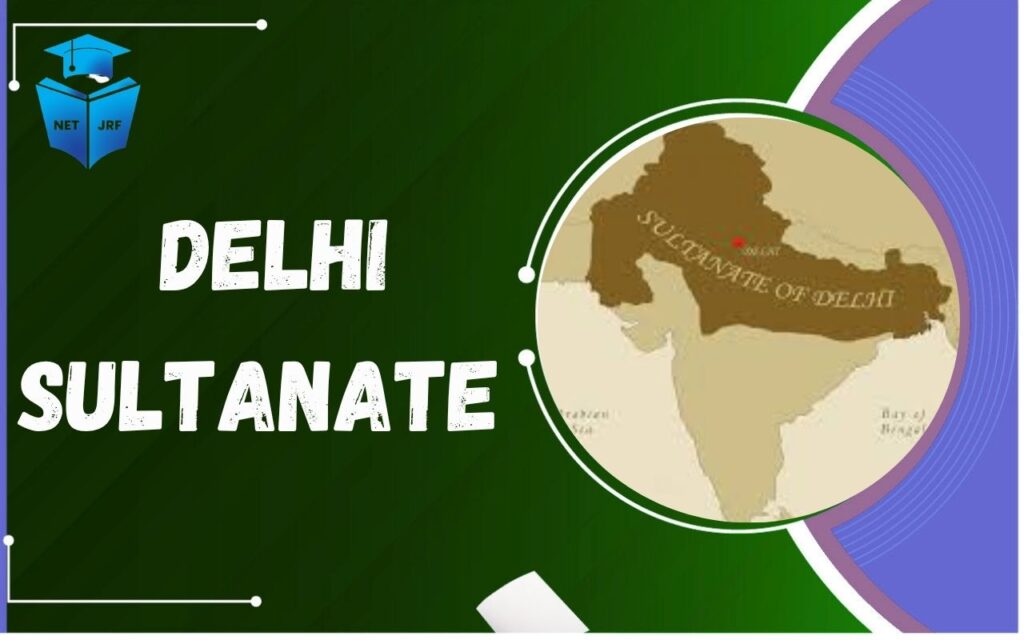

The Delhi Sultanate changed the map of India between 1200 AD and 1526 AD. This era began when Turkish and Afghan rulers defeated local Indian kings to build a new empire. These leaders took the title of “Sultan,” which is why we call this time the Sultanate period. It was a time of massive change in how people lived, worked, and prayed. Understanding these changes helps us see how modern India grew from its medieval roots.

The Sultanate period is not just about one family. It includes five different dynasties that ruled from the city of Delhi. These rulers brought new ideas about government, taxes, and building styles. They moved beyond North India and reached deep into the South.
Join UGC NET Foundation Batch Online
Delhi Sultanate Foundation of Political Developments
The story starts with the Ghorids. Muhammad Ghuri paved the way for Turkish rule in India. After his death, his trusted slave Qutubuddin Aibak took over. He founded the Mamluk or Slave Dynasty in 1206 AD.
- This was the first major step in the Political Developments The Delhi Sultanate history. Aibak was a brave and generous man known as “Lakh Baksh” or the giver of lakhs. He built the Quwwat-ul-Islam mosque and started the famous Qutub Minar.
- However, Aibak died early in 1210 AD after falling from his horse while playing Polo. His son-in-law, Iltutmish, then took the throne. Many historians call Iltutmish the real founder of the Sultanate.
- He saved the empire from Mongol invaders led by Chenghiz Khan. He also introduced the “Group of Forty” or Turkan-i-Chahalgani to help him rule. Iltutmish created a new currency system with silver Tanka and copper Jittal coins.
Rise of Razia and Balban
Iltutmish chose his daughter, Razia Sultan, to rule after him. She was the first woman to lead the Sultanate. She was brave but faced many revolts from Turkish nobles who did not want to follow a woman.
- After her short reign, several weak rulers followed until Balban rose to power. Balban was a very strict ruler. He used a policy of “Blood and Iron” to keep order.
- He made people perform sijada (prostration) and paibos (kissing the Sultan’s feet) to show his high status.
Khalji
The Khalji dynasty began in 1290 AD when Jalaluddin Khalji took power. He was a mild ruler who started his reign at age 70. However, his nephew Alauddin Khalji was much more ambitious.
- Alauddin killed his uncle and became the Sultan in 1296 AD. Under his rule, the Political Developments The Delhi Sultanate reached South India for the first time. He plundered Devagiri and conquered many kingdoms like Gujarat, Chittor, and Malwa.
- Alauddin was a master of administration. He separated religion from politics. He introduced the Dagh system (branding horses) and the Chehra system (keeping records of soldiers) to improve the army.
- His most famous reforms were in the market. He fixed the prices of everything from grains to cattle. He set up different markets called Mandi and Sarai Adl. Officers called Shahna-i-Mandi watched these markets to stop cheating.
Administrative
- Alauddin wanted a huge army to stop Mongol raids. To pay for this army without going broke, he controlled the economy strictly.
- He took away the powers of local chiefs and the interference of religious leaders (Ulema) in state matters.
- He used spies to keep track of everything happening in his kingdom. This made him one of the most powerful and feared Sultans in history.
Tughlaq Dynasty
In 1320 AD, Ghiyasuddin Tughlaq founded the Tughlaq dynasty. His son, Muhammad bin Tughlaq, became the next Sultan in 1325 AD.
- Muhammad bin Tughlaq was a very learned man but his ideas were often too far ahead of his time. He tried to move the capital from Delhi to Daulatabad in the South. He wanted to control the whole country from a central point. However, the move was a disaster, and many people died on the way.
- He also tried to introduce “token currency” using bronze coins. He wanted these coins to have the same value as silver ones. Unfortunately, people started making fake coins at home, and the system failed.
- He planned big military missions to places like Khurasan and the Himalayas, but these also caused huge financial losses. Despite these failures, he showed a great interest in improving agriculture.
The Reign of Firuz Shah Tughlaq
After Muhammad, Firuz Shah Tughlaq took the throne in 1351 AD. He was a more peaceful ruler. He focused on building things rather than fighting wars. He built many canals to help farmers, including one from the Yamuna to the Sutlej.
- He founded the city of Hissar-i-Firoza. Firuz Shah also cared for the poor. He created departments like Diwan-i-Khairat for charity and Diwan-i-Bandagan for slaves. However, he made the iqta (land grant) system hereditary, which eventually weakened the Sultan’s power.
The Sayyid and Lodi Dynasties
After the Tughlaqs, the Political Developments The Delhi Sultanate began to shrink. In 1398, a foreign invader named Timur attacked Delhi and destroyed much of it. He left Khizr Khan in charge of Multan, who then founded the Sayyid Dynasty in 1414 AD. The Sayyid rulers were not very strong.
- They spent most of their time dealing with revolts in nearby areas. The last Sayyid ruler, Alam Shah, gave up his throne to Bahlol Lodi in 1451 AD.
- The Lodi Dynasty was the first to be led by Afghan rulers. Bahlol Lodi brought back some stability by defeating the Sultan of Jaunpur. His son, Sikandar Lodi, was the most successful Lodi king.
- He expanded the empire into Bihar and Gwalior. He was also a poet who wrote in Persian. Sikandar Lodi signed treaties with other kingdoms and worked to improve the economy.
End of Sultanate
The last ruler of the Lodi family was Ibrahim Lodi. He was very strict and upset many of his senior commanders. One of his governors, Daulat Khan Lodi, invited Babur from Kabul to invade India. In 1526 AD, the First Battle of Panipat took place.
- Even though Ibrahim Lodi had a much larger army, Babur defeated him. This battle marked the end of the Sultanate and the beginning of the Mughal Empire in India.
Best UGC NET Offline Classes in Jaipur
Delhi Sultanate Administration and Government Systems
The Sultan was the head of everything. He was the chief judge and the supreme commander of the army. To help him, there was a council called Majlis-i-Khalwat. The empire was divided into regions called Iqtas.
- The Sultan gave these lands to nobles or commanders called Iqtadars or Muqtis. These people collected taxes and maintained an army for the Sultan.
- Over time, these roles changed, but the system remained the backbone of the government.
Delhi Sultanate Important Government Offices
Several departments handled different parts of the state. The Wazir led the Diwan-i-Wizarat, which looked after money and general administration.
- The Diwan-i-Arz was the military department headed by the Ariz-i-Mumalik. Spies were very important for the Sultan.
- The head of intelligence was called the Barid-i-Mumalik. These officials helped keep the vast empire under control and ensured that taxes reached the treasury.
Delhi Sultanate Economy, Trade, and Taxation
The economy during the Political Developments The Delhi Sultanate era was mostly based on farming. Rulers cleared forests to create more fertile land. They used iron tools and wells for irrigation.
- During Firuz Shah Tughlaq’s time, new canals made farming even better. Farmers grew crops like rice, sugarcane, cotton, and indigo. T
- rade also flourished, especially with Central and Western Asia. Merchants known as Multanis and Karwanis handled large-scale trade of food grains and cloth.

Delhi Sultanate Industry and Craft
Textiles were the biggest industry at this time. The introduction of the spinning wheel in the 14th century helped produce more cotton.
- Bengal and Gujarat became famous for high-quality cotton cloth called Muslin.
- The building industry was also huge because Sultans loved building mosques, forts, and tombs. Other new industries included paper making, which became popular during this period.
Delhi Sultanate Art, Architecture, and Literature
The Delhi Sultanate brought a new style of building to India. This style combined Indian and Islamic ideas. For the first time, builders used arches and domes instead of just flat roofs. They used stones and a special plaster called gypsum. The buildings were decorated with beautiful calligraphy, often showing verses from the Quran.|
Music and Literature
Music also saw great changes. The famous poet Amir Khusrau invented the Sitar and the Tabla. He was known as “Tuti-e-Hind” or the Parrot of India.
- Many great books were written during this time. Ziauddin Barani wrote the Tarikh-i-Firuz Shahi, and the traveler Ibn Battuta wrote the Rihla.
- These books tell us a lot about how people lived and what the Sultans were like.
Delhi Sultanate Economic Systems and Revenue Policies
The economic stability of the Delhi Sultanate, Ghorids, Turks, Khaljis, Tughlaqs, Sayyids, Lodis depended on land revenue.
- Most rulers followed the Sharia laws regarding taxes like Kharaj (land tax) and Jizya (tax on non-Muslims). Alauddin Khilji was particularly strict about revenue collection. He measured all land and fixed the tax at half of the total produce.
- The Tughlaqs also introduced various economic changes. Firoz Shah Tughlaq abolished many illegal taxes and focused on agricultural growth through irrigation.
- He dug many canals to provide water to dry regions. These policies helped the peasants but also required a strong central administration to function correctly.
- Commerce flourished as well. The Sultanate established trade links with Central Asia and the Middle East.
- Gold and silver coins, known as Tankas, became the standard currency. The presence of wealthy merchants and bankers in the noble class shows that trade was a vital part of the Delhi Sultanate, Ghorids, Turks, Khaljis, Tughlaqs, Sayyids, Lodis economy.
Delhi Sultanate Social Structures
Society during the Delhi Sultanate, Ghorids, Turks, Khaljis, Tughlaqs, Sayyids, Lodis era was strictly divided into four segments. This hierarchy determined the wealth, location, and lifestyle of the people. The Sultan and his family occupied the highest position in this social order.
- Nobles (Aristocrats): This wealthy group included the Sultan’s relatives, merchants, and bankers. They lived in luxury in the most popular parts of the city.
- Priests: This group consisted of Brahmins and Ulemas. The Sultan provided them with tax-free land, making them quite wealthy.
- Townspeople: This segment included businessmen, artisans, and administrative staff who lived in urban centers.
- Peasants: This was the lowest segment. They lived in villages and worked on farms. They had to pay taxes and revenues to support the state.
The social fabric remained complex throughout the Delhi Sultanate, Ghorids, Turks, Khaljis, Tughlaqs, Sayyids, Lodis period. While the elite enjoyed great power, the common people faced heavy tax burdens, especially during the Khalji and Tughlaq reigns.
Timeline of Delhi Sultanate, Ghorids, Turks, Khaljis, Tughlaqs, Sayyids, Lodis
| Dynasty Name | Ruling Period | Key Founders/Rulers | Primary Focus |
| Mamluk (Slave) | 1206 – 1290 | Qutb-ud-din Aibak, Iltutmish | Establishment and Consolidation |
| Khalji | 1290 – 1320 | Jalal-ud-din & Alauddin Khilji | Military Expansion and Market Reforms |
| Tughlaq | 1320 – 1414 | Muhammad & Firoz Shah Tughlaq | Administrative Experiments & Public Works |
| Sayyid | 1414 – 1451 | Khizr Khan | Maintaining the Core Territory |
| Lodi | 1451 – 1526 | Bahlol & Ibrahim Lodi | Afghan Rule and Centralization |
Delhi Sultanate Architecture and Technological
The Delhi Sultanate, Ghorids, Turks, Khaljis, Tughlaqs, Sayyids, Lodis era introduced Indo-Islamic culture to India. This mixture of Indian and Islamic styles appeared clearly in the architecture of the time. Builders used domes and arches in new and innovative ways. These structures still dominate the landscape of Delhi today.
- Qutub Minar: Iltutmish completed this massive tower in Delhi.
- Quwwat-ul-Islam Mosque: Aibak built this as one of the first mosques in the region.
- Alai Darwaza: Alauddin Khilji added this gateway to the Qutub complex.
- Tughlaqabad: The Tughlaqs built this massive fortified city.
- Tomb of Balban: This tomb represents early Indo-Islamic funerary architecture.
Beyond buildings, the Sultanate brought new technologies to India. They improved textile engineering by introducing processes like ginning, carding, and spinning. Ginning involves extracting seeds from cotton, while carding loses fibers for processing. Spinning helps in making yarn. These innovations helped the textile industry grow and improve significantly during the Delhi Sultanate, Ghorids, Turks, Khaljis, Tughlaqs, Sayyids, Lodis years.
Join UGC NET Coaching in Jaipur
Comparison of Major Dynasties
| Feature | Mamluk Dynasty | Khalji Dynasty | Tughlaq Dynasty |
| Origin | Turkish Slaves | Turkish/Afghan | Turkish |
| Expansion | Northern India | Southern Conquests | Peak Expansion & Decline |
| Famous Ruler | Iltutmish | Alauddin Khilji | Muhammad bin Tughlaq |
| Key Contribution | Administration | Market Controls | Public Works & Canals |
| End of Reign | Internal Coup | Tughlaq Revolt | Timur’s Invasion |
Delhi Sultanate Political Developments
The political developments of the Delhi Sultanate reveal a gradual shift from centralized imperial authority to regional fragmentation, shaped by invasions, internal revolts, administrative changes, and the rise of new ruling dynasties.
- Rise of Turks: The Ghorid invasions led to the first Turkish rule under the Slave Dynasty.
- Centralized Power: Iltutmish and Balban made the Sultan the absolute head of the state.
- Expansion: Alauddin Khalji took the Political Developments – The Delhi Sultanate into South India.
- Economic Reforms: Price controls and new taxes like Jizya and Kharaj were introduced.
- New Cities: Tughlaq rulers built cities like Jahanpanah and Firuzabad.
- Decline: Internal revolts, weak rulers, and the invasion of Timur weakened the empire.
- Final Fall: The Battle of Panipat in 1526 ended the Sultanate era.
Delhi Sultanate Point for Students
- The Sultanate lasted from 1206 to 1526 AD.
- There were five dynasties: Slave, Khalji, Tughlaq, Sayyid, and Lodi.
- The Iqta system was the main way of managing land and the army.
- Architecture featured new elements like the true arch and the double dome.
- The period ended when the Mughals defeated the Lodis at Panipat.
Conclusion
The political journey of the Delhi Sultanate, Ghorids, Turks, Khaljis, Tughlaqs, Sayyids, Lodis shaped the future of the Indian subcontinent. These five dynasties brought about massive changes in governance, military tactics, and cultural expression. From the early foundations laid by the Ghorids and Mamluks to the final days of the Lodis, the era remained dynamic and influential.
The monuments they built and the administrative systems they created left a permanent mark on history. Students of history find this period fascinating because of its complex characters and the rapid shift of power. Even today, the legacy of the Delhi Sultanate, Ghorids, Turks, Khaljis, Tughlaqs, Sayyids, Lodis lives on in the language, architecture, and traditions of modern India. Understanding this era is essential for anyone looking to master the history of South Asia.

FAQs
|