
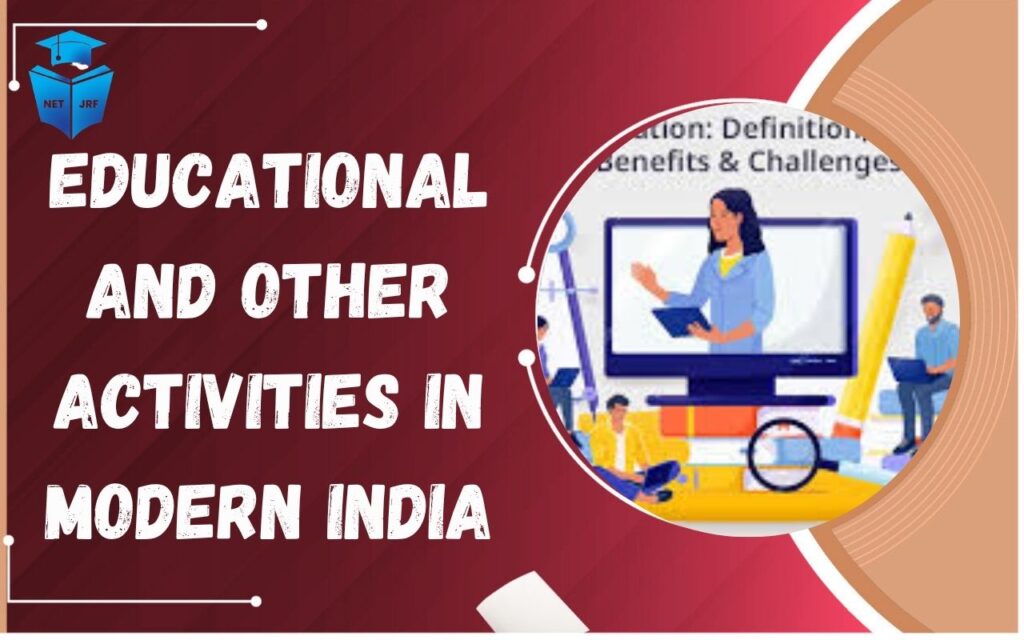
Educational and Other Activities in Modern India: Check Growth of Learning and Skill Development

Educational and Other Activities in Modern India in this topic you learn how modern education digital learning skill development vocational training and research activities support intellectual growth social awareness and national development

vishal

Educational and Other Activities in Modern India

Table of Contents

During colonial India, modern education and social activities played a key role in transforming society. The East India Company and later British policies introduced Western-style schools, colleges, and universities, aiming to train clerks and administrators while spreading English language and knowledge. Missionaries and social reformers promoted literacy, female education, and vocational training. These educational initiatives, along with public debates, print culture, and reform societies, not only modernized learning but also stimulated social awareness, critical thinking, and early nationalist consciousness, laying the foundation for modern Indian society.

Study Planner

Modern Education in India Evolution 

The education system in India gradually evolved from traditional learning methods to a modern, organized institutional framework.

Enroll UGC NET Foundation Batch Online

Key Stages of Development:

  • Traditional Education: Learning took place in gurukuls and pathshalas, focusing on religious, moral, and classical knowledge.
  • Colonial Reforms: The British introduced Western-style schools, colleges, and universities, promoting English, science, and administrative training.
  • Post-Independence Expansion: After 1947, India saw rapid growth in schools, colleges, and universities, emphasizing access, literacy, and professional education.
  • Digital Transformation: In recent decades, technology-driven education, online learning platforms, and digital resources have modernized teaching and widened access nationwide.

Each phase progressively modernized Indian education, blending traditional knowledge with contemporary learning methods and global standards.

Educational and Other Activities in Modern India 

Modern education in India extends beyond traditional classroom learning and includes a variety of complementary activities.

Major Components:

  • Formal Schooling: Structured education through schools, colleges, and universities.
  • Skill Development Programs: Vocational training and practical skill-building initiatives.
  • Online Learning Platforms: Digital education, e-learning, and virtual classrooms.
  • Cultural Educational Initiatives: Programs promoting arts, heritage, and social values.
  • Research and Innovation Activities: Scientific research, innovation labs, and higher studies.

Together, these components enhance intellectual growth, practical skills, and social capabilities, preparing learners for modern challenges and opportunities.

Structure of Modern Education System

The modern education system in India is organized into multiple levels, each serving a specific purpose in human development.

Levels of Education:

  • Primary Education: Focuses on basic literacy, numeracy, and foundational skills.
  • Secondary Education: Covers advanced academic subjects and prepares students for higher studies.
  • Higher Education: Includes colleges, universities, and research institutions, emphasizing specialized knowledge and intellectual development.
  • Skill Education: Provides technical and vocational training to equip learners with practical and professional skills.

Together, these levels ensure a comprehensive framework for intellectual, social, and professional growth.

Best UGC NET Foundation Course

Educational Institutions Role 

Educational institutions serve as centers of knowledge, skill development, and social transformation.

Important Institutions:

  • Schools: Provide foundational learning and literacy.
  • Colleges: Offer specialized academic programs and professional courses.
  • Universities: Focus on higher education, research, and intellectual development.
  • Technical Institutes: Deliver vocational and technical training for employable skills.
  • Online Education Platforms: Expand access to digital learning and flexible education opportunities.

Together, these institutions enable millions of students to acquire knowledge, develop skills, and participate actively in societal and economic progress.

Government Initiatives for Education

The Indian government has implemented various policies to enhance the quality, accessibility, and relevance of education.

Major Initiatives:

  • Universal Education Programs: Aim to provide basic education for all children.
  • Skill Development Initiatives: Focus on vocational training and employable skills.
  • Digital Learning Platforms: Promote online education and e-learning resources.
  • Teacher Training Reforms: Improve teaching quality and professional development.
  • Curriculum Modernization: Update syllabi to meet modern educational and societal needs.

These initiatives collectively strive to make education more inclusive, practical, and future-ready.

App JRF Adda

Digital Education Revolution

Technology has transformed modern education, enabling learning beyond traditional classrooms.

Join UGC NET Offline Coaching in Jaipur

Features of Digital Learning:

  • Online Classes: Real-time interactive sessions.
  • Virtual Classrooms: Remote learning with collaboration tools.
  • Educational Mobile Applications: Access to learning materials anytime, anywhere.
  • Digital Libraries: Vast resources for research and self-study.

Digital education empowers students to learn flexibly and efficiently, bridging geographical and social barriers in India’s education system.

Skill Development Activities

Modern education focuses on skill development along with academic knowledge.

Important skills promoted

  • Communication skills
  • Technical knowledge
  • Critical thinking
  • Problem solving ability

Educational Reforms in Modern India

Educational reforms in modern India focus on enhancing the quality, relevance, and accessibility of learning to meet the needs of a rapidly changing society.

Key Reforms:

  • Curriculum Modernization: Updating syllabi to include contemporary knowledge, critical thinking, and practical skills.
  • Research Promotion: Encouraging higher education institutions to engage in innovative research and development.
  • Inclusive Education Policies: Ensuring access for marginalized groups, differently-abled students, and girls.
  • Technology Integration in Learning: Incorporating digital tools, online platforms, and virtual classrooms for effective education.

These reforms collectively prepare students for modern challenges and help make India’s education system more equitable, innovative, and globally competitive.

Social Impact of Education

Education plays a vital role in transforming society by promoting social, economic, and intellectual development.

Major Impacts:

  • Reduction in Poverty: Education improves skills and employability, helping people break the cycle of poverty.
  • Promotion of Gender Equality: Increased access to education empowers women and challenges traditional gender roles.
  • Growth of Democratic Values: Education fosters awareness of rights, responsibilities, and civic participation.
  • Development of Scientific Thinking: Encourages critical reasoning, problem-solving, and innovation.

Overall, educational progress contributes directly to national development and social transformation.

Best UGC NET Offline Coaching in Jaipur

Educational Opportunities in Modern India

Modern India provides diverse learning opportunities to meet the needs of students and professionals.

Key Opportunities:

  • Distance Education: Flexible learning for remote learners.
  • Online Certification Programs: Short-term skill and knowledge-based courses.
  • International Collaboration in Research: Exposure to global academic standards and innovation.
  • Skill Development Institutes: Vocational training and employable skill enhancement.

These initiatives allow students to access global knowledge, develop practical skills, and compete in an increasingly interconnected world.

JRF Adda Book

Read UGC NET Notes
1 Archaeological Sources for UGC NET Epigraphy – Study of Inscriptions Meaning of Historical Sources Archaeological
2 Meaning of Historical Sources Archaeological Sources for UGC NET Literary Sources in History Archaeological
3 Exploration in Archaeology Excavation Techniques in Archaeology Dating of Archaeological Sites Archaeological
4 Excavation Techniques in Archaeology Exploration in Archaeology Dating of Archaeological Sites Archaeological
5 Epigraphy – Study of Inscriptions Inscriptions in Reconstructing History Numismatics in History Archaeological
6 Inscriptions in Reconstructing History Epigraphy – Study of Inscriptions Archaeological Sources for UGC NET Archaeological
7 Numismatics in History Importance of Coins in History Epigraphy – Study of Inscriptions Archaeological
8 Importance of Coins in History Numismatics in History Archaeological Sources for UGC NET Archaeological
9 Dating of Archaeological Sites Excavation Techniques in Archaeology Dating Ancient Literary Sources Archaeological
10 Indigenous Literature Literary Sources in History Secular Literature as Historical Source Literary
11 Dating Ancient Literary Sources Literary Sources in History Dating of Archaeological Sites Literary
12 Literary Sources in History Indigenous Literature Foreign Accounts of India Literary
13 Foreign Accounts of India Greek Accounts on Ancient India Chinese Accounts on India Literary
14 Greek Accounts on Ancient India Foreign Accounts of India Chinese Accounts on India Literary
15 Secular Literature as Historical Source Literary Sources in History Indigenous Literature Literary
16 Role of Myths and Legends in Historical Reconstruction Literary Sources in History Secular Literature as Historical Source Literary
17 Chinese Accounts on India Foreign Accounts of India Greek Accounts on Ancient India Literary
18 Arabic Accounts on India Foreign Accounts of India Chinese Accounts on India Literary
19 Neolithic and Chalcolithic Phases Neolithic Revolution in India Chalcolithic Culture in India Neolithic
20 Hunting, Gathering & Food Production Neolithic Revolution in India Neolithic Settlements in India Neolithic
21 Neolithic Revolution in India Neolithic Settlements in India Tools and Technology in Neolithic Period Neolithic
22 Neolithic Settlements in India Distribution of Neolithic Cultures in India Neolithic Revolution in India Neolithic
23 Distribution of Neolithic Cultures in India Neolithic Settlements in India Tools and Technology in Neolithic Period Neolithic
24 Tools and Technology in Neolithic Period Neolithic Revolution in India Chalcolithic Culture in India Neolithic
25 Chalcolithic Culture in India Settlement Pattern & Economy in Chalcolithic Phase Trade & Exchange Networks in Chalcolithic Societies Neolithic
26 Settlement Pattern & Economy – Chalcolithic Phase Chalcolithic Culture in India Trade & Exchange Networks in Chalcolithic Societies Neolithic
27 Trade & Exchange Networks – Chalcolithic Societies Chalcolithic Culture in India IVC Internal & External Trade Neolithic
28 Indus Valley Civilization – UGC NET Major Sites of Indus Civilization Urban Planning in Harappan Civilization IVC
29 IVC Internal & External Trade Internal Trade – Harappan Civilization Craft Specialization in Harappan Civilization IVC
30 Political Organization – Harappan Civilization Social Structure – Indus Civilization Urban Planning in Harappan Civilization IVC
31 Major Sites of Indus Civilization Indus Valley Civilization – UGC NET Urban Planning in Harappan Civilization IVC
32 Urban Planning & Settlement – Harappan Civilization Architecture & Town Planning – Harappan Cities IVC as First Urbanization in India IVC
33 Architecture & Town Planning – Harappan Cities Urban Planning in Harappan Civilization Major Sites of Indus Civilization IVC
34 Craft Specialization & Industrial Activities – Harappan Agriculture & Food Economy – Harappans IVC Internal & External Trade IVC
35 Agriculture & Food Economy – Harappans Craft Specialization in Harappan Civilization Internal Trade – Harappan Civilization IVC
36 Internal Trade – Harappan Civilization IVC Internal & External Trade Craft Specialization in Harappan Civilization IVC
37 Religion & Beliefs – Indus Civilization Social Structure – Indus Civilization Indus Valley Civilization – UGC NET IVC
38 Social Structure – Indus Civilization Political Organization – Harappan Civilization Religion & Beliefs – Indus Civilization IVC
39 Decline of Indus Civilization Indus Valley Civilization – UGC NET IVC as First Urbanization in India IVC
40 IVC as First Urbanization in India Urban Planning in Harappan Civilization Second Urbanization in India IVC
41 Vedic & Later Vedic Periods – Aryan Varna System Early Vedic Society and Economy Later Vedic Society and Economy Vedic
42 Origin of Vedic Civilization Aryan Debate – Migration, Invasion & Indigenous Theories Early Vedic Society and Economy Vedic
43 Aryan Debate – Migration, Invasion & Indigenous Theories Origin of Vedic Civilization Early Vedic Society and Economy Vedic
44 Early Vedic Society and Economy Political Institutions – Early Vedic Period Social Structure – Early Vedic Period Vedic
45 Political Institutions – Early Vedic Period Early Vedic Society and Economy Monarchical States in Ancient India Vedic
46 Social Structure – Early Vedic Period Emergence of Varnas & Social Stratification Early Vedic Society and Economy Vedic
47 Later Vedic Society and Economy Emergence of Varnas & Social Stratification Impact of Iron Technology in India Vedic
48 Emergence of Varnas & Social Stratification Social Structure – Early Vedic Period Later Vedic Society and Economy Vedic
49 Emergence of Heterodox Sects in India Jainism, Buddhism & Ajivikas – Origins & Teachings Later Vedic Society and Economy Vedic
50 Impact of Iron Technology in India Later Vedic Society and Economy Agricultural Expansion & Economic Changes – Ancient India Vedic
51 Religious & Philosophical Vedic Ideas Emergence of Varnas & Social Stratification Emergence of Heterodox Sects in India Vedic
52 Megalithic Culture of South India Neolithic and Chalcolithic Phases Agricultural Expansion & Economic Changes General
53 State System in Ancient India Rise of Mahajanapadas Transition: Tribal Polities to Territorial States General
54 Transition: Tribal Polities to Territorial States Rise of Mahajanapadas Later Vedic Society and Economy General
55 Rise of Mahajanapadas Monarchical States in Ancient India Republican States (Gana-Sanghas) – Ancient India Magadha
56 Monarchical States in Ancient India Rise of Mahajanapadas Emergence of Magadha Magadha
57 Republican States (Gana-Sanghas) – Ancient India Rise of Mahajanapadas Monarchical States in Ancient India Magadha
58 Agricultural Expansion & Economic Changes – Ancient India Second Urbanization in India Impact of Iron Technology in India General
59 Second Urbanization in India IVC as First Urbanization in India Rise of Mahajanapadas General
60 Jainism, Buddhism & Ajivikas – Origins & Teachings Emergence of Heterodox Sects in India Ashoka’s Policy of Dhamma General
61 Emergence of Magadha Geographical Advantages of Magadha Early Rulers of Magadha Magadha
62 Geographical Advantages of Magadha Natural Resources & Economic Strength of Magadha Reasons for Success of Magadha Magadha
63 Natural Resources & Economic Strength of Magadha Geographical Advantages of Magadha Economic Policies of the Nandas Magadha
64 Early Rulers of Magadha Haryanka Dynasty – Rise of Magadha Emergence of Magadha Magadha
65 Haryanka Dynasty – Rise of Magadha Expansion Policy of Bimbisara Early Rulers of Magadha Magadha
66 Expansion Policy of Bimbisara Ajatashatru – Military Reforms Haryanka Dynasty – Rise of Magadha Magadha
67 Ajatashatru – Military Reforms Wars of Ajatashatru Expansion Policy of Bimbisara Magadha
68 Wars of Ajatashatru Ajatashatru – Military Reforms Udayin & Establishment of Pataliputra Magadha
69 Udayin & Establishment of Pataliputra Wars of Ajatashatru Shishunaga Dynasty Magadha
70 Shishunaga Dynasty Administrative Structure of the Shishunagas Nanda Dynasty Magadha
71 Administrative Structure of the Shishunagas Shishunaga Dynasty Central Administration Under Mauryas Magadha
72 Nanda Dynasty Mahapadma Nanda – Imperial Expansion Shishunaga Dynasty Magadha
73 Mahapadma Nanda – Imperial Expansion Military Strength of the Nandas Nanda Dynasty Magadha
74 Economic Policies of the Nandas Nanda Dynasty Taxation System – Mauryan State Magadha
75 Military Strength of the Nandas Mahapadma Nanda – Imperial Expansion Defeat of Nandas & Rise of Mauryan Empire Magadha
76 Reasons for Success of Magadha Geographical Advantages of Magadha Natural Resources & Economic Strength of Magadha Magadha
77 Mahajanapadas to Empire – Evolution & Rise of Magadha Rise of Mahajanapadas Emergence of Magadha Magadha
78 Mauryan Empire – Expansion Rise of Chandragupta Maurya Expansion of Mauryan Empire Maurya
79 Rise of Chandragupta Maurya Role of Chanakya in Rise of Mauryan Empire Defeat of Nandas & Rise of Mauryan Empire Maurya
80 Role of Chanakya in Rise of Mauryan Empire Rise of Chandragupta Maurya Defeat of Nandas & Rise of Mauryan Empire Maurya
81 Defeat of Nandas & Rise of Mauryan Empire Military Strength of the Nandas Rise of Chandragupta Maurya Maurya
82 Chandragupta Maurya – Seleucus Treaty & Diplomacy Expansion of Mauryan Empire Greek Accounts on Ancient India Maurya
83 Expansion of Mauryan Empire Chandragupta Maurya – Seleucus Treaty & Diplomacy Kalinga War Maurya
84 Administration of Chandragupta Maurya Central Administration Under Mauryas Mauryan Bureaucracy Maurya
85 Sources for Mauryan History Archaeological Sources for UGC NET Greek Accounts on Ancient India Maurya
86 Central Administration Under Mauryas Provincial Administration – Mauryan Empire Mauryan Bureaucracy Maurya
87 Provincial Administration – Mauryan Empire Local Administration – Mauryan Empire Central Administration Under Mauryas Maurya
88 Local Administration – Mauryan Empire Provincial Administration – Mauryan Empire Mauryan Bureaucracy Maurya
89 Mauryan Bureaucracy Central Administration Under Mauryas Espionage System – Mauryan Empire Maurya
90 Espionage System – Mauryan Empire Mauryan Bureaucracy Central Administration Under Mauryas Maurya
91 Ancient India – Trade and Commerce Trade and Commerce Under Mauryas Agrarian Economy – Mauryan Period Maurya
92 Agrarian Economy – Mauryan Period Taxation System – Mauryan State Trade and Commerce Under Mauryas Maurya
93 Trade and Commerce Under Mauryas Ancient India – Trade and Commerce Agrarian Economy – Mauryan Period Maurya
94 Taxation System – Mauryan State Agrarian Economy – Mauryan Period Economic Policies of the Nandas Maurya
95 Kalinga War Ashoka’s Policy of Dhamma Expansion of Mauryan Empire Maurya
96 Ashoka’s Policy of Dhamma Nature & Philosophy of Dhamma Kalinga War Maurya
97 Nature & Philosophy of Dhamma Ashoka’s Policy of Dhamma Jainism, Buddhism & Ajivikas Maurya

Educational and Other Activities in Modern India FAQs

Loader image

Education equips individuals with knowledge, skills, and awareness, enabling them to improve their quality of life, social participation, and decision-making abilities. It fosters equality, critical thinking, and social progress.

Digital technology has transformed education by providing online learning platforms, virtual classrooms, and access to global resources. Students can now learn anytime, anywhere, enhancing flexibility, inclusivity, and reach.

India’s education system is structured into four main levels:

  • Primary Education: Basic literacy and foundational skills.
  • Secondary Education: Advanced academic subjects.
  • Higher Education: Universities, colleges, and research institutions.

Technical and Skill Training: Vocational education and professional skills development.

Skill development programs equip students with practical abilities and professional competencies needed for employment and entrepreneurship. They bridge the gap between education and industry requirements.
Leave a Reply

Recent Posts
Aditi

Aditi Sharma, founder of JRFAdda, is a Computer Science educator with an MCA degree and JRF qualification (99.91 percentile, Dec 2019). Her experience includes roles as an SBI SO (DBA), work at Cognizant, and over 5 years of teaching online and offline. She has also served as a Government Computer Teacher in Rajasthan.