
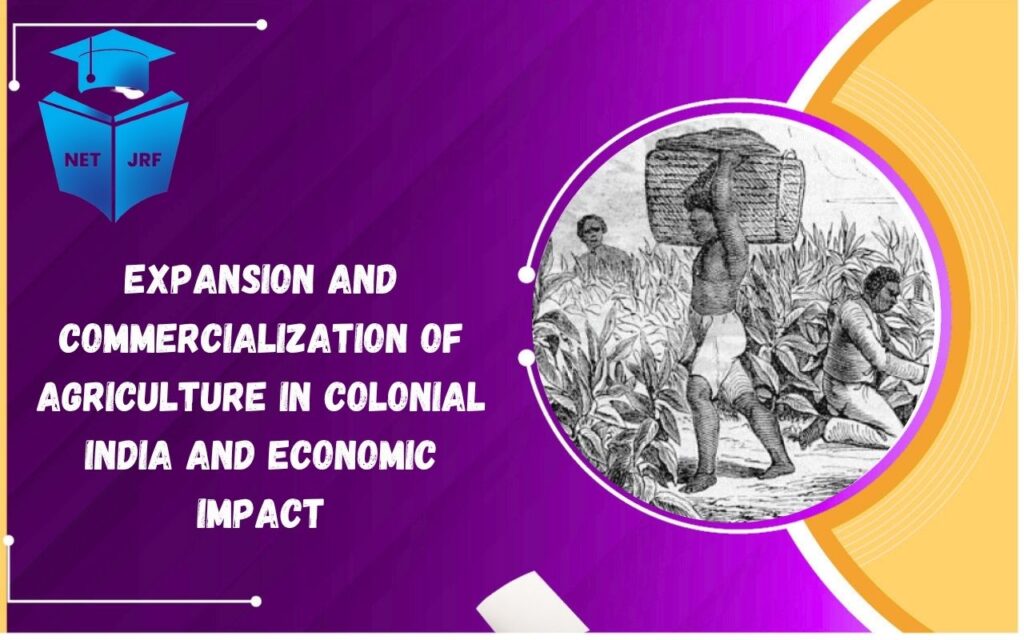
Expansion and Commercialization of Agriculture became one of the most important economic transformations in colonial India. During British rule, agriculture shifted from subsistence farming to market-oriented production. Farmers increasingly produced crops for sale rather than for household consumption.
Best UGC NET Coaching in Jaipur
This change occurred mainly because British industries required large quantities of raw materials. As a result, Indian agriculture became closely connected with global trade networks and colonial economic policies. The process had deep social, economic, and political consequences for Indian society.

Growth of Agriculture for Trade
Expansion and Commercialization of Agriculture refers to the process in which agricultural production shifts from subsistence farming to production for markets. Instead of growing crops mainly for family consumption, farmers grow crops to sell in local or international markets.
Key Features
- Increase in agricultural land under cultivation
- Production of cash crops such as cotton, indigo, jute, tea, and opium
- Integration of agriculture with global trade
- Rise of commercial markets and mandis
- Greater dependence on moneylenders and traders
This transformation tied Indian agriculture closely to the needs of British industries during the Industrial Revolution.
Rise of Commercial Agriculture in India
Several factors led to the rise of Expansion and Commercialization of Agriculture during colonial rule.
1. Demand from British Industries
The Industrial Revolution in Britain created a huge demand for raw materials. Crops such as cotton, jute, and indigo were required for British factories. Therefore the colonial administration encouraged Indian farmers to cultivate commercial crops.
- Development of Transport and Railways
Railways, roads, and ports improved during the nineteenth century. These new transport networks connected rural areas with urban markets and export ports.
This infrastructure helped farmers sell crops in distant markets, increasing commercial agriculture.
3. Expansion of Global Trade
The integration of India into the global economy increased agricultural exports. Between the nineteenth and early twentieth century, exports of agricultural products increased dramatically.
4. Land Revenue Systems
British land settlements such as Permanent Settlement, Ryotwari, and Mahalwari forced peasants to pay fixed land revenue in cash.
Because taxes had to be paid in money, farmers had to produce crops that could be sold in markets.
5. Rise of Moneylenders and Traders
Moneylenders provided loans to farmers for seeds, irrigation, or taxes. In return, peasants had to sell crops to repay loans, increasing dependence on commercial markets.
Best UGC NET Offline Coaching in Jaipur
Major Cash Crops Produced
Under Expansion and Commercialization of Agriculture, several crops became important export commodities.
Important Commercial Crops
| Crop | Region | Main Use |
| Cotton | Bombay Presidency, Gujarat | Textile industries in Britain |
| Indigo | Bengal, Bihar | Dye for European textile industry |
| Jute | Bengal | Industrial packaging |
| Tea | Assam | Export to Europe |
| Opium | Bihar | Trade with China |
These crops replaced traditional food crops in many regions.
Expansion and Commercialization of Agriculture – Key Characteristics
Expansion and commercialization of agriculture introduced major changes in the structure and purpose of farming in colonial India.
| Feature | Description |
| Market orientation | Crops produced mainly for sale |
| Cash crop cultivation | Cotton, jute, indigo, tea, opium |
| Global integration | Agriculture linked with world trade |
| Colonial control | Production directed by British economic needs |
| Rural transformation | Changes in land ownership, labor relations |
Indian Economy Impact
The policy of Expansion and Commercialization of Agriculture brought several economic changes in colonial India.
Positive Economic Effects
Some historians point out that the expansion and commercialization of agriculture also produced a few limited positive economic changes during the colonial period. Although the benefits were uneven, certain developments contributed to the growth of the agricultural economy.
- Growth of Export Trade
Commercial agriculture increased the export of crops such as cotton, jute, tea, and oilseeds. This expanded India’s participation in international trade and connected rural production with global markets. - Development of Market Networks
The commercialization of agriculture encouraged the growth of rural markets, trading centers, and merchant networks. Farmers increasingly sold their produce in local and regional markets rather than only producing for their own consumption. - Improvement in Transport Systems
The expansion of railways and roads improved the transportation of agricultural goods. These networks allowed crops to move faster from farming areas to cities and ports. - Expansion of Irrigation
In some regions, irrigation projects such as canals helped increase agricultural productivity. These projects supported the cultivation of certain commercial crops and expanded the area under farming.
However, these benefits mainly helped colonial businesses rather than ordinary peasants.
Negative Economic Effects
The expansion and commercialization of agriculture also created several negative economic consequences for rural India during the colonial period. These problems weakened the agricultural economy and increased the hardship faced by peasants.
- Dependence on Foreign Markets
Farmers increasingly depended on international markets to sell their crops. When global prices fell, peasants suffered heavy losses because their income relied on unstable foreign demand. - Decline of Food Crop Cultivation
In many regions, farmers replaced traditional food crops with commercial crops such as cotton, indigo, and jute. This shift reduced the area under food grain cultivation and weakened local food security. - Unequal Distribution of Profits
Most of the profits from commercial agriculture did not go to the farmers. British traders, merchants, and local intermediaries gained the largest share of benefits, while peasants remained poor. - Drain of Wealth
A large part of the agricultural surplus produced in India was exported to Britain. Instead of being invested in Indian development, this wealth supported the British economy, contributing to the long-term economic exploitation of the colony.
Social Impact on Rural India
The expansion and commercialization of agriculture brought major changes to the social structure of rural India during the colonial period. Farming gradually shifted from traditional subsistence agriculture to market-oriented production. This transformation affected peasants, land ownership patterns, and village social relations.
- Rise of Landless Labour
Many small peasants lost their land because they could not pay heavy land revenue or repay debts. As a result, a large number of farmers became landless agricultural labourers who worked on the fields of landlords or rich peasants for low wages. - Growth of Rural Indebtedness
Commercial farming required money for seeds, tools, and taxes. Most farmers borrowed from local moneylenders at very high interest rates. When crops failed or prices fell, peasants could not repay their loans and often had to mortgage or sell their land. - Emergence of New Rural Classes
Colonial agricultural policies created new social groups in villages. These included zamindars (landlords) who collected rent, rich peasants who owned large lands, moneylenders who controlled rural credit, and agricultural labourers who worked for wages.
These developments increased social and economic inequality in rural society and created tensions that later contributed to various peasant movements in India.
Commercialization and Famine
The Expansion and Commercialization of Agriculture also contributed to severe famines in colonial India.
The expansion and commercialization of agriculture also increased the risk of severe famines in colonial India. Agriculture became more focused on cash crops grown for trade rather than food crops needed for local consumption. This change weakened the food security of rural communities.
- Replacement of Food Crops
Many farmers were encouraged or forced to grow export crops such as cotton, indigo, and jute instead of food grains. As a result, the area under food cultivation decreased, making villages more vulnerable to food shortages. - Export of Grain During Shortages
Even during times of crop failure or scarcity, large quantities of grain continued to be exported to foreign markets. Colonial trade policies often prioritized international trade and revenue over the food needs of the local population. - Limited Government Relief
The colonial government usually provided very little support during famine conditions. Relief measures were slow and inadequate, which worsened the suffering of rural people. - Famines like the Indian Famine of 1899–1900 caused widespread hardship and loss of life. These disasters revealed how colonial agricultural policies and commercial priorities often ignored the basic food needs of the Indian population.
Traditional Agriculture vs Commercial Agriculture
Traditional farming and commercial farming represent two different approaches to agriculture based on purpose, scale, and technology.
| Feature | Traditional Agriculture | Commercial Agriculture |
| Purpose | Household consumption | Market sale |
| Crop type | Food grains | Cash crops |
| Market role | Limited | Central |
| Risk level | Lower | High due to price fluctuations |
| Economic control | Local farmers | Colonial trade system |
Role of Infrastructure in Agricultural Expansion
Infrastructure played a key role in Expansion and Commercialization of Agriculture.
Infrastructure development played an important role in the expansion and commercialization of agriculture during the colonial period. The British introduced transport and irrigation facilities mainly to support trade and the movement of agricultural goods.

- Railways
Railways connected interior agricultural regions with major cities and ports. This network helped farmers and traders transport crops quickly to markets. It also made it easier to export raw agricultural products to international markets. - Irrigation Projects
The colonial government built canals and irrigation systems in some regions to increase agricultural production. However, these projects mainly supported areas that produced commercial crops such as cotton and wheat, rather than focusing on food security. - Ports and Trade Networks
Major ports like Port of Mumbai and Port of Kolkata became important centers for exporting agricultural commodities. These ports connected Indian agriculture with global trade routes and strengthened the colonial export economy.
Effects on Indian Peasantry
The Expansion and Commercialization of Agriculture had mixed effects on Indian peasants.
Economic Pressures on Farmers
- Economic Pressure
Farmers in colonial India faced heavy land taxes, rising debts, and unstable crop prices. Many peasants had to borrow money from moneylenders to pay revenue or manage farming expenses. This constant financial burden created insecurity and poverty in rural areas. - Forced Crop Cultivation
In several regions, peasants were compelled to grow specific commercial crops such as indigo or opium. These crops served colonial trade interests rather than local food needs, leaving farmers with little freedom to decide what they wanted to cultivate. - Agricultural Instability
The shift toward market-oriented farming made agriculture dependent on global prices. When international demand fell or prices dropped, farmers suffered heavy losses, which increased poverty and economic uncertainty in rural society.
Future Impact on Economy
Historians argue that Expansion and Commercialization of Agriculture had long-term effects on India’s economic development.
Key Outcomes
- Integration of India into global capitalist economy
- Weak development of domestic industries
- Increased rural poverty
- Structural inequalities in land ownership
Historical Evaluation of Agricultural Commercialization
Many historians believe that the expansion and commercialization of agriculture had long-lasting effects on India’s economic structure. Colonial agricultural policies linked Indian farming closely with global markets, but this integration often benefited colonial powers more than local producers.
- Integration into the Global Economy
Commercial agriculture connected India with the international capitalist economy. Large quantities of raw agricultural products such as cotton, jute, and tea were exported to foreign markets. - Weak Development of Domestic Industries
Because the colonial system focused mainly on exporting raw materials, the growth of domestic manufacturing remained limited. This imbalance slowed the development of modern industries within India. - Growth of Rural Poverty
Many farmers faced low incomes due to unstable market prices and heavy taxation. As a result, poverty increased in rural areas, especially among small peasants and agricultural labourers. - Structural Inequalities in Land Ownership
Colonial policies strengthened the power of large landlords and wealthy peasants while many small farmers lost their land. This created long-term inequalities in land ownership within rural society. - By the early twentieth century, Indian agriculture had become strongly dependent on export markets that were largely controlled by colonial authorities. This dependency shaped the economic challenges India faced in the later stages of its development.

Conclusion
In conclusion, Expansion and Commercialization of Agriculture transformed the structure of Indian agriculture during the colonial period. British policies encouraged production of cash crops for global markets, linking rural India to international trade.
Although agricultural exports increased, most benefits went to colonial traders and landlords. The process also created rural inequality, indebtedness, and vulnerability to famine.
Expansion and Commercialization of Agriculture FAQs

2. Why did commercialization of agriculture begin in colonial India?
It began because British industries needed raw materials such as cotton, indigo, and jute. Colonial policies encouraged farmers to produce these crops for export.
3. How did railways influence agricultural commercialization?
Railways connected villages with urban markets and ports. This allowed farmers to sell crops in distant markets and increased agricultural trade.
4. What were the major cash crops in colonial India?
Important commercial crops included cotton, indigo, jute, tea, opium, and oilseeds. These crops were exported to Britain and other global markets.
5. How did commercialization affect Indian peasants?
Many peasants became dependent on moneylenders and market prices. Debt increased and many farmers lost land, becoming agricultural laborers.