

Famines Epidemics and Government Policy in Colonial India and Social Economic Crisis

Famines Epidemics and Government Policy in Colonial India in this topic you learn how food crises disease outbreaks colonial revenue systems famine relief and public health measures shaped Indian society under British rule

gunjan

famines epidemics and government policy in colonial india

Table of Contents

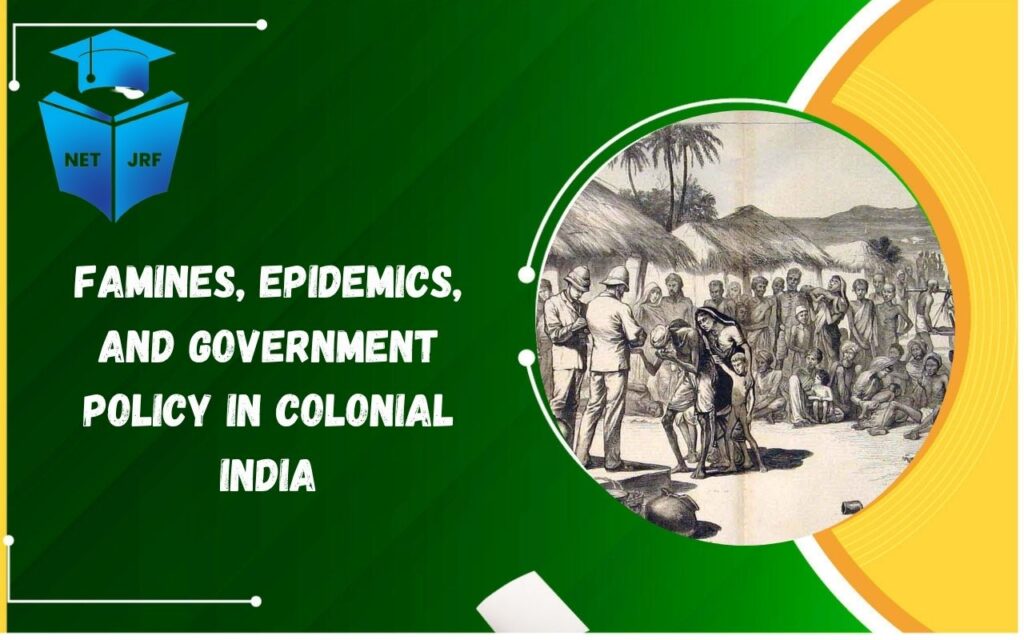
Famines, epidemics and the Government Policy became central issues in colonial India because recurring food shortages and disease outbreaks caused widespread suffering among the population. During the nineteenth and early twentieth centuries, several major famines and epidemics devastated large parts of the country.

The interaction between food scarcity, disease outbreaks, and administrative responses shaped the history of Famines, Epidemics and the Government Policy under British rule. While natural factors like drought contributed to these crises, colonial economic policies, inadequate relief systems, and poor public health infrastructure intensified the impact.

Study Planner

Meaning and Historical Context

The phrase Famines, Epidemics and the Government Policy refers to the relationship between food crises, disease outbreaks, and administrative actions taken by colonial authorities to manage these disasters.

  • Famine refers to severe food shortages that lead to starvation and high mortality.
  • Epidemic refers to the rapid spread of infectious diseases among a large population.
  • Government policy refers to the strategies adopted by colonial authorities to manage or respond to these crises.

During colonial rule, these crises became frequent due to environmental challenges combined with economic changes.

Enroll UGC NET Online Course

Major Famines in Colonial India

Several devastating famines occurred during British rule.

Important Famines

  1. Bengal Famine (1770)
  2. Chalisa Famine (1783–84)
  3. Orissa Famine (1866)
  4. Great Famine (1876–78)
  5. Indian Famine (1899–1900)

These events demonstrate the severity of Famines, Epidemics and the Government Policy challenges during colonial governance.

Major Famines in Colonial India

These disasters highlight how Famines, Epidemics and the Government Policy became major historical concerns.

Famine Year Region Affected Impact
Bengal Famine 1770 Bengal Massive population loss
Orissa Famine 1866 Eastern India Administrative failure
Great Famine 1876–78 South India Millions of deaths
Indian Famine 1899–1900 Western India Large scale distress

Causes of Famines in Colonial India

Many factors contributed to famine conditions.

Major Causes

1. Failure of Monsoon Rains

Agriculture in India depended heavily on monsoon rainfall.

  • Droughts or insufficient rains led to crop failure, reducing food availability.
  • Regions dependent on single-season crops were especially vulnerable.

2. Colonial Revenue Policies

British revenue systems, such as high land taxes, forced farmers to pay taxes even in years of poor harvests.

  • This left farmers with little food for themselves, worsening famine conditions.

3. Commercialization of Agriculture

Farmers were encouraged to grow cash crops like cotton, indigo, and jute for export instead of food crops.

  • Reduced food production for local consumption made populations more vulnerable to famine

4. Poor Transportation in Early Periods

Before railways and good roads, it was difficult to transport food to affected areas quickly.

  • Regions with crop failure could not easily receive grain from surplus areas, increasing starvation.

5. Lack of Food Storage Systems

India lacked large-scale granaries or storage facilities.

  • Without proper storage, surplus grains could not be saved for emergencies, leading to food shortages during famines.

Although drought triggered food shortages, economic policies worsened the crisis. These conditions intensified Famines, Epidemics and the Government Policy debates among historians.

Economic Policies and Famine Vulnerability

British economic policies changed agricultural patterns.

Important Economic Factors

1. Expansion of Cash Crops

Farmers were encouraged to grow cash crops like cotton, indigo, and jute for export.

  • This reduced land available for food crops, leaving people dependent on market prices.

2. Reduction of Food Crop Cultivation

Focus on cash crops caused food scarcity locally, making populations more vulnerable when crops failed.

3. Heavy Land Revenue Demands

British land revenue systems required high taxes from farmers, even in years of poor harvests.

  • Farmers had less grain to store or consume, increasing famine risk.

4. Export of Food Grains During Shortages

Even during food shortages, grains were often exported to Britain or other regions, worsening local famine conditions.

These factors increased rural vulnerability and contributed to Famines, Epidemics and the Government Policy failures.

Enroll UGC NET Foundation Course

Spread of Epidemics During Colonial Period

Food shortages often weakened public health, making populations vulnerable to disease outbreaks.

Major Epidemics

  • Cholera outbreaks in the nineteenth century
  • Plague epidemic in the 1890s
  • Influenza pandemic in 1918

These disease outbreaks demonstrate the close relationship between famine conditions and Famines, Epidemics and the Government Policy challenges.

App JRF Adda

Government Response to Famines

Colonial authorities introduced several administrative measures.

Important Relief Measures

The British government introduced several administrative and relief measures to manage famines in India, though these were often limited in effectiveness:

1. Establishment of Famine Commissions

The government set up famine commissions to investigate causes of famines and recommend policies.

  • These commissions studied rainfall patterns, crop production, and economic factors to predict and prevent future famines.

2. Development of Famine Relief Works

Authorities organized relief works, such as road construction, canal digging, and other public projects, where famine-affected people could earn wages and buy food.

  • These works provided employment and limited income, helping people survive during food shortages.

3. Distribution of Limited Food Aid

In extreme cases, the government distributed grains, rice, or other food supplies to famine-stricken populations.

  • However, the aid was often insufficient, delayed, or concentrated in specific areas, leaving many still vulnerable.

4. Creation of Famine Codes

By the late 19th century, the British introduced famine codes—official guidelines for famine management.

These measures formed the basis of Famines, Epidemics and the Government Policy reforms during the late nineteenth century.

Famine Commissions

The British government created several commissions to study famine causes.

Major Famine Commissions

  1. Famine Commission of 1880
  2. Later famine commissions during the early twentieth century

These commissions recommended administrative guidelines for famine relief. Their reports influenced Famines, Epidemics and the Government Policy frameworks.

Famine Codes

Famine codes established rules for managing food crises.

Key Provisions

  • Identification of famine conditions
  • Organization of relief works
  • Food distribution programs
  • Employment schemes for affected populations

Although these policies attempted to address famine conditions, critics argued that Famines, Epidemics and the Government Policy responses remained inadequate.

Public Health Policies and Epidemic Control

British authorities introduced some measures to control epidemics.

Public Health Measures

  • Sanitation reforms in cities
  • Quarantine measures
  • Medical inspections in ports
  • Establishment of hospitals

Despite these efforts, the colonial health system remained limited, which affected the success of Famines, Epidemics and the Government Policy strategies.

Join UGC NET Offline Coaching in Jaipur

Criticism by Nationalist Leaders

Indian nationalists strongly criticized colonial responses to famine and epidemics.

Major Criticisms

  • The government prioritized revenue collection over relief.
  • Food exports continued during famine periods.
  • Relief programs were insufficient.

These criticisms highlighted failures in Famines, Epidemics and the Government Policy under colonial rule.

JRF Adda Book

Social Impact of Famine and Epidemics

These crises had deep social consequences.

Social Effects

  • Large population loss
  • Migration from affected regions
  • Increased poverty in rural areas
  • Decline in agricultural productivity

The social consequences further emphasize the importance of studying Famines, Epidemics and Government Policy in Indian history.

The history of Famines, Epidemics and the Government Policy in colonial India reflects the complex interaction between environmental challenges and colonial economic structures. While drought and disease triggered crises, colonial policies related to taxation, agriculture, and trade often intensified their impact.

Read UGC NET Notes
1 Archaeological Sources for UGC NET Epigraphy – Study of Inscriptions Meaning of Historical Sources Archaeological
2 Meaning of Historical Sources Archaeological Sources for UGC NET Literary Sources in History Archaeological
3 Exploration in Archaeology Excavation Techniques in Archaeology Dating of Archaeological Sites Archaeological
4 Excavation Techniques in Archaeology Exploration in Archaeology Dating of Archaeological Sites Archaeological
5 Epigraphy – Study of Inscriptions Inscriptions in Reconstructing History Numismatics in History Archaeological
6 Inscriptions in Reconstructing History Epigraphy – Study of Inscriptions Archaeological Sources for UGC NET Archaeological
7 Numismatics in History Importance of Coins in History Epigraphy – Study of Inscriptions Archaeological
8 Importance of Coins in History Numismatics in History Archaeological Sources for UGC NET Archaeological
9 Dating of Archaeological Sites Excavation Techniques in Archaeology Dating Ancient Literary Sources Archaeological
10 Indigenous Literature Literary Sources in History Secular Literature as Historical Source Literary
11 Dating Ancient Literary Sources Literary Sources in History Dating of Archaeological Sites Literary
12 Literary Sources in History Indigenous Literature Foreign Accounts of India Literary
13 Foreign Accounts of India Greek Accounts on Ancient India Chinese Accounts on India Literary
14 Greek Accounts on Ancient India Foreign Accounts of India Chinese Accounts on India Literary
15 Secular Literature as Historical Source Literary Sources in History Indigenous Literature Literary
16 Role of Myths and Legends in Historical Reconstruction Literary Sources in History Secular Literature as Historical Source Literary
17 Chinese Accounts on India Foreign Accounts of India Greek Accounts on Ancient India Literary
18 Arabic Accounts on India Foreign Accounts of India Chinese Accounts on India Literary
19 Neolithic and Chalcolithic Phases Neolithic Revolution in India Chalcolithic Culture in India Neolithic
20 Hunting, Gathering & Food Production Neolithic Revolution in India Neolithic Settlements in India Neolithic
21 Neolithic Revolution in India Neolithic Settlements in India Tools and Technology in Neolithic Period Neolithic
22 Neolithic Settlements in India Distribution of Neolithic Cultures in India Neolithic Revolution in India Neolithic
23 Distribution of Neolithic Cultures in India Neolithic Settlements in India Tools and Technology in Neolithic Period Neolithic
24 Tools and Technology in Neolithic Period Neolithic Revolution in India Chalcolithic Culture in India Neolithic
25 Chalcolithic Culture in India Settlement Pattern & Economy in Chalcolithic Phase Trade & Exchange Networks in Chalcolithic Societies Neolithic
26 Settlement Pattern & Economy – Chalcolithic Phase Chalcolithic Culture in India Trade & Exchange Networks in Chalcolithic Societies Neolithic
27 Trade & Exchange Networks – Chalcolithic Societies Chalcolithic Culture in India IVC Internal & External Trade Neolithic
28 Indus Valley Civilization – UGC NET Major Sites of Indus Civilization Urban Planning in Harappan Civilization IVC
29 IVC Internal & External Trade Internal Trade – Harappan Civilization Craft Specialization in Harappan Civilization IVC
30 Political Organization – Harappan Civilization Social Structure – Indus Civilization Urban Planning in Harappan Civilization IVC
31 Major Sites of Indus Civilization Indus Valley Civilization – UGC NET Urban Planning in Harappan Civilization IVC
32 Urban Planning & Settlement – Harappan Civilization Architecture & Town Planning – Harappan Cities IVC as First Urbanization in India IVC
33 Architecture & Town Planning – Harappan Cities Urban Planning in Harappan Civilization Major Sites of Indus Civilization IVC
34 Craft Specialization & Industrial Activities – Harappan Agriculture & Food Economy – Harappans IVC Internal & External Trade IVC
35 Agriculture & Food Economy – Harappans Craft Specialization in Harappan Civilization Internal Trade – Harappan Civilization IVC
36 Internal Trade – Harappan Civilization IVC Internal & External Trade Craft Specialization in Harappan Civilization IVC
37 Religion & Beliefs – Indus Civilization Social Structure – Indus Civilization Indus Valley Civilization – UGC NET IVC
38 Social Structure – Indus Civilization Political Organization – Harappan Civilization Religion & Beliefs – Indus Civilization IVC
39 Decline of Indus Civilization Indus Valley Civilization – UGC NET IVC as First Urbanization in India IVC
40 IVC as First Urbanization in India Urban Planning in Harappan Civilization Second Urbanization in India IVC
41 Vedic & Later Vedic Periods – Aryan Varna System Early Vedic Society and Economy Later Vedic Society and Economy Vedic
42 Origin of Vedic Civilization Aryan Debate – Migration, Invasion & Indigenous Theories Early Vedic Society and Economy Vedic
43 Aryan Debate – Migration, Invasion & Indigenous Theories Origin of Vedic Civilization Early Vedic Society and Economy Vedic
44 Early Vedic Society and Economy Political Institutions – Early Vedic Period Social Structure – Early Vedic Period Vedic
45 Political Institutions – Early Vedic Period Early Vedic Society and Economy Monarchical States in Ancient India Vedic
46 Social Structure – Early Vedic Period Emergence of Varnas & Social Stratification Early Vedic Society and Economy Vedic
47 Later Vedic Society and Economy Emergence of Varnas & Social Stratification Impact of Iron Technology in India Vedic
48 Emergence of Varnas & Social Stratification Social Structure – Early Vedic Period Later Vedic Society and Economy Vedic
49 Emergence of Heterodox Sects in India Jainism, Buddhism & Ajivikas – Origins & Teachings Later Vedic Society and Economy Vedic
50 Impact of Iron Technology in India Later Vedic Society and Economy Agricultural Expansion & Economic Changes – Ancient India Vedic
51 Religious & Philosophical Vedic Ideas Emergence of Varnas & Social Stratification Emergence of Heterodox Sects in India Vedic
52 Megalithic Culture of South India Neolithic and Chalcolithic Phases Agricultural Expansion & Economic Changes General
53 State System in Ancient India Rise of Mahajanapadas Transition: Tribal Polities to Territorial States General
54 Transition: Tribal Polities to Territorial States Rise of Mahajanapadas Later Vedic Society and Economy General
55 Rise of Mahajanapadas Monarchical States in Ancient India Republican States (Gana-Sanghas) – Ancient India Magadha
56 Monarchical States in Ancient India Rise of Mahajanapadas Emergence of Magadha Magadha
57 Republican States (Gana-Sanghas) – Ancient India Rise of Mahajanapadas Monarchical States in Ancient India Magadha
58 Agricultural Expansion & Economic Changes – Ancient India Second Urbanization in India Impact of Iron Technology in India General
59 Second Urbanization in India IVC as First Urbanization in India Rise of Mahajanapadas General
60 Jainism, Buddhism & Ajivikas – Origins & Teachings Emergence of Heterodox Sects in India Ashoka’s Policy of Dhamma General
61 Emergence of Magadha Geographical Advantages of Magadha Early Rulers of Magadha Magadha
62 Geographical Advantages of Magadha Natural Resources & Economic Strength of Magadha Reasons for Success of Magadha Magadha
63 Natural Resources & Economic Strength of Magadha Geographical Advantages of Magadha Economic Policies of the Nandas Magadha
64 Early Rulers of Magadha Haryanka Dynasty – Rise of Magadha Emergence of Magadha Magadha
65 Haryanka Dynasty – Rise of Magadha Expansion Policy of Bimbisara Early Rulers of Magadha Magadha
66 Expansion Policy of Bimbisara Ajatashatru – Military Reforms Haryanka Dynasty – Rise of Magadha Magadha
67 Ajatashatru – Military Reforms Wars of Ajatashatru Expansion Policy of Bimbisara Magadha
68 Wars of Ajatashatru Ajatashatru – Military Reforms Udayin & Establishment of Pataliputra Magadha
69 Udayin & Establishment of Pataliputra Wars of Ajatashatru Shishunaga Dynasty Magadha
70 Shishunaga Dynasty Administrative Structure of the Shishunagas Nanda Dynasty Magadha
71 Administrative Structure of the Shishunagas Shishunaga Dynasty Central Administration Under Mauryas Magadha
72 Nanda Dynasty Mahapadma Nanda – Imperial Expansion Shishunaga Dynasty Magadha
73 Mahapadma Nanda – Imperial Expansion Military Strength of the Nandas Nanda Dynasty Magadha
74 Economic Policies of the Nandas Nanda Dynasty Taxation System – Mauryan State Magadha
75 Military Strength of the Nandas Mahapadma Nanda – Imperial Expansion Defeat of Nandas & Rise of Mauryan Empire Magadha
76 Reasons for Success of Magadha Geographical Advantages of Magadha Natural Resources & Economic Strength of Magadha Magadha
77 Mahajanapadas to Empire – Evolution & Rise of Magadha Rise of Mahajanapadas Emergence of Magadha Magadha
78 Mauryan Empire – Expansion Rise of Chandragupta Maurya Expansion of Mauryan Empire Maurya
79 Rise of Chandragupta Maurya Role of Chanakya in Rise of Mauryan Empire Defeat of Nandas & Rise of Mauryan Empire Maurya
80 Role of Chanakya in Rise of Mauryan Empire Rise of Chandragupta Maurya Defeat of Nandas & Rise of Mauryan Empire Maurya
81 Defeat of Nandas & Rise of Mauryan Empire Military Strength of the Nandas Rise of Chandragupta Maurya Maurya
82 Chandragupta Maurya – Seleucus Treaty & Diplomacy Expansion of Mauryan Empire Greek Accounts on Ancient India Maurya
83 Expansion of Mauryan Empire Chandragupta Maurya – Seleucus Treaty & Diplomacy Kalinga War Maurya
84 Administration of Chandragupta Maurya Central Administration Under Mauryas Mauryan Bureaucracy Maurya
85 Sources for Mauryan History Archaeological Sources for UGC NET Greek Accounts on Ancient India Maurya
86 Central Administration Under Mauryas Provincial Administration – Mauryan Empire Mauryan Bureaucracy Maurya
87 Provincial Administration – Mauryan Empire Local Administration – Mauryan Empire Central Administration Under Mauryas Maurya
88 Local Administration – Mauryan Empire Provincial Administration – Mauryan Empire Mauryan Bureaucracy Maurya
89 Mauryan Bureaucracy Central Administration Under Mauryas Espionage System – Mauryan Empire Maurya
90 Espionage System – Mauryan Empire Mauryan Bureaucracy Central Administration Under Mauryas Maurya
91 Ancient India – Trade and Commerce Trade and Commerce Under Mauryas Agrarian Economy – Mauryan Period Maurya
92 Agrarian Economy – Mauryan Period Taxation System – Mauryan State Trade and Commerce Under Mauryas Maurya
93 Trade and Commerce Under Mauryas Ancient India – Trade and Commerce Agrarian Economy – Mauryan Period Maurya
94 Taxation System – Mauryan State Agrarian Economy – Mauryan Period Economic Policies of the Nandas Maurya
95 Kalinga War Ashoka’s Policy of Dhamma Expansion of Mauryan Empire Maurya
96 Ashoka’s Policy of Dhamma Nature & Philosophy of Dhamma Kalinga War Maurya
97 Nature & Philosophy of Dhamma Ashoka’s Policy of Dhamma Jainism, Buddhism & Ajivikas Maurya

Famines, Epidemics and Government Policy in Colonial India FAQs

Loader image

Famines occurred frequently due to a combination of natural and man-made factors:

Droughts and crop failures caused by irregular monsoon rains.Heavy taxation under British land revenue policies, which left farmers with little food.Commercialization of agriculture, where farmers grew cash crops like cotton or indigo instead of food crops.
Poor early transportation and storage systems, which made it hard to move food to affected areas.These factors together made millions of people vulnerable to starvation.

Famine codes were administrative guidelines issued by the British government to manage famines.

They outlined early warning measures, such as monitoring rainfall and crop production.
They specified relief works, like public employment projects, and rationing or food distribution methods.Famine codes aimed to reduce mortality, but their implementation was often limited and delayed, especially in rural Indian areas.

The influenza pandemic of 1918, also known as the Spanish flu, caused millions of deaths in India.Poor nutrition and malnourishment due to famines worsened the impact.Crowded cities and lack of proper healthcare facilities made the disease spread rapidly.

Famines weakened the population in multiple ways: Starvation and malnutrition reduced the body’s natural immunity.Malnourished people were more vulnerable to infectious diseases like cholera, malaria, and influenza. Famines also forced people to migrate or gather in relief camps, which increased the risk of disease transmission.


Leave a Reply

Recent Posts
Aditi

Aditi Sharma, founder of JRFAdda, is a Computer Science educator with an MCA degree and JRF qualification (99.91 percentile, Dec 2019). Her experience includes roles as an SBI SO (DBA), work at Cognizant, and over 5 years of teaching online and offline. She has also served as a Government Computer Teacher in Rajasthan.