
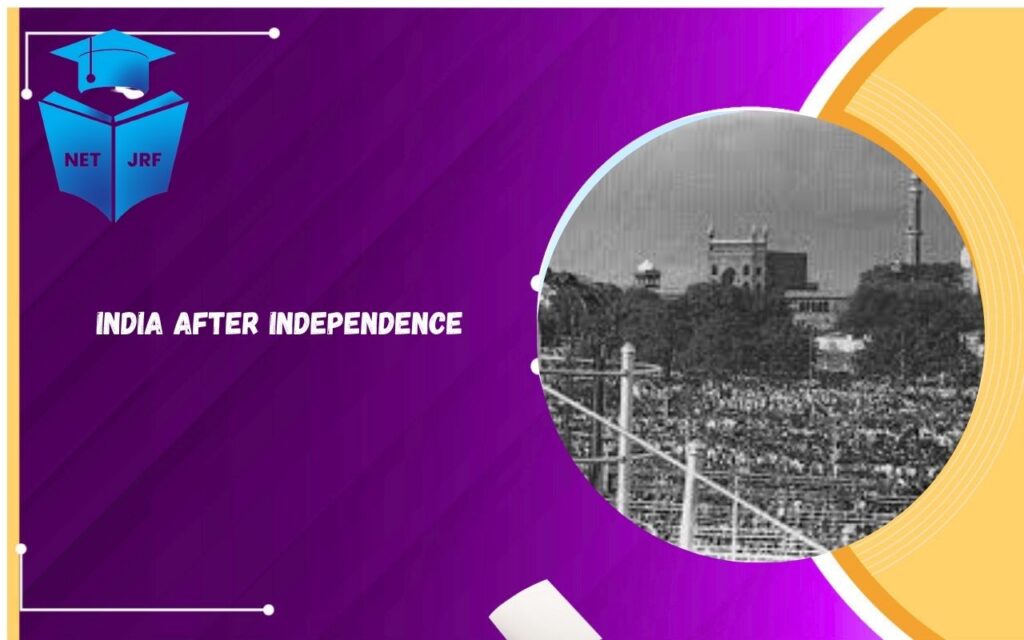
India After Independence marks the period beginning in 1947 when the country emerged from colonial rule. The phrase India After Independence describes the historical phase when Indian leaders worked to build democratic institutions, create a modern economy, maintain unity in a diverse society, and address social inequalities.
The early decades of India After Independence presented enormous challenges. Leaders had to unite a country divided by Partition, poverty, illiteracy, regional diversity. The government also needed to establish political stability, economic growth, and social justice.

India After Independence
When India achieved independence on 15 August 1947, the country faced several serious problems. British colonial rule had left deep economic weakness, social divisions, and administrative challenges.
Important conditions included
- Partition of the subcontinent
- Refugee crisis across borders
- Communal violence in many regions
- Weak industrial base
- Widespread poverty
These conditions made nation building extremely difficult during India After Independence.
Major Issues in India After Independence
These issues shaped the early political agenda during India After Independence.
| Challenge | Description | Impact |
| Partition crisis | Large scale migration between India Pakistan | Social tension humanitarian crisis |
| Economic weakness | Low industrial development | Slow economic growth |
| Communal tension | Religious conflict in several regions | Threat to national unity |
| Political integration | Hundreds of princely states existed | Need for administrative unity |
India After Independence Nation Building
Nation building refers to the process of creating a stable, unified political community. Leaders such as Jawaharlal Nehru, Sardar Vallabhbhai Patel, B R Ambedkar played crucial roles during India After Independence.
Political Integration of Princely States
At independence, more than 560 princely states existed. These states were ruled by local princes under British supervision.
Sardar Vallabhbhai Patel led efforts to integrate these states into the Indian Union.
Important methods included
- Negotiation with rulers
- Political agreements called Instruments of Accession
- Administrative integration into Indian states
This integration strengthened national unity in the early years of India After Independence.
Enroll UGC NET Foundation Course
Adoption of the Constitution
One of the most important achievements during India After Independence was the adoption of the Constitution in 1950.
The Constitution established
- Democratic political system
- Fundamental rights for citizens
- Federal structure of government
- Independent judiciary
The Constitution created a legal framework for governance during India After Independence.
Economic Planning in Independent India
Economic development became a central goal during India After Independence. Leaders believed that planned development could reduce poverty.
Five Year Plans
The government introduced Five Year Plans to guide economic policy.
Major objectives included
- Industrial growth
- Agricultural development
- Infrastructure expansion
- Reduction of poverty
Public sector industries played an important role during early planning years of India After Independence.
Green Revolution
Agricultural reforms were necessary to improve food production.
The Green Revolution introduced
- High yielding crop varieties
- Modern irrigation techniques
- Chemical fertilizers
- Agricultural research institutions
These reforms increased food production significantly during later decades of India After Independence.
Political Ideologies in Independent India
Political ideologies strongly influenced the political system during India After Independence.
Left Wing Ideology
Left wing politics emphasizes social equality, economic redistribution, state intervention in the economy.
Key principles include
- Government control over major industries
- Protection of workers rights
- Welfare policies for poor communities
Several political parties in India adopted left oriented economic policies during the early years of India After Independence.
Enroll UGC NET Offline Coaching in Jaipur
Right Wing Ideology
Right wing ideology supports traditional institutions, cultural nationalism, market based economic policies.
Important features include
- Emphasis on national identity
- Support for private enterprise
- Promotion of cultural traditions
Debates between left wing ideas and right wing ideas shaped political discussions during India After Independence.

Communalism as a Challenge
Communalism refers to political conflict based on religious identity. It remained a major challenge during India After Independence.
Causes of Communal Tension
Important reasons included
- Historical religious divisions
- Political mobilization based on identity
- Economic competition between communities
- Misuse of religion in politics
Communal tensions sometimes resulted in riots which threatened social harmony.
Government Response
The Indian government adopted several measures to reduce communal conflict.
Important steps included
- Secular constitutional principles
- Protection of minority rights
- Legal action against communal violence
- Promotion of national integration programs
These policies aimed to maintain unity during India After Independence.
Social Transformation
Social reform remained another important aspect of India After Independence.
Expansion of Education
Education policies aimed to reduce illiteracy.
Key initiatives included
- Establishment of universities
- Expansion of school education
- Literacy campaigns
Education helped create new opportunities for social mobility.
Women Empowerment
Women gained greater legal rights during India After Independence.
Important reforms included
- Hindu Code Bills
- Equal political rights
- Increased participation in education
Women gradually gained greater representation in public life.
Rural Development
Large sections of the population lived in villages.
Government programs focused on
- Agricultural development
- Rural employment schemes
- Infrastructure development
These initiatives aimed to improve living conditions during India After Independence.
Democratic Institutions
India developed one of the largest democratic systems in the world during India After Independence.
Key Democratic Features
Important democratic institutions include
- Free elections
- Independent judiciary
- Multi party political system
- Federal structure
Regular elections allowed citizens to choose their representatives.
Economic Liberalisation
In 1991, India introduced major economic reforms.
Important changes included
- Reduction of government control over industries
- Promotion of private investment
- Opening economy to global markets
These reforms transformed the economic structure during later decades of India After Independence.
Enroll UGC NET Offline Classes in Jaipur
Continuing Challenges
Despite major achievements, several challenges remain.
Important issues include
- Economic inequality
- Regional development gaps
- Environmental problems
- Political polarization
Addressing these challenges remains an important task in modern India.

Conclusion
India After Independence represents a complex journey of nation building, political development, economic transformation. Leaders created democratic institutions, integrated diverse regions, expanded education, and promoted economic growth.
The story of India After Independence shows how a newly independent nation addressed deep social divisions, economic challenges, political uncertainties. \
FAQs

What were the main challenges after independence
Major challenges included partition crisis refugee migration communal tension poverty low industrial development.
Why was the Constitution important
The Constitution created democratic governance fundamental rights federal structure independent judiciary.
What role did planning play in economic development
Five Year Plans guided industrial growth agricultural improvement infrastructure development poverty reduction.
What is communalism in Indian politics
Communalism refers to political conflict based on religious identity which can create social tension.
What is the difference between left wing and right wing ideology
Left wing ideology focuses on social equality state intervention. Right wing ideology supports market economy national cultural identity.
How did education change after independence
Government expanded schools universities literacy programs to increase access to education.
Why is India After Independence important for UGC NET
The topic explains nation building political development economic policy social change in modern India.