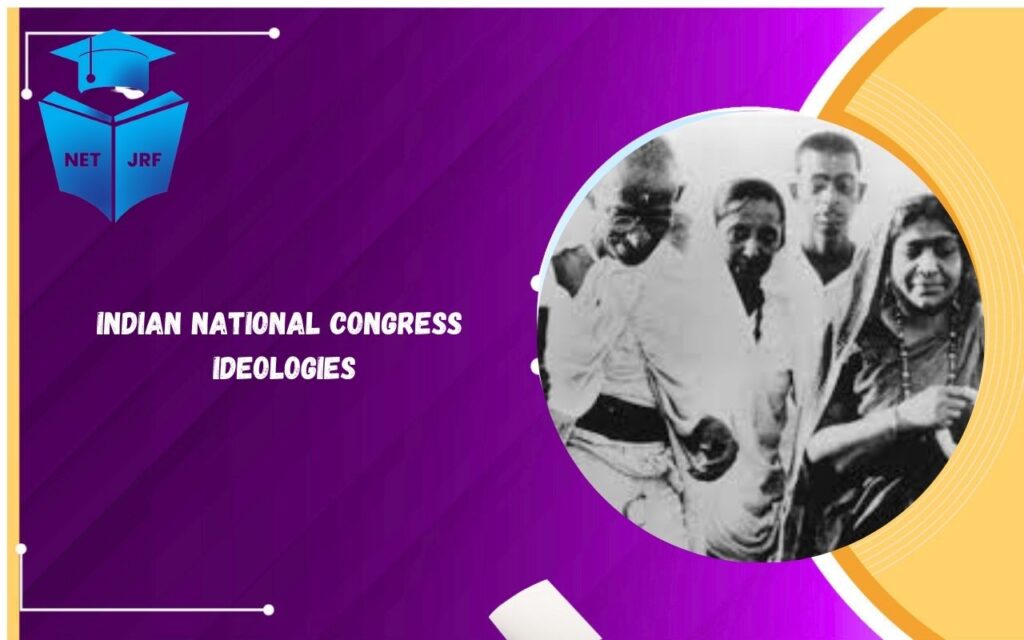
Indian National Congress played a central role in the growth of Indian nationalism during the colonial period. It emerged as the first national political organization that united educated Indians from different regions. The organization created a platform where leaders discussed political rights, administrative reforms, and national unity.
The Indian National Congress gradually developed various ideologies, political programmes that guided the Indian freedom struggle. These ideas evolved over time as different leaders responded to changing political circumstances.

Congress Ideology
During the late nineteenth century, educated Indians began questioning colonial rule. They recognized economic exploitation, racial discrimination, and lack of political representation.
- In response to these conditions, political leaders established the Indian National Congress in 1885 to present Indian grievances before the British government.
- Initially the organization believed that constitutional reforms could improve governance in India. However, as political awareness increased, the ideological direction of the Indian National Congress expanded toward stronger nationalist demands.
Indian National Congress Ideologies and Political Vision
The Indian National Congress developed several ideological principles that guided its political actions.
Core ideological ideas included
- Promotion of political representation for Indians
- Protection of civil rights
- Economic development of India
- National unity among diverse communities
- Gradual movement toward self government
These ideas helped shape the political philosophy of the Indian National Congress during the early phase of the freedom movement.
Early Moderate Ideology
During its initial decades, the leadership of the Indian National Congress followed moderate political ideology.
Moderate leaders believed that British rule could improve through reforms rather than confrontation.
Key features of moderate ideology
- Loyalty toward British Crown
- Faith in constitutional methods
- Demand for administrative reforms
- Gradual expansion of political rights
- Cooperation with colonial authorities
Moderate leaders presented petitions, resolutions, memorandums to British authorities to achieve reforms. Their political approach shaped the early character of the Indian National Congress.
Major Moderate Leaders
Several important leaders guided the moderate phase.
Key figures included
- Dadabhai Naoroji
- Surendranath Banerjee
- Gopal Krishna Gokhale
- Pherozeshah Mehta
These leaders used the platform of the Indian National Congress to criticize economic exploitation under colonial rule. They also raised issues related to taxation, civil services, political representation.
Economic Nationalism in Congress Ideology
One important ideological contribution of the Indian National Congress involved economic nationalism.
Leaders argued that colonial policies caused economic decline in India. Dadabhai Naoroji developed the famous Drain Theory which explained how wealth moved from India to Britain.
Economic issues raised by the Indian National Congress included
- heavy taxation on peasants
- destruction of local industries
- unequal trade policies
- export of Indian raw materials
By highlighting economic exploitation, the Indian National Congress strengthened nationalist consciousness.
Enroll UGC NET Mock Test Series
Political Programmes of Congress
The Indian National Congress adopted several programmes to achieve its goals.
Important political programmes
- Demand for legislative reforms
- Expansion of Indian representation in government
- Reduction in military expenditure
- Protection of civil liberties
- Economic reforms for development
Through these programmes the Indian National Congress attempted to influence colonial policy.

Indian National Congress Ideologies Programmes
This ideological framework helped guide the activities of the Indian National Congress.
| Indian National Congress Ideologies Programmes | Explanation |
| Constitutional Reform | Demand for representation in legislative councils |
| Economic Justice | Opposition to colonial exploitation |
| Civil Rights | Protection of freedom speech equality before law |
| National Unity | Bringing people from different regions together |
| Self Government | Gradual demand for political autonomy |
Indian National Congress Rise of Extremist Nationalists
During the early years of the Indian National Congress, most leaders followed moderate political methods. They believed that constitutional reforms, petitions, and peaceful discussions with the British government could gradually improve the political condition of India. However, by the beginning of the twentieth century, many young nationalists became dissatisfied with these moderate methods.
This dissatisfaction led to the emergence of a new group known as the extremist nationalists within the Congress. These leaders believed that the existing approach was too slow and ineffective in achieving real political change. They argued that stronger and more direct political action was necessary to challenge British authority.
Major Extremist Leaders
Several influential leaders guided the extremist phase of the nationalist movement. Among them, three leaders became especially famous and were often referred to as the Lal-Bal-Pal trio.
Bal Gangadhar Tilak was one of the most prominent nationalist leaders from Maharashtra. He strongly criticized British rule and encouraged people to actively participate in the freedom struggle. Tilak believed that political rights could not be achieved through requests alone. He popularized the powerful slogan that self-rule is our birthright and we shall have it. Through newspapers, public speeches, and cultural festivals such as Ganapati and Shivaji celebrations, he mobilized large numbers of people.
Bipin Chandra Pal, a leader from Bengal, also played a key role in spreading nationalist ideas. He supported aggressive political strategies such as the boycott of British goods and promotion of Swadeshi industries. Pal believed that national awakening was essential for political freedom. His speeches and writings inspired many young Indians to join the nationalist movement.
Lala Lajpat Rai, often called the Lion of Punjab, became another major leader of the extremist group. He actively worked to spread political awareness in northern India. Lajpat Rai supported national education, economic self-reliance, and strong opposition to colonial policies.
Join UGC NET Coaching in Jaipur
Ideology of the Extremists
The extremist leaders introduced several new ideas that differed from the earlier moderate approach. They believed that Indians should rely on their own strength rather than depending on British goodwill.
Some of the main principles of the extremist ideology included:
- demand for self-rule or Swaraj
- boycott of British goods and institutions
- promotion of Swadeshi industries and indigenous products
- encouragement of national education
- mobilization of mass participation in political struggle
These ideas aimed to strengthen national unity and encourage people to take an active role in the fight against colonial rule.
Congress Impact
The emergence of extremist leaders significantly changed the ideological direction of the Indian National Congress. Earlier, the Congress mainly represented the interests of educated elites and used moderate political methods.
- The extremist approach introduced a more energetic and assertive style of nationalism.
- Extremist leaders encouraged public protests, political campaigns, and economic boycott movements. Their ideas helped spread nationalist feelings among wider sections of society, including students, traders, and young political activists.
- Although disagreements between moderates and extremists later created divisions within the Congress, the rise of extremist nationalism played an important role in strengthening the freedom struggle. It prepared the ground for more intense political movements in the twentieth century and helped transform the Congress into a broader nationalist organization.
Extremist Ideology Key Principles
Extremist leaders emphasized
- complete self rule
- boycott of British goods
- promotion of Swadeshi industries
- mass participation in political struggle
These ideas encouraged stronger nationalist feeling across India. As a result the Indian National Congress began mobilizing larger sections of society.
Swadeshi Movement
The Swadeshi movement became one of the most important programmes associated with nationalist ideology.
This movement encouraged people to
- boycott foreign goods
- promote indigenous industries
- strengthen economic self reliance
The Swadeshi movement significantly increased the influence of the Indian National Congress among common people.
Contribution to National Unity
The Indian National Congress helped connect leaders from different provinces.
Through annual sessions, political debates, public meetings, leaders shared ideas about national problems.
This interaction helped create
- political unity across regions
- awareness about common colonial issues
- development of national identity
Therefore the Indian National Congress played a major role in building the idea of India as a nation.
Evolution Toward Mass Nationalism
Initially the Congress represented mostly educated elite groups. Over time its programmes expanded to involve wider sections of society.
Later movements organized under Congress leadership included
- Non Cooperation Movement
- Civil Disobedience Movement
- Quit India Movement
These movements transformed the Indian National Congress from an elite political body into a mass nationalist organization.
Enroll UGC NET Offline Classes in Jaipur
Role in Political Education
Another major contribution of the Indian National Congress involved political education.
Through speeches publications debates leaders explained issues such as
- economic exploitation
- political rights
- national unity
- democratic governance
This process helped spread political awareness among Indians. It prepared society for larger nationalist struggles.
Impact on Indian Politics
The political ideas developed within the Indian National Congress shaped the future of Indian democracy.
Major long term impacts included
- development of democratic political culture
- emergence of national leadership
- expansion of political participation
- foundation for independence movement
These contributions highlight the historical importance of the Indian National Congress in modern Indian history.

Conclusion
The Indian National Congress played a transformative role in shaping the Indian freedom movement. Its ideologies evolved from moderate constitutional reform to stronger nationalist programmes such as Swadeshi mass movements. Through a political education leadership organization the Indian National Congress united diverse communities against colonial rule.
Indian National Congress FAQs

When was the Congress established?
The Indian National Congress was established in 1885 during the period of British rule in India. Its first annual session was held in Bombay. The meeting was presided over by Womesh Chandra Bonnerjee, who became the first president of the Congress. Leaders from different regions attended this session and discussed the political and administrative issues affecting Indians.
What were the early ideologies of the Congress?
In its early phase, the Congress followed moderate political ideas. The leaders believed that reforms could be achieved through peaceful and constitutional methods. They focused on presenting petitions, passing resolutions, and holding discussions with the British government. Their main aim was to secure administrative reforms, expand political rights, and increase Indian participation in government institutions.
What is economic nationalism in Congress ideology?
Economic nationalism became an important part of Congress ideology. Many leaders believed that British economic policies were harming India’s economy. They pointed out that colonial policies encouraged the export of raw materials from India while British manufactured goods flooded Indian markets. This situation weakened local industries and increased poverty. Congress leaders therefore demanded economic reforms to protect Indian industries and promote national economic development.
Who were the extremist leaders in the Congress?
During the early twentieth century, a group of leaders known as extremists emerged within the Congress. They believed that moderate methods were not enough to achieve political rights. Important extremist leaders included Bal Gangadhar Tilak, Bipin Chandra Pal, and Lala Lajpat Rai. These leaders supported stronger nationalist strategies such as boycott movements, promotion of Swadeshi goods, and greater public participation in the freedom struggle.