
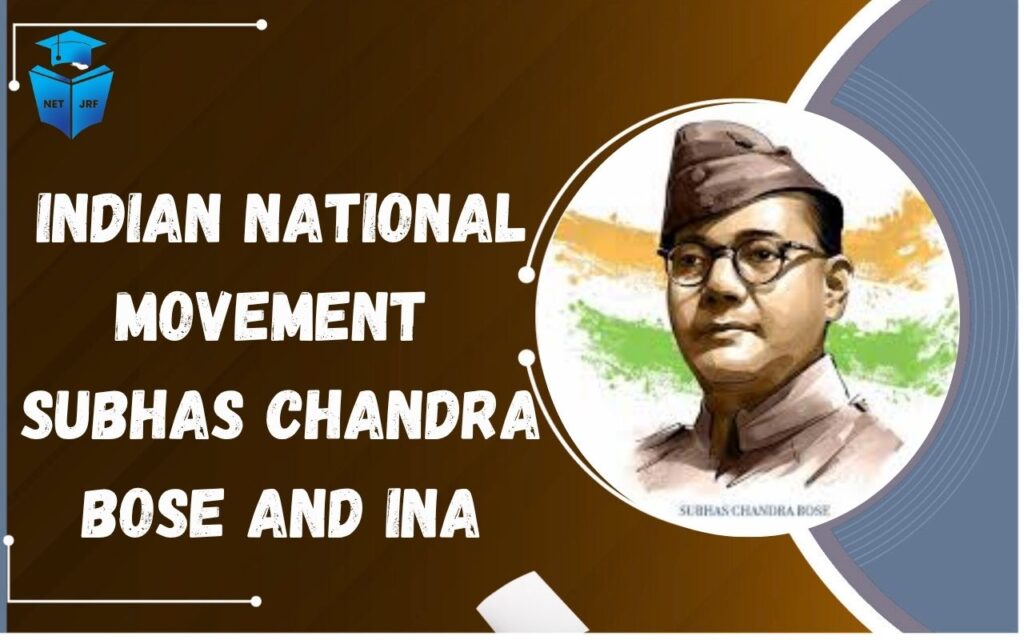

Indian National Movement Subhas Chandra Bose INA and Azad Hind Government

Indian National Movement Subhas Chandra Bose and INA In this topic you learn how Bose shaped the freedom struggle through militant nationalism Forward Bloc Indian National Army Azad Hind Government military campaigns women participation and the impact on India’s independence movement.

vishal

Indian National Movement Subhas Chandra Bose and INA

Table of Contents

The Indian National Movement- represents the long struggle of Indians against British colonial rule that finally led to independence in 1947. This national awakening developed through different methods such as constitutional reforms, mass protests, revolutionary activities, and armed resistance. Subhas Chandra Bose emerged as one of the most dynamic leaders who introduced a militant approach within the Indian National Movement-.

Study Planner

Background Indian National Movement

The Indian National Movement developed gradually during the late nineteenth and early twentieth centuries. Its objective was to end British colonial domination and establish self rule in India. Early nationalists demanded reforms, but later leaders adopted more radical strategies.

Historians generally divide the Indian National Movement into three major phases.

Enroll UGC NET Online Coaching

1. Moderate Phase (1885–1905)

Early leaders believed in constitutional agitation and dialogue with British authorities.

Key characteristics:

  • Use of petitions and memorandums
  • Faith in British justice
  • Demand for administrative reforms
  • Economic critique of colonial rule

Important leaders included:

  • Dadabhai Naoroji
  • Gopal Krishna Gokhale
  • Surendranath Banerjee

These leaders created the foundation for future stages of the Indian National Movement by spreading political awareness among Indians.

2. Extremist Phase (1905–1919)

This phase witnessed a more assertive nationalist strategy. Leaders encouraged boycott of British goods and promotion of indigenous industries.

Important features:

  • Swadeshi movement
  • National education movement
  • Boycott of foreign goods
  • Promotion of self reliance

Extremist leaders like Bal Gangadhar Tilak inspired youth participation in the Indian National Movement-.

3. Gandhian Phase (1919–1947)

Mass mobilization became the central strategy during this stage.

Major movements included:

  1. Non Cooperation Movement (1920–22)
  2. Civil Disobedience Movement (1930–34)
  3. Quit India Movement (1942)

These movements involved millions of people and transformed the Indian National Movement- into a mass national struggle. Mahatma Gandhi played a central role in this phase.

Best UGC NET Online Coaching

Subhas Chandra Bose in Indian National Movement

The Indian National Movement witnessed diverse ideological approaches, and Bose represented the militant nationalist viewpoint. Born in 1897 in Cuttack, he was a brilliant student who later resigned from the Indian Civil Service to join the freedom struggle.

Key stages of his political life include:

  • Joined Indian National Congress in 1921
  • Worked under C.R. Das in Bengal
  • Participated in nationalist campaigns
  • Became president of the Congress in 1938 and 1939

Bose believed that independence required strong political leadership and decisive action. His ideas influenced the revolutionary direction of the Indian National Movement.

Ideological Differences within the Movement

Bose respected Gandhi but disagreed with the principle of complete non violence. He believed that freedom could be achieved faster through international support and armed resistance.

Major differences included:

  • Gandhi emphasized non violent mass struggle
  • Bose supported militant nationalism
  • Bose demanded immediate complete independence
  • Gandhi preferred gradual political pressure

These debates enriched the ideological diversity within the Indian National Movement.

Formation of Forward Bloc

In 1939, Bose founded the Forward Bloc after resigning from the presidency of the Indian National Congress.

Objectives of the organization:

  • Unite radical nationalist forces
  • Strengthen anti colonial resistance
  • Promote socialist ideas
  • Prepare India for complete independence

The Forward Bloc helped Bose continue his political activities outside the Congress structure while remaining connected to the broader Indian National Movement.

App JRF Adda

Formation Indian National Army

One of the most remarkable developments in the Indian National Movement was the formation of the Indian National Army (INA).

The INA was initially formed in 1942 by Captain Mohan Singh with support from Japan during World War II. Later Bose reorganized and strengthened the army after reaching Southeast Asia.

Enroll UGC NET Offline Classes in Jaipur

Major Objectives of INA

  • Fight British forces militarily
  • Inspire Indians to revolt against colonial rule
  • Mobilize Indian soldiers abroad
  • Support the liberation of India

The INA symbolized the militant phase of the Indian National Movement-.

Structure of Azad Hind Government

In 1943 Bose announced the formation of the Provisional Government of Free India, also known as Azad Hind Government. This government worked closely with the INA.

Indian National Movement INA Government Structure

Department Head Responsibility
Defence Subhas Chandra Bose Leadership of INA military operations
Foreign Affairs Abid Hasan International diplomacy
Interior Syed Mahmud Administration
Finance Lakshmi Swaminathan Economic resources

The Azad Hind Government demonstrated the global dimension of the Indian National Movement-.

Military Campaigns of INA

Under Bose’s leadership, the INA conducted military operations against British forces in Southeast Asia.

Major events include:

  • Delhi Chalo campaign
  • Battles of Imphal and Kohima
  • Liberation of Andaman and Nicobar Islands

The islands were renamed Swaraj and Shaheed Islands. These events boosted morale within the Indian National Movement- and inspired Indians across the world.

Rani Jhansi Regiment

An important innovation introduced by Bose was the formation of an all women combat unit known as the Rani Jhansi Regiment.

Important features:

  • Led by Captain Lakshmi Swaminathan
  • Symbol of women empowerment
  • Demonstrated gender participation in nationalist struggle

This regiment represented progressive ideals within the Indian National Movement-.

Impact of INA on Freedom Struggle

Although the INA could not achieve military victory, its impact on the Indian National Movement was significant.

Major contributions:

1. Rise of Nationalist Sentiment

INA activities inspired Indians to believe that British rule could be challenged militarily.

2. Influence on Armed Forces

The INA trials created strong sympathy among Indian soldiers and civilians.

3. Political Pressure on British Government

The British administration realized that loyalty of Indian troops could no longer be guaranteed.

4. Inspiration for Naval Revolt

The Royal Indian Navy Mutiny of 1946 reflected growing nationalist sentiments within armed forces.

These developments accelerated the final phase of the Indian National Movement.

Legacy of Subhas Chandra Bose

The leadership of Bose left a deep imprint on Indian political history.

Key aspects of his legacy include:

  • Promotion of militant nationalism
  • Globalization of India’s freedom struggle
  • Inspiration to Indian youth
  • Symbol of courage and sacrifice

His vision expanded the strategic dimension of the Indian National Movement beyond India’s borders.

JRF Adda Book

Conclusion

The Indian National Movement- included diverse strategies such as constitutional reforms, mass protests, and revolutionary activities. Subhas Chandra Bose introduced a unique militant approach that emphasized international alliances and armed resistance. His leadership of the INA and establishment of the Azad Hind Government gave new momentum to the struggle. Even though military success remained limited, the psychological and political impact strengthened the Indian National Movement- and contributed to India’s eventual independence.

Best UGC NET Offline Coaching in Jaipur

Read UGC NET Notes
1 Archaeological Sources for UGC NET Epigraphy – Study of Inscriptions Meaning of Historical Sources Archaeological
2 Meaning of Historical Sources Archaeological Sources for UGC NET Literary Sources in History Archaeological
3 Exploration in Archaeology Excavation Techniques in Archaeology Dating of Archaeological Sites Archaeological
4 Excavation Techniques in Archaeology Exploration in Archaeology Dating of Archaeological Sites Archaeological
5 Epigraphy – Study of Inscriptions Inscriptions in Reconstructing History Numismatics in History Archaeological
6 Inscriptions in Reconstructing History Epigraphy – Study of Inscriptions Archaeological Sources for UGC NET Archaeological
7 Numismatics in History Importance of Coins in History Epigraphy – Study of Inscriptions Archaeological
8 Importance of Coins in History Numismatics in History Archaeological Sources for UGC NET Archaeological
9 Dating of Archaeological Sites Excavation Techniques in Archaeology Dating Ancient Literary Sources Archaeological
10 Indigenous Literature Literary Sources in History Secular Literature as Historical Source Literary
11 Dating Ancient Literary Sources Literary Sources in History Dating of Archaeological Sites Literary
12 Literary Sources in History Indigenous Literature Foreign Accounts of India Literary
13 Foreign Accounts of India Greek Accounts on Ancient India Chinese Accounts on India Literary
14 Greek Accounts on Ancient India Foreign Accounts of India Chinese Accounts on India Literary
15 Secular Literature as Historical Source Literary Sources in History Indigenous Literature Literary
16 Role of Myths and Legends in Historical Reconstruction Literary Sources in History Secular Literature as Historical Source Literary
17 Chinese Accounts on India Foreign Accounts of India Greek Accounts on Ancient India Literary
18 Arabic Accounts on India Foreign Accounts of India Chinese Accounts on India Literary
19 Neolithic and Chalcolithic Phases Neolithic Revolution in India Chalcolithic Culture in India Neolithic
20 Hunting, Gathering & Food Production Neolithic Revolution in India Neolithic Settlements in India Neolithic
21 Neolithic Revolution in India Neolithic Settlements in India Tools and Technology in Neolithic Period Neolithic
22 Neolithic Settlements in India Distribution of Neolithic Cultures in India Neolithic Revolution in India Neolithic
23 Distribution of Neolithic Cultures in India Neolithic Settlements in India Tools and Technology in Neolithic Period Neolithic
24 Tools and Technology in Neolithic Period Neolithic Revolution in India Chalcolithic Culture in India Neolithic
25 Chalcolithic Culture in India Settlement Pattern & Economy in Chalcolithic Phase Trade & Exchange Networks in Chalcolithic Societies Neolithic
26 Settlement Pattern & Economy – Chalcolithic Phase Chalcolithic Culture in India Trade & Exchange Networks in Chalcolithic Societies Neolithic
27 Trade & Exchange Networks – Chalcolithic Societies Chalcolithic Culture in India IVC Internal & External Trade Neolithic
28 Indus Valley Civilization – UGC NET Major Sites of Indus Civilization Urban Planning in Harappan Civilization IVC
29 IVC Internal & External Trade Internal Trade – Harappan Civilization Craft Specialization in Harappan Civilization IVC
30 Political Organization – Harappan Civilization Social Structure – Indus Civilization Urban Planning in Harappan Civilization IVC
31 Major Sites of Indus Civilization Indus Valley Civilization – UGC NET Urban Planning in Harappan Civilization IVC
32 Urban Planning & Settlement – Harappan Civilization Architecture & Town Planning – Harappan Cities IVC as First Urbanization in India IVC
33 Architecture & Town Planning – Harappan Cities Urban Planning in Harappan Civilization Major Sites of Indus Civilization IVC
34 Craft Specialization & Industrial Activities – Harappan Agriculture & Food Economy – Harappans IVC Internal & External Trade IVC
35 Agriculture & Food Economy – Harappans Craft Specialization in Harappan Civilization Internal Trade – Harappan Civilization IVC
36 Internal Trade – Harappan Civilization IVC Internal & External Trade Craft Specialization in Harappan Civilization IVC
37 Religion & Beliefs – Indus Civilization Social Structure – Indus Civilization Indus Valley Civilization – UGC NET IVC
38 Social Structure – Indus Civilization Political Organization – Harappan Civilization Religion & Beliefs – Indus Civilization IVC
39 Decline of Indus Civilization Indus Valley Civilization – UGC NET IVC as First Urbanization in India IVC
40 IVC as First Urbanization in India Urban Planning in Harappan Civilization Second Urbanization in India IVC
41 Vedic & Later Vedic Periods – Aryan Varna System Early Vedic Society and Economy Later Vedic Society and Economy Vedic
42 Origin of Vedic Civilization Aryan Debate – Migration, Invasion & Indigenous Theories Early Vedic Society and Economy Vedic
43 Aryan Debate – Migration, Invasion & Indigenous Theories Origin of Vedic Civilization Early Vedic Society and Economy Vedic
44 Early Vedic Society and Economy Political Institutions – Early Vedic Period Social Structure – Early Vedic Period Vedic
45 Political Institutions – Early Vedic Period Early Vedic Society and Economy Monarchical States in Ancient India Vedic
46 Social Structure – Early Vedic Period Emergence of Varnas & Social Stratification Early Vedic Society and Economy Vedic
47 Later Vedic Society and Economy Emergence of Varnas & Social Stratification Impact of Iron Technology in India Vedic
48 Emergence of Varnas & Social Stratification Social Structure – Early Vedic Period Later Vedic Society and Economy Vedic
49 Emergence of Heterodox Sects in India Jainism, Buddhism & Ajivikas – Origins & Teachings Later Vedic Society and Economy Vedic
50 Impact of Iron Technology in India Later Vedic Society and Economy Agricultural Expansion & Economic Changes – Ancient India Vedic
51 Religious & Philosophical Vedic Ideas Emergence of Varnas & Social Stratification Emergence of Heterodox Sects in India Vedic
52 Megalithic Culture of South India Neolithic and Chalcolithic Phases Agricultural Expansion & Economic Changes General
53 State System in Ancient India Rise of Mahajanapadas Transition: Tribal Polities to Territorial States General
54 Transition: Tribal Polities to Territorial States Rise of Mahajanapadas Later Vedic Society and Economy General
55 Rise of Mahajanapadas Monarchical States in Ancient India Republican States (Gana-Sanghas) – Ancient India Magadha
56 Monarchical States in Ancient India Rise of Mahajanapadas Emergence of Magadha Magadha
57 Republican States (Gana-Sanghas) – Ancient India Rise of Mahajanapadas Monarchical States in Ancient India Magadha
58 Agricultural Expansion & Economic Changes – Ancient India Second Urbanization in India Impact of Iron Technology in India General
59 Second Urbanization in India IVC as First Urbanization in India Rise of Mahajanapadas General
60 Jainism, Buddhism & Ajivikas – Origins & Teachings Emergence of Heterodox Sects in India Ashoka’s Policy of Dhamma General
61 Emergence of Magadha Geographical Advantages of Magadha Early Rulers of Magadha Magadha
62 Geographical Advantages of Magadha Natural Resources & Economic Strength of Magadha Reasons for Success of Magadha Magadha
63 Natural Resources & Economic Strength of Magadha Geographical Advantages of Magadha Economic Policies of the Nandas Magadha
64 Early Rulers of Magadha Haryanka Dynasty – Rise of Magadha Emergence of Magadha Magadha
65 Haryanka Dynasty – Rise of Magadha Expansion Policy of Bimbisara Early Rulers of Magadha Magadha
66 Expansion Policy of Bimbisara Ajatashatru – Military Reforms Haryanka Dynasty – Rise of Magadha Magadha
67 Ajatashatru – Military Reforms Wars of Ajatashatru Expansion Policy of Bimbisara Magadha
68 Wars of Ajatashatru Ajatashatru – Military Reforms Udayin & Establishment of Pataliputra Magadha
69 Udayin & Establishment of Pataliputra Wars of Ajatashatru Shishunaga Dynasty Magadha
70 Shishunaga Dynasty Administrative Structure of the Shishunagas Nanda Dynasty Magadha
71 Administrative Structure of the Shishunagas Shishunaga Dynasty Central Administration Under Mauryas Magadha
72 Nanda Dynasty Mahapadma Nanda – Imperial Expansion Shishunaga Dynasty Magadha
73 Mahapadma Nanda – Imperial Expansion Military Strength of the Nandas Nanda Dynasty Magadha
74 Economic Policies of the Nandas Nanda Dynasty Taxation System – Mauryan State Magadha
75 Military Strength of the Nandas Mahapadma Nanda – Imperial Expansion Defeat of Nandas & Rise of Mauryan Empire Magadha
76 Reasons for Success of Magadha Geographical Advantages of Magadha Natural Resources & Economic Strength of Magadha Magadha
77 Mahajanapadas to Empire – Evolution & Rise of Magadha Rise of Mahajanapadas Emergence of Magadha Magadha
78 Mauryan Empire – Expansion Rise of Chandragupta Maurya Expansion of Mauryan Empire Maurya
79 Rise of Chandragupta Maurya Role of Chanakya in Rise of Mauryan Empire Defeat of Nandas & Rise of Mauryan Empire Maurya
80 Role of Chanakya in Rise of Mauryan Empire Rise of Chandragupta Maurya Defeat of Nandas & Rise of Mauryan Empire Maurya
81 Defeat of Nandas & Rise of Mauryan Empire Military Strength of the Nandas Rise of Chandragupta Maurya Maurya
82 Chandragupta Maurya – Seleucus Treaty & Diplomacy Expansion of Mauryan Empire Greek Accounts on Ancient India Maurya
83 Expansion of Mauryan Empire Chandragupta Maurya – Seleucus Treaty & Diplomacy Kalinga War Maurya
84 Administration of Chandragupta Maurya Central Administration Under Mauryas Mauryan Bureaucracy Maurya
85 Sources for Mauryan History Archaeological Sources for UGC NET Greek Accounts on Ancient India Maurya
86 Central Administration Under Mauryas Provincial Administration – Mauryan Empire Mauryan Bureaucracy Maurya
87 Provincial Administration – Mauryan Empire Local Administration – Mauryan Empire Central Administration Under Mauryas Maurya
88 Local Administration – Mauryan Empire Provincial Administration – Mauryan Empire Mauryan Bureaucracy Maurya
89 Mauryan Bureaucracy Central Administration Under Mauryas Espionage System – Mauryan Empire Maurya
90 Espionage System – Mauryan Empire Mauryan Bureaucracy Central Administration Under Mauryas Maurya
91 Ancient India – Trade and Commerce Trade and Commerce Under Mauryas Agrarian Economy – Mauryan Period Maurya
92 Agrarian Economy – Mauryan Period Taxation System – Mauryan State Trade and Commerce Under Mauryas Maurya
93 Trade and Commerce Under Mauryas Ancient India – Trade and Commerce Agrarian Economy – Mauryan Period Maurya
94 Taxation System – Mauryan State Agrarian Economy – Mauryan Period Economic Policies of the Nandas Maurya
95 Kalinga War Ashoka’s Policy of Dhamma Expansion of Mauryan Empire Maurya
96 Ashoka’s Policy of Dhamma Nature & Philosophy of Dhamma Kalinga War Maurya
97 Nature & Philosophy of Dhamma Ashoka’s Policy of Dhamma Jainism, Buddhism & Ajivikas Maurya

FAQs

Loader image

The Indian National Army was a military force formed during World War II to fight British colonial rule. It consisted mainly of Indian prisoners of war and expatriates in Southeast Asia.

The Azad Hind Government was established in 1943 in Singapore under the leadership of Subhas Chandra Bose. It aimed to represent a free Indian state in exile.

The famous slogan of the INA was Delhi Chalo. It encouraged soldiers to march toward India and liberate the country from colonial rule.

Women participated through the Rani Jhansi Regiment led by Captain Lakshmi Swaminathan. This unit symbolized gender equality in the freedom struggle.

The INA trials and military campaigns created strong nationalist sentiments among Indians. These events weakened British authority and increased pressure for independence.

The Indian National Movement transformed India politically, socially, and culturally. It united diverse communities in the struggle against colonial rule and ultimately led to independence in 1947.

Leave a Reply

Recent Posts
Aditi

Aditi Sharma, founder of JRFAdda, is a Computer Science educator with an MCA degree and JRF qualification (99.91 percentile, Dec 2019). Her experience includes roles as an SBI SO (DBA), work at Cognizant, and over 5 years of teaching online and offline. She has also served as a Government Computer Teacher in Rajasthan.