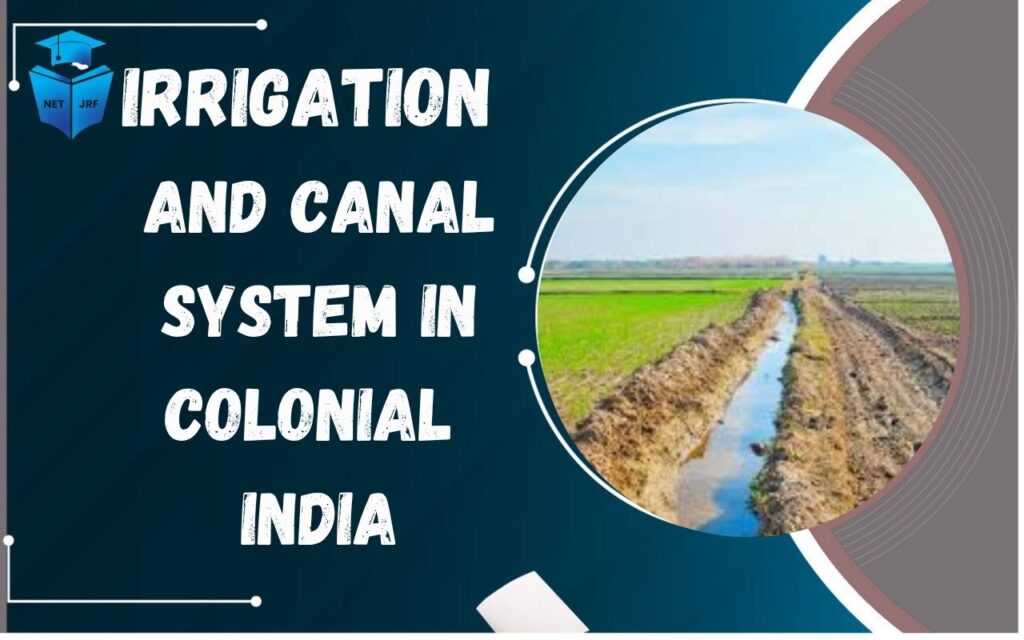
Irrigation and Canal System in Colonial India

Irrigation and Canal System in this topic you learn how colonial canal projects improved agriculture supported commercial crops increased revenue and created regional inequalities in rural India

vishal

Irrigation and Canal System in Colonial India

Table of Contents

Irrigation and Canal System played an important role in shaping agricultural development during the colonial period in India. British administrators constructed canals, dams, and irrigation networks to increase agricultural production and generate higher land revenue.

Study Planner

Agriculture formed the backbone of the colonial Indian economy. Since rainfall remained uncertain in many regions, irrigation projects became necessary to maintain crop production. However, colonial irrigation policies mainly focused on revenue generation rather than rural welfare.

Enroll UGC NET Foundation Course

Irrigation and Canal System Meaning 

Irrigation and Canal System refers to the artificial supply of water to agricultural fields through canals, reservoirs, tanks, or dams.

Irrigation helps farmers maintain crop production even when rainfall becomes insufficient. Canal systems distribute river water across large agricultural areas.

Key Features

  • Controlled Water Supply
    Water for crops was systematically managed to ensure availability during dry periods.
  • Canal Construction
    Canals were built from major rivers to irrigate agricultural lands efficiently.
  • Irrigation Infrastructure Development
    Extensive networks of canals, dams, and channels were created to support large-scale farming.
  • Government Management
    The colonial government oversaw and maintained irrigation systems to maximize agricultural output, often favoring cash crop regions.

These systems became an important part of agricultural modernization during colonial rule.

Irrigation Development Historical Background 

The development of Irrigation and Canal System in India began before colonial rule, but British administrators expanded large-scale irrigation projects.

  • Pre-Colonial Irrigation

      • Indian rulers built tanks, wells, and small canals to support agriculture. Local communities maintained these systems.
  • Colonial Expansion

    • The British government began large canal projects mainly during the nineteenth century. These projects focused on increasing agricultural revenue and commercial crop production.
    • Major canal projects appeared in northern India, especially in Punjab and Uttar Pradesh.

Major Canal Projects in Colonial India

The expansion of Irrigation and Canal System produced several important canal networks.

  • Upper Ganga Canal (1854)
    One of the largest irrigation projects of the 19th century, it supplied water to vast tracts in northern India.
  • Bari Doab Canal
    Located in Punjab, it irrigated the fertile land between the Ravi and Beas rivers, boosting crop production.
  • Godavari Canal System
    In southern India, canals supported delta regions, increasing agricultural output and stability.

Major Irrigation and Canal System Projects

The growth of agriculture during the colonial period was closely linked with the development of large irrigation works and canal systems.

Canal Project Region Year Impact
Upper Ganga Canal Uttar Pradesh 1854 Large irrigation network
Bari Doab Canal Punjab 1859 Agricultural expansion
Godavari Canal Andhra region 1850s Delta irrigation development
Sirhind Canal Punjab Late 19th century Increased wheat production

Join UGC NET Mock Test Series

Objectives of Colonial Irrigation Policy

The development of Irrigation and Canal System served several objectives during colonial rule.

  • Increase Agricultural Production

      • Irrigation improved crop yields and allowed cultivation in dry regions.
  • Revenue Generation

      • Higher agricultural production increased land revenue for the colonial government.
  • Expansion of Commercial Crops

      • Canal irrigation supported cultivation of cotton, sugarcane, wheat, and other market crops.
  • Prevention of Famines

    • Some irrigation projects aimed to reduce famine risks by stabilizing food production.
    • However, economic motives remained the primary objective.

App JRF Adda

Economic Impact of Irrigation in Colonial India


The expansion of irrigation and canal systems significantly boosted crop yields. Crops like wheat, sugarcane, and cotton saw improved productivity due to reliable water supply.

Expansion of Cultivated Land
Irrigation made previously arid or semi-arid regions suitable for farming. Large tracts of land that were once uncultivable became productive, supporting the growth of cash crops.

Development of Agricultural Markets
Higher agricultural output encouraged the growth of local and regional markets. Farmers could sell surplus produce, which also supported trade networks linked to colonial export demands.

Unequal Benefits
Despite these improvements, the advantages were uneven. Regions near major canals or fertile river basins benefited more, while many areas remained dependent on rain-fed agriculture, sustaining economic inequality.

Top UGC NET Offline Classes in Jaipur

Social Impact on Rural Society

The expansion of Irrigation and Canal System also affected rural social relations.

Rise of Prosperous Farmers

Higher Income for Irrigated Areas
Farmers with access to canals and irrigation often earned significantly more than those relying solely on rainfall. Reliable water supply allowed multiple crops per year and cultivation of profitable cash crops.

Increase in Land Value
Irrigated land became highly valuable. Wealthy landlords and investors purchased large tracts in canal colonies, consolidating land ownership in fewer hands.

Regional Inequality
Regions without irrigation lagged behind economically. This disparity created visible differences in wealth, living standards, and opportunities between canal-irrigated and rain-fed areas, reinforcing social hierarchies in rural India.

Canal Colonies in Punjab

One important outcome of the Irrigation and Canal System was the creation of canal colonies in Punjab.

Key Features of Canal Colonies

  • The colonial government planned and developed settlements around newly irrigated areas.
  • Farmers and settlers migrated to these regions to cultivate fertile land.
  • Infrastructure like roads, drainage, and canals supported farming activities.

Agricultural Growth

  • These colonies focused on high-yield crops such as wheat and cotton.
  • Punjab emerged as one of the most productive agricultural regions during colonial India.
  • Canal colonies helped increase overall agricultural output and created pockets of prosperity within the province.

Challenges and Criticism

Despite expansion, the Irrigation and Canal System also faced criticism.

Challenges of Irrigation and Canal System

While the Irrigation and Canal System brought agricultural growth, it also created several problems for farmers and rural society.

High Water Charges

  • Farmers were required to pay fees for using canal water.
  • These charges added to the financial burden of peasants already facing debt and high taxes.

Unequal Distribution

  • Some regions benefited from well-planned irrigation, while others remained dependent on rainfall.
  • This created regional disparities in agricultural productivity and prosperity.

Environmental Problems

  • Poor drainage led to waterlogging in some areas.
  • Excessive irrigation caused soil salinity, reducing long-term fertility.
  • These issues limited the sustainability of canal-based agriculture in certain districts.

The combination of financial, regional, and environmental challenges showed that colonial irrigation projects, while improving output in some areas, also reinforced inequalities and vulnerabilities in rural India.

Stepwise Development of Canal Irrigation

The development of Irrigation and Canal System followed several stages.

  1. Identification of major rivers for irrigation projects
  2. Construction of dams and canal networks
  3. Distribution of water through branch canals
  4. Settlement of farmers in irrigated regions
  5. Expansion of commercial agriculture

This process transformed agricultural landscapes.

Major Effects of Irrigation Development

Irrigation development played an important role in transforming agriculture, especially during the colonial period. The construction of canals, dams, and irrigation systems increased the availability of water for farming. As a result, agricultural production improved in many regions. However, irrigation development also produced several economic and social effects on rural society.

Effect Description
Higher crop yield Increased agricultural production
Agricultural expansion Cultivation in dry regions
Economic growth Development of rural markets
Social inequality Uneven distribution of irrigation benefits

Conclusion

The expansion of Irrigation and Canal System marked an important development in colonial agricultural policy. Large canal projects increased irrigated land, improved crop production, and supported commercial agriculture.

Top UGC NET Offline Coaching in Jaipur

However, these projects mainly served colonial economic interests. Benefits remained concentrated in certain regions while other areas continued to face agricultural challenges.

JRF Adda Book

Read UGC NET Notes
1 Archaeological Sources for UGC NET Epigraphy – Study of Inscriptions Meaning of Historical Sources Archaeological
2 Meaning of Historical Sources Archaeological Sources for UGC NET Literary Sources in History Archaeological
3 Exploration in Archaeology Excavation Techniques in Archaeology Dating of Archaeological Sites Archaeological
4 Excavation Techniques in Archaeology Exploration in Archaeology Dating of Archaeological Sites Archaeological
5 Epigraphy – Study of Inscriptions Inscriptions in Reconstructing History Numismatics in History Archaeological
6 Inscriptions in Reconstructing History Epigraphy – Study of Inscriptions Archaeological Sources for UGC NET Archaeological
7 Numismatics in History Importance of Coins in History Epigraphy – Study of Inscriptions Archaeological
8 Importance of Coins in History Numismatics in History Archaeological Sources for UGC NET Archaeological
9 Dating of Archaeological Sites Excavation Techniques in Archaeology Dating Ancient Literary Sources Archaeological
10 Indigenous Literature Literary Sources in History Secular Literature as Historical Source Literary
11 Dating Ancient Literary Sources Literary Sources in History Dating of Archaeological Sites Literary
12 Literary Sources in History Indigenous Literature Foreign Accounts of India Literary
13 Foreign Accounts of India Greek Accounts on Ancient India Chinese Accounts on India Literary
14 Greek Accounts on Ancient India Foreign Accounts of India Chinese Accounts on India Literary
15 Secular Literature as Historical Source Literary Sources in History Indigenous Literature Literary
16 Role of Myths and Legends in Historical Reconstruction Literary Sources in History Secular Literature as Historical Source Literary
17 Chinese Accounts on India Foreign Accounts of India Greek Accounts on Ancient India Literary
18 Arabic Accounts on India Foreign Accounts of India Chinese Accounts on India Literary
19 Neolithic and Chalcolithic Phases Neolithic Revolution in India Chalcolithic Culture in India Neolithic
20 Hunting, Gathering & Food Production Neolithic Revolution in India Neolithic Settlements in India Neolithic
21 Neolithic Revolution in India Neolithic Settlements in India Tools and Technology in Neolithic Period Neolithic
22 Neolithic Settlements in India Distribution of Neolithic Cultures in India Neolithic Revolution in India Neolithic
23 Distribution of Neolithic Cultures in India Neolithic Settlements in India Tools and Technology in Neolithic Period Neolithic
24 Tools and Technology in Neolithic Period Neolithic Revolution in India Chalcolithic Culture in India Neolithic
25 Chalcolithic Culture in India Settlement Pattern & Economy in Chalcolithic Phase Trade & Exchange Networks in Chalcolithic Societies Neolithic
26 Settlement Pattern & Economy – Chalcolithic Phase Chalcolithic Culture in India Trade & Exchange Networks in Chalcolithic Societies Neolithic
27 Trade & Exchange Networks – Chalcolithic Societies Chalcolithic Culture in India IVC Internal & External Trade Neolithic
28 Indus Valley Civilization – UGC NET Major Sites of Indus Civilization Urban Planning in Harappan Civilization IVC
29 IVC Internal & External Trade Internal Trade – Harappan Civilization Craft Specialization in Harappan Civilization IVC
30 Political Organization – Harappan Civilization Social Structure – Indus Civilization Urban Planning in Harappan Civilization IVC
31 Major Sites of Indus Civilization Indus Valley Civilization – UGC NET Urban Planning in Harappan Civilization IVC
32 Urban Planning & Settlement – Harappan Civilization Architecture & Town Planning – Harappan Cities IVC as First Urbanization in India IVC
33 Architecture & Town Planning – Harappan Cities Urban Planning in Harappan Civilization Major Sites of Indus Civilization IVC
34 Craft Specialization & Industrial Activities – Harappan Agriculture & Food Economy – Harappans IVC Internal & External Trade IVC
35 Agriculture & Food Economy – Harappans Craft Specialization in Harappan Civilization Internal Trade – Harappan Civilization IVC
36 Internal Trade – Harappan Civilization IVC Internal & External Trade Craft Specialization in Harappan Civilization IVC
37 Religion & Beliefs – Indus Civilization Social Structure – Indus Civilization Indus Valley Civilization – UGC NET IVC
38 Social Structure – Indus Civilization Political Organization – Harappan Civilization Religion & Beliefs – Indus Civilization IVC
39 Decline of Indus Civilization Indus Valley Civilization – UGC NET IVC as First Urbanization in India IVC
40 IVC as First Urbanization in India Urban Planning in Harappan Civilization Second Urbanization in India IVC
41 Vedic & Later Vedic Periods – Aryan Varna System Early Vedic Society and Economy Later Vedic Society and Economy Vedic
42 Origin of Vedic Civilization Aryan Debate – Migration, Invasion & Indigenous Theories Early Vedic Society and Economy Vedic
43 Aryan Debate – Migration, Invasion & Indigenous Theories Origin of Vedic Civilization Early Vedic Society and Economy Vedic
44 Early Vedic Society and Economy Political Institutions – Early Vedic Period Social Structure – Early Vedic Period Vedic
45 Political Institutions – Early Vedic Period Early Vedic Society and Economy Monarchical States in Ancient India Vedic
46 Social Structure – Early Vedic Period Emergence of Varnas & Social Stratification Early Vedic Society and Economy Vedic
47 Later Vedic Society and Economy Emergence of Varnas & Social Stratification Impact of Iron Technology in India Vedic
48 Emergence of Varnas & Social Stratification Social Structure – Early Vedic Period Later Vedic Society and Economy Vedic
49 Emergence of Heterodox Sects in India Jainism, Buddhism & Ajivikas – Origins & Teachings Later Vedic Society and Economy Vedic
50 Impact of Iron Technology in India Later Vedic Society and Economy Agricultural Expansion & Economic Changes – Ancient India Vedic
51 Religious & Philosophical Vedic Ideas Emergence of Varnas & Social Stratification Emergence of Heterodox Sects in India Vedic
52 Megalithic Culture of South India Neolithic and Chalcolithic Phases Agricultural Expansion & Economic Changes General
53 State System in Ancient India Rise of Mahajanapadas Transition: Tribal Polities to Territorial States General
54 Transition: Tribal Polities to Territorial States Rise of Mahajanapadas Later Vedic Society and Economy General
55 Rise of Mahajanapadas Monarchical States in Ancient India Republican States (Gana-Sanghas) – Ancient India Magadha
56 Monarchical States in Ancient India Rise of Mahajanapadas Emergence of Magadha Magadha
57 Republican States (Gana-Sanghas) – Ancient India Rise of Mahajanapadas Monarchical States in Ancient India Magadha
58 Agricultural Expansion & Economic Changes – Ancient India Second Urbanization in India Impact of Iron Technology in India General
59 Second Urbanization in India IVC as First Urbanization in India Rise of Mahajanapadas General
60 Jainism, Buddhism & Ajivikas – Origins & Teachings Emergence of Heterodox Sects in India Ashoka’s Policy of Dhamma General
61 Emergence of Magadha Geographical Advantages of Magadha Early Rulers of Magadha Magadha
62 Geographical Advantages of Magadha Natural Resources & Economic Strength of Magadha Reasons for Success of Magadha Magadha
63 Natural Resources & Economic Strength of Magadha Geographical Advantages of Magadha Economic Policies of the Nandas Magadha
64 Early Rulers of Magadha Haryanka Dynasty – Rise of Magadha Emergence of Magadha Magadha
65 Haryanka Dynasty – Rise of Magadha Expansion Policy of Bimbisara Early Rulers of Magadha Magadha
66 Expansion Policy of Bimbisara Ajatashatru – Military Reforms Haryanka Dynasty – Rise of Magadha Magadha
67 Ajatashatru – Military Reforms Wars of Ajatashatru Expansion Policy of Bimbisara Magadha
68 Wars of Ajatashatru Ajatashatru – Military Reforms Udayin & Establishment of Pataliputra Magadha
69 Udayin & Establishment of Pataliputra Wars of Ajatashatru Shishunaga Dynasty Magadha
70 Shishunaga Dynasty Administrative Structure of the Shishunagas Nanda Dynasty Magadha
71 Administrative Structure of the Shishunagas Shishunaga Dynasty Central Administration Under Mauryas Magadha
72 Nanda Dynasty Mahapadma Nanda – Imperial Expansion Shishunaga Dynasty Magadha
73 Mahapadma Nanda – Imperial Expansion Military Strength of the Nandas Nanda Dynasty Magadha
74 Economic Policies of the Nandas Nanda Dynasty Taxation System – Mauryan State Magadha
75 Military Strength of the Nandas Mahapadma Nanda – Imperial Expansion Defeat of Nandas & Rise of Mauryan Empire Magadha
76 Reasons for Success of Magadha Geographical Advantages of Magadha Natural Resources & Economic Strength of Magadha Magadha
77 Mahajanapadas to Empire – Evolution & Rise of Magadha Rise of Mahajanapadas Emergence of Magadha Magadha
78 Mauryan Empire – Expansion Rise of Chandragupta Maurya Expansion of Mauryan Empire Maurya
79 Rise of Chandragupta Maurya Role of Chanakya in Rise of Mauryan Empire Defeat of Nandas & Rise of Mauryan Empire Maurya
80 Role of Chanakya in Rise of Mauryan Empire Rise of Chandragupta Maurya Defeat of Nandas & Rise of Mauryan Empire Maurya
81 Defeat of Nandas & Rise of Mauryan Empire Military Strength of the Nandas Rise of Chandragupta Maurya Maurya
82 Chandragupta Maurya – Seleucus Treaty & Diplomacy Expansion of Mauryan Empire Greek Accounts on Ancient India Maurya
83 Expansion of Mauryan Empire Chandragupta Maurya – Seleucus Treaty & Diplomacy Kalinga War Maurya
84 Administration of Chandragupta Maurya Central Administration Under Mauryas Mauryan Bureaucracy Maurya
85 Sources for Mauryan History Archaeological Sources for UGC NET Greek Accounts on Ancient India Maurya
86 Central Administration Under Mauryas Provincial Administration – Mauryan Empire Mauryan Bureaucracy Maurya
87 Provincial Administration – Mauryan Empire Local Administration – Mauryan Empire Central Administration Under Mauryas Maurya
88 Local Administration – Mauryan Empire Provincial Administration – Mauryan Empire Mauryan Bureaucracy Maurya
89 Mauryan Bureaucracy Central Administration Under Mauryas Espionage System – Mauryan Empire Maurya
90 Espionage System – Mauryan Empire Mauryan Bureaucracy Central Administration Under Mauryas Maurya
91 Ancient India – Trade and Commerce Trade and Commerce Under Mauryas Agrarian Economy – Mauryan Period Maurya
92 Agrarian Economy – Mauryan Period Taxation System – Mauryan State Trade and Commerce Under Mauryas Maurya
93 Trade and Commerce Under Mauryas Ancient India – Trade and Commerce Agrarian Economy – Mauryan Period Maurya
94 Taxation System – Mauryan State Agrarian Economy – Mauryan Period Economic Policies of the Nandas Maurya
95 Kalinga War Ashoka’s Policy of Dhamma Expansion of Mauryan Empire Maurya
96 Ashoka’s Policy of Dhamma Nature & Philosophy of Dhamma Kalinga War Maurya
97 Nature & Philosophy of Dhamma Ashoka’s Policy of Dhamma Jainism, Buddhism & Ajivikas Maurya

Irrigation and Canal System in Colonial India FAQs

Loader image

The British developed canals mainly to increase agricultural production and collect higher land revenue.

The Upper Ganga Canal was one of the largest irrigation projects developed during the nineteenth century.

Canal colonies were newly irrigated agricultural settlements created in Punjab through canal irrigation systems.

Irrigation improved crop yields and allowed cultivation in dry regions.

Problems included waterlogging, soil salinity, and unequal distribution of irrigation benefits.

Irrigation ensures stable crop production in regions where rainfall remains uncertain.

Irrigation and Canal System refers to the network of canals and irrigation projects built by the colonial government to supply water for agriculture and increase land revenue.


Leave a Reply

Recent Posts
Aditi

Aditi Sharma, founder of JRFAdda, is a Computer Science educator with an MCA degree and JRF qualification (99.91 percentile, Dec 2019). Her experience includes roles as an SBI SO (DBA), work at Cognizant, and over 5 years of teaching online and offline. She has also served as a Government Computer Teacher in Rajasthan.