The making of the Indian Constitution stands as one of the most remarkable achievements in modern Indian political history. After independence in 1947, Indian leaders faced the task of building a democratic system capable of governing a diverse country. A written constitution became essential to provide legal structure, protect citizens’ rights, and guide governance. The process of The making of Indian Constitution involved intense debates, careful drafting, and contributions from many leaders, scholars, and legal experts.
Enroll UGC NET Online Coaching
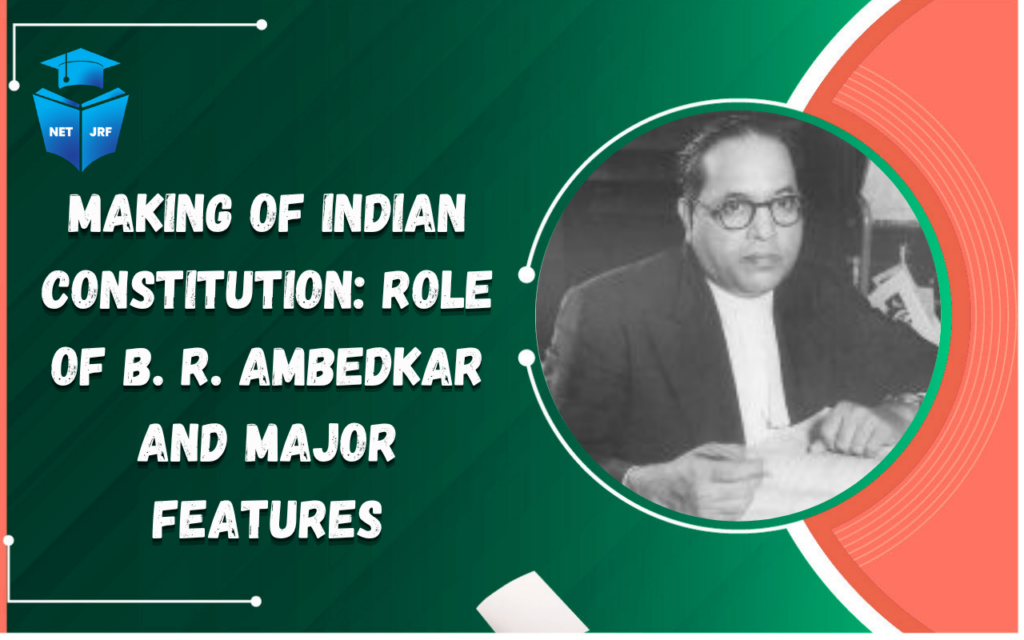
Among them, B. R. Ambedkar played the most influential role. As chairman of the Drafting Committee, Ambedkar guided the process and ensured that the constitution reflected democratic ideals, social justice, and equality.

Background of Constitution Making
The demand for a constitution developed gradually during the Indian freedom struggle. Nationalist leaders believed that independent India required a clear legal framework to govern the nation.
The British government eventually accepted the idea of a constitution-making body. In 1946, the Constituent Assembly of India was established to draft the new constitution.
Important developments leading to The making of Indian Constitution included:
- Demand for self governance during the nationalist movement
- Political negotiations between British authorities and Indian leaders
- Formation of the Constituent Assembly in 1946
- Beginning of constitution drafting after independence in 1947
These developments created the foundation for The making of Indian Constitution.
Constituent Assembly Composition
The Constituent Assembly consisted of representatives elected from different provinces and princely states. It represented diverse regions, communities, and political perspectives.
Key characteristics of the assembly included:
- Total membership of about 389 members before partition
- Representation from provinces and princely states
- Inclusion of lawyers, scholars, political leaders, and social reformers
After the partition of India in 1947, some members moved to Pakistan. The assembly continued its work with reduced membership.
The debates and discussions within the assembly formed a central part of The making of Indian Constitution.
Role of B. R. Ambedkar in Constitution Drafting
In August 1947, the Constituent Assembly created the Drafting Committee to prepare the constitution. Ambedkar became its chairman.
- His legal knowledge and understanding of social issues made him the ideal leader for this responsibility.
- Ambedkar guided the drafting process with a focus on equality, democracy, and protection of marginalized communities.
Contribution to Social Justice
Ambedkar strongly believed that political democracy must include social equality.
- Therefore he ensured that constitutional provisions protected fundamental rights and eliminated discrimination.
- His ideas shaped the values embedded in The making of Indian Constitution.
Protection of Fundamental Rights
Ambedkar supported constitutional guarantees for freedom, equality, and legal protection. These rights later became a key part of the constitution.
- Because of his immense contribution, Ambedkar is widely recognized as the chief architect associated with The making of Indian Constitution.
The making of Indian Constitution Timeline of Major Events
This timeline summarizes important milestones in The making of Indian Constitution.
| Year | Event | Significance |
| 1946 | Constituent Assembly formed | Beginning of constitution drafting |
| 1947 | Drafting Committee established | Ambedkar appointed chairman |
| 1948 | Draft constitution presented | Assembly debates began |
| 1949 | Constitution adopted | Completion of drafting |
| 1950 | Constitution implemented | India became a republic |
Important Committees of the Constituent Assembly
The Constituent Assembly of India was responsible for drafting the Constitution of India. Since the task of writing a constitution for a large and diverse country was very complex, the Assembly created several special committees to study different aspects of governance and administration.
Each committee examined a particular subject and submitted reports and recommendations. These reports helped the Assembly discuss important issues and prepare the final Constitution.
- Drafting Committee
The Drafting Committee was one of the most important committees. It was responsible for preparing the final draft of the Constitution based on the discussions and recommendations of other committees.
The committee was chaired by B. R. Ambedkar, who played a major role in shaping the Constitution. - Union Constitution Committee
This committee studied the structure and powers of the central government. It helped decide how authority would be distributed between the central government and other institutions.
It was headed by Jawaharlal Nehru. - Fundamental Rights Committee
This committee focused on identifying the basic rights that should be guaranteed to all citizens. The committee’s recommendations later became the Fundamental Rights section of the Constitution.
It was also chaired by Jawaharlal Nehru. - Provincial Constitution Committee
The Provincial Constitution Committee studied the structure and functioning of provincial (state) governments. It suggested how powers and responsibilities should be organized at the regional level. - Advisory Committee on Minorities
This committee examined issues related to minorities, tribal groups, and fundamental rights. It recommended safeguards and protections for different communities to ensure equality and justice in the new nation.
Sources of the Indian Constitution
The constitution did not emerge in isolation. The drafting committee studied many existing constitutions and adopted useful elements from them.
Major influences included:
- British parliamentary system
- United States constitution for fundamental rights
- Irish constitution for directive principles
- Canadian constitution for federal structure
These influences helped shape The making of Indian Constitution into a comprehensive democratic document.

Major Features of the Indian Constitution
India adopted a written constitution that clearly defines government powers and citizens’ rights. It remains one of the longest constitutions in the world.
This feature emerged directly from The making of Indian Constitution through extensive debates.
-
Federal System
-
-
- India adopted a federal system where power is divided between central government and state governments.
- This arrangement allows regional autonomy while maintaining national unity.
-
-
Parliamentary Democracy
-
-
- The constitution established a parliamentary system similar to the British model. In this system, the executive remains accountable to the legislature.
-
-
Fundamental Rights
-
-
- Fundamental rights protect citizens from discrimination and guarantee freedoms such as speech, equality, and religion.
- These rights reflect the ideals promoted during The making of Indian Constitution.
-
-
Directive Principles of State Policy
-
- Directive principles guide government policies toward social welfare and economic justice.
- Although they are not legally enforceable, they influence governance and policy decisions.
Enroll UGC NET Coaching in Jaipur
Importance for Democracy
The Constitution of India established the legal and institutional foundation of democracy in India. It clearly defines the relationship between the state and its citizens, ensuring that government authority operates within constitutional limits. By providing rights to citizens and creating democratic institutions, the Constitution laid the groundwork for a stable democratic system.
The Constitution also ensures that power is exercised in a way that protects individual freedom, equality, and justice. It created a framework where people participate in governance and where the rule of law is respected.
Major Democratic Principles
- Universal Adult Franchise
The Constitution introduced universal adult franchise, which means that every adult citizen has the right to vote regardless of caste, religion, gender, or economic status. This principle made the democratic system inclusive and allowed citizens to participate directly in choosing their representatives. - Equality Before Law
The Constitution guarantees equality before the law, meaning that all individuals are treated equally under the legal system. No person is above the law, and every citizen has the same legal protection. - Independent Judiciary
An independent judiciary ensures that laws and government actions follow constitutional principles. Institutions such as the Supreme Court of India act as guardians of the Constitution and protect citizens’ rights. - Protection of Minority Rights
The Constitution also includes safeguards to protect the rights of minority communities. These provisions help ensure social harmony and fairness in a diverse society like India.
Challenges Faced During Drafting
The drafting of the Constitution of India was a complex and demanding task. The members of the Constituent Assembly of India had to design a political system that could govern a large, diverse, and newly independent nation. They had to consider social, political, and cultural differences while ensuring unity and stability in India.
During this process, the constitution makers faced several major challenges.
-
Managing Regional Diversity
-
-
- India is a country with great diversity in language, culture, religion, and traditions. The constitution makers had to create a system that respected regional identities while maintaining national unity. They needed to ensure that different regions and communities felt represented in the new political system.
-
-
Protecting Minority Rights
-
-
- Another important challenge was protecting the rights of minority communities. The leaders wanted to ensure that all citizens, regardless of religion, caste, or background, would enjoy equal rights and protection under the law. Therefore, the Constitution included provisions for fundamental rights and safeguards for minorities.
-
-
Balancing Federal and Central Powers
-
-
- The constitution makers had to decide how power should be distributed between the central government and the states. They created a federal system with a strong central authority to maintain national unity while allowing states to manage their own local affairs.
-
-
Ensuring Social Justice
-
- India had long faced social inequalities such as caste discrimination and economic inequality. The constitution makers aimed to build a society based on justice, equality, and opportunity for all citizens. As a result, the Constitution included provisions promoting social justice and equality.
Enroll UGC NET Offline Coaching in Jaipur
Significance in Modern India
The Constitution of India remains the foundation of governance in India even today. It provides the basic framework for the functioning of the government and defines the relationship between the state and its citizens. The Constitution establishes important institutions such as the Parliament, the executive, and the judiciary, which together ensure democratic governance in the country.
- The principles developed during the making of the Constitution continue to influence laws, political institutions, and democratic practices in modern India. It guarantees fundamental rights to citizens, including equality, freedom, and protection of civil liberties. These rights help safeguard democracy and ensure that every citizen receives fair treatment under the law.
- The Constitution also plays an important role in shaping public policy and judicial decisions. Courts often interpret constitutional provisions to resolve legal disputes and protect the rights of citizens. Institutions such as the Supreme Court of India ensure that government actions remain consistent with constitutional values.
- Overall, the Constitution of India remains a powerful symbol of democratic ideals, justice, and national unity. It continues to guide the development of India and serves as the backbone of its democratic system.

Conclusion
The making of Indian Constitution represents a historic moment in the creation of modern India. Through careful debate, legal expertise, and visionary leadership, the Constituent Assembly produced a democratic constitution that continues to guide the nation. The contributions of B. R. Ambedkar and other leaders ensured that the constitution protected equality, justice, and democratic governance.
The making of Indian Constitution FAQs

What is the significance of the Indian Constitution?
It establishes a democratic framework, defines citizen rights, guides governance, and ensures rule of law across India.
Which committees were important in drafting the Constitution?
Drafting Committee, Union Constitution Committee, Fundamental Rights Committee, Provincial Constitution Committee, and Advisory Committee on Minorities.
What are the fundamental rights in the Constitution?
Rights include equality before law, freedom of speech, protection of minorities, and protection from discrimination.
What is the federal structure of India?
Power is divided between central government and state governments to maintain unity while granting regional autonomy.
How did Ambedkar promote social justice in the Constitution?
He ensured legal equality, protection for marginalized communities, and safeguards for minority rights.