
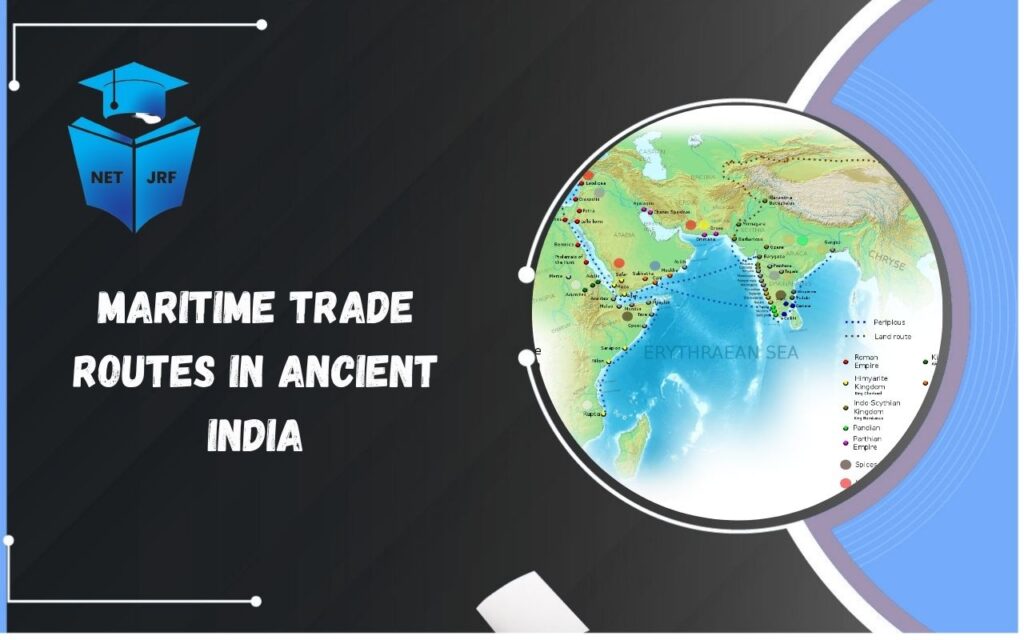

Maritime Trade Routes in Ancient India: Major Ports, Trade Routes, Maritime Trade

Maritime Trade Routes in this topic you learn how ancient Indian sea trade connected ports with Rome West Asia and Southeast Asia through major ports merchants shipbuilding goods traded inland links and its economic cultural impact.

vishal

maritime trade routes in ancient india

Table of Contents

Maritime trade routes in ancient India played a very important role in connecting India with distant regions like Rome, Southeast Asia, and West Asia. These routes helped in the movement of goods, culture, ideas, and people across seas. They were not just trade paths but strong links that connected India with the wider world.

Study Planner

Maritime Trade Routes in Ancient India

The Maritime trade routes in ancient India developed mainly during the Sangam age and early historic period. Coastal regions of South India became very active in overseas trade. Ports were established, ships were built, and traders traveled long distances across seas.

These routes connected Indian ports with regions like the Roman Empire, Arabia, and Southeast Asia. The Maritime trade routes in ancient India helped India export valuable goods and import luxury items.

Enroll UGC NET Online Coaching

Development of Maritime trade routes in ancient India

The Maritime trade routes in ancient India developed due to several important reasons.

Geographical Advantage

  • Long coastline along Arabian Sea and Bay of Bengal
  • Natural harbors suitable for ports
  • Easy access to foreign lands

This geographical advantage supported the growth of Maritime trade routes in ancient India.

Knowledge of Monsoon Winds

  • Sailors understood seasonal wind patterns
  • Used monsoon winds for faster travel
  • Reduced travel time significantly

This knowledge made Maritime trade routes in ancient India more efficient and reliable.

Political Support

  • Kings encouraged trade for revenue
  • Ports were protected and maintained
  • Trade taxes were regulated

Political support helped strengthen Maritime trade routes in ancient India.

Major Ports

Ports were the backbone of sea trade.

Important Ports

  • Muziris in Kerala
  • Arikamedu near Puducherry
  • Kaveripattinam in Tamil region
  • Bharuch in Gujarat

These ports acted as centers of Maritime trade routes in ancient India.

Trade Routes

The Maritime trade routes in ancient India connected India with many regions.

Western Route

  • Linked India with Roman Empire
  • Passed through Arabian Sea
  • Important for spice trade

Eastern Route

  • Connected India with Southeast Asia
  • Spread Indian culture and religion

These routes expanded the reach of Maritime trade routes in ancient India.

Goods Traded

The Maritime trade routes in ancient India carried a wide variety of goods.

Exports

  • Spices like pepper
  • Textiles like cotton and silk
  • Precious stones and ivory

Imports

  • Gold and silver
  • Wine and glassware
  • Luxury items

This exchange made Maritime trade routes in ancient India economically significant.

Enroll UGC NET Online Course

Role of Merchants

Merchants played a key role.

Their Functions

  • Organized trade voyages
  • Managed ships and goods
  • Maintained trade relations

Merchant communities helped expand Maritime trade routes in ancient India.

App JRF Adda

Shipbuilding and Navigation

The Maritime trade routes in ancient India required strong ships and navigation skills.

Features

  • Wooden ships built locally
  • Use of stars and wind direction for navigation
  • Knowledge passed through generations

This expertise made Maritime trade routes in ancient India successful.

Maritime trade routes in ancient India Overview

Maritime trade routes in ancient India were vital lifelines connecting India with the wider world, facilitating the exchange of goods, culture, and ideas. These sea routes not only enriched kingdoms economically but also spread Indian culture across Asia and beyond.

Aspect Description
Maritime trade routes in ancient India Sea-based trade connections
Ports Muziris, Arikamedu, Bharuch
Routes Western and eastern sea routes
Goods Spices, textiles, gold
Merchants Organized trade voyages
Impact Economic and cultural growth

Maritime Trade Routes in Ancient India: Cultural and Economic Impact

Maritime trade in ancient India was more than just the movement of goods; it served as a bridge for ideas, culture, and economic prosperity, connecting India with Southeast Asia, the Roman world, and beyond.

  • Cultural Impact

      • The maritime trade routes had a profound effect on culture:
  • Spread of Indian Culture to Southeast Asia
      • Indian traders, settlers, and travelers introduced Indian religion, customs, and governance ideas to regions like Indonesia, Cambodia, and Thailand.
      • Early kingdoms in Southeast Asia adopted Indian-style administration, Sanskrit language, and temple architecture.
  • Exchange of Ideas and Traditions
      • Ships and ports were not just for goods; they carried knowledge, religious beliefs, and artistic traditions.
      • This cultural interaction led to shared festivals, rituals, and artistic motifs across regions.
  • Influence on Art and Religion
    • Indian religious art, including Buddhist and Hindu iconography, spread along maritime trade routes.
    • Temples and sculptures in Southeast Asia often reflect Indian styles and motifs, showing the reach of Indian cultural influence.

Summary:

  • Maritime trade acted as a cultural bridge, connecting India with far-off lands, and leaving a lasting imprint on art, religion, and social traditions.

Enroll UGC NET Coaching in Jaipur

Economic Importance

Maritime trade was crucial for the economy of ancient India:

  • Increase in Wealth
      • Trade in spices, textiles, pearls, and ivory brought immense wealth to ports and inland regions.
      • Foreign coins, like Roman gold, circulated widely, reflecting prosperity.
  • Growth of Port Cities
      • Key ports like Muziris, Puhar, Korkai, and Tamralipti developed into bustling economic hubs.
      • Ports became centers of administration, commerce, and urban life, attracting artisans, traders, and settlers.
  • Development of Trade Industries
      • Shipbuilding, textile production, pearl processing, and metalwork industries thrived due to maritime demand.
      • The economy diversified beyond agriculture to crafts and maritime services.
  • Rise in Employment
    • Maritime trade created jobs for sailors, dockworkers, artisans, and merchants.
    • Enabled regional prosperity, connecting rural producers with international markets.

Summary:

  • Maritime trade was an engine of economic growth, stimulating production, employment, and urban development.

Connection with Inland Trade

Sea trade depended on internal trade.

Dependence on Inland Trade

  • Goods for overseas markets originated from interior regions.
    • Examples: spices from the Western Ghats, pearls from southern coasts, textiles from Tamil regions.
  • Inland traders and networks collected, transported, and supplied these goods to ports.
  • Without well-organized inland trade, ports would not have had sufficient goods for export.

Transport to Ports

  • Rivers, carts, and caravan routes were used to carry goods from villages and towns to coastal cities.
  • Key ports like Muziris, Puhar, Korkai, and Tamralipti depended on inland connections to receive raw materials and finished goods.

Enroll UGC NET Offline Coaching in Jaipur

Integration with Maritime Trade

  • Once goods reached the ports, ships transported them overseas to destinations like the Roman Empire, Southeast Asia, and the Middle East.
  • Imports such as gold, wine, glassware, and luxury items were then distributed inland, again relying on local trade networks. 

Thus, Maritime trade routes in ancient India worked together with inland trade systems.

JRF Adda Book

Challenges in Maritime Trade

Maritime trade in ancient India was thriving and lucrative, but it was not without difficulties. Traders had to navigate natural hazards, human threats, and technical limitations.

Major Challenges

Storms and Rough Seas

  • Ships often faced monsoon storms, strong winds, and rough waves, especially in the Arabian Sea and Bay of Bengal.
  • Sudden weather changes could damage ships, spoil goods, or even cause shipwrecks.
  • Traders needed experience and knowledge of seasonal patterns to plan voyages safely.

Pirate Attacks

  • Coastal and maritime routes were sometimes plagued by pirates and bandits.
  • Pirates could loot cargo, capture ships, or demand ransom, creating significant economic risk.
  • To counter this, traders often sailed in convoys or relied on armed escorts for protection.

Navigation Difficulties

  • Ancient sailors had limited navigation tools and depended on stars, sun, and coastal landmarks.
  • Navigational errors could lead to delays, loss of direction, or accidents at sea.
  • Knowledge of tides, currents, and seasonal winds was crucial for successful voyages.

Traders overcame these challenges to maintain Maritime trade routes in ancient India.

Conclusion

The Maritime trade routes in ancient India played a crucial role in shaping India’s economic and cultural history. They connected India with distant lands, encouraged trade, and helped in cultural exchange.


Read UGC NET Notes
1 Archaeological Sources for UGC NET Epigraphy – Study of Inscriptions Meaning of Historical Sources Archaeological
2 Meaning of Historical Sources Archaeological Sources for UGC NET Literary Sources in History Archaeological
3 Exploration in Archaeology Excavation Techniques in Archaeology Dating of Archaeological Sites Archaeological
4 Excavation Techniques in Archaeology Exploration in Archaeology Dating of Archaeological Sites Archaeological
5 Epigraphy – Study of Inscriptions Inscriptions in Reconstructing History Numismatics in History Archaeological
6 Inscriptions in Reconstructing History Epigraphy – Study of Inscriptions Archaeological Sources for UGC NET Archaeological
7 Numismatics in History Importance of Coins in History Epigraphy – Study of Inscriptions Archaeological
8 Importance of Coins in History Numismatics in History Archaeological Sources for UGC NET Archaeological
9 Dating of Archaeological Sites Excavation Techniques in Archaeology Dating Ancient Literary Sources Archaeological
10 Indigenous Literature Literary Sources in History Secular Literature as Historical Source Literary
11 Dating Ancient Literary Sources Literary Sources in History Dating of Archaeological Sites Literary
12 Literary Sources in History Indigenous Literature Foreign Accounts of India Literary
13 Foreign Accounts of India Greek Accounts on Ancient India Chinese Accounts on India Literary
14 Greek Accounts on Ancient India Foreign Accounts of India Chinese Accounts on India Literary
15 Secular Literature as Historical Source Literary Sources in History Indigenous Literature Literary
16 Role of Myths and Legends in Historical Reconstruction Literary Sources in History Secular Literature as Historical Source Literary
17 Chinese Accounts on India Foreign Accounts of India Greek Accounts on Ancient India Literary
18 Arabic Accounts on India Foreign Accounts of India Chinese Accounts on India Literary
19 Neolithic and Chalcolithic Phases Neolithic Revolution in India Chalcolithic Culture in India Neolithic
20 Hunting, Gathering & Food Production Neolithic Revolution in India Neolithic Settlements in India Neolithic
21 Neolithic Revolution in India Neolithic Settlements in India Tools and Technology in Neolithic Period Neolithic
22 Neolithic Settlements in India Distribution of Neolithic Cultures in India Neolithic Revolution in India Neolithic
23 Distribution of Neolithic Cultures in India Neolithic Settlements in India Tools and Technology in Neolithic Period Neolithic
24 Tools and Technology in Neolithic Period Neolithic Revolution in India Chalcolithic Culture in India Neolithic
25 Chalcolithic Culture in India Settlement Pattern & Economy in Chalcolithic Phase Trade & Exchange Networks in Chalcolithic Societies Neolithic
26 Settlement Pattern & Economy – Chalcolithic Phase Chalcolithic Culture in India Trade & Exchange Networks in Chalcolithic Societies Neolithic
27 Trade & Exchange Networks – Chalcolithic Societies Chalcolithic Culture in India IVC Internal & External Trade Neolithic
28 Indus Valley Civilization – UGC NET Major Sites of Indus Civilization Urban Planning in Harappan Civilization IVC
29 IVC Internal & External Trade Internal Trade – Harappan Civilization Craft Specialization in Harappan Civilization IVC
30 Political Organization – Harappan Civilization Social Structure – Indus Civilization Urban Planning in Harappan Civilization IVC
31 Major Sites of Indus Civilization Indus Valley Civilization – UGC NET Urban Planning in Harappan Civilization IVC
32 Urban Planning & Settlement – Harappan Civilization Architecture & Town Planning – Harappan Cities IVC as First Urbanization in India IVC
33 Architecture & Town Planning – Harappan Cities Urban Planning in Harappan Civilization Major Sites of Indus Civilization IVC
34 Craft Specialization & Industrial Activities – Harappan Agriculture & Food Economy – Harappans IVC Internal & External Trade IVC
35 Agriculture & Food Economy – Harappans Craft Specialization in Harappan Civilization Internal Trade – Harappan Civilization IVC
36 Internal Trade – Harappan Civilization IVC Internal & External Trade Craft Specialization in Harappan Civilization IVC
37 Religion & Beliefs – Indus Civilization Social Structure – Indus Civilization Indus Valley Civilization – UGC NET IVC
38 Social Structure – Indus Civilization Political Organization – Harappan Civilization Religion & Beliefs – Indus Civilization IVC
39 Decline of Indus Civilization Indus Valley Civilization – UGC NET IVC as First Urbanization in India IVC
40 IVC as First Urbanization in India Urban Planning in Harappan Civilization Second Urbanization in India IVC
41 Vedic & Later Vedic Periods – Aryan Varna System Early Vedic Society and Economy Later Vedic Society and Economy Vedic
42 Origin of Vedic Civilization Aryan Debate – Migration, Invasion & Indigenous Theories Early Vedic Society and Economy Vedic
43 Aryan Debate – Migration, Invasion & Indigenous Theories Origin of Vedic Civilization Early Vedic Society and Economy Vedic
44 Early Vedic Society and Economy Political Institutions – Early Vedic Period Social Structure – Early Vedic Period Vedic
45 Political Institutions – Early Vedic Period Early Vedic Society and Economy Monarchical States in Ancient India Vedic
46 Social Structure – Early Vedic Period Emergence of Varnas & Social Stratification Early Vedic Society and Economy Vedic
47 Later Vedic Society and Economy Emergence of Varnas & Social Stratification Impact of Iron Technology in India Vedic
48 Emergence of Varnas & Social Stratification Social Structure – Early Vedic Period Later Vedic Society and Economy Vedic
49 Emergence of Heterodox Sects in India Jainism, Buddhism & Ajivikas – Origins & Teachings Later Vedic Society and Economy Vedic
50 Impact of Iron Technology in India Later Vedic Society and Economy Agricultural Expansion & Economic Changes – Ancient India Vedic
51 Religious & Philosophical Vedic Ideas Emergence of Varnas & Social Stratification Emergence of Heterodox Sects in India Vedic
52 Megalithic Culture of South India Neolithic and Chalcolithic Phases Agricultural Expansion & Economic Changes General
53 State System in Ancient India Rise of Mahajanapadas Transition: Tribal Polities to Territorial States General
54 Transition: Tribal Polities to Territorial States Rise of Mahajanapadas Later Vedic Society and Economy General
55 Rise of Mahajanapadas Monarchical States in Ancient India Republican States (Gana-Sanghas) – Ancient India Magadha
56 Monarchical States in Ancient India Rise of Mahajanapadas Emergence of Magadha Magadha
57 Republican States (Gana-Sanghas) – Ancient India Rise of Mahajanapadas Monarchical States in Ancient India Magadha
58 Agricultural Expansion & Economic Changes – Ancient India Second Urbanization in India Impact of Iron Technology in India General
59 Second Urbanization in India IVC as First Urbanization in India Rise of Mahajanapadas General
60 Jainism, Buddhism & Ajivikas – Origins & Teachings Emergence of Heterodox Sects in India Ashoka’s Policy of Dhamma General
61 Emergence of Magadha Geographical Advantages of Magadha Early Rulers of Magadha Magadha
62 Geographical Advantages of Magadha Natural Resources & Economic Strength of Magadha Reasons for Success of Magadha Magadha
63 Natural Resources & Economic Strength of Magadha Geographical Advantages of Magadha Economic Policies of the Nandas Magadha
64 Early Rulers of Magadha Haryanka Dynasty – Rise of Magadha Emergence of Magadha Magadha
65 Haryanka Dynasty – Rise of Magadha Expansion Policy of Bimbisara Early Rulers of Magadha Magadha
66 Expansion Policy of Bimbisara Ajatashatru – Military Reforms Haryanka Dynasty – Rise of Magadha Magadha
67 Ajatashatru – Military Reforms Wars of Ajatashatru Expansion Policy of Bimbisara Magadha
68 Wars of Ajatashatru Ajatashatru – Military Reforms Udayin & Establishment of Pataliputra Magadha
69 Udayin & Establishment of Pataliputra Wars of Ajatashatru Shishunaga Dynasty Magadha
70 Shishunaga Dynasty Administrative Structure of the Shishunagas Nanda Dynasty Magadha
71 Administrative Structure of the Shishunagas Shishunaga Dynasty Central Administration Under Mauryas Magadha
72 Nanda Dynasty Mahapadma Nanda – Imperial Expansion Shishunaga Dynasty Magadha
73 Mahapadma Nanda – Imperial Expansion Military Strength of the Nandas Nanda Dynasty Magadha
74 Economic Policies of the Nandas Nanda Dynasty Taxation System – Mauryan State Magadha
75 Military Strength of the Nandas Mahapadma Nanda – Imperial Expansion Defeat of Nandas & Rise of Mauryan Empire Magadha
76 Reasons for Success of Magadha Geographical Advantages of Magadha Natural Resources & Economic Strength of Magadha Magadha
77 Mahajanapadas to Empire – Evolution & Rise of Magadha Rise of Mahajanapadas Emergence of Magadha Magadha
78 Mauryan Empire – Expansion Rise of Chandragupta Maurya Expansion of Mauryan Empire Maurya
79 Rise of Chandragupta Maurya Role of Chanakya in Rise of Mauryan Empire Defeat of Nandas & Rise of Mauryan Empire Maurya
80 Role of Chanakya in Rise of Mauryan Empire Rise of Chandragupta Maurya Defeat of Nandas & Rise of Mauryan Empire Maurya
81 Defeat of Nandas & Rise of Mauryan Empire Military Strength of the Nandas Rise of Chandragupta Maurya Maurya
82 Chandragupta Maurya – Seleucus Treaty & Diplomacy Expansion of Mauryan Empire Greek Accounts on Ancient India Maurya
83 Expansion of Mauryan Empire Chandragupta Maurya – Seleucus Treaty & Diplomacy Kalinga War Maurya
84 Administration of Chandragupta Maurya Central Administration Under Mauryas Mauryan Bureaucracy Maurya
85 Sources for Mauryan History Archaeological Sources for UGC NET Greek Accounts on Ancient India Maurya
86 Central Administration Under Mauryas Provincial Administration – Mauryan Empire Mauryan Bureaucracy Maurya
87 Provincial Administration – Mauryan Empire Local Administration – Mauryan Empire Central Administration Under Mauryas Maurya
88 Local Administration – Mauryan Empire Provincial Administration – Mauryan Empire Mauryan Bureaucracy Maurya
89 Mauryan Bureaucracy Central Administration Under Mauryas Espionage System – Mauryan Empire Maurya
90 Espionage System – Mauryan Empire Mauryan Bureaucracy Central Administration Under Mauryas Maurya
91 Ancient India – Trade and Commerce Trade and Commerce Under Mauryas Agrarian Economy – Mauryan Period Maurya
92 Agrarian Economy – Mauryan Period Taxation System – Mauryan State Trade and Commerce Under Mauryas Maurya
93 Trade and Commerce Under Mauryas Ancient India – Trade and Commerce Agrarian Economy – Mauryan Period Maurya
94 Taxation System – Mauryan State Agrarian Economy – Mauryan Period Economic Policies of the Nandas Maurya
95 Kalinga War Ashoka’s Policy of Dhamma Expansion of Mauryan Empire Maurya
96 Ashoka’s Policy of Dhamma Nature & Philosophy of Dhamma Kalinga War Maurya
97 Nature & Philosophy of Dhamma Ashoka’s Policy of Dhamma Jainism, Buddhism & Ajivikas Maurya

Maritime trade routes in Ancient India FAQs

Loader image

 Routes connected India with the Roman Empire, West Asia, and Southeast Asia.
Western routes carried spices and luxury items to Rome.Eastern routes spread Indian culture, religion, and trade to Southeast Asia.

 Important ports included Muziris, Arikamedu, Kaveripattinam, Bharuch, Puhar, and Tamralipti.These ports served as trade hubs and centers of administration and urban life.
They handled export of goods like spices and textiles and import of luxury items.

 Exports included spices like pepper, textiles like cotton and silk, ivory, pearls, and precious stones. These products were highly valued in Rome, Arabia, and Southeast Asia.
Export trade brought wealth and prestige to coastal kingdoms.

 Imports included gold, silver, wine, glassware, and other luxury items. These goods enriched Indian elites and urban markets. Imports also stimulated crafts and local economic activity.

Leave a Reply

Recent Posts
Aditi

Aditi Sharma, founder of JRFAdda, is a Computer Science educator with an MCA degree and JRF qualification (99.91 percentile, Dec 2019). Her experience includes roles as an SBI SO (DBA), work at Cognizant, and over 5 years of teaching online and offline. She has also served as a Government Computer Teacher in Rajasthan.