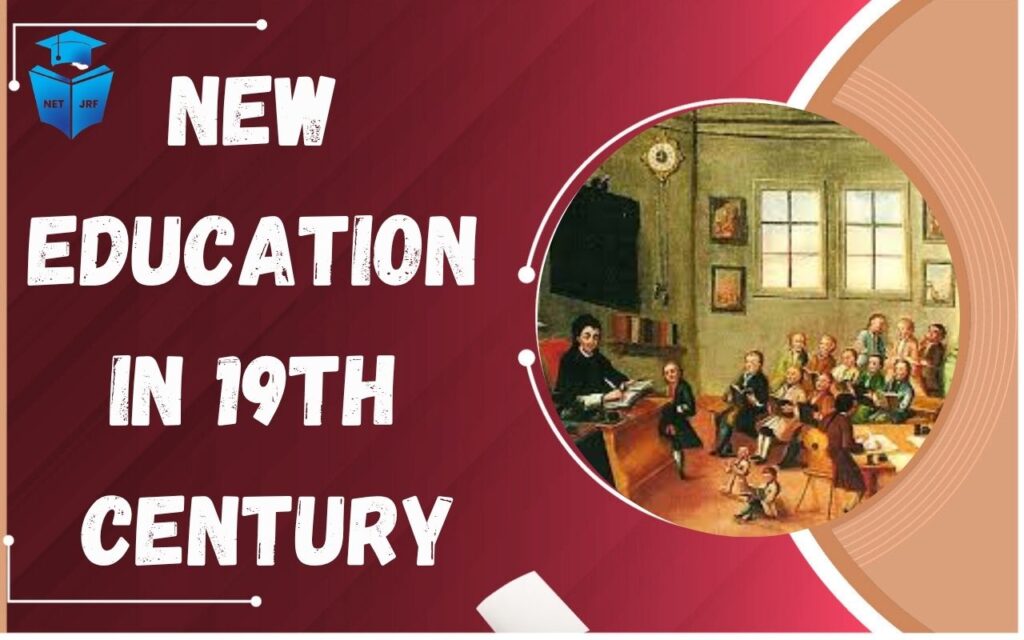
New Education in the 19th Century refers to the modern system of education introduced in India during British colonial rule. This system gradually replaced traditional forms of learning that had existed for centuries. It introduced Western subjects, modern institutions, scientific knowledge, and new teaching methods.
Join UGC NET Foundation Course
During the early colonial period, British administrators believed that education could help them manage a vast empire. As a result, New Education in the 19th Century developed as an important colonial policy. The aim was to create a group of educated Indians who could assist the government in administration, law, education, trade.

Over time, this educational change produced deep social consequences. It created a new class of educated people, spread new political ideas, and encouraged social reform movements.
New Education in 19th Century Historical Background
Before the introduction of modern education, Indian society already possessed an established system of learning. Education existed in different forms depending on region, religion, social structure.
Common traditional institutions included:
- Gurukuls that taught Sanskrit scriptures, philosophy
-
- Pathshalas that provided elementary education
- Madrasas that focused on Islamic theology, Persian language
- Temple schools that offered religious instruction
- These institutions played an important role in preserving cultural knowledge.
- However, they mainly focused on classical languages, religious texts, and moral education. Subjects such as modern science, political economy, European history were largely absent.
- When the British East India Company expanded political control over India, the colonial administration began discussing the need for a new educational policy.
- This debate ultimately led to the creation of New Education in the 19th Century which aimed to promote Western knowledge in India.
Major Education Policies
Several official decisions transformed the educational structure of colonial India. These reforms gradually established a modern system of schools, colleges, and universities.
-
Charter Act 1813
-
-
- The Charter Act of 1813 marked the first time the British government formally accepted responsibility for education in India.
- Key provisions included:
- Annual fund allocated for educational development
- Permission for Christian missionaries to open schools
- Support for spreading Western knowledge
- Although the policy did not immediately transform education, it laid the foundation for later reforms connected with New Education in the 19th Century.
-
-
Macaulay Minute 1835
-
-
- One of the most influential documents in colonial education history was the Minute written by Thomas Babington Macaulay in 1835.
- Important points included:
- Promotion of English language education
- Preference for Western science, literature
- Creation of a class of Indians trained in European knowledge
- Macaulay believed English education would create a group of intermediaries who could connect colonial rulers with Indian society. His views strongly influenced the direction of New Education in the 19th Century.
-
-
Wood Despatch 1854
- Wood Despatch provided the most comprehensive educational policy framework of the colonial period. Historians often describe it as the Magna Carta of modern education in India.
Major recommendations included:
- Establishment of universities in major cities
- Creation of teacher training institutions
- Development of primary education in local languages
- Expansion of secondary schools
These reforms significantly strengthened New Education in the 19th Century by building an organized education system across the country.
New Education System Core Features
The new colonial education system introduced several features that distinguished it from traditional learning.
Western Curriculum
The curriculum included modern subjects such as:
- Physics
- Mathematics
- Political science
- European history
- Philosophy
This broadened the intellectual horizons of students.
-
English Medium Education
-
-
- English gradually became the primary language for higher education. Knowledge of English allowed educated Indians to access global intellectual traditions.
- This feature became one of the defining elements of New Education in the 19th Century.
-
-
Secular Academic Structure
-
-
- Unlike earlier systems where religion dominated education, the colonial system promoted secular learning. Students studied science, history, geography, and political thought.
-
-
Formal Institutional Structure
-
- Education became more organized through the establishment of schools, colleges, and universities. This institutional expansion made New Education in the 19th Century a structured system rather than informal learning.

Traditional Education Versus Modern Colonial Education
To better understand the shift in learning approaches, it is important to compare traditional education with modern colonial education, highlighting how New Education in the 19th Century transformed Indian society and knowledge systems.
| Feature | Traditional System | Colonial System |
| Main subjects | Religion, philosophy | Science, history |
| Language | Sanskrit, Persian | English |
| Institutions | Gurukuls, madrasas | Schools, colleges |
| Access | Limited social groups | Growing urban classes |
| Purpose | Religious learning | Administrative training |
This comparison highlights the transformation produced by New Education in the 19th Century.
Join UGC NET Offline Classes in Jaipur
Universities Established Under Colonial Rule
The establishment of universities marked an important stage in the development of modern education.
| University | Year | Importance |
| Calcutta University | 1857 | First modern university |
| Bombay University | 1857 | Major centre in western India |
| Madras University | 1857 | Expanded higher education |
These universities trained professionals who later participated in social reform movements, journalism, law, politics.
Social Impact
The introduction of New Education in the 19th Century brought profound changes in Indian society, influencing social structures, creating new opportunities, and shaping modern cultural and political awareness.
Rise of Middle Class
- Teachers, lawyers, clerks, journalists, doctors emerged
- Urban-based, salaried employment, literate population
- Opportunities for social mobility based on merit
Promotion of Social Reforms
- Education encouraged questioning of social practices
- Reformers addressed sati, child marriage, untouchability
- Spread awareness about women’s education
Growth of Political Awareness
- Exposure to concepts of liberty, equality, democracy
- Educated Indians started participating in debates and politics
- Inspired leaders who later contributed to nationalist movements
Development of Print Culture
- Newspapers, journals, and books expanded literacy and debate
- Created a platform for social, cultural, and political discourse
Rise of Political Awareness
Education exposed Indians to political ideas like liberty, equality, nationalism.
- These ideas later inspired leaders who led the freedom struggle.
- Thus New Education in the 19th Century indirectly contributed to the emergence of Indian nationalism.
Positive Effects of Colonial Education
Colonial education under New Education in the 19th Century had several positive effects, including the rise of an educated middle class, social reforms, political awareness, and the growth of print culture across India.
| Impact | Explanation |
| Intellectual awakening | Spread of rational thinking |
| Social reform | Questioning of harmful customs |
| Political awareness | Growth of nationalism |
| Middle class growth | Creation of professional groups |
| Expansion of journalism | Newspapers spread ideas |
Criticism of Colonial Education
Despite several benefits, many scholars criticized New Education in the 19th Century.
Major criticisms included:
- Neglect of indigenous knowledge traditions
- Limited access for rural populations
- Education focused mainly on clerical jobs
- Cultural distance between educated elites, rural society
These issues created debates among Indian intellectuals, reformers.
Role of Missionaries
- Established schools and promoted female education
- Provided scholarships and learning materials in vernacular
- Helped spread literacy and modern knowledge in rural areas
Criticism of New Education
- Neglect of indigenous knowledge, arts, and crafts
- Limited rural access, mainly urban populations benefited
- Focus on clerical training for administrative purposes
- Cultural alienation between English-educated elites and traditional society
Key Education Policies
Best UGC NET Offline Classes in Jaipur
Policies That Built New Education in 19th Century
| Policy | Year | Contribution |
| Charter Act | 1813 | Education funding |
| Macaulay Minute | 1835 | English education emphasis |
| Wood Despatch | 1854 | Organized education system |
| Universities Establishment | 1857 | Higher education institutions |
Conclusion
The transformation of education during colonial rule marked a crucial turning point in Indian history. New Education in the 19th Century introduced modern institutions, scientific learning, Western intellectual traditions that reshaped social thinking across the country. It created a new educated middle class, encouraged reform movements, stimulated political awareness that later contributed to the rise of Indian nationalism.

New Education in 19th Century FAQs

2 Why did the British introduce modern education in India
The British introduced modern education to train Indians for administrative and clerical roles in colonial governance. They wanted a class of educated intermediaries who could act as translators, clerks, and officers. At the same time, Western education exposed Indians to European scientific knowledge, rational thinking, and political ideas, which gradually influenced social reform and modern intellectual discourse.
3 Which policy played the biggest role in education reform
The Wood Despatch of 1854 played the most comprehensive role in shaping education in colonial India. It provided a structured framework for establishing schools, teacher training institutions, and universities. The Despatch also recommended primary education in local languages while promoting English for higher studies, creating a systematic hierarchy for education. It laid the foundation for modern New Education in the 19th Century.
4 How did education influence Indian society
Modern education transformed Indian society by producing a literate and informed middle class. Educated individuals questioned social evils like sati, child marriage, and untouchability. They promoted women’s education, encouraged rational thinking, and participated in debates and reforms. Education also introduced political awareness, preparing Indians to challenge colonial policies and eventually contributing to nationalist movements.
5 Did colonial education replace traditional systems completely
Colonial education did not entirely replace traditional learning. Gurukuls, madrasas, pathshalas, and temple schools continued in many regions. However, modern schools, colleges, and universities gradually became dominant, especially in urban centers. Traditional institutions adapted in some areas, but the structured New Education in the 19th Century set the direction for mainstream education.
6 How did universities influence Indian nationalism
The universities established under colonial rule such as Calcutta, Bombay, and Madras—produced a new class of professionals including lawyers, teachers, journalists, and administrators. These individuals engaged in public debates, social reform, and political activism. Universities became centers for intellectual discourse and helped nurture leaders who later participated in nationalist movements and organized campaigns for social and political change.
7 What subjects were introduced through modern education
Under New Education in the 19th Century, students studied a broad range of subjects. Science, mathematics, and European history formed the core of modern knowledge. Political philosophy, economics, and literature introduced critical thinking and global perspectives. This curriculum marked a shift from religious and classical learning to secular, rational, and practical education suitable for administrative and professional roles.
8 How did New Education in 19th Century affect women
New Education in the 19th Century gradually opened opportunities for women’s education. Missionary and government schools encouraged literacy among girls, and educated women participated in social reform movements, advocating for women’s rights, health, and social equality within their communities.
9 What role did English language play in modern education
English became the main medium for higher education under New Education in the 19th Century. It provided access to Western scientific knowledge, literature, and law, and helped create a professional class proficient in administration, law, and public service.
10 How did colonial education impact rural India
Colonial education initially benefited mainly urban populations. Rural areas lagged due to limited schools and teachers. Over time, government and missionary initiatives gradually extended primary education to villages, increasing literacy and awareness, though access remained uneven.