
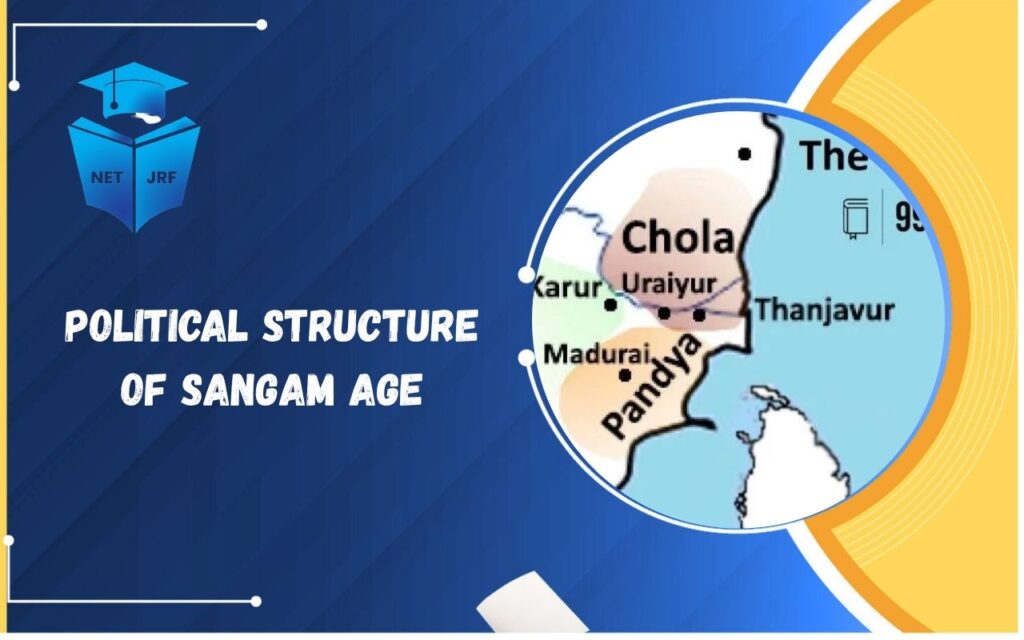

Political Structure of Sangam Age: Major Kingdoms, Kingship, Powers, Duties

Political Structure of Sangam Age explains what you learn about major kingdoms, kingship, powers of rulers, local chiefs, councils, village administration, military organization, revenue system, justice and king people relations.

vishal

pandya kingdom in sangam age

Table of Contents

The political structure of the Sangam age gives us a clear picture of how early South Indian kingdoms were organized, governed, and maintained power. It reflects a dynamic system where kings, local chiefs, and assemblies all played important roles in maintaining stability and order.

Study Planner

Political structure of Sangam age Understanding 

The Political structure of the Sangam age was mainly monarchical in nature. Kings held central authority, but they did not rule alone. 

  • They depended on ministers, military leaders, and local chieftains to manage different parts of the kingdom.
  • This system was flexible and practical. It allowed rulers to control large territories while also giving some autonomy to smaller units.

Enroll UGC NET Online Coaching

Sangam Age Major Kingdoms 

The Sangam Age in ancient Tamil Nadu (c. 3rd century BCE – 3rd century CE) was politically dominated by three major dynasties. Each kingdom had its own strengths, resources, and cultural identity.

Chera Kingdom

  • Location: Western part of the Tamil region, corresponding roughly to present-day Kerala.
  • Economy and Trade: Controlled key trade routes and ports, facilitating commerce with other regions of India and foreign lands.
  • Significance: The Cheras were known for their maritime trade, especially in spices, and played a major role in connecting Tamil Nadu to global trade networks.

Chola Kingdom

  • Location: Fertile Kaveri delta region.
  • Agriculture: Agriculture and irrigation systems were highly developed, supporting a prosperous economy.
  • Cultural Contributions: While primarily known for agriculture, the Cholas also promoted arts and literature within their kingdom.

Pandya Kingdom

  • Location: Southern part of the Tamil region.
  • Trade and Literature: Known for their patronage of literature and active trade, including exports of pearls, spices, and other goods.
  • Significance: The Pandyas were cultural leaders, encouraging poets, festivals, and social activities alongside economic development.

Relations Among the Kingdoms

  • These kingdoms often engaged in wars to expand territory or assert dominance.
  • At the same time, they maintained trade and diplomatic relations, recognizing the importance of economic and cultural exchange.

Sangam Age Nature of Kingship 

In the Sangam Age, the political system revolved around the king as the central authority. Sangam literature provides rich insights into how kings were viewed, their responsibilities, and their expected qualities.

Hereditary Monarchy

  • Kingship was hereditary, passing from one generation to the next, often within the same dynasty.
  • This system ensured continuity of leadership, stability in governance, and maintenance of dynastic traditions.

Supreme Authority

  • The king held supreme authority over his kingdom, making decisions on administration, law, and defense.
  • Local chiefs or officials assisted the king but ultimate power rested with him.

Enroll UGC NET Online Course

Duty to Protect the People

  • A king’s primary responsibility was the protection of his subjects.
  • This included defending the kingdom from enemies, maintaining internal peace, and ensuring the safety of villages and towns.

Responsibility to Maintain Justice

  • Kings were expected to uphold justice, resolving disputes fairly and ensuring law and order.
  • Justice was not only a legal duty but also a moral one, reflecting the king’s role as a protector of dharma.

Qualities Expected of Kings

  • Bravery in war: Kings were expected to lead their armies courageously and demonstrate military skill.
  • Generosity in peace: Kings should care for their people by patronizing culture, trade, and public welfare, as well as rewarding loyal subjects. 

App JRF Adda

King in Sangam Age Powers and Duties 

In the Sangam Age, the king was the central figure of authority, holding significant powers while also being bound by duties toward his kingdom and people. Sangam literature provides a vivid picture of the king’s responsibilities and administrative structure.

Main Duties of the King

  • Protection of Territory: The king was responsible for defending the kingdom from external threats and ensuring the safety of the borders.
  • Maintenance of Law and Order: He ensured peace within the kingdom, resolved disputes, and upheld justice.
  • Collection of Taxes: The king collected taxes from land, trade, and crafts to fund administration, public works, and the army.
  • Welfare of the People: Kings were expected to look after the well-being of their subjects by supporting agriculture, trade, festivals, and cultural activities.

Role of the Royal Court

  • The king was not entirely solitary in decision-making. He was assisted by a council of officials, including:
    • Ministers: Advised on administration, revenue, and policies.
    • Priests: Guided on religious and ethical matters, ensuring that governance aligned with dharma.
    • Military Commanders: Planned and led wars, training soldiers, and protecting the kingdom.
  • This council helped the king make informed decisions while maintaining an organized and efficient administration.

Powers of the King

  • The king had wide-ranging authority over military, economic, judicial, and religious matters.
  • Despite having absolute powers, Sangam literature emphasizes that kings were expected to act wisely, ethically, and for the benefit of their people

Enroll UGC NET Coaching in Jaipur

Administrative Structure of Sangam Age

The Sangam Age (c. 3rd century BCE – 3rd century CE) had a well-organized political system with the king at the center, supported by local chiefs, elders, and military leaders. Sangam literature provides rich details on governance, administration, and the responsibilities of different officials.

Role of Local Chieftains (Velir)

  • Who were they: Local chiefs, known as Velir, ruled smaller regions under the authority of major kings (Chera, Chola, and Pandya).
  • Functions:
    • Maintaining local administration in villages and towns.
    • Supporting the king during wars and military campaigns.
    • Collecting taxes and tributes from people.
  • Autonomy: Velir enjoyed some independence in managing their territories but remained loyal to the king, ensuring a stable regional governance system.

Administrative System

The Sangam Age had a simple but effective administration, without the complexity of later bureaucracies.

Levels of Administration:

  1. Central Level: Led by the king, responsible for overall governance, defense, and justice.
  2. Regional Level: Managed by local chiefs (Velir), coordinating with the king and ensuring local order.
  3. Village Level: Villages were the basic administrative units, managing daily affairs collectively.

Key Features:

  • Governance was based on personal loyalty rather than a complex bureaucracy.
  • There was a direct relationship between the ruler and the people, ensuring accountability.

Village Administration

  • Villages had considerable self-governance.
  • Elders played a key role in decision-making, often resolving disputes collectively.
  • Villagers managed irrigation, agriculture, and local resources, reflecting early forms of local democracy and self-governance.

Revenue System

Revenue was crucial for maintaining the state machinery and supporting the army.

Sources of Revenue:

  • Land tax paid by farmers, either in cash or kind.
  • Trade tax from merchants and marketplaces.
  • Tribute from local chiefs, reinforcing the king’s authority.

Military Organization

Military strength was essential for protection, expansion, and maintaining authority.

Features of the Army:

  • Infantry – foot soldiers for defense and attacks.
  • Cavalry – fast-moving horsemen for raids and scouting.
  • Elephants – used in battles for intimidation and strength.
  • Chariots – important for warfare and royal displays.

Importance:

  • Protected the kingdom from external enemies.
  • Enabled territorial expansion.
  • Maintained the king’s authority and ensured obedience of subjects.

Justice System

  • The king was the supreme judge, responsible for law and order.
  • Punishments could be harsh to deter crime and maintain discipline.
  • The system ensured respect for the law, combining fear with fairness in governance. 

JRF Adda Book

Political structure of Sangam age in practice

Sangam literature provides vivid accounts of kings, chieftains, councils, and villages, showing how governance worked in practice.

Aspect Description
Political structure of Sangam age governance Monarchy with strong king
Administration Simple and decentralized
Local chiefs Important role in regions
Military Strong and active
Revenue Land and trade based

Role of assemblies and councils

Although monarchy was the dominant form of governance in the Sangam Age, kings did not rule alone. The political system included advisory councils and assemblies that supported the king in decision-making and administration.

Types of Councils

  1. Council of Ministers – A group of ministers who assisted the king in governance, policy-making, and administration.
  2. Assembly of Elders – Respected village or regional elders who provided guidance based on experience and social knowledge.

Functions of Advisory Bodies

  • Advising the King: They offered insights on political, economic, and social matters.
  • Discussing Policies: Councils debated new policies, taxes, or military actions to ensure effective governance.
  • Helping in Administration: They assisted in implementing the king’s decisions at regional and local levels.

Nature of Authority

  • These bodies did not limit the king’s authority; the king remained the supreme decision-maker.
  • They acted as support systems, providing wisdom, experience, and administrative assistance. 

Relationship Between King and People in the Sangam Age

In the Sangam Age, the political system emphasized a close and personal link between the king and his subjects. Kings were not distant rulers; their authority was rooted in moral responsibility and public service.

Key Points

  • Accessibility of the King: Kings were approachable, and subjects could appeal directly to them for justice or support.
  • Expectation of Protection: People expected the king to protect them from enemies, ensure law and order, and support their welfare.
  • Loyalty: Loyalty to the king was valued highly, and it was a mutual relationship—the king protected his people, and in return, they offered service and obedience.
  • Praise in Literature: A good king was celebrated in Sangam poems, which praised his bravery, generosity, and fair governance. This shows how public perception influenced royal prestige.

Enroll UGC NET Offline Coaching in Jaipur

Political Ideals in Sangam Literature

Sangam texts provide a vision of the ideal king, reflecting the values and expectations of society at the time.

Qualities of an Ideal King

  • Brave: Demonstrated courage in war and defended the kingdom.
  • Generous: Supported his subjects, artists, and religious institutions.
  • Just: Ensured fairness and upheld law and order.
  • Protector of the Weak: Defended the vulnerable, including farmers, artisans, and common people.

These ideals shaped Sangam governance, guiding rulers in their decisions and setting standards for ethical leadership.

The Political structure of Sangam age shows a well-balanced system where kings held power but depended on chiefs, councils, and people


Read UGC NET Notes
1 Archaeological Sources for UGC NET Epigraphy – Study of Inscriptions Meaning of Historical Sources Archaeological
2 Meaning of Historical Sources Archaeological Sources for UGC NET Literary Sources in History Archaeological
3 Exploration in Archaeology Excavation Techniques in Archaeology Dating of Archaeological Sites Archaeological
4 Excavation Techniques in Archaeology Exploration in Archaeology Dating of Archaeological Sites Archaeological
5 Epigraphy – Study of Inscriptions Inscriptions in Reconstructing History Numismatics in History Archaeological
6 Inscriptions in Reconstructing History Epigraphy – Study of Inscriptions Archaeological Sources for UGC NET Archaeological
7 Numismatics in History Importance of Coins in History Epigraphy – Study of Inscriptions Archaeological
8 Importance of Coins in History Numismatics in History Archaeological Sources for UGC NET Archaeological
9 Dating of Archaeological Sites Excavation Techniques in Archaeology Dating Ancient Literary Sources Archaeological
10 Indigenous Literature Literary Sources in History Secular Literature as Historical Source Literary
11 Dating Ancient Literary Sources Literary Sources in History Dating of Archaeological Sites Literary
12 Literary Sources in History Indigenous Literature Foreign Accounts of India Literary
13 Foreign Accounts of India Greek Accounts on Ancient India Chinese Accounts on India Literary
14 Greek Accounts on Ancient India Foreign Accounts of India Chinese Accounts on India Literary
15 Secular Literature as Historical Source Literary Sources in History Indigenous Literature Literary
16 Role of Myths and Legends in Historical Reconstruction Literary Sources in History Secular Literature as Historical Source Literary
17 Chinese Accounts on India Foreign Accounts of India Greek Accounts on Ancient India Literary
18 Arabic Accounts on India Foreign Accounts of India Chinese Accounts on India Literary
19 Neolithic and Chalcolithic Phases Neolithic Revolution in India Chalcolithic Culture in India Neolithic
20 Hunting, Gathering & Food Production Neolithic Revolution in India Neolithic Settlements in India Neolithic
21 Neolithic Revolution in India Neolithic Settlements in India Tools and Technology in Neolithic Period Neolithic
22 Neolithic Settlements in India Distribution of Neolithic Cultures in India Neolithic Revolution in India Neolithic
23 Distribution of Neolithic Cultures in India Neolithic Settlements in India Tools and Technology in Neolithic Period Neolithic
24 Tools and Technology in Neolithic Period Neolithic Revolution in India Chalcolithic Culture in India Neolithic
25 Chalcolithic Culture in India Settlement Pattern & Economy in Chalcolithic Phase Trade & Exchange Networks in Chalcolithic Societies Neolithic
26 Settlement Pattern & Economy – Chalcolithic Phase Chalcolithic Culture in India Trade & Exchange Networks in Chalcolithic Societies Neolithic
27 Trade & Exchange Networks – Chalcolithic Societies Chalcolithic Culture in India IVC Internal & External Trade Neolithic
28 Indus Valley Civilization – UGC NET Major Sites of Indus Civilization Urban Planning in Harappan Civilization IVC
29 IVC Internal & External Trade Internal Trade – Harappan Civilization Craft Specialization in Harappan Civilization IVC
30 Political Organization – Harappan Civilization Social Structure – Indus Civilization Urban Planning in Harappan Civilization IVC
31 Major Sites of Indus Civilization Indus Valley Civilization – UGC NET Urban Planning in Harappan Civilization IVC
32 Urban Planning & Settlement – Harappan Civilization Architecture & Town Planning – Harappan Cities IVC as First Urbanization in India IVC
33 Architecture & Town Planning – Harappan Cities Urban Planning in Harappan Civilization Major Sites of Indus Civilization IVC
34 Craft Specialization & Industrial Activities – Harappan Agriculture & Food Economy – Harappans IVC Internal & External Trade IVC
35 Agriculture & Food Economy – Harappans Craft Specialization in Harappan Civilization Internal Trade – Harappan Civilization IVC
36 Internal Trade – Harappan Civilization IVC Internal & External Trade Craft Specialization in Harappan Civilization IVC
37 Religion & Beliefs – Indus Civilization Social Structure – Indus Civilization Indus Valley Civilization – UGC NET IVC
38 Social Structure – Indus Civilization Political Organization – Harappan Civilization Religion & Beliefs – Indus Civilization IVC
39 Decline of Indus Civilization Indus Valley Civilization – UGC NET IVC as First Urbanization in India IVC
40 IVC as First Urbanization in India Urban Planning in Harappan Civilization Second Urbanization in India IVC
41 Vedic & Later Vedic Periods – Aryan Varna System Early Vedic Society and Economy Later Vedic Society and Economy Vedic
42 Origin of Vedic Civilization Aryan Debate – Migration, Invasion & Indigenous Theories Early Vedic Society and Economy Vedic
43 Aryan Debate – Migration, Invasion & Indigenous Theories Origin of Vedic Civilization Early Vedic Society and Economy Vedic
44 Early Vedic Society and Economy Political Institutions – Early Vedic Period Social Structure – Early Vedic Period Vedic
45 Political Institutions – Early Vedic Period Early Vedic Society and Economy Monarchical States in Ancient India Vedic
46 Social Structure – Early Vedic Period Emergence of Varnas & Social Stratification Early Vedic Society and Economy Vedic
47 Later Vedic Society and Economy Emergence of Varnas & Social Stratification Impact of Iron Technology in India Vedic
48 Emergence of Varnas & Social Stratification Social Structure – Early Vedic Period Later Vedic Society and Economy Vedic
49 Emergence of Heterodox Sects in India Jainism, Buddhism & Ajivikas – Origins & Teachings Later Vedic Society and Economy Vedic
50 Impact of Iron Technology in India Later Vedic Society and Economy Agricultural Expansion & Economic Changes – Ancient India Vedic
51 Religious & Philosophical Vedic Ideas Emergence of Varnas & Social Stratification Emergence of Heterodox Sects in India Vedic
52 Megalithic Culture of South India Neolithic and Chalcolithic Phases Agricultural Expansion & Economic Changes General
53 State System in Ancient India Rise of Mahajanapadas Transition: Tribal Polities to Territorial States General
54 Transition: Tribal Polities to Territorial States Rise of Mahajanapadas Later Vedic Society and Economy General
55 Rise of Mahajanapadas Monarchical States in Ancient India Republican States (Gana-Sanghas) – Ancient India Magadha
56 Monarchical States in Ancient India Rise of Mahajanapadas Emergence of Magadha Magadha
57 Republican States (Gana-Sanghas) – Ancient India Rise of Mahajanapadas Monarchical States in Ancient India Magadha
58 Agricultural Expansion & Economic Changes – Ancient India Second Urbanization in India Impact of Iron Technology in India General
59 Second Urbanization in India IVC as First Urbanization in India Rise of Mahajanapadas General
60 Jainism, Buddhism & Ajivikas – Origins & Teachings Emergence of Heterodox Sects in India Ashoka’s Policy of Dhamma General
61 Emergence of Magadha Geographical Advantages of Magadha Early Rulers of Magadha Magadha
62 Geographical Advantages of Magadha Natural Resources & Economic Strength of Magadha Reasons for Success of Magadha Magadha
63 Natural Resources & Economic Strength of Magadha Geographical Advantages of Magadha Economic Policies of the Nandas Magadha
64 Early Rulers of Magadha Haryanka Dynasty – Rise of Magadha Emergence of Magadha Magadha
65 Haryanka Dynasty – Rise of Magadha Expansion Policy of Bimbisara Early Rulers of Magadha Magadha
66 Expansion Policy of Bimbisara Ajatashatru – Military Reforms Haryanka Dynasty – Rise of Magadha Magadha
67 Ajatashatru – Military Reforms Wars of Ajatashatru Expansion Policy of Bimbisara Magadha
68 Wars of Ajatashatru Ajatashatru – Military Reforms Udayin & Establishment of Pataliputra Magadha
69 Udayin & Establishment of Pataliputra Wars of Ajatashatru Shishunaga Dynasty Magadha
70 Shishunaga Dynasty Administrative Structure of the Shishunagas Nanda Dynasty Magadha
71 Administrative Structure of the Shishunagas Shishunaga Dynasty Central Administration Under Mauryas Magadha
72 Nanda Dynasty Mahapadma Nanda – Imperial Expansion Shishunaga Dynasty Magadha
73 Mahapadma Nanda – Imperial Expansion Military Strength of the Nandas Nanda Dynasty Magadha
74 Economic Policies of the Nandas Nanda Dynasty Taxation System – Mauryan State Magadha
75 Military Strength of the Nandas Mahapadma Nanda – Imperial Expansion Defeat of Nandas & Rise of Mauryan Empire Magadha
76 Reasons for Success of Magadha Geographical Advantages of Magadha Natural Resources & Economic Strength of Magadha Magadha
77 Mahajanapadas to Empire – Evolution & Rise of Magadha Rise of Mahajanapadas Emergence of Magadha Magadha
78 Mauryan Empire – Expansion Rise of Chandragupta Maurya Expansion of Mauryan Empire Maurya
79 Rise of Chandragupta Maurya Role of Chanakya in Rise of Mauryan Empire Defeat of Nandas & Rise of Mauryan Empire Maurya
80 Role of Chanakya in Rise of Mauryan Empire Rise of Chandragupta Maurya Defeat of Nandas & Rise of Mauryan Empire Maurya
81 Defeat of Nandas & Rise of Mauryan Empire Military Strength of the Nandas Rise of Chandragupta Maurya Maurya
82 Chandragupta Maurya – Seleucus Treaty & Diplomacy Expansion of Mauryan Empire Greek Accounts on Ancient India Maurya
83 Expansion of Mauryan Empire Chandragupta Maurya – Seleucus Treaty & Diplomacy Kalinga War Maurya
84 Administration of Chandragupta Maurya Central Administration Under Mauryas Mauryan Bureaucracy Maurya
85 Sources for Mauryan History Archaeological Sources for UGC NET Greek Accounts on Ancient India Maurya
86 Central Administration Under Mauryas Provincial Administration – Mauryan Empire Mauryan Bureaucracy Maurya
87 Provincial Administration – Mauryan Empire Local Administration – Mauryan Empire Central Administration Under Mauryas Maurya
88 Local Administration – Mauryan Empire Provincial Administration – Mauryan Empire Mauryan Bureaucracy Maurya
89 Mauryan Bureaucracy Central Administration Under Mauryas Espionage System – Mauryan Empire Maurya
90 Espionage System – Mauryan Empire Mauryan Bureaucracy Central Administration Under Mauryas Maurya
91 Ancient India – Trade and Commerce Trade and Commerce Under Mauryas Agrarian Economy – Mauryan Period Maurya
92 Agrarian Economy – Mauryan Period Taxation System – Mauryan State Trade and Commerce Under Mauryas Maurya
93 Trade and Commerce Under Mauryas Ancient India – Trade and Commerce Agrarian Economy – Mauryan Period Maurya
94 Taxation System – Mauryan State Agrarian Economy – Mauryan Period Economic Policies of the Nandas Maurya
95 Kalinga War Ashoka’s Policy of Dhamma Expansion of Mauryan Empire Maurya
96 Ashoka’s Policy of Dhamma Nature & Philosophy of Dhamma Kalinga War Maurya
97 Nature & Philosophy of Dhamma Ashoka’s Policy of Dhamma Jainism, Buddhism & Ajivikas Maurya

Political structure of Sangam age FAQs

Loader image

 The major kingdoms were Chera, Chola, and Pandya. Cheras dominated trade, Cholas focused on agriculture, and Pandyas promoted literature and commerce. Each kingdom had unique resources and culture.

 Kings ruled as hereditary monarchs with supreme authority. They protected the kingdom, collected taxes, maintained law, and supported public welfare. Advisors helped in making wise decisions.

 Local chiefs, called Velir, managed smaller regions under kings. They collected taxes, maintained local peace, and supported military campaigns while enjoying some autonomy.

 Councils of ministers and assemblies of elders advised kings on governance, taxes, and military actions. They helped implement decisions without limiting the king’s power.

 Revenue came from land taxes, trade taxes, and tributes from local chiefs. These funds supported the army, public works, and festivals, keeping the kingdom stable.

 The army included infantry, cavalry, elephants, and chariots. They defended the kingdom, expanded territories, and maintained the king’s authority over subjects.

 The king acted as the supreme judge. Disputes were resolved fairly, punishments deterred crime, and law enforcement ensured peace within villages and towns.


Leave a Reply

Recent Posts
Aditi

Aditi Sharma, founder of JRFAdda, is a Computer Science educator with an MCA degree and JRF qualification (99.91 percentile, Dec 2019). Her experience includes roles as an SBI SO (DBA), work at Cognizant, and over 5 years of teaching online and offline. She has also served as a Government Computer Teacher in Rajasthan.